Whiskey Distillery Equipment: From Grain to Barrel
ZR Brew Technical Team
Équipe d'ingénierie spécialisée dans les équipements de brassage, de fermentation et de production de boissons
Updated: September 24, 2026
Whiskey distillery equipment works as a connected process, not as an isolated still. A project must move grain through milling and mashing, fermentation, distillation, spirit collection, proofing and storage, then into barrel filling and maturation. The right scope depends on the recipe, batch rhythm, site utilities, cleaning plan, local licensing and the intended product.
Whiskey equipment process map
| Étape |
Typical equipment |
Key design question |
| Manutention des céréales |
Receiving, storage, mill, conveyors and dust control |
How will grain be stored, milled and transferred without interrupting the batch schedule? |
| Écrasage |
Mash tun, cooker or brewhouse vessels, pumps and heat exchange |
What mash profile, solids load and heating method suit the recipe? |
| Fermentation |
Fermentation tanks, cooling, transfer piping and controls |
How many tanks are required for residence time, cleaning and still supply? |
| Distillation |
Pot still, column, lyne arm or swan neck, condenser and receivers |
Which configuration provides the required spirit character and separation control? |
| Spirit handling |
Collection tanks, pumps, proofing water, filtration and storage |
How will cuts, blending, measurement and traceability be controlled? |
| Barrel operations |
Barrel filling, transfer, warehouse handling and records |
How will fill level, batch identity, location and maturation records be maintained? |
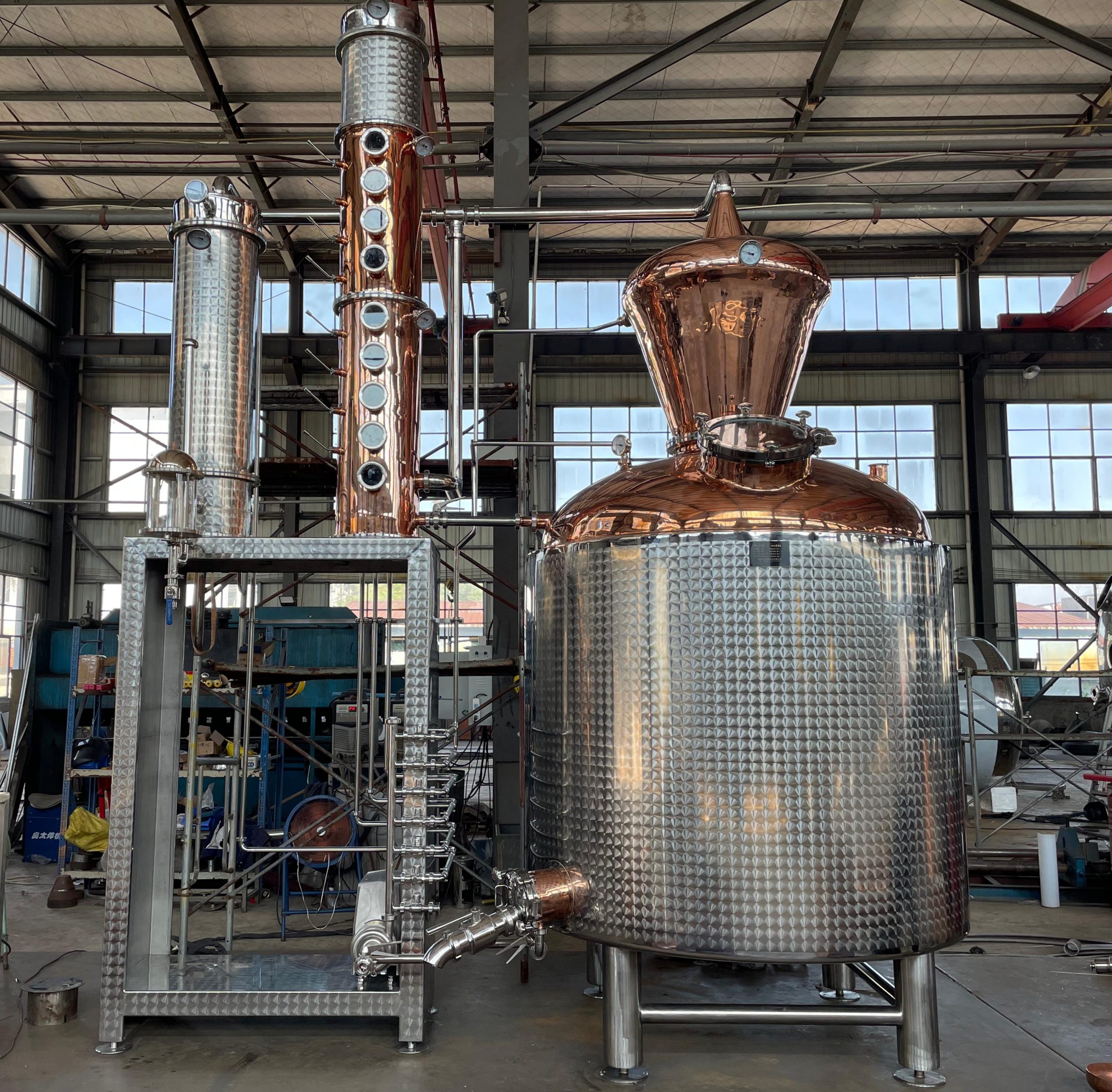
Start with grain handling and mashing
Grain handling sets the rhythm for every downstream vessel. Define grain varieties, receiving frequency, storage conditions, milling rate, dust management and the path from mill to mash vessel. The mash system must then be matched to the recipe, solids content, heating method, conversion approach and cooling requirement. A larger still cannot compensate for a mash train that cannot supply it consistently.
Map pumps, valves, pipe sizes, access and drainage while the layout is still flexible. Include allowance for cleaning, inspection and safe maintenance around hot vessels and moving grain equipment.
Fermentation capacity determines distillery utilization
Fermenters should be sized from residence time, fill volume, yeast management, cleaning turnaround and the number of batches available to the still each week. Too little fermentation capacity starves the still; too much can add idle capital and floor-space demand. Cooling duty, temperature measurement and a repeatable transfer route are part of the whiskey distillery equipment brief, not optional afterthoughts.
ZR Brew’s published distillery range covers approximately 100L to 5000L. The final vessel count and working volume must be confirmed from the selected process rather than inferred from a nominal catalog size.
Choose pot, column and hybrid still equipment
Pot stills, columns and hybrid systems give a distillery different ways to manage vapor contact, reflux, copper contact, cuts and repeatability. Published ZR Brew configurations include red copper, SUS304, SUS316 and copper-stainless hybrid construction, with steam, direct-fire or project-specific heating. Depending on the model, the scope can include a still pot, onion head, swan neck, column, dephlegmator, condenser, CIP, piping and collection tanks.
Controls may use Schneider PID or Siemens PLC components depending on the model. These are configuration choices, not a promise that every unit has the same automation or performance. Confirm heating duty, condenser capacity, receiver volume, instrumentation, pressure protection and the intended operating modes for the exact system.
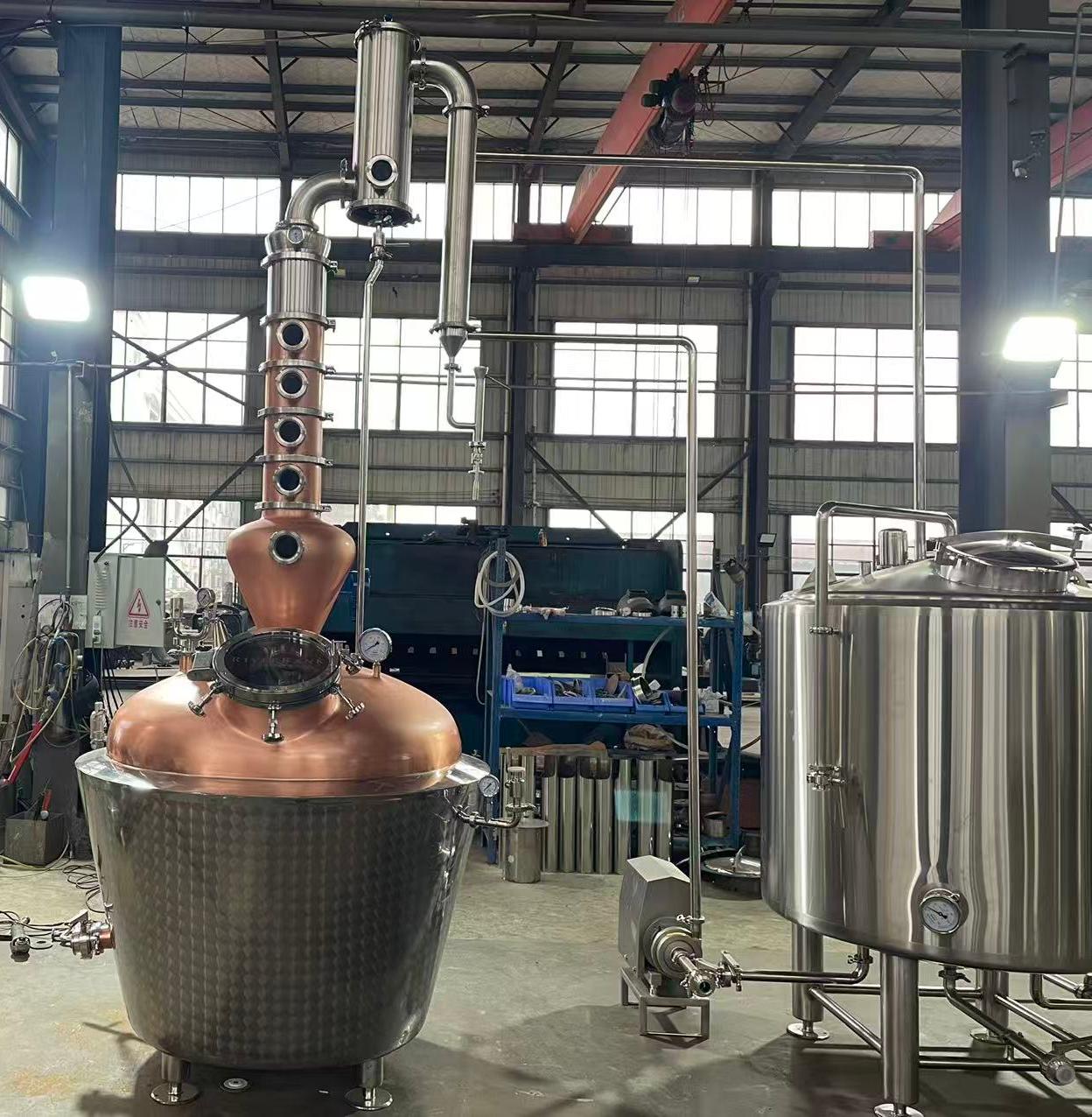
Spirit collection, proofing and barrel filling
After distillation, the line needs defined collection points for heads, hearts and tails, plus secure transfer, measurement and storage. Proofing requires a suitable water system, controlled mixing and a verification plan. Filtration should be selected for the product objective and validated rather than treated as a universal recipe.
Barrel filling adds a second traceability boundary. Specify the filling method, hose and pump compatibility, batch records, barrel identification, warehouse access and spill control. The equipment plan should also address cleaning between products and safe handling of spirit at its actual concentration.
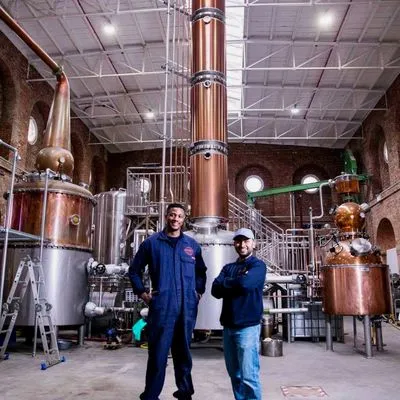
Copper Rivet project: a verified upstream integration example
For the verified Copper Rivet Distillery project in Chatham, United Kingdom, ZR Brew supplied a 3000L distillery brewkit with a steam-heated two-vessel brewhouse, a 40HL hot-liquor tank, a cold-liquor tank, six 60HL fermentation tanks and filtration equipment. This public case confirms coordinated brewing and fermentation equipment for a distillery project. It does not disclose production output, alcohol yield, payback, revenue or other performance metrics.
Utilities, safety and compliance
Plan steam or fuel, electrical supply, cooling water, process water, compressed air, drainage, ventilation, fire protection and CIP discharge before equipment is ordered. Distilled-spirit facilities also require a site-specific review of flammable vapor, hot surfaces, pressure, electrical classification, cleaning chemicals, access and emergency response.
In the United States, the TTB distilled spirits resource is an official regulatory starting point. Requirements vary by jurisdiction. Company-level CE or ISO statements do not establish model-level approval; request the applicable declarations, material records, electrical documents and pressure-test records for the exact equipment and destination.
Build a project-ready equipment brief
- Define grain, mash recipe, legal product category, batch volume and operating calendar.
- Calculate milling, mashing, fermentation, distillation, storage and barrel-filling residence times.
- Specify still configuration, heating, condenser duty, receivers, controls, CIP and collection points.
- Document room dimensions, access, floor loading, drainage, ventilation, utilities and future expansion.
- Request an itemized scope for vessels, piping, controls, installation boundaries, documentation, training and commissioning.
- Confirm licensing, fire, electrical and equipment approvals before fabrication is released.
Common planning mistakes
- Sizing the still without matching mash and fermentation capacity.
- Comparing boiler volume while ignoring column arrangement, condenser duty and receiver capacity.
- Leaving proofing water, spirit storage, CIP and barrel handling outside the project scope.
- Assuming a company certificate proves compliance for every vessel or destination.
- Approving a layout before ventilation, fire protection, access and drainage are reviewed.
FAQ
What equipment is needed for commercial whiskey production?
A complete system can include grain handling, milling, mashing, fermentation, stills, condensers, receivers, spirit storage, proofing water, filtration, CIP and barrel filling. The exact scope follows the recipe, batch plan and jurisdiction.
Is a pot still or column still better for whiskey?
Neither is universally better. Pot, column and hybrid designs provide different control over vapor contact, reflux, copper exposure and spirit character. Select from the approved process and required repeatability.
How should still capacity be selected?
Match working volume to mash and fermentation supply, run time, heat-up, cleaning, condenser duty, storage and barrel-filling demand. Nominal vessel size alone does not determine output.
Can one system make more than one spirit?
Some configurations are designed for multiple spirit types, but flexibility depends on removable components, column arrangement, controls, cleaning and the approved process. Confirm the exact operating modes before purchase.
Review ZR Brew’s distillery equipment range and the commercial distillery equipment selection guide. For a process-specific whiskey equipment schedule and layout, contacter l'équipe du projet ZR Brew.
Author: ZR Brew Technical Team, Brewing, Fermentation and Beverage Equipment Engineering Team. The team supports equipment selection, process planning, manufacturing, installation and commissioning for distillery and beverage projects.


 Publié