Hop bitter substances, protein–polyphenol coagulation, evaporation, colour, pH, Maillard products and DMS: the nine changes every brewer should understand.
Once lautering is finished, the wort enters the kettle — and for the next one to two hours it undergoes a cascade of physical and chemical changes that no later stage can fully undo. So what actually happens inside that boiling vessel? Which changes are desirable, which are losses, and which can quietly ruin your beer months later? This guide breaks down the basic changes during wort boiling, with the original process diagrams and data tables redrawn for practical use.
1. Why Do We Boil Wort at All — and What Actually Changes?
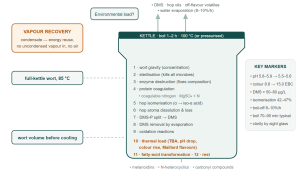
Wort is boiled for 1–2 hours while hops are added. Boiling dissolves and transforms the bitter and aromatic substances of hops, sterilises the wort, destroys enzymes, drives off unwanted volatiles, and stabilises the final composition of what brewers call cast wort (定型麦汁). Skip the kettle and you do not get beer — you get sweet, unstable, microbially fragile malt water.
Before going further, ask yourself: can you name the nine key changes? They are:
- Dissolution and transformation of hop bitter substances.
- Formation and separation of coagulable protein–polyphenol complexes.
- Evaporation of excess water to reach the target gravity.
- Sterilisation of the wort.
- Complete destruction of enzyme activity, fixing wort composition.
- Rise in wort colour.
- Increase in wort acidity.
- Formation of reducing substances.
- Changes in dimethyl sulfide (DMS) content.
2. What Happens to Hop Bitter Substances — and Why Is Only a Third of Your Hop Utilised?
Hop additions aim at two things: dissolving and isomerising the bitter substances so the beer gets its clean, refreshing bitterness, and extracting polyphenols that help coagulate wort proteins. But where do those bitter substances actually end up? Not in your glass, mostly — see Table 1.
Table 1 — Fate of Hop Bitter Substances Through the Brewing Process
| Fraction |
Share of bitter substances (%) |
Relative bitterness value (%) |
| Hop sludge (spent hops) |
20 |
7 |
| Coagulum / trub |
50 |
18 |
| Foam cover and yeast |
10 |
25 |
| Remaining in finished beer |
20 |
50 |
Table 1. Redrawn from the original table of bitter-substance distribution; the trub fraction alone carries half of the added bitter substances — a strong argument for carefully designed kettle and whirlpool separation.
Almost nothing dissolves instantly. Only a small part of hop material enters solution quickly — mostly water-soluble phenols plus a little protein, carbohydrate and mineral matter — while the rest must be extracted. And here is the uncomfortable fact: α-acid is not soluble in cold wort. It only becomes soluble after isomerising to iso-α-acid during the boil, which is exactly why hops must be boiled rather than merely steeped.
Even then, only about one third of the α-acid isomerises into iso-α-acid, and part of that is adsorbed and lost after boiling. So no brewer gets 100% hop utilisation — but the question is: are you getting the best share your kettle can deliver?
2.1 α-Acid: Solubility, pH, and the Isomerisation Window
α-Acid solubility depends strongly on wort pH and temperature. In wort at pH 5.9, solubility can reach 480 mg/L; at pH 5.0 the saturation values fall to about 40 mg/L at 25 °C and 60 mg/L at 100 °C. Iso-α-acid, by contrast, dissolves readily — hence the whole isomerisation strategy. In very acidic conditions, such as fermenting beer crashing in pH, α-acid solubility collapses to just 0.5–2 mg/L.
Boil time is equally decisive. With 80 mg/L α-acid added, iso-α-acid rises rapidly through the first half of the boil; during a 90–120 minute boil the isomerisation ratio slowly declines from about 47.2% to 42%. Recipe formulations that add hops only in the final 30 minutes see utilisation drop to roughly 24% — while late-hopping in the whirlpool at 90–95 °C can still isomerise, which matters greatly for aroma-focused beers.
Table 2 — Effect of Wort pH on Hop Isomerisation
| Wort pH |
4.75 |
5.03 |
5.28 |
5.52 |
5.85 |
| α-acid (mg/L) |
3.4 |
4.0 |
4.3 |
4.6 |
6.7 |
| Iso-α-acid (mg/L) |
28.9 |
33.1 |
34.0 |
36.5 |
39.5 |
Table 2. Redrawn from the original pH-isomerisation table. Higher pH lifts both α-acid solubility and iso-α-acid formation — but a lower boil pH improves protein–polyphenol precipitation and beer hygiene, so the two goals must be balanced.
2.2 β-Acid, Soft Resins and Hard Resins
β-Acid is barely soluble at all: about 1.5 mg/L at 25 °C and 9 mg/L at 100 °C, and even at pH 10 no more than roughly 100 mg/L. Most β-acid is therefore removed with the spent hops; the rest can precipitate out as pH falls during fermentation and lagering, leaving only traces in the finished beer.
Soft and hard resins, by contrast, dissolve well into wort during boiling. The oxidation products of humulone and related compounds show excellent solubility, which explains a useful brewing rule: even hops with almost no α-acid can still contribute pleasant bitterness — their bitterness value simply differs from that of iso-α-acid.
2.3 Can You Save Hops Without Losing Bitterness?
Yes — and modern breweries do it in two ways:
- Advanced hop products. Diatomaceous earth, bentonite and silicate-based formulations provide an enormous contact surface between hop material and wort, speeding dissolution and isomerisation. Compared with ordinary hop steeping, modern products can cut hop usage by 10–15%.
- High-adjunct grists. When wort contains less nitrogenous and polyphenol material (e.g. 30% rice or 40% raw barley with enzyme assistance), protein coagulation demand falls and hop consumption drops by roughly 10–22%. Watch out though — bitterness recovery becomes more variable, so additions must still be calculated on the normal basis.
2.4 Hop Polyphenols, Oils, Fatty Acids and Proteins
Hop polyphenols dissolve progressively during boiling — more slowly from whole hops than from pellets or extracts. Monomeric phenols such as gallic acid, protocatechuic acid, caffeic acid, quercetin and catechin glycosides can condense into di-, tri- and polymeric forms; the smaller condensed fractions (molecular weight 600–3000, or a polymerisation degree of 2–10) behave as “tannins” and bind strongly to wort protein, forming flocculent hot-break sediment. Larger polyphenols stay in solution, form non-biological haze with cold-break material, or polymerise and oxidise into reddish-brown compounds that deepen wort colour.
Hop oil behaves quite differently. Its main components are terpene hydrocarbons; the proportion of oxidised substances can climb 10–50% during storage (depending on packaging, oxygen pickup and storage temperature) — and oxidised terpenes are highly odour-active with a threshold near 5 × 10⁻⁴ mg/L. During boiling, the vast majority of hop oil volatilises with the steam, which is precisely why aroma hops should not be added too early. What survives is mainly humulene, caryophyllene and sesquiterpene alcohols, giving the beer its pleasant aroma.
Hop fatty acids enter the kettle with the hops too: roughly 20% of the volatile fraction is free fatty acids, so octanoic, decanoic and lauric acid levels rise as soon as hops are added. After boiling, much of this free fatty acid is adsorbed onto protein coagula, so measured free fatty acid falls again — but long-chain unsaturated fatty acids (palmitoleic, oleic and especially linoleic acid) held by hop material cannot all be adsorbed, and part travels into the fermenter. Finally, whole hops and pellets contain about 50% salt-soluble protein; typical hop worts carry just 1.5–5 mg/L of hop-derived protein, mostly low-molecular-weight material below 2600 Da, which binds polyphenols, minerals and some flavour substances and influences beer fullness and mouthfeel.
3. How Do Hot Break and Cold Break Actually Form?
Ever watched wort suddenly turn clear after twenty minutes of cloudy, murky rolling? That is protein coagulation doing its work — one of the most important changes in the kettle. At the start of boiling, wort appears dull and hazy; fine flocks slowly precipitate, grow into larger flakes and separate out, and the wort becomes bright and clear.
Hot break — and how to maximise it
Complexes formed from protein and polyphenols, and from protein with polyphenol oxides, are insoluble when hot and separate as coagulum during boiling. Four factors accelerate their formation:
- Long boiling time — a 2-hour boil forms large coagula; the higher the boiling pressure, the higher the temperature and the quicker the separation.
- Vigorous boiling motion — rolling turbulence intensifies the protein–polyphenol reaction.
- Lower pH — coagulation is optimal near pH 5.2, so kettle pH should be driven as low as practical.
- Hop polyphenols — malt and hop polyphenols both bind wort protein, with malt polyphenols playing the larger role. That is why the first hop addition should go in within the first 10 minutes of the boil, so malt polyphenols and wort protein can react fully and hop utilisation improves.
At the end of the boil, check the wort visually or through a sample glass: coagulum should appear as large flakes suspended in clear wort. The bigger the flakes, the better the protein precipitation.
Cold break and residual coagulable nitrogen
Complexes of protein degradation products and polyphenols dissolve during boiling and only separate when the wort cools — the familiar cold break. Even after a long boil, wort still carries a small amount of high-molecular-weight coagulable nitrogen, below 20 mg/L; this can later sediment in the beer and cause chill haze, which is why cold-side clarification and stabilisation still matter.
4. Why Evaporate? The Boil-Off Rate Question
Traditional boiling runs at atmospheric pressure and about 100 °C. Boiling intensity is judged by how vigorously the kettle content rolls, and evaporation raises wort gravity steadily. Practical targets: 8–10% evaporation per hour, which simultaneously promotes protein denaturation and coagulation and reduces undesirable malt, wort and hop aromas.
But evaporation costs serious energy — and here is the trade-off every brewery faces: more evaporation means more aroma stripping and more sparge water needed later, while recovery of heat from the vapour stream can offset part of the cost. Wort gravity after boiling typically climbs 1–2 °P above full-kettle gravity, so accurate gravity measurement at the end of the boil is essential. Pressurised boiling can shorten the time required.
5. Colour, pH and the Maillard Question
Boiling darkens wort through melanoidin and polyphenol oxidation, and the finished cast wort is always darker than the final beer because yeast adsorbs large amounts of colour during fermentation — which is why colour must be judged from the right point in the process. See Table 3.
Table 3 — Wort Colour Changes During Boiling
| Étape |
EBC (approximate) |
| Full-kettle wort |
8.8 |
| Cast wort |
15.0 |
| Pilsner-type wort |
12.3 |
Table 3. Redrawn from the original wort colour table (approximate EBC values).
pH falls by roughly 0.2–0.4 during the boil: full-kettle wort sits at 5.8–5.9 and cast wort at 5.5–5.6. The drop favours globulin precipitation and sedimentation and reduces hop colour extraction. Acidic melanoidins and hop-borne acidic substances further raise wort acidity. A lower pH also gives finer, cleaner hop bitterness and better brewery hygiene, and pH 5.2 is optimal for protein–polyphenol precipitation — but push pH too low and hop utilisation suffers, forcing higher hop additions.
5.1 Maillard Products: Flavour Friends or Enemies?
Much of the wort’s aroma comes from the malt itself — particularly from dark malts, through malt kilning and high-temperature roasting, where sugars react with amino acids. Those reactions continue in the kettle: this is the Maillard reaction, first described by Louis-Camille Maillard, in which sugars (hexoses and pentoses) react with amino acids, dipeptides or tripeptides to form coloured substances, alongside volatile heterocyclic aroma compounds.
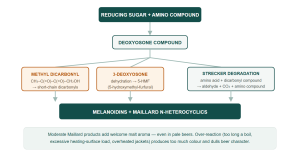
Low-molecular and volatile Maillard products strongly influence beer aroma and flavour. They are welcome in dark, malt-accented beers, and beneficial in moderately malt-forward pale beers; but exceed the limit — through excessive boil time or harsh heating — and they damage the beer’s typical character. Maillard colour formation is largely irreversible, unlike polyphenol-driven colour, part of which can be reduced again during fermentation. To keep beer pale, keep residual alkalinity of the mashing water low or acidify the wort.
Physical conditions matter too: boil temperature, holding time, and the temperature of the heating medium all shape Maillard output. An overheated film of wort clinging to the heating surface, or an over-hot external boiler, will degrade wort quality — a reminder that gentle, well-distributed heat beats brute force.
6. Reducing Substances, Sulfides and the DMS Battle
Maillard reactions also build up reducing substances: melanoidins, reductones and dienols. They fall into two groups — slow-acting reducing substances such as reductones, and fast-acting Maillard reaction products. Both strongly suppress oxygen and raise the wort’s antioxidant capacity, which pays off later as better flavour stability.
6.1 Sulfur-Containing Compounds: Where Off-Flavours Come From
Sulfur amino acids degrade during boiling. Cysteine forms hydrogen sulfide (H₂S), which is unstable and further breaks down into propionaldehyde, dimethyl sulfide, dimethyl disulfide and dimethyl trisulfide — compounds with relatively low odour thresholds. Cystine degrades through thioacetaldehyde or sulfate pathways to H₂S and acetaldehyde, and heat conversion produces methional and acetaldehyde. Methionine breaks down mainly into methional, which then reacts with Maillard intermediates to form sulfur-containing compounds that are difficult to strip out.
6.2 DMS: The Compound That Decides Whether Your Beer Smells of Cooked Sweetcorn
Both wort and beer contain DMS — a volatile sulfur compound perceived as unpleasant cooked-sweetcorn or vegetable character at elevated levels. Its flavour threshold is roughly 50–60 µg/L. DMS originates from S-methylmethionine (DMS precursor, DMS-P) in malt, and its quantity depends on barley variety, malting method and kilning temperature.
Boiling splits the precursor into free DMS, which then evaporates with the water vapour. That makes DMS content a direct function of boil intensity and evenness. Malting dries the precursor into active DMS-P and free DMS, and this process repeats in the kettle: the longer and more vigorous the boil, the more DMS-P converts and the more is evaporated. Since energy matters, most breweries boil 70–90 minutes and keep malt DMS-P as low as possible; in that window DMS-P converts to DMS and is stripped. Pressurised boiling allows a shorter time.
Watch the whirlpool: DMS-P carried into the whirlpool continues converting to DMS, but cannot be evaporated there. With the same wort composition, how much of this late conversion reaches your beer depends on your yeast strain — a crucial detail for lager brewers chasing clean, DMS-free flavour.
7. How Would You Audit Your Own Boil? (Extended Checklist)
With two tables, two diagrams and nine changes on the table, here is how to turn theory into a weekly routine:
- Track full-kettle vs cast-wort gravity — a 1–2 °P rise is expected; anything else signals boil-off drift.
- Verify boil-off rate at 8–10% per hour — too low starves coagulation, too high wastes energy and strips aroma.
- Log kettle pH — target 5.8–5.9 at full kettle falling to 5.5–5.6 at cast; aim near 5.2 for optimal protein–polyphenol precipitation.
- Add the first hop charge within 10 minutes — it improves protein coagulation and hop utilisation at once.
- Check hot-break flake size through the sight glass — large flakes mean good precipitation; small, hazy flocks mean you should extend or intensify the boil.
- Control boil time against DMS — 70–90 min typical; measure wort DMS to confirm you are below the 50–60 µg/L threshold.
- Keep aroma hops late — terpene hydrocarbons volatilise with the steam, so early aroma additions are simply expensive perfume up the chimney.
- Recover vapour heat and re-check the heating surface — clean surfaces and correct jacket temperatures prevent localised Maillard over-reaction.
FAQ: Wort Boiling in Practice
Q1: How long should wort be boiled?
Most breweries boil 70–90 minutes. Traditional practice allows up to 1–2 hours for full protein coagulation, colour development and DMS stripping; pressurised boiling can shorten the time.
Q2: Why is only about a third of my hop α-acid utilised?
α-acid must isomerise to iso-α-acid to dissolve, and only roughly one third converts; on top of that, about half of the added bitter substances leave with the trub, and 10% with foam and yeast (Table 1).
Q3: Does a longer boil give me more bitterness?
Not proportionally. Iso-α-acid concentration rises quickly in the first half of the boil, then the isomerisation ratio slowly falls from about 47% to 42% over 90–120 minutes.
Q4: How do I get a brighter, cleaner wort?
Longer boil, vigorous rolling motion, low pH near 5.2, and a first hop addition inside the first 10 minutes. Check flake size in the sight glass before knocking out.
Q5: What DMS level should I target?
Below the 50–60 µg/L flavour threshold. Ensure boiling is vigorous and even, keep malt DMS-P low, and remember that DMS-P carried into the whirlpool keeps converting without being evaporated.
Conclusion: So What Should You Take Away from the Kettle?
Wort boiling is a balancing act. Bitterness requires isomerisation, clarity requires vigorous coagulation at low pH, stability requires complete enzyme destruction and sterility, and drinkability requires DMS and off-flavour volatiles to be driven off. Yet every hour of boiling also costs energy and creates colour and Maillard flavour that cannot be undone.
Understand the nine changes, measure the two gravity points and the boil-off rate, watch hop utilisation, and keep DMS below threshold — and your kettle stops being a black box and becomes a controllable, repeatable process.


 Publié