A Système de brassage de bière de 50 litres is a practical solution for pilot brewing, recipe development, brewing education, and small-batch beer production. It allows brewers to test ingredients, refine brewing processes, and produce limited quantities without investing in a larger commercial brewhouse.
For craft breweries, brewpubs, restaurants, and beverage startups, choosing the right 50L brewing equipment involves more than tank capacity. Buyers also need to consider fermentation, temperature control, heating methods, utilities, and future production plans.
This guide explains what a 50L brewing system includes, who should use it, and how to choose a suitable configuration.
What Is a 50L Beer Brewing System?
A 50L beer brewing system is a compact brewing setup designed to produce approximately 50 liters of wort per nominal batch, depending on equipment design and operating conditions.
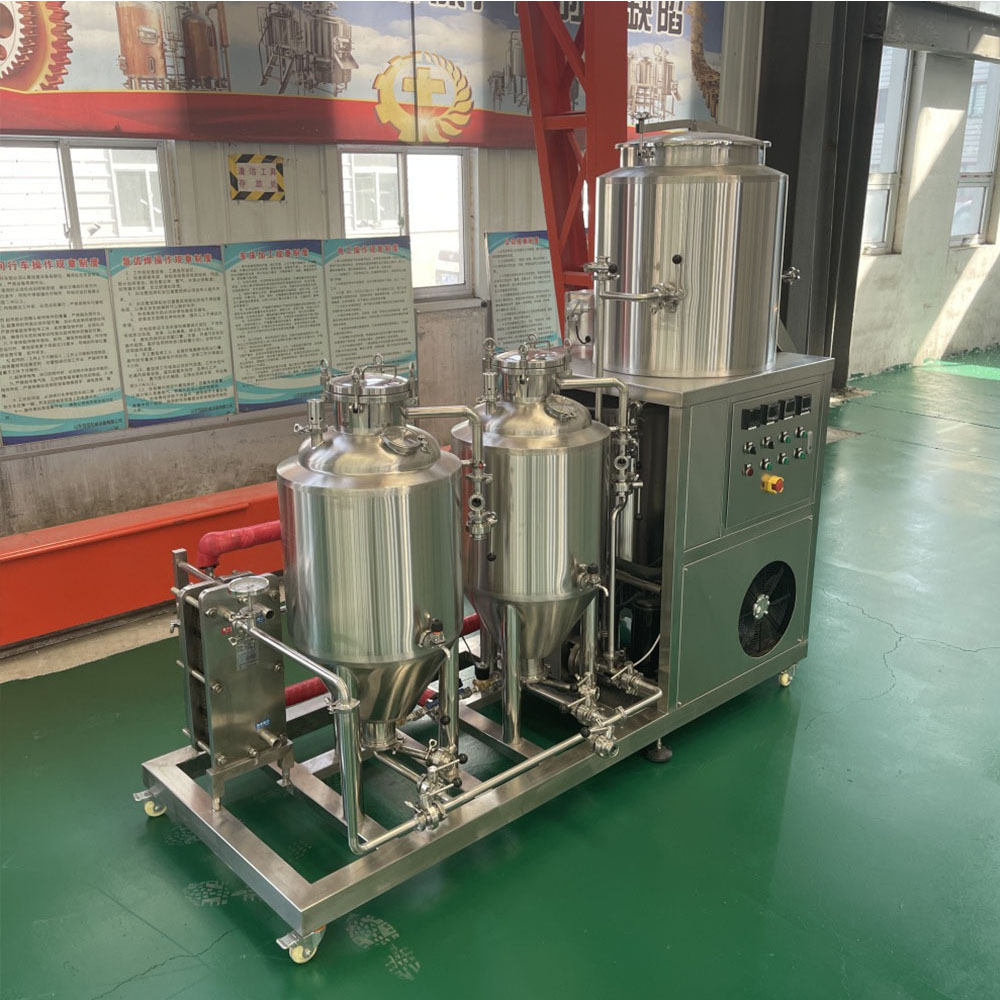
It typically includes equipment for mashing, wort separation, boiling, and cooling. Fermentation tanks, temperature-control equipment, and additional accessories can be configured according to the project.
A 50L system is best suited to pilot brewing and small-batch applications rather than high-volume commercial beer production.
Its main advantage is flexibility: brewers can experiment with different recipes and brewing parameters while using smaller quantities of raw materials.
Who Should Use a 50L Brewing System?
A 50L brewing system can support several types of brewing operations.
| Buyer Type |
Exemple d'application |
| Craft Breweries |
Testing new beer recipes before commercial production |
| Brewpubs & Taprooms |
Producing experimental or limited-release beers |
| Restaurants |
Developing small batches for in-house beverage programs |
| Beverage Startups |
Testing products before investing in larger equipment |
| Brewing Schools |
Teaching brewing processes and equipment operation |
| R&D Facilities |
Evaluating ingredients, fermentation methods, and recipes |
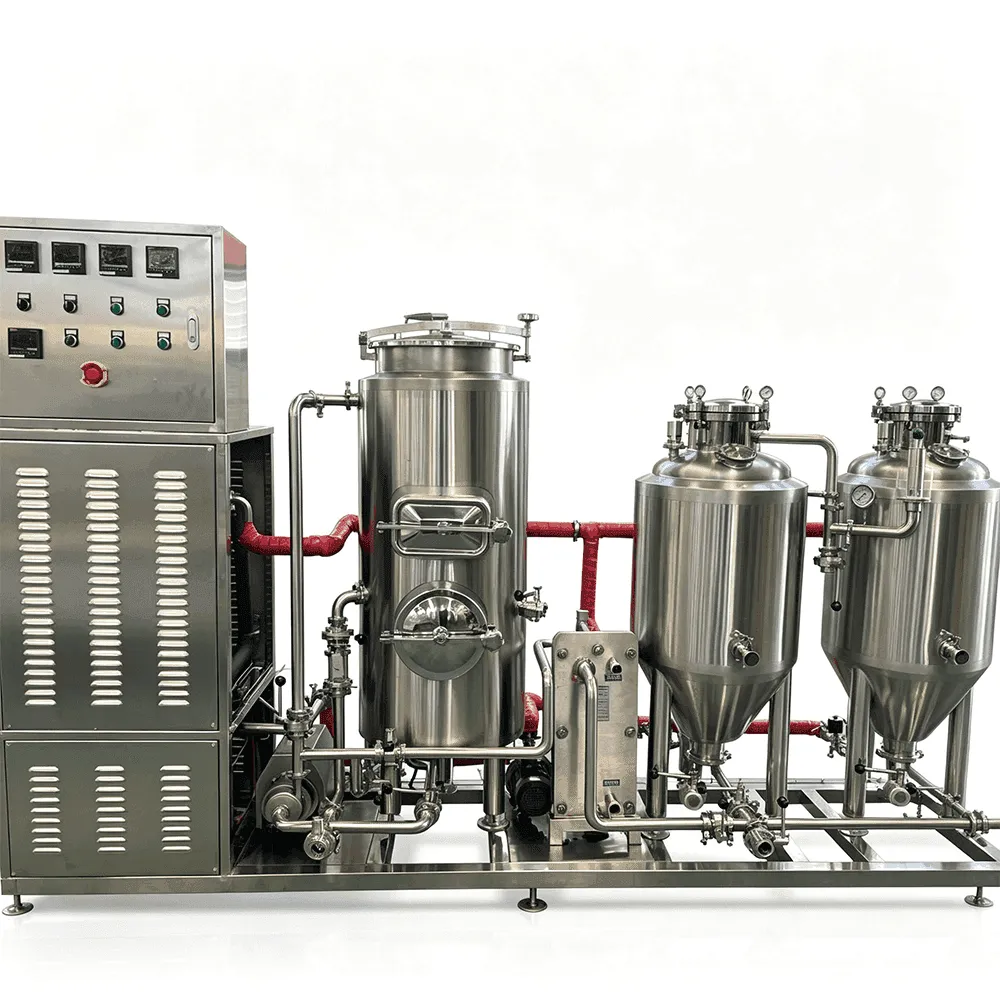
For breweries already operating larger systems, a 50L pilot brewing system can provide a separate platform for product development without occupying the main production line.
However, businesses planning frequent commercial sales should evaluate whether 50L provides enough production capacity.
What Equipment Is Included in a 50L Beer Brewing System?
The exact configuration depends on the manufacturer and project requirements. A complete brewing setup generally needs the following equipment or functions:
| équipement |
Fonction principale |
| Mash/Lauter Equipment |
Converts malt starches and separates wort from grain |
| Brew Kettle |
Boils wort and supports hop additions |
| Wort Cooling Equipment |
Reduces wort temperature before fermentation |
| Fermentation Tank |
Provides a controlled environment for fermentation |
| Temperature Controller |
Monitors and regulates selected process conditions |
| Chiller or Cooling System |
Supports temperature control where required |
| Pumps, Valves & Piping |
Transfers liquid between process stages |
| Cleaning Accessories |
Support equipment cleaning and sanitation |
Some compact systems combine multiple brewing functions into fewer vessels, helping reduce equipment footprint.
Before ordering, buyers should confirm whether the quotation covers only the brewhouse or also includes fermentation tanks, cooling equipment, controls, and accessories.
This distinction is important when comparing prices from different suppliers.
How Should You Configure a 50L Brewhouse and Fermentation System?
A well-planned 50L brewing setup should consider the complete process from wort production to finished beer.
50L Brewhouse
The brewhouse handles mashing, lautering, boiling, and related wort-production steps. Its vessel arrangement should match the brewing process, available space, and desired level of operation.
Fermentation Tanks
Fermentation tanks should be selected according to actual wort transfer volume, required headspace, fermentation time, and planned brewing frequency.
A nominal 50L brewhouse does not automatically mean that every fermentation vessel must have a 50L total volume.
PID Control System
A PID temperature controller can help maintain selected process temperatures by regulating connected heating or cooling equipment.
Buyers should confirm which functions are controlled, which operations remain manual, and whether the specified controller meets their brewing requirements.
Cooling Equipment
Temperature control is important during wort cooling and fermentation.
Depending on the system design, buyers may require a wort heat exchanger, a glycol chiller, or other cooling arrangements.
The cooling solution should be selected based on the expected heat load, fermentation schedule, and installation conditions.
How Much Beer Can a 50L Brewing System Produce?
A nominal 50L brewing system does not necessarily produce 50 liters of packaged beer per batch.
Actual finished beer volume depends on wort losses, fermentation losses, yeast and sediment removal, transfers, and packaging.
For initial planning, the nominal wort production can be estimated as follows:
Nominal Weekly Wort Production = 50L × Brewing Batches per Week
| Brewing Frequency |
Nominal Weekly Wort Production |
| 1 batch |
50L |
| 2 batches |
100L |
| 3 batches |
150L |
| 4 batches |
200L |
These are theoretical planning figures before process losses, not guaranteed finished beer yields.
Production capacity also depends on having sufficient fermentation tanks available for each new batch.
For pilot brewing, smaller production volumes can be advantageous because they allow more frequent recipe changes without committing large amounts of ingredients.
Electric vs Steam Heating: Which Is Better for a 50L System?
Heating method is an important purchasing consideration.
For compact brewing equipment, electric heating is often a practical option because it can simplify installation where a suitable electrical supply is available.
Steam heating may be considered for projects with appropriate steam infrastructure, although it introduces additional equipment and utility requirements.
| Consideration |
Chauffage électrique |
Chauffage à la Vapeur |
| Heat Source |
Electrical heating elements or another electric arrangement |
External steam supply |
| Installation |
Requires suitable electrical capacity |
Requires steam generation or supply infrastructure |
| Contrôle de la température |
Depends on controller and heater design |
Depends on steam control and system design |
| Typical Consideration |
Compact, independently operated systems |
Facilities with existing steam utilities |
The best option depends on local electricity availability, operating costs, installation conditions, and the actual equipment configuration.
Buyers should confirm available heating options with ZR Brew rather than assuming every 50L model supports both methods.
What Utilities and Space Does a 50L Brewing System Need?
Before purchasing a 50L beer brewing system, buyers should review the installation site and available utilities.
Important requirements include:
- Electrical supply: Confirm voltage, frequency, phase, and total connected power.
- Water supply: Check water quality, pressure, and connections for brewing and cleaning.
- Drainage: Provide suitable drainage for cleaning water and brewing operations.
- Ventilation: Consider steam, moisture, heat, and fermentation-related CO₂ management.
- Cooling: Confirm whether the selected system requires a dedicated chiller and associated utilities.
- Floor space: Allow room for brewing vessels, fermentation tanks, controls, cleaning, and maintenance.
- Hygiene: Provide an appropriate environment for food and beverage production.
Equipment dimensions and utility requirements should be confirmed using the selected model’s technical drawings.
For restaurants and small commercial spaces, local safety, building, and food-production requirements should also be checked before installation.
Should You Choose a 50L, 100L, or Larger Brewing System?
The right capacity depends on how the equipment will be used.
| System Size |
Best-Suited Application |
Main Buying Consideration |
| 50L |
Pilot brewing, recipe testing, education, limited batches |
Flexibility and small production volume |
| 100L |
Larger pilot batches and small-scale production |
Higher output per batch |
| Nano Brewery System |
Regular small commercial production |
Production schedule, fermentation capacity, and scalability |
A 50L system is often appropriate when the main objective is experimentation or limited-volume brewing.
A 100L or larger system may be more suitable when customer demand is established and the brewery needs greater output per batch.
If your primary goal is regular commercial beer sales, calculate expected weekly demand before choosing a 50L system.
Equipment capacity should support your business plan, not just your available installation space.
How Can ZR Brew Support Your 50L Brewing Project?
ZR Brew manufactures stainless steel brewing equipment and provides customized brewing system solutions for different production requirements.
For a 50L pilot brewing project, equipment selection should consider the intended brewing process, fermentation configuration, temperature-control requirements, utilities, and available space.
To request a suitable configuration, buyers should provide:
- Intended application: pilot brewing, education, restaurant, or small-batch production.
- Target batch size and weekly brewing frequency.
- Required fermentation tank quantity and capacity.
- Preferred heating and control arrangements.
- Available electrical supply and cooling conditions.
- Installation space and future expansion plans.
These details help define the equipment scope and avoid unnecessary components or missing utilities.
Buyers can explore ZR Brew’s 50L Beer Brewing System, Small Batch Brewery Equipment, and Cuves de fermentation et cuves de clarification pour la bière for related equipment options.
Foire aux questions
Is a 50L beer brewing system suitable for commercial use?
It can support limited commercial applications where local requirements permit, but its small batch capacity may not be economical for regular high-volume sales. It is particularly suitable for pilot brewing, testing, and small specialty batches.
Does a 50L brewing system include fermentation tanks?
Not always. Some quotations cover only the brewhouse, while others include fermentation tanks and supporting equipment. Confirm the complete equipment list before ordering.
How many fermentation tanks do I need for a 50L brewery?
The quantity depends on weekly brewing frequency, fermentation duration, cleaning time, and tank working capacity. A brewery producing several batches each week may need multiple fermentation tanks to maintain its schedule.
Can a 50L brewing system use a PID controller?
Yes, PID-based temperature control can be used in suitable system configurations. The exact control functions depend on the selected equipment.
Can I upgrade from a 50L to a 100L brewing system later?
Expansion is possible, but it may require replacing the brewhouse and upgrading fermentation, cooling, electrical, or other supporting equipment. Buyers should consider future production targets during initial planning.
Get a Customized 50L Beer Brewing System from ZR Brew
A suitable 50L brewing system should match your brewing objectives, production schedule, utilities, and available space.
Whether you need equipment for recipe development, pilot brewing, or small-batch beer production, ZR Brew can help you discuss an appropriate stainless steel brewing system configuration.
Contact ZR Brew with your target batch size, intended application, electrical requirements, and installation layout to request a customized 50L brewing equipment quotation.


 Publié