Inside the modern lauter tun — screens, rakes, automation, sparging — and the NORTEK mash filter that big brands are switching to.
Every liter of beer you sell passes through a wort separation step first. So why do some breweries runoff bright wort in 90 minutes while others fight a stuck mash every second brew? The answer usually sits in the equipment choices: screen slot geometry, rake knife design, draw-off pipe layout, and the level of automation. This guide walks through the modern lauter tun component by component, then looks at the plate-and-frame mash filter that brands like Heineken, Brahma, Kronenbourg, Harbin and Chongqing Brewery have adopted — so you can decide which system fits your brewhouse.
1. What Does a Modern Lauter Tun Actually Look Like?
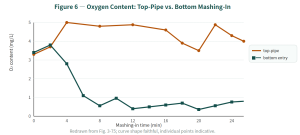
Today’s lauter tun is a far cry from the old open square coolship. Modern vessels are stainless steel, well insulated, and — most importantly — mash in from the bottom. Why does that matter? Because bottom entry keeps oxygen pickup below 1 mg/L, while filling through a top pipe can push dissolved oxygen far higher. Figure 1 shows the essential anatomy of a modern lauter tun.
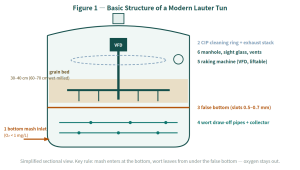
Two components deserve a closer look even though they rarely make the brochure. First, the bottom inlet valve assembly distributes mash evenly across the plate area so the grain bed forms without density differences. Second, the underside cleaning system: rotating spray heads (about 2 per square meter) wash the space below the false bottom, because that shadow zone collects trub and particles that would otherwise seed a stuck mash. The space between the screen and the vessel bottom is only about 20 mm — just enough for wort to escape without exposing the plates to air.
2. Why Does Screen Plate Design Make or Break Your Runoff?
The false bottom is the actual filter medium, so its slot geometry decides how much husk material passes and how fast wort can flow. Have you ever wondered why two lauter tuns of the same size perform so differently? Look at the slots. A modern welded-slot screen is only 0.7 mm wide but offers a free flow area of up to 18% of the plate surface. Compare that with milled-plate designs, and you can see the difference in Figure 2.
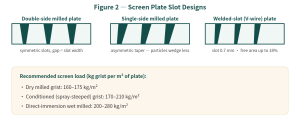
Interesting finding from newer research: even when the open area drops to 10–12% of the plate, filtration still works well — because the grain bed, not the plate, is the real filter. What actually kills runoff speed is clogging at the slot surface. That is why German manufacturer Hupmann introduced inclined screen plates: each slot face leans against the rotation direction of the raking knives, so grist particles are swept off instead of wedging into the gaps. Breweries report clearly faster runoffs with this design.
How Should Wort Leave the Vessel?
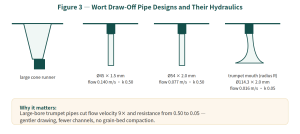
Below every square meter of false bottom sits one wort outlet. Modern designs use cone-shaped draw pipes that draw gently from the plate, avoiding trub starvation zones and the “channeling” that plagues older flat inlets. All draw pipes connect to a central wort collector fitted with an air sensor — if air enters, the pump stops automatically. Figure 3 compares four pipe designs and their hydraulic data; the difference is dramatic.
3. What Does the Raking Machine Really Do?
After first wort filtration, the compacted grain bed resists flow. The raking machine — the component brewers most often blame for trouble — exists to loosen the bed, open new wort channels, and improve water-grist contact during sparging. Used correctly, it cuts runoff time substantially; used carelessly, it drags husks into the wort and destroys clarity.
The rules are precise. Rake knives must cut the bed without destroying the filter layer that has already formed, so height is steplessly adjustable and the machine starts just 1–2 cm above the plates. Knife spacing widens by roughly 50% for dry-milled grist (loose husks need more room), and spacing increases from the outer to the inner radius by about 50% as well — because inner knives travel a shorter circle. Within the inner third of the radius the spacing is about 240 mm; in the middle third it is 220 mm. Blades on opposite sides are deliberately offset so their tracks complement rather than overlap each other.
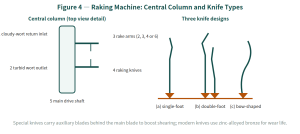
How big should the machine be? Table 1 links lauter tun size to rake configuration — note how revolutions per cycle stretch as diameter grows, and why vessels above ~12 m circumference need four or more arms simply to finish one revolution in reasonable time.
Table 1 — Lauter Tuns and Their Matching Raking Machines
| Grist load (t) |
Filtration area (m²) |
Circumference (m) |
Time per revolution (min) |
Number of arms |
| 2 |
11.5 |
12 |
4 |
2 |
| 4 |
22.8 |
17 |
5.7 |
2 |
| 8 |
45.5 |
24 |
8 |
4 |
| 16 |
91 |
34 |
11.4 |
8 |
Table 1. Lauter tun vs. raking machine parameters . Assumptions: rim speed 3 m/min, 175 kg/m² grist load, 31.5 cm grain bed.
4. What Are the Technical Requirements of a Modern Lauter Tun?
If you are buying a new lauter tun — or auditing your current one — the checklist in Table 2 is the fastest way to judge the design. Does your vessel meet these numbers?
Table 2 — Technical Requirements for a Modern Lauter Tun
| Technical item |
Requirement |
| Capacidad de producción |
9–15 brews per day |
| Bottom mashing-in |
Reduces oxygen pickup |
| Screen slot width |
0.5–0.7 mm |
| Free flow area of screen |
15% |
| Turbid wort return below wort surface |
Reduces oxygen pickup |
| Wort collector cones |
1 per m², cone velocity 0.015 m/s |
| Raking knife count |
2–2.25 per m² |
| Special knife design (auxiliary blades behind main blade) |
Increases shearing effect during raking |
| Knife material |
Zinc-alloyed bronze |
| Rake and wort pump control |
Variable frequency (VFD) |
| Under-screen cleaning head density |
2 per m² |
| Continuous sparging |
Good permeability of grain bed |
| Screen load with immersion-conditioned grist |
250 kg/m² — fast runoff, no bed stratification |
| Spent-grain door area also filters |
Increases total filtration area |
| N₂ or CO₂ pressurized filtration |
0.02–0.03 MPa, increases runoff speed |
Table 2. Technical requirements for modern lauter tuns .
5. How Is a Modern Lauter Tun Controlled?
Modern lauter tuns no longer rely on a brewer watching a sight glass. Control runs on flow rate and pressure differential (ΔP) — and increasingly on multi-parameter models that bring in bed height, rake height, rake speed, wort flow, sparge water volume, kettle capacity, and turbidity all at once. Figure 5 shows how the module system turns three raw measurements into three independent control loops.
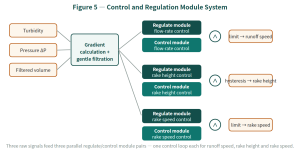
What signals feed the system? Manually checked indicators include appearance, first wort and kettle wort quantity, concentration, color and pH, plus solids in the Imhoff funnel (must stay below 0.2 mL). Online instruments track sparge water temperature, flow and volume, wort flow and temperature, rake height, per-section runoff speed, and bed pressure differential. The more of these you automate, the more repeatable every brew becomes.
6. What Happens During the Seven Steps of Lautering?
Wort filtration runs through seven steps: preheating, mashing-in, rest, turbid wort reflux, first wort filtration, sparging, and spent grain removal. Which of these quietly decides your beer’s shelf life? The answer may surprise you — it’s the second one.
6.1 Preheating
Before mash arrives, the vessel is checked, screens tightened and cleaned, rakes in home position, dampers closed to hold temperature. Then 78 °C water is filled up to the plates — pushing air out of the under-screen space. Why? Because trapped oxygen there would dissolve straight into your first wort, and preheating also stops the plates from stealing heat from the mash.
6.2 Mashing-In: Why Is Bottom Entry So Critical?
Mash is pumped in while stirring, spread evenly by the rakes, within 8–12 minutes and at a transfer speed kept under 2–4 m/s. Uneven distribution means uneven extraction and lower yield — and once the bed forms, you cannot fix it. The real villain, though, is oxygen: every splash entrains air into a wort that is supposed to stay anaerobic. Figure 6 shows measured oxygen content for top-pipe loading versus bottom entry, and the gap is not subtle.
6.3 Rest: Does the Bed Really Build Itself?
After mashing-in, heavy husks and light fragments settle fast, forming a 30–40 cm grain layer (60–70 cm with wet milling) in three natural strata: a coarse bottom layer, a middle husk layer — the thickest and the true filter medium — and a light top layer of protein and fine husk particles. First wort gathers above the bed. The whole rest takes just 10–20 minutes, but skipping it is a classic beginner’s mistake: no stratification, no clean runoff. Warmer mash settles faster; a well-executed sacccharification that fully degrades β-glucans settles even better.
6.4 Turbid Wort Reflux
The first wort through a fresh bed is always cloudy — it carries particles that slipped through the plates. This turbid wort contains over ten times the fatty acids (C₈–C₁₈) of bright wort, and letting it reach the kettle raises iodine values and harms foam, flavor and head retention. So the brewer opens the draw-off valves to vent air, closes them, opens the runoff valves, and pumps the cloudy wort back below the wort surface — never onto the bed — for about 10 minutes until it runs clear.
6.5 First Wort Filtration: How Fast Should It Run?
First wort filtration normally takes 75–105 minutes; a modern system with good raking gets under 60. The wort valve opens gradually — start at 1/4 to 1/3 open, then widen — to keep the bed loose. Rakes may run, but slowly: 1/5 to 1/3 r/min, height never closer than 3–5 cm to the plates. A differential pressure gauge automatically adjusts rake speed and depth. At 25–30 minutes, measure first wort gravity to plan sparging. For a 12 °P beer, first wort must hit 16–20 °P — that is, 40–80% above the target beer gravity.
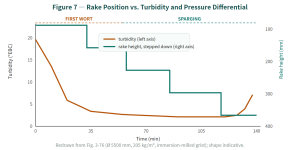
What controls the speed? Three levers dominate. Temperature: wort at 20 °C filters about 20% slower than at 15 °C because viscosity falls with heat — hold the mash temperature, hold the speed. Bed resistance: resistance is minimal at the start and climbs as solids pack, so the operator must adapt continuously. Grind and malt quality: see Tables 3 and 4.
Table 3 — Wort Extract, Runoff Time and Viscosity (75 °C)
| Extract (°P) |
Runoff time for equal volume (s) |
Viscosity (mPa·s) |
| 0 |
85 |
1.00 |
| 10 |
108 |
1.27 |
| 15 |
122 |
1.44 |
| 20 |
147 |
1.73 |
| 25 |
187 |
2.20 |
Table 3. Relationship of wort viscosity, filtration time and extract .
Table 4 — Malt Quality, Mashing Method and Filtration Speed
| Malt quality |
Mashing method |
β-glucan (mg/L) |
Wort viscosity (mPa·s) |
Filtration (L/kg·30 min) |
| Under-modified |
Two-fold decoction |
1290 |
2.60 |
2.5 |
| Fast infusion |
1220 |
3.38 |
1.7 |
| Well-modified |
Two-fold decoction |
364 |
1.98 |
2.8 |
| Fast infusion |
383 |
2.27 |
2.2 |
Table 4. Malt quality, mashing method and filtration speed .
Notice what Table 4 really says: a poorly modified malt mashed too fast produces the most viscous, slowest-filtering wort of all four combinations. Mill type matters just as much — measured first wort flow rates are 66.5 g/min for dry milling, 78.1 for conditioned milling, and 110.0 for wet milling. Wet-milled husks form a thicker but far more permeable bed (35 cm dry, 40 cm conditioned, 55 cm wet), which is why wet-milled vessels can push loads from 200 to 225 or even 300 kg/m². So why don’t all breweries wet mill? Because the wort comes out cloudier — a trade-off many brands refuse to accept.
Table 5 — Screen Load, Filtration Time and Runoff Speed
| Grist load (kg/m²) |
150 |
225 |
300 |
| Grain bed depth (cm) |
27 |
40.5 |
54 |
| Filtration time 180 min → speed (L/m²·s) |
0.11 |
0.16 |
0.21 |
| Filtration time 150 min → speed (L/m²·s) |
0.13 |
0.19 |
0.25 |
| Filtration time 120 min → speed (L/m²·s) |
0.16 |
0.24 |
0.32 |
Table 5. Relationship of screen load, filtration time and filtration speed . Excessive speed raises flow friction — faster is not automatically better.
Checking First Wort Quality
First wort is the report card of your malt and your mashing. Check color, clarity, odor, taste and iodine reaction — the iodine test reveals whether husk fragments and unconverted starch leaked into the wort. Expect first wort yield around 40–50% of total extract; the rest waits in the bed for sparging. Yield is calculated as: first wort (hL) × 0.98 × °P ÷ grist (100 kg) — the 0.98 corrects for the lower temperature of first wort (~70 °C).
Gravity is read with a saccharometer calibrated at 20 °C, read at the meniscus top in the brewhouse, with a temperature correction scale (red figures for corrections above/below 20 °C). One caution from the textbook worth repeating: don’t push the hydrometer in too deep — wort clinging to the stem drags the reading low.
Sparging is a diffusion process — extraction rate depends on contact area, concentration difference, and time. Run it in two or three stages (about 20%, then 50%, then 30% of the sparge water), each spray lasting no more than 10 minutes from a ring pipe with nozzles over the bed. Water temperature sits at 76–78 °C, never above 80 °C: cooler water leaves starch unconverted, hotter water releases α-amylase-damaged starch, extra color and — worst of all — oxygen. When the water table nears the bed surface (within 1–2 cm), sparge immediately; any later and polyphenol oxidases get to work. If turbidity rises, lift the rakes to loosen the bed; if ΔP climbs, drop them. How much sparge water do you need? Table 6 has the classic ratio.
Table 6 — First Wort Gravity vs. Sparge Water Volume
| First wort gravity (°P) |
First wort : sparge water ratio |
| 14 |
1 : 0.7 |
| 16 |
1 : 1.0 |
| 18 |
1 : 1.2 |
| 20 |
1 : 1.5 |
Table 6. First wort concentration and sparging water volume .
Stop sparging at the right moment. Mixed wort gravity for an 11 °P beer is typically held at 9.4–9.6 °P (1.0–1.5 °P below final gravity); the last runnings run at 1–1.5 °P. Chase further and you extract tannins, husk flavors and silicates that ruin the beer — and boil off extra water for nothing. Watch sparge pH too: it creeps up during sparging, and above 6.0 you lose kettle protein coagulation, so dose lactic acid as needed. And remember what Table 7 shows: late runnings get dramatically darker (per 12 °P), nitrogen-poor and polyphenol-rich — which is exactly why they must be blended, not boiled neat.
Table 7 — Composition of Sparge Worts vs. First Wort
| Artículo |
First wort |
1st sparge wort |
2nd sparge wort |
3rd sparge wort |
Blended wort |
| Gravity (°P) |
16.3 |
13.9 |
5.3 |
1.6 |
10.2 |
| pH |
5.69 |
5.74 |
5.99 |
6.35 |
5.81 |
| Color (EBC) |
7.8 |
6.5 |
3.2 |
2.2 |
5.6 |
| Final fermentability (%) |
82.4 |
83.6 |
86.0 |
83.4 |
81.8 |
| Total N (mg/100 mL) |
140.8 |
118.2 |
46.8 |
16.0 |
86.3 |
| High-MW N (mg/100 mL) |
35.9 |
28.7 |
12.1 |
5.8 |
22.1 |
| FAN (mg/100 mL) |
26.0 |
22.6 |
9.8 |
3.4 |
17.1 |
| Polyphenols (mg/L) |
236 |
200 |
79 |
37 |
151 |
| Anthocyanogens (mg/L) |
110 |
91 |
50 |
28 |
61 |
Table 7. Composition of sparge worts vs. first wort . Normalized-to-12 °P values in the original show 3rd sparge wort color jumps to 17.5 EBC with polyphenols at 294 mg/L — a strong argument for disciplined sparge cutoffs.
6.7 Spent Grains: Waste or Revenue?
When sparge gravity hits spec, drain the bed, open the spent grain outlet, and drop the grain — modern vessels use a hinged bottom door whose area even contributes extra filtration surface during the run. The grain falls into a screw conveyor that lightly compresses it and pumps it into a silo, with an air vent separating conveying air from grain before truck loading. Unsold wet grain must be dried to 10–12% moisture (1.25–1.36 kg of steam per kg of water evaporated). Is it worth it? Table 8 says yes — spent grain is a genuine feed product.
Table 8 — Composition of Spent Grain Dry Matter
| Componente |
Content (%) |
Componente |
Content (%) |
| Protein |
28.0 |
Cellulose |
17.5 |
| Fat |
8.2 |
Minerals |
5.3 |
| N-free extract |
41.0 |
|
Table 8. Dry matter composition of spent grains (original Table 3-44). Wet grain runs 70–80% moisture; 100 kg grist yields 100–130 kg wet grain, with nutritional value about 1/5 of equal-weight barley.
7. When Does a Mash Filter Beat a Lauter Tun?
So why are Heineken, Brahma, Kronenbourg, Harbin and Chongqing Brewery investing in mash filters? Because a plate-and-frame filter with chambered elements extracts more wort from the same grist, runs a shorter cycle, and automates beautifully. The French NORTEK design is a useful case study. Its frame-and-chamber plates measure 2100 × 2100 mm with 40–60 mm chambers, weigh about 250 kg each, and give 16–22 m² of plate area per unit — supporting loads up to 8 kg grist per m² of filtration area.
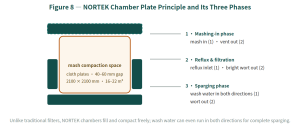
The clever part is inside the plates. Traditional filters fix the cloth rigidly; NORTEK clamps it with an O-ring seal between chamber plates, so the cloth never cracks or leaks. During mashing-in the chambers fill through driven-by floating particles — “the sedimentation phase is turbid and unclear,” as the original text puts it — while during sparging the flow direction can be reversed and the cloth flexes, keeping every chamber washed evenly. Membrane versions add a squeeze phase that presses the beds dry before discharge.
And the grind? A mash filter tolerates — even prefers — much finer milling than a lauter tun, as Table 9 makes obvious. That finer grind means faster extraction and higher yield, one reason filter users report wort collection efficiency around 100% ± 0.5%.
Table 9 — Grist Particle Size Distribution by Milling System
| Sieve fraction |
Six-roll mill (%) |
Disc mill (%) |
Hammer mill (%) |
| I (husks) |
11 |
1 |
1 |
| II |
4 |
3 |
4 |
| III (grits) |
16 |
30–35 |
9 |
| IV (grits) |
43 |
30–40 |
26 |
| V (flour) |
10 |
10–20 |
19 |
| VI (fine flour) |
16 |
<16 |
41 |
Table 9. Grist particle size distribution of different milling systems . Hammer-milled grist — unusable in a lauter tun — is exactly what a mash filter wants.
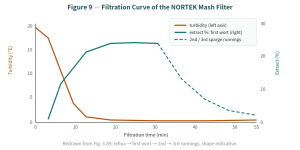
Table 10 — NORTEK Mash Filter Wort Quality Indicators
| Indicator |
Target |
| First wort yield (%) |
>52 |
| Solids (Imhoff funnel, mL/L) |
<20 |
| Turbidity (EBC) |
<25 |
| Polyphenols (mg/L) |
<215 |
| Anthocyanogens (mg/L) |
<0.4 |
| Wort moisture after press (hull water, %) |
<74 |
Table 10. Related wort quality indicators for NORTEK mash filter production . Notes from the original: solids measured with an Imhoff funnel; color figures referenced to 12 °P wort.
The verdict? Choose a lauter tun if you want maximum wort clarity, flexible grist, classic husk-bed character, and 9–15 brews/day per vessel. Choose a mash filter if extract yield (100% ± 0.5), short total cycles (<120 min including cleaning and discharge), fine hammer-milled grist and full automation outweigh the higher clarity demands. Many large groups run both: filters for volume brands, lauter tuns for flagship clarity.
Preguntas frecuentes
- Q1: How wide are lauter tun screen slots, and how much open area do I need?
- Modern welded-slot plates use 0.5–0.7 mm slots with about 15% free flow area (up to 18% for welded designs). Research shows even 10–12% open area suffices, because the grain bed does the real filtering.
- Q2: What first wort gravity should I target for a 12 °P beer?
- 16–20 °P — roughly 40–80% above the beer target — with first wort yield around 40–50% of total extract. Measure at 25–30 minutes into runoff to plan your sparge water.
- Q3: How fast should the rakes turn during first wort filtration?
- Very slowly: 1/5 to 1/3 r/min, and never lower the knives closer than 3–5 cm to the plates. During sparging, raise the rakes if turbidity climbs and lower them if pressure differential rises.
- Q4: Why is my first wort cloudy even after reflux?
- Check three things: crush quality (too much flour), rake knives running too deep or too fast, and excessive ΔP from opening the wort valve too quickly. Reflux must also enter below the wort surface, not onto the bed.
- Q5: Can a mash filter really hit 100% extract?
- The NORTEK design targets 100% ± 0.5% wort collection thanks to fine hammer-milled grist, membrane squeezing of the beds, and complete two-direction sparging — with full cycles under 120 minutes including cleaning and discharge.
Conclusion: So Which Vessel Deserves Your Next Investment?
A lauter tun is only as good as its weakest component: slot geometry, draw-off hydraulics, rake control, and automation modules each add or subtract minutes and clarity. A mash filter trades that mechanical finesse for brute extraction efficiency and automation. Either way, the numbers in this guide — slot widths, knife spacings, sparge ratios, oxygen limits — are the benchmarks to hold any supplier to.


 Publicado