Factors that influence saccharification yield — and how to measure, evaluate, and fix extract losses before they eat your margin.
Every percentage point of extract you leave behind in the spent grains is money poured down the drain. So what actually determines saccharification yield (brewhouse yield)? And more importantly — how can you tell whether your losses come from the malt, the mash, the lauter tun, or the way your team runs the brewhouse? This guide walks through the influencing factors, the evaluation methods, and the proven fixes.
1. What Exactly Is Saccharification Yield — and Why Should You Care?
Saccharification yield is the ratio of the extract actually recovered in the wort to the amount of malt charged. In the laboratory, well-made pale malt delivers 74–79% extract on a dry basis — and the higher this number, the better. But here is the question every production manager should ask: if my malt tests at 79% in the lab, why does my brewhouse only see 76%?
That gap between laboratory yield and practical (brewhouse) yield is where the money hides. Losing just 1% of yield on a 1,000-brew-per-year schedule means buying hundreds of kilograms of malt that end up as cattle feed instead of beer. No wonder brewery managers everywhere chase every tenth of a percent.
2. Which Factors Influence Saccharification Yield?
Yield is never lost in one dramatic failure — it leaks away through five overlapping areas. Do you know which one is costing you the most?
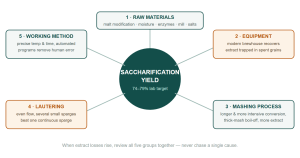
2.1 Raw Materials — Is Your Malt Giving You a Fair Start?
Malt is the single most important indicator. Poorly modified malt, high moisture, weak enzyme activity, poor milling, alkaline brewing water, or high proportions of specialty malts all drag the extract figure down. Since lab extract sits at 74–79% and every brewer wants the top of that range, the first diagnostic question is always: does my malt analysis match my brewhouse reality?
2.2 Equipment — Can Your Brewhouse Even Reach Top Yield?
A modern mashing and lautering house is designed to produce top-quality wort and high yield at the same time. That requires the full set of auxiliary equipment — efficient sparging, well-designed underlets and draw-off systems — to flush out the extract trapped in the spent grains. Older, traditional brewhouses simply cannot match modern recovery rates. Could your yield gap be an equipment gap?
2.3 Mashing Process — Does Longer and Stronger Always Win?
The longer and more intensive the saccharification, the higher the yield — up to a point. Drawing off thick mash and boiling it (decoction) releases additional extract. But beware the trap: boiling a large proportion of thick mash makes the spent grains harder to wash, so an over-aggressive regime can push yield back down. Balance, not brute force, wins this game.
2.4 Lautering — Where Most Yield Is Actually Lost
Fast run-off distributes the mash unevenly across the false bottom, and uneven flow means uneven sparging — both cut yield. The practical lessons are clear:
- Several small sparges beat one continuous sparge — portion-wise washing rinses extract out more completely.
- Uneven draw-off valve operation lowers yield just as surely as uneven sparging.
- The quality of your lautering is ultimately reflected in one number: the washable extract content of the spent grains.
2.5 Working Method — Is Human Error Silently Taxing Your Yield?
The whole mashing operation rests on enzymatic action, so temperature and time must be controlled precisely for the enzymes to do their best work. Modern brewhouses therefore run pre-programmed, automated mashing sequences with the brewer in a supervisory role — stepping in only when necessary. Automation removes the human factor, avoids costly mistakes, and delivers consistently optimal process execution. Every manual override is a small bet against your own yield.
Bottom line: Yield is influenced by many interacting factors. When extract losses climb, review the whole chain — raw materials, equipment, process, lautering, and working method — and control the gap between lab yield and practical yield with regular spent-grain analysis.
3. How Do You Actually Evaluate Yield Performance?
In daily practice, yield problems are diagnosed through wort and mash analysis: measure the total extract recovered in the wort, then quantify what was left behind. Two numbers tell the whole story — washable extract and degradable extract.
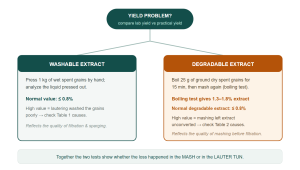
Press 1 kg of wet spent grains with a hand press and analyze the expressed liquid. The washable extract content of well-run lautering should stay at or below 0.8%. Anything higher means your sparging left extract in the bed — and Table 1 tells you where to look.
Spent grains also contain extract that never dissolved during mashing at all. To measure it, boil 25 g of ground dry spent grains for 15 minutes and mash the sample again; the boiling test returns 1.3–1.8% total extract. Of that, the normal degradable-extract share is about 0.8% — and it is the yardstick for how well the mashing stage did its job before filtration ever started. Table 2 lists the causes when it runs high.
Table 1 — Common Causes of Excessive Washable Extract in Spent Grains
| Cause |
Explanation |
Solución |
| Poor lauter tun filtration |
High-molecular gum substances make the wort viscous, so extract is very hard to wash out of the bed |
Use well-modified malt; monitor wort viscosity |
| Screen slots too fine |
Extract-laden wort clings to the bed surface and cannot be rinsed out |
Match slot design to grist; avoid over-fine slots |
| Raking machine installed unevenly |
Rake knives set too low or badly worn disturb and channel the bed |
Level installation; inspect and adjust knives regularly |
| Grist load exceeded |
Grain bed too thick — bed depth exceeds what the underlets can rinse |
Keep the charge within the design capacity |
| Mashing temperature too low |
Conversion incomplete; extract remains bound in the grains |
Correct temperature program, adequate rests |
| Run-off time too short |
Extract has no time to diffuse out of the bed during sparging |
Extend run-off; sparge in stages, not in a rush |
| Uneven grain bed in the lauter tun |
Uneven raking distribution causes uneven sparging, poor washing |
Rake evenly; use low-permeability-corrected slots or a knife adjuster |
| Grain bed compacted too tight |
Bed squeezes shut and sparge water cannot penetrate |
Control bed resistance; rake to relieve compaction |
| Sparge water added too early |
First wort not yet fully run off, so it is diluted before extraction is complete |
Keep first-wort : sparge-water ratio at about 1 : 1 – 1 : 1.2 |
| Too little sparge water |
First wort too concentrated; extract remains in the bed |
Increase sparge water volume within concentration limits |
| Sparge water too cold or uneven inflow |
Very little extract diffuses from the bed into the sparge water |
Sparge at 76–78 °C with even, gentle sprinkling |
| Blocked passages between spent-grain plates |
Wort channels through the bed; pockets of extract never contacted |
Run a strict wort filtration process; maintain sparge temperature |
| Poorly designed / badly arranged sparge rings |
Wet and dry zones form; extract is washed out only in patches |
Choose a suitable sparge distributor; strict sparging discipline |
Table 1. Redrawn from the original table of common causes of high washable extract ;
Table 2 — Causes of Excessive Degradable Extract in Spent Grains
| Cause |
Explanation |
Solución |
| Poorly modified malt |
Enzymes cannot penetrate the endosperm contents, so extract stays locked in |
Use well-modified malt; enforce strict malting practice to secure good enzyme development |
| Adjunct ratio too high |
Conversion becomes incomplete; enzyme capacity is stretched too thin |
Use suitable low-temperature enzyme rests; set the mash program correctly |
| Milling problems |
Endosperm insufficiently exposed (or crushed too fast at high malt moisture) — contents not released |
Adjust mill settings and roll conditioning; re-check grist fractions |
| Mashing time too short or unsuitable program |
Excessive mash pumping, pumps running dry (air ingress) and similar factors degrade overall mash performance |
Longer conversion time; intensified mashing (decoction); gentle, appropriate stirring and pumping speeds |
Table 2. Redrawn from the original causes table for high degradable extract .
6. What Is Low Yield Really Costing You? (Extended Analysis)
Let’s put a number on it. Suppose a 20-hL brewhouse at 12 °P loses just one percentage point of brewhouse yield. Over a thousand brews a year, that is roughly 10 metric tons of extract-equivalent malt — several thousand euros of raw material converted into low-value spent grain. Suddenly, a yield audit doesn’t sound bureaucratic, does it?
6.1 A Practical Yield-Audit Checklist
- Track the lab-vs-practical gap every brew — a widening gap is your earliest warning signal.
- Press-test the spent grains after every second or third brew (washable extract ≤ 0.8%).
- Run the boiling test weekly (degradable extract ≤ 0.8%) to separate mashing losses from lautering losses.
- Log sparge-water ratio — first wort : sparge water at 1 : 1 to 1 : 1.2 is the reference point.
- Verify sparge-water temperature stays at 76–78 °C with even distribution.
- Inspect raking knives and screen plates on a fixed schedule — a worn knife costs yield every single brew.
6.2 Automation as a Yield Strategy
The textbook is blunt about the working method: brewhouses that run pre-programmed automated mashing sequences — with operators observing rather than improvising — avoid the human-factor losses that manual operation inevitably introduces. If your yield fluctuates brew to brew for no technical reason, the variance itself is the clue: people, not equipment, are the variable.
FAQ: Brewhouse & Saccharification Yield
Q1: What is a good saccharification yield?
Laboratory extract for well-made pale malt is 74–79%. Practical brewhouse yield should track the lab figure as closely as possible; the washable-extract test (≤ 0.8%) tells you how close you actually are.
Q2: How do I know whether the loss is in the mash or the lauter tun?
Run both spent-grain tests. High washable extract points to lautering and sparging problems (Table 1); high degradable extract points to mashing and raw-material problems (Table 2).
Q3: Does faster lautering hurt yield?
It can. Fast run-off distributes the mash unevenly, and uneven flow plus uneven sparging reduce recovery. Portion-wise sparging recovers more extract than one continuous sparge.
Q4: What sparge-water temperature should I use?
76–78 °C, applied evenly. Colder water leaves extract behind; uneven sprinkling creates dry channels that never get washed.
Q5: How often should I analyze spent grains?
In a busy production brewery, a press test every few brews and a boiling test weekly is a sound routine — more frequently whenever the lab-vs-practical yield gap widens.
Conclusion: So What Should You Remember About Brewhouse Yield?
Saccharification yield is not a single number — it is a chain of five factor groups: raw materials, equipment, mashing process, lautering, and working method. The two spent-grain tests turn a vague “our yield feels low” into a precise diagnosis: washable extract exposes lautering losses, degradable extract exposes mashing losses, and both have a clear 0.8% benchmark.
When losses rise, resist the urge to fix one variable. Control the lab-vs-practical gap, analyze the final spent grains regularly, and act on Tables 1 and 2 systematically — that is how disciplined breweries hold top yield brew after brew.


 Publicado