1. What Exactly Is Fermentation Degree — and Why Should Every Brewer Track It?
During primary fermentation, yeast decomposes and consumes the fermentable sugars in wort, producing ethanol, CO₂ and a range of other metabolites. Because alcohol and dissolved extract change the density of the liquid in different directions, the extract concentration of the wort falls steadily as fermentation proceeds. Fermentation degree is simply the measure of how far that fall has gone.
In other words, can you answer this question at any moment of the fermentation: what percentage of the original extract has already been converted? That is exactly what fermentation degree tells you:
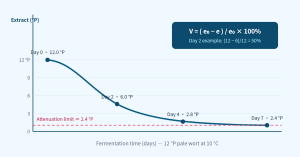
V = Decrease in wort extract concentrationOriginal wort concentration × 100%V — degree of fermentation · the decrease is the difference between original extract (e₀) and current extract (e)
A wort of 12 °P that now reads 6 °P has a fermentation degree of (12 − 6) / 12 × 100% = 50%. Simple — but the trap hides in how you measure the “current extract.” Measure it one way and you get the apparent degree; remove the alcohol first and you get the real degree. Confuse the two and every downstream decision — centrifuge timing, tank transfer, maturation length — inherits the error.
2. Why Does the Saccharometer “Lie”? Understanding Apparent Degree of Fermentation (Va)
When a hydrometer (saccharometer) is used to follow primary fermentation, the reading you get is called the apparent degree of fermentation. It is fast, cheap and done in the fermentation cellar — which is why virtually every brewery manages its tanks by apparent attenuation.
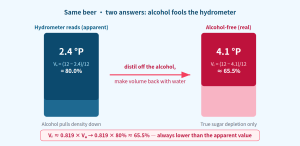
But here is the catch: alcohol is lighter than water. As ethanol accumulates, it drags the density of the beer down beyond what the true sugar depletion alone would cause. The hydrometer cannot tell sugar from alcohol — it only reads density. The result?
The apparent degree of fermentation always over-reads. Because the CO₂ produced by fermentation lowers the relative density, the decrease in extract concentration measured with a saccharometer is greater than the actual decrease. The beer looks “drier” than it truly is.
In daily practice, most breweries determine the original wort density and follow fermentation in the cellar — not the laboratory — using apparent values as the working basis for fermentation management. That is perfectly fine, as long as you know the systematic bias and correct for it when it matters.
3. What Is Real Degree of Fermentation, and Where Does the Famous 0.819 Factor Come From?
To obtain the real (true) degree of fermentation, you must first remove the alcohol from the beer: the sample is distilled, and the residue is made back up to the original volume with water before the density is measured. What remains is the density change caused by sugar depletion alone — the true attenuation.
Repeating such a distillation for every tank is impractical, of course. Fortunately, as early as 1870, Balling established the empirical conversion factor that has served brewers ever since:
Vᵣ ≈ 0.819 × VₐBalling (1870) · real degree of fermentation from apparent degree — valid for the normal range of beer gravities
Worked example: your 12 °P wort reads an apparent attenuation of 80%. The real degree of fermentation is therefore 0.819 × 80% ≈ 65.5%, corresponding to a real extract of about 12 × (1 − 0.655) ≈ 4.1 °P — not the 2.4 °P the hydrometer suggested. One quick multiplication, and your beer’s true carbohydrate content is on the table.
The same logic runs in reverse for planning: if a recipe demands a finished real attenuation of, say, 62%, the tank-side apparent target is roughly 62 / 0.819 ≈ 76% before you may consider the beer fermented out.
| Aspect |
Apparent degree of fermentation (Vₐ) |
Real degree of fermentation (Vᵣ) |
| How measured |
Hydrometer in the cellar, sample as-is |
Distil off alcohol, restore volume with water, then measure |
| Influenced by alcohol? |
Yes — alcohol lowers density, value reads too high |
No — alcohol removed, reflects true sugar depletion |
| Typical use |
Daily tank management, transfer decisions |
Laboratory checks, excise/analysis, recipe targets |
| Example (12 °P wort) |
Apparent extract 2.4 °P → Vₐ = 80% |
Real extract ≈ 4.1 °P → Vᵣ ≈ 65.5% |
| Conversion |
Vᵣ ≈ 0.819 × Vₐ (Balling factor, 1870) |
Table 1Apparent vs. real degree of fermentation at a glance.
4. What Is the Attenuation Limit — and Why Does Fermentation Stop Before the Sugars Are Gone?
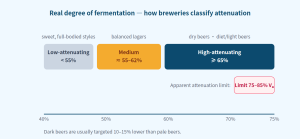
Left long enough, every well-made wort approaches a floor called the attenuation limit (发酵度极限): the fermentation degree reached when yeast has consumed essentially everything it can. For a normal pale-beer wort, the attenuation limit is around 75–85% apparent; dark beers are typically pitched with attenuation targets some 10–15% lower than pale beers.
Why does fermentation stop at all? Because wort contains more than glucose and maltose:
- Non-fermentable dextrins and higher oligosaccharides — branch-length sugars that most brewery yeast strains cannot cleave;
- Maltotriose hesitation — many lager strains consume maltotriose slowly or only partially;
- Yeast flocculation and exhaustion — cells that drop out of suspension stop working, whatever sugars remain;
- Rising alcohol and falling pH — increasingly hostile surroundings throttle yeast metabolism.
Brewers classify beers by their real degree of fermentation. Where does your style sit?
| Classification |
Real degree of fermentation |
Typical character |
Typical styles |
| High-attenuating |
≥ 65% |
Dry, crisp, lighter body; residual fermentable sugar nearly zero |
Diet / light beers, dry lagers, brut-style ales |
| Medium-attenuating |
≈ 60% (around 60%) |
Balanced body vs. dryness; the classic lager zone |
Pale lagers, Pilsners |
| Low-attenuating |
< 55% |
Sweet, full, malty; appreciable residual extract |
Dark beers, sweet stouts, malt-forward specials |
Table 2Beer classification by real attenuation — match the target to your style.
5. What Is Apparent Attenuation of the Beer — the Number Your Cellar Lives By?
Alongside fermentation degree, cellars work daily with apparent attenuation — the decrease in hydrometer reading from original gravity to the current reading. In practice the two concepts are handled together: first calculate the expected degree of fermentation after attenuation is complete, then track the tank against it.
For a typical 10–12 °P pale wort, attenuation is considered complete when the apparent extract has fallen to roughly 2.3–2.7 °P — an apparent attenuation of 76–80% and, by Balling’s factor, a real attenuation near 62–66%. When the reading holds steady for 24 hours or more, primary fermentation is finished and the beer can move to maturation.
Practical tip: judge “finished” by two consecutive identical readings (e.g. 24 h apart), not by a single number. A falling reading means yeast is still working; a static reading above your target signals a potential slow fermentation — see Section 6.
6. What Is Final (Slow) Attenuation — and How Do You Measure It in the Cellar?
Even after the tank reading goes flat, the question remains: is the beer truly finished, or has yeast merely stalled? To answer it, brewers measure the final attenuation (also called the slow or residual attenuation): how much additional fermentable extract is still hiding in the “finished” beer.
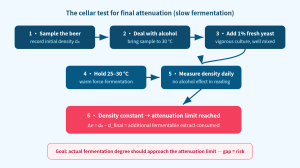
Before calculating it, you must first know roughly what is fermentable in the wort. For pale beers, brewers generally accept that a residual fermentable extract of well under 1% — commonly around 0.3–0.5% — marks the practical floor of fermentation. The classic cellar procedure runs as follows:
- Sample the beer from tank or bottle (note the density before treatment);
- Remove the alcohol interference — the sample is dealt with so the measurement reflects extract, then brought to 30 °C;
- Add about 1% fresh, vigorous yeast and hold at 25–30 °C;
- Measure the density periodically. The density measured by this method contains no alcohol effect, so any further decrease is real sugar consumption;
- The difference between the initial density and the final constant density is the additional extract decrease caused by renewed fermentation — the basis of the final attenuation value.
When the density no longer falls, the beer has hit its own attenuation limit. The gap between the tank’s actual degree of fermentation and this measured limit is the final attenuation — and the whole purpose of the test is precisely this: brewers want the actual fermentation degree to approach the attenuation limit as closely as the beer style allows. A large gap predicts refermentation, gushing or off-flavours in package; a small gap predicts stability.
Why does fermentation turn slow in the first place?
Slow fermentation has many parents — and most of them are preventable:
- Wort composition: too little FAN (free amino nitrogen), insufficient zinc, or an excess of non-fermentable dextrins starve or stall the yeast;
- Yeast condition: poor viability, over-pitching of stale slurry, or a maltotriose-weak strain;
- Process faults: temperatures pitched too low, abrupt chilling, or excessive oxygen removal before pitching;
- Contamination: wild yeast or bacteria competing for the remaining sugars;
- Storage and packaging factors: yeast autolysis in fermentation and finished-beer storage vessels releases growth factors and nutrients that can restart fermentation in the package — one more reason the final attenuation test matters for shelf-life.
| Symptom in the cellar |
Likely root cause |
Corrective action |
| Gravity stalls above target, yeast in suspension |
Low FAN / zinc-poor wort, under-oxygenation |
Verify malt nitrogen, add yeast nutrient, rouse with CO₂/air as appropriate |
| Reading static for days, yeast flocs early |
Poor yeast vitality or wrong strain for the wort |
Re-pitch fresh culture; raise temperature 1–2 °C to rouse |
| Attenuation fine in tank, refermentation in bottle |
Residual fermentables + autolysed-yeast nutrients |
Run the final attenuation test; tighten filtration/centrifuge and storage time |
| Wide gap between actual and limit attenuation |
Fermentation stopped early — style mismatch or fault |
Diagnose above causes; adjust mashing fermentability (see our mashing guides) |
Table 3Quick diagnosis checklist for slow fermentation.
7. How Do Apparent, Real and Final Attenuation Fit Into One Fermentation Control Plan?
The three numbers answer three different questions, and a disciplined brewery uses all of them:
- Apparent degree of fermentation (Vₐ) — “Where are we today?” Daily cellar readings drive transfer and cooling decisions.
- Real degree of fermentation (Vᵣ ≈ 0.819 Vₐ) — “What is truly in the beer?” Recipe design, lab release analysis and excise calculations.
- Final attenuation — “How close are we to the limit?” Stability, shelf-life and slow-fermentation diagnostics before packaging.
Control them together and your fermentations become predictable: pitch with a target Vₐ, convert to Vᵣ for release specs, and confirm with the forced-fermentation test that the gap to the attenuation limit is within style. That is fermentation degree turned from a textbook formula into a working tool — exactly the mindset we build into ZR Brewing’s fermentation equipment.
Frequently Asked Questions About Beer Fermentation Degree
1. What is the difference between fermentation degree and attenuation?
Fermentation degree expresses how much extract has been consumed at any moment; attenuation describes the fall of the gravity reading itself. Apparent attenuation is measured with a hydrometer as-is; real attenuation is measured after removing the alcohol, so real values are always lower.
2. Why is the apparent degree of fermentation always higher than the real one?
Ethanol is lighter than water. Its presence lowers the beer’s density, so the hydrometer under-reads the true extract — the sugar depletion therefore appears greater than it really is, inflating the apparent value.
3. What exactly does the Balling factor 0.819 mean?
It is the empirical ratio between real and apparent degree of fermentation established by Balling in 1870: Vᵣ ≈ 0.819 × Vₐ. Multiply your cellar reading by 0.819 to estimate the true attenuation without distillation.
4. What is the attenuation limit of pale-beer wort?
For normal pale worts the limit lies around 75–85% apparent attenuation (roughly 61–70% real). Dark beers are usually targeted about 10–15% lower than pale beers.
5. How is high- vs. low-attenuating beer classified?
By real degree of fermentation: about 60% counts as medium attenuation, 65% or above is high attenuation (dry, diet and light beers), and below about 55% is low attenuation (sweet, full-bodied dark styles).
Example: 12 °P original wort, apparent reading 2.4 °P → Vₐ = 80% → Vᵣ = 0.819 × 80% ≈ 65.5% → real extract ≈ 12 × (1 − 0.655) ≈ 4.1 °P.
7. What is the purpose of the final attenuation test?
To show how much fermentable extract remains and how far the beer still is from its attenuation limit. Brewers want the actual fermentation degree to approach the limit; a large gap predicts refermentation, gushing and flavour instability in package.
8. Can yeast autolysis restart fermentation in the package?
Yes. Autolysing yeast in fermentation and finished-beer storage vessels releases growth factors that let residual yeast consume leftover fermentable sugars — one reason long storage on yeast and insufficient final attenuation are both shelf-life risks.
Need Fermentation Tanks That Turn These Numbers Into Results?
Predictable attenuation starts with hardware: precise temperature control, sanitary conical geometry, complete CIP coverage and dependable yeast management. ZR Brewing manufactures stainless-steel conical fermenters, unitanks and complete fermentation systems for craft breweries and industrial lines worldwide.
Talk to our engineers about your target attenuation — we will match the tank to your beer.


 Publicado