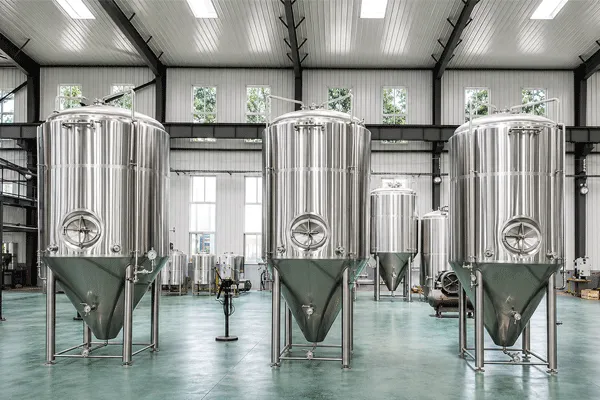
A stainless steel storage tank for beverages is a sanitary vessel, usually SUS304 or SUS316, that holds beer, wine, cider, kombucha or spirits between processing steps. SUS304 suits most beer and low-chloride liquids. SUS316 is worth specifying when the product, cleaning chemistry or water carries more chlorides or acidity.
What Is a Beverage Storage Tank, Exactly?
In a brewery or beverage plant, “storage tank” covers any stainless vessel that holds liquid without being the main processing vessel. Fermenters and bright beer tanks are close relatives, but a storage tank in the narrow sense may hold finished beer, base wine, cider, brewing water or kombucha before packaging.
Search for “stainless steel storage tanks” and you will find metals suppliers, water-tank pages and chemical-storage listings mixed together. Compared with general-purpose water or chemical tanks, a beverage tank has extra demands:
- Food-contact interior surfaces that can be cleaned in place (CIP) without dead legs
- Temperature control, usually through a glycol cooling jacket
- Ports, valves and manways placed for sampling, transfer and cleaning
- A pressure rating if the tank will hold carbonated product
- Insulation that keeps the jacket efficient and stops condensation on the shell
A water tank built to a generic spec can miss every one of these points. That is the main reason beverage producers order project-specific vessels instead of off-the-shelf tanks.
Why the Steel Grade Is Decided First
Every other choice depends on the grade. Port fittings, valves and welding consumables need to match or be compatible with the shell material, and the grade also limits which cleaning chemicals you can use comfortably for the life of the tank.
Both grades are austenitic stainless steels. The practical difference is that SUS316 contains added molybdenum, which improves resistance to pitting corrosion from chlorides. Chlorides reach a tank from more places than most buyers expect: brewing or rinse water, some sanitizers, salted or fruit-based products, and coastal air on the outside of the shell.
SUS304 vs SUS316 for Beverage Tanks
| Factor |
SUS304 |
SUS316 |
| Alloy difference |
No molybdenum addition |
Added molybdenum |
| Chloride pitting resistance |
Adequate where chloride exposure is controlled |
Higher; better margin where chlorides are present |
| Typical beverage fit |
Beer fermentation, conditioning and bright beer storage |
Higher-acidity or higher-chloride products, aggressive cleaning regimes |
| Status in ZR Brew configurations |
Normal standard material for fermentation and storage vessels |
Available option, subject to project requirements |
| Material cost |
Inferior |
Higher; quoted per project |
| Fittings and valves |
Widely matched in standard brewery components |
Matching 316 components need to be confirmed at quotation |
Where SUS304 is enough
For most breweries, 304 is the sensible default. ZR Brew’s fermentation tanks and bright beer tanks are normally built from SUS304, and beer is a relatively mild product for the alloy as long as cleaning and rinsing are done properly.
When SUS316 earns its cost
Look harder at 316 if your liquid is noticeably more acidic than beer (many wines and ciders fall here), if your water supply has a high chloride content, or if your cleaning program relies on chlorine-based sanitizers. Spirits plants and mixed-beverage facilities that run several products through the same tanks also tend to benefit from the extra margin.
Beyond the Grade: Jacket, Insulation and Pressure
Glycol cooling jackets
ZR Brew fermentation and storage vessels use glycol cooling jackets, and the number and position of cooling zones can be configured. Tall tanks or tanks that are often run part-full usually need more than one zone so the liquid level and the cooled area match.
Aislamiento
Insulation keeps glycol demand down and stops the outer shell sweating. As a reference point, one published ZR Brew 3000L fermentation tank configuration uses a 100 mm insulation layer, has a total volume of approximately 3750L and is built from SUS304. Those figures apply to that published model only; insulation thickness for a custom tank is set by the cooling target and room conditions.
Pressure rating
A tank that will carbonate or hold carbonated beer needs a working pressure rating. ZR Brew lists a typical working pressure of approximately 0.2 MPa (about 30 psi) for its fermentation and bright tanks, depending on the model. A pressure-rated tank costs more to build and inspect, so specify it only if the tank will actually see pressure.

ZR Brew Custom Stainless Steel Vessels: What You Can Specify
ZR Brew builds custom-engineered stainless steel vessels for brewing, fermentation, beverage mixing, liquid storage, sanitary processing and temperature-controlled production. There is no fixed model catalog for this line, because each vessel is engineered around the project. The configurable parameters are:
| Parámetro |
What gets defined |
| Capacity and dimensions |
Working and total volume, diameter, height to fit the site |
| Material grade |
SUS304 as standard for brewery vessels; SUS316 subject to project requirements |
| Pressure rating |
Atmospheric storage or pressure-rated for carbonated product |
| Heating or cooling structure |
Glycol cooling jackets, number of cooling zones, heating where needed |
| Aislamiento |
Thickness and cladding |
| Agitation |
Agitator if the product needs mixing |
| Manway |
Top or side position |
| Ports and valves |
Sampling, CIP, carbonation, racking and level points |
| Surface finish |
Interior and exterior surface treatment |
| Controles |
Temperature control and monitoring requirements |
The same engineering team supports brewery projects from 50L pilot systems to 150HL commercial breweries, so storage vessels can be matched to an existing or planned brewhouse.
During the order, buyers can confirm materials and components before production, request factory video inspections, receive weekly production photos and videos, and review hydraulic pressure-test information. Technical drawings, material certificates and pressure-test records are confirmed for each order rather than assumed from a standard document set.
How to Specify a Custom Storage Tank in 6 Steps
- Define the liquid and its life in the tank. Write down the product, its storage temperature, how long it stays in the tank and whether it is carbonated. You are done when another engineer could tell from your note whether the tank needs a pressure rating.
- Check chloride sources. Get a water analysis and list every cleaning and sanitizing chemical you plan to use. Mark which ones contain chlorine.
- Choose the grade. Use the table above. If you pick 316 because of chlorides, extend the same grade to wetted valves and fittings.
- Set capacity and footprint. Measure ceiling height, door width and floor loading. Confirm working volume separately from total volume.
- List every port. Sampling valve, CIP spray ball, racking arm, carbonation stone, temperature sensor, level indicator. Add anything you may need later, since adding a port after fabrication is costly.
- Agree the documentation before production. Ask for drawings for approval, material confirmation, the pressure-test method and the compliance documents your market requires. Production should start only after the drawing is signed off.
Preguntas frecuentes
Is SUS304 suitable for storing beer?
Yes. Food-grade SUS304 is the normal material for ZR Brew fermentation tanks and bright beer tanks, provided cleaning and rinsing remove chloride residues.
When should I choose SUS316 instead?
Consider 316 for more acidic products such as many wines and ciders, high-chloride water, chlorine-based sanitizers, or multi-product plants. Apply it to wetted fittings too, not just the shell.
Can a storage tank also be used to carbonate beer?
Only if it is pressure-rated. ZR Brew fermentation and bright tanks typically work at about 0.2 MPa (30 psi), depending on model. Confirm the rating for your specific vessel.
Does every storage tank need insulation?
Any tank cooled by a glycol jacket benefits from insulation, which cuts glycol demand and prevents condensation. Thickness is set per project.
What documents come with a custom tank?
Drawings for approval, material confirmation before production, production photos and pressure-test information are available. Material certificates and destination-market compliance documents are confirmed per order.


 Publicado