Internally heated boil kettles are compact, efficient and popular — but have you ever wondered what happens inside those heater tubes? In real production they can suffer temperature differences of up to 25 °C within a single kettle, a fretting phenomenon called pulsation, and beer stone fouling that shortens cleaning cycles. The cure is surprisingly elegant: a variable-frequency return pump that forces the wort to circulate. Here is the thermodynamics behind the problem — and the eight measurable wins forced circulation delivers.
How does heat actually get from steam to wort inside the heater?
The thermodynamic model of vapor-to-wort heat exchange in an internally heated kettle looks simple from the outside — steam condenses, wort boils — but the details decide your brewing efficiency. On the steam side, vapor condenses on the outer wall of the heater tubes and forms a condensate film that releases its latent heat through the tube wall into the wort. The thickness of this laminar film (δ) has a decisive influence on heat transfer.
On a vertical heater tube, the condensate film is divided into roughly three zones: a smooth laminar zone at the top, a wavy laminar zone in the middle, and a turbulent zone below. On the wort side of the tube, the flow splits into four zones as well: the heating zone, the thin-film nucleation zone, the early-bubble boiling zone, and the fully boiling zone — because heat transfer depends closely on how many vapor bubbles the wort carries.
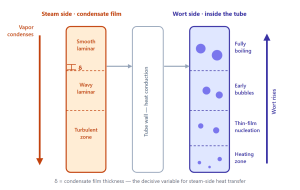
One more nuance matters: heat exchange in the laminar zone is controlled by the condensate film thickness, while turbulence on the vapor side steadily improves the steam-side heat transfer. In other words, the more the condensate film is disturbed, the better the heater performs. Keep that in mind — it explains everything that follows.
What goes wrong inside an internally heated boil kettle?
With Figure 1 in mind, it is easy to imagine how many factors complicate the wort-to-steam heat exchange in real production: the heater material, the wort velocity inside the tubes, the steam temperature, surface fouling such as beer stone and scorched material, and the mounting position of the heater itself. Under the combined influence of these factors, internally heated kettles typically show three problems:
- Pulsation — local overheating at the start of the boil makes the wort “fret” and surge.
- Temperature unevenness — poor convection leaves wort at different temperatures within one kettle, with gaps of up to 25 °C.
- Beer stone fouling — deposits build up on the heater tubes, shortening cleaning cycles and limiting brewhouse output.
Which five factors decide how well your internal heater performs?
Before blaming the kettle, it helps to know which levers actually move the needle. In production, five variables dominate the heat exchange between wort and steam:
- Heater material and surface finish. Thermal conductivity sets the baseline, but surface roughness decides how easily the condensate film drains and how firmly beer stone anchors. A polished stainless surface drains faster and fouls more slowly.
- Wort velocity inside the tubes. Slow wort means a thick boundary layer on the wort side and sluggish bubble release — exactly the condition that invites pulsation. This is the single variable forced circulation controls directly.
- Steam temperature and pressure. Higher steam temperature increases the driving temperature difference, but it also thickens the condensate film and raises the risk of local overheating and scorching on the tube wall.
- Fouling — beer stone and scorched material. Deposits act as an insulating layer. Even a thin layer measurably lowers heat transfer, which is why cleaning intervals and heat-transfer efficiency are really the same conversation.
- Mounting position of the heater. Where the heater sits determines the fountain effect and therefore the convection pattern of the whole vessel. A poorly placed heater creates dead corners that never reach boiling temperature.
Notice that four of these five are fixed once the vessel is built. Wort velocity is the one you can still change — which is precisely why the forced-circulation retrofit works so well on existing equipment.
Why does a temperature difference build up in the first place?
The ideal heating state is easy to describe: wort moves downward through the kettle like a piston — the famous piston effect — so every point in the kettle shares nearly the same temperature. That is the state every brewer wants, because uniform heating raises the utilization of bitter hop substances and protects wort quality.
Real kettles rarely cooperate. Wall friction makes wort sliding down the vessel wall form its own circulation loops, and the fountain effect from the internal heater creates free-convection regions. The result is a kettle divided into a problem zone and a mixing zone with different temperatures — and in unfavorable cases, plug-flow behavior instead of proper mixing:
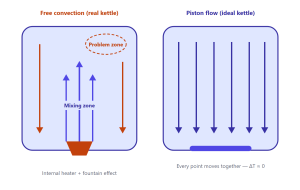
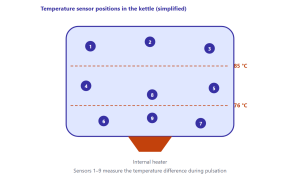
How large does the gap become in practice? Modern kettles carry temperature sensors at several positions, so the difference can be measured directly. When heating starts, the wort leaving the heater is clearly hotter than the wort near the bottom and the surface — freshly discharged wort is about 20 °C hotter than the wort at the kettle bottom, and it takes roughly 15 minutes before the whole kettle reaches boiling temperature. And even after boiling begins, poor convection means the sensors still disagree for a while — equalization needs time.
What exactly is “pulsation” — and why should you care?
At the start of the boil, the wort inside and around the heater is in a state of violent, surging convection: the temperature difference between the heater outlet and the rest of the kettle is large, so the driving force for wort movement inside the heater is insufficient — and the imbalance shows up as pulsation, a rhythmic fretting and surging of the wort. Only when the heater temperature approaches boiling does the pulsation die away. In practice, a kettle typically needs to hold and settle for around 30 minutes before the boil runs calmly:
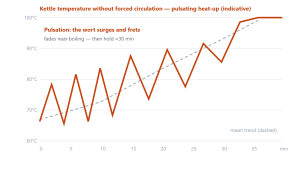
Why does pulsation deserve your attention beyond the annoyance? Because wort and hops boiling together put every component of the heater under high mechanical stress — and when acoustic resonance joins in, the pressure rises above normal levels and causes mechanical fatigue. Pulsation also slashes the heat-transfer efficiency of both heater and kettle. These drawbacks bind up the whole wort boiling process, burn energy, and can even damage equipment directly.
Internal vs. external wort boiling: where does forced circulation sit?
If forced circulation consumes more electricity than classic internal boiling but less than external boiling, is it actually the right choice for your brewery? The honest answer depends on what you are optimising for — capital cost, energy per hectolitre, or batches per day.
- Traditional internal boiling is the cheapest to build and the gentlest on the electricity meter, because it relies purely on thermosiphon convection. Its price is paid in pulsation, temperature gaps of up to 25 °C and beer stone build-up.
- External wort boiling pushes the wort through an external heat exchanger at high velocity, giving excellent heat transfer and intense evaporation. But the pump duty — and the electricity bill — is the highest of the three, and the wort is exposed to higher shear.
- Forced-circulation internal boiling lands in between. It keeps the compact internal heater geometry, borrows the controlled velocity of external systems, and spends a moderate amount of pump energy to eliminate pulsation and most of the fouling.
Look at the totals rather than the pump alone. Cutting 10 minutes of heating time per brew and lifting heat-transfer efficiency by 15% means the steam saved per batch is real money — and doubling consecutive brews from 8 to 16 per cleaning cycle removes entire CIP stops from the weekly schedule. For most production breweries, that trade is comfortably positive.
Rule of thumb: if your kettle needs a 30-minute settling hold before the boil runs calmly, you are paying for pulsation on every single batch. A pump that removes that hold usually pays for itself in capacity before it pays for itself in energy.
Can forced circulation really fix all of this?
Yes — and the fix is refreshingly mechanical. A forced-circulation wort boiling system adds a variable-frequency return pump to the loop: from the start of heating, the pump drives the wort around the circuit at a controlled velocity, so the heater is always fed with a strong, steady flow instead of waiting for thermosiphon convection to get moving.
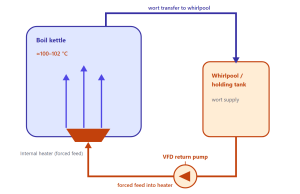
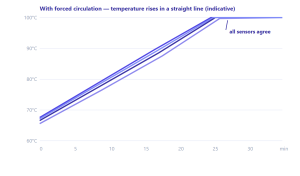
The result is immediate: the wort in the kettle reaches every corner with a uniform temperature. Temperature curves recorded after the pump is switched on show how dramatically the heating state improves:
What measurable results does forced circulation deliver?
Breweries that switch report a consistent pattern of improvements — not just calmer kettles, but hard numbers on capacity, cleaning and beer flavor:
Table 1. The eight characteristics of forced-circulation wort boiling
| # |
Characteristic |
What it means for your brewery |
| 1 |
Pulsation disappears completely; wort velocity in the heat-exchange tubes stays constant |
Calm, stable heat transfer; less mechanical stress on heater components |
| 2 |
Temperature difference in the kettle virtually eliminated — wort temperature rises in a straight line |
Uniform boil everywhere, better hop utilization and wort quality |
| 3 |
Heat-transfer efficiency up 15%; heating time shortened by 10 min |
Faster brews and more batches per day from the same equipment |
| 4 |
Interior “clogging” of heater tubes greatly reduced; less beer stone |
Cleaning intervals extended; consecutive brews per kettle rise from 8 to 16 — higher equipment utilization, lower consumption |
| 5 |
Higher wort heating temperatures possible without local overheating |
Process freedom without compromising product quality |
| 6 |
Better removal of undesirable flavor substances |
Improved beer flavor and aroma purity |
| 7 |
Electricity consumption above traditional internal boiling, but below external boiling |
A balanced energy profile between the two classic systems |
| 8 |
Continuous pump circulation at 18–20 cycles per hour |
Consistent, controllable flow — independent of thermosiphon luck |
How do you integrate forced circulation into your brewhouse?
Thinking about the retrofit? Three practical pointers from the system design:
- Choose a variable-frequency pump. The circulation demand changes between heat-up, boil and transfer phases — a VFD pump lets you match flow to the phase instead of paying for full speed all the time, and keeps tube velocity constant to protect the heat-exchange surfaces.
- Close the loop sensibly. The circulation circuit ties the kettle to the whirlpool / holding tank, so the same pump infrastructure can serve the transfer and pre-boil circulation phases — one investment, several duties.
- Watch the cycle count. At 18–20 circulation cycles per hour, the pump is doing real work — but remember point 7 of Table 1: the electricity bill sits between internal and external boiling, so factor it into your payback calculation.
The hidden win is cleanliness. Steady, forced flow keeps beer stone and “clogging” from settling inside the heater tubes. Doubling consecutive brews from 8 to 16 per cleaning cycle means fewer CIP stops, steadier production scheduling, and a heater that performs like new for longer.
Is your kettle already pulsating? A six-point field checklist
Not sure whether your internal heater is the bottleneck? Walk through these six symptoms during the next two brews. Two or more “yes” answers usually justify a circulation retrofit:
Table 2. Pulsation and fouling checklist for internally heated boil kettles
| Symptom you can observe |
What it usually means |
What forced circulation changes |
| The kettle rumbles, or the level gauge “breathes” rhythmically during heat-up |
Pulsation — the gap between heater outlet and bulk wort is too large |
Constant tube velocity; the surging disappears completely |
| Two temperature sensors in the same kettle disagree by more than 5 °C |
Free convection with separate problem and mixing zones |
Sensor curves converge; the temperature difference is virtually eliminated |
| Heat-up takes noticeably longer than the original design figure |
Beer stone plus sluggish convection lowering heat transfer |
Heat-transfer efficiency up 15%, heating time shortened by 10 min |
| Visible beer stone on the tubes after only a handful of brews |
Low wort velocity lets deposits settle and bake on |
Continuous scouring flow — consecutive brews rise from 8 to 16 per CIP |
| You routinely hold around 30 minutes before the boil runs calmly |
Pulsation persists until the heater approaches boiling temperature |
The boil starts calm; that hold time comes back as capacity |
| Evaporation rate or hop utilisation drifts from batch to batch |
Wort experiences different temperature histories in different corners |
A uniform, repeatable boil everywhere in the vessel |
Frequently asked questions about internal wort boiling optimization
What is “pulsation” in an internally heated boil kettle?
At the start of heating, the temperature gap between heater outlet and the rest of the kettle is so large that the wort surges rhythmically — a fretting, uneven convection state. It disappears only when the heater nears boiling temperature, which typically forces the kettle to hold for around 30 minutes before a calm boil.
How large can the temperature difference inside one kettle get?
Without forced convection, wort freshly discharged from the heater can be about 20 °C hotter than the wort at the kettle bottom, and overall differences of up to 25 °C are possible. Equalization after boiling starts is slow when convection is poor.
What is the “piston effect” and why does it matter?
In the ideal heating state, wort moves downward through the kettle like a piston — every point at the same temperature at the same time. It is the most uniform heating state possible, and forced circulation is how you approach it in a real kettle.
Why does beer stone matter so much on the heater tubes?
Fouling insulates the heat-exchange surface, lowers heat-transfer efficiency and shortens cleaning cycles. With forced circulation the tubes are scoured by constant flow, so deposits form more slowly and consecutive brews per cleaning cycle can double from 8 to 16.
The pump’s electricity consumption is higher than traditional internal boiling — but lower than external wort boiling. In return you save 10 minutes of heating per brew and gain 15% heat-transfer efficiency, which offsets much of the pump cost.
How often does the wort circulate through the system?
Continuously, at roughly 18–20 circulation cycles per hour — flow velocity in the heat-exchange tubes stays constant, which is precisely what suppresses pulsation and keeps heating uniform.
Can a forced-circulation pump be retrofitted to an existing boil kettle?
In most cases yes. Because the retrofit only adds a variable-frequency return pump and a circulation line into the heater inlet, the vessel, the heater and the existing pipework usually stay untouched. The project is far cheaper than replacing the kettle with an external boiling system — which is exactly why wort velocity is described as the one heat-transfer variable you can still change after commissioning.
Does forced circulation change evaporation rate or hop utilisation?
It makes both more repeatable. Pulsation and the associated temperature gaps give different parts of the wort different thermal histories, so evaporation and isomerisation drift from batch to batch. Once every point of the kettle boils at the same temperature, total evaporation becomes predictable and bitter-substance utilisation improves — one of the reasons brewers report cleaner, more consistent bitterness after the switch.
Conclusion: give your kettle a pump, and it will repay you twice
An internally heated boil kettle fighting pulsation, 25 °C temperature gaps and beer stone is a kettle burning time, energy and mechanical goodwill on every single batch. The thermodynamics of Figure 1 tell you why: heat transfer lives and dies by film thickness and bubble formation. Forced circulation takes that physics in hand — a variable-frequency return pump delivering 18–20 cycles per hour eliminates pulsation, straightens the temperature curves, lifts heat transfer by 15%, shortens heating by 10 minutes, doubles the brews between cleanings, and strips unwanted flavor compounds along the way. The kettle that once surged and fretted now boils like a piston. Isn’t that how every boil should run?


 Publicado