What actually happens when yeast meets wort?
Beer fermentation is a complex biochemical transformation. Yeast’s headline products are ethanol and carbon dioxide — but alongside them it builds a whole family of by-products: higher alcohols, esters, aldehydes, acids, ketones and sulfur compounds. These trace substances decide your beer’s flavour, foam, colour and colloidal stability. In other words, fermentation doesn’t just make alcohol — it makes the beer itself.
Top fermentation or bottom fermentation — which is yours?
Depending on the yeast, brewing splits into top fermentation (top-cropping yeast, warmer temperatures) and bottom fermentation (bottom-cropping yeast, cooler temperatures). The two produce beers of distinctly different character:
- Bottom fermentation is the world’s dominant method — and over 98% of Chinese beer is brewed this way. Pilsner, export and light lager styles all belong here; China’s famous Tsingtao-style beer is a classic bottom-fermented lager.
- Top fermentation covers wheat beer, Altbier, Kölsch and most ales; in the UK it remains the mainstay. Wheat beers are growing fast in China, and with them, top-fermentation technique.
What are the two phases — and what changed in modern practice?
Traditionally the process divides into primary fermentation (also called main fermentation, where yeast multiplies and most fermentable sugar is consumed) and secondary fermentation (the continuation, run in closed vessels, where residual sugar is slowly converted, CO₂ saturates the beer and it matures). Modern technology has layered new options on this base: high-temperature fermentation, stirred fermentation, pressure fermentation, continuous fermentation, immobilised-yeast fermenters, and the “single-vessel” method where primary and secondary fermentation share one tank — shortening cycle times, raising vessel utilisation, simplifying management, all while safeguarding quality.
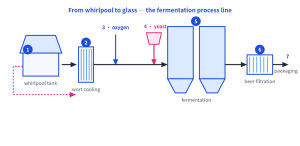
What are the three stages of fermentation?
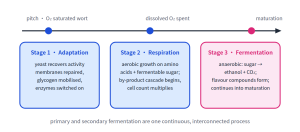
The whole fermentation divides roughly into three phases — and because the process runs continuously, primary and secondary fermentation should be read as one interconnected sequence:
- Yeast adaptation. Pitched yeast first recovers its physiological activity in oxygen-rich wort — repairing membranes, mobilising glycogen reserves, building enzymes.
- Aerobic respiration. Using wort amino acids as the main nitrogen source and fermentable sugars as the carbon source, yeast respires, harvests energy, and multiplies — producing a cascade of metabolic by-products along the way.
- Anaerobic fermentation. Once oxygen is spent, yeast switches to alcoholic fermentation: sugar becomes ethanol and CO₂, and the flavour chemistry of your beer begins in earnest.
Keep one nuance in mind: some by-products are re-partially degraded by the yeast later in the cycle — these formation-and-breakdown dynamics are tied tightly to yeast metabolism, and they deserve your attention.
Where does yeast get its energy — two paths, two very different pay-offs?
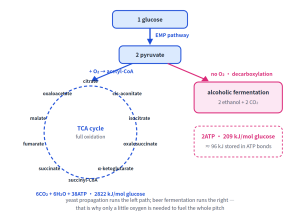
Yeast can obtain energy in two ways, and the fork in the road is oxygen:
Path 1 · The EMP–TCA cycle (aerobic respiration)
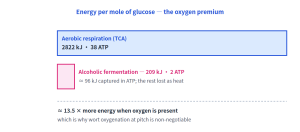
With oxygen present, yeast runs the EMP pathway to pyruvate, feeds it into the TCA cycle, and completely oxidises sugar to water and CO₂, releasing energy. Burning 1 mole of glucose yields 2822 kJ of heat, most of which is transferred to ATP — that stored energy becomes the yeast’s growth engine:
C₆H₁₂O₆ + 6O₂ + 38ADP + 38Pi → 6CO₂ + 6H₂O + 38ATP + heat (aerobic)
Path 2 · EMP → pyruvate → alcoholic fermentation (anaerobic)
Without oxygen, yeast still runs EMP to pyruvate — then decarboxylates and reduces it to ethanol and CO₂. Fermentation is a biological oxidation of sugar, but a stingier one: each mole of glucose releases about 209 kJ, of which only about 96 kJ is transferred into the high-energy bonds of ATP; the rest is lost as heat.
C₆H₁₂O₆ + 2ADP + 2H₃PO₄ → 2CH₃CH₂OH + 2CO₂ + 2ATP + 113 kJ (anaerobic)
During the yeast propagation phase the first situation dominates; during beer fermentation proper, the second. Clearly, the energy from aerobic metabolism far exceeds that from anaerobic metabolism — which is why only a small share of glucose need be oxidised aerobically to fully cover yeast growth and maintenance.
What exactly happens across the 12 steps from glucose to ethanol?
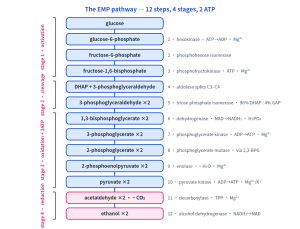
The alcoholic fermentation of glucose runs through 12 reactions in 4 stages. Once you see the map, the enzymes, cofactors and energy pay-offs all fall into place.
Stage 1 · Phosphorylation — glucose becomes a hexose diphosphate (steps 1–3)
Glucose is first activated by two phosphorylations to form reactive fructose-1,6-bisphosphate, priming it for splitting into two three-carbon pieces:
- (1) Phosphorylation of glucose → glucose-6-phosphate. Hexokinase, powered by ATP (phosphate group + energy), needs Mg²⁺ activation:glucose + ATP —hexokinase, Mg²⁺→ glucose-6-phosphate + ADP
- (2) Isomerisation → fructose-6-phosphate. Phosphohexose isomerase shifts the carbonyl position:
- (3) Second phosphorylation → fructose-1,6-bisphosphate. Phosphofructokinase, again ATP + Mg²⁺, makes the molecule reactive:fructose-6-phosphate + ATP —phosphofructokinase, Mg²⁺→ F-1,6-BP + ADP
Stage 2 · Cleavage — one hexose phosphate becomes two triose phosphates (steps 4–5)
- (4) Aldolase splits F-1,6-BP between carbons 3 and 4 into phosphodihydroxyacetone (DHAP) and 3-phosphoglyceraldehyde (GAP).
- (5) Triose interconversion. The two trioses are isomers; triose phosphate isomerase interconverts them. At equilibrium DHAP holds 96% and GAP only 4% — yet the reaction keeps drifting toward GAP precisely because it is continuously consumed in the next step, so fermentation never stalls.
Stage 3 · Oxidation — 3-phosphoglyceraldehyde becomes pyruvate (steps 6–10)
- (6) Dehydrogenation + phosphorylation → 1,3-bisphosphoglycerate. Phosphoglyceraldehyde dehydrogenase, NAD → NADH₂ and H₃PO₄: the energy released concentrates in an acid-anhydride bond — a high-energy phosphate bond. This is where the cell earns energy.
- (7) Substrate-level phosphorylation → 3-phosphoglycerate. Phosphoglycerate kinase hands the high-energy phosphate to ADP, storing it as ATP (Mg²⁺): 1,3-BPG + ADP → 3-PG + ATP.
- (8) Phosphate shift → 2-phosphoglycerate. A mutase moves the phosphate; a 2,3-BPG intermediate shuttles it.
- (9) Enolisation → 2-phosphoenolpyruvate (PEP). Enolase removes one water (Mg²⁺); internal energy redistribution concentrates onto the phosphate bond, creating another high-energy bond.
- (10) Pyruvate formation. Pyruvate kinase (Mg²⁺ or K⁺, irreversible) transfers PEP’s high-energy phosphate to ADP — another ATP. The unstable enol pyruvate then tautomerises spontaneously to pyruvate.
C₆H₁₂O₆ + 2NAD + 2H₃PO₄ + 2ADP → 2CH₃COCOOH + 2NADH₂ + 2ATP (EMP summary, steps 1–10)
Note the elegance: glucose reaches pyruvate by the same EMP route whether oxygen is present or not. Aerobic conditions then drive pyruvate on to full oxidation (water + CO₂); anaerobic conditions turn it toward ethanol and CO₂.
Stage 4 · Reduction — pyruvate becomes ethanol (steps 11–12)
- (11) Decarboxylation → acetaldehyde. Pyruvate decarboxylase (cofactor TPP — thiamine pyrophosphate — plus Mg²⁺, irreversible) strips CO₂:pyruvate —TPP, Mg²⁺→ acetaldehyde + CO₂
- (12) Reduction → ethanol. Alcohol dehydrogenase uses the NADH₂ generated in step 6 as reducing power — closing the redox loop:acetaldehyde + NADH₂ —ADH→ ethanol + NAD
Overall: C₆H₁₂O₆ + 2ADP + 2H₃PO₄ → 2CH₃CH₂OH + 2CO₂ + 2ATP + 113 kJ
Can one table summarise all twelve steps?
Table 1 — The 12 reactions of alcoholic fermentation at a glance
| # |
Substrate → product |
Enzyme |
Cofactors / notes |
| 1 |
glucose → glucose-6-phosphate |
hexokinase |
ATP → ADP · Mg²⁺ |
| 2 |
glucose-6-P → fructose-6-P |
phosphohexose isomerase |
— |
| 3 |
fructose-6-P → fructose-1,6-BP |
phosphofructokinase |
ATP → ADP · Mg²⁺ |
| 4 |
F-1,6-BP → DHAP + 3-PG-aldehyde |
aldolase |
splits between C3 and C4 |
| 5 |
DHAP ⇌ 3-PG-aldehyde |
triose phosphate isomerase |
equilibrium 96% : 4% |
| 6 |
3-PG-aldehyde → 1,3-BPG |
phosphoglyceraldehyde dehydrogenase |
NAD → NADH₂ · H₃PO₄ · energy captured |
| 7 |
1,3-BPG → 3-phosphoglycerate |
phosphoglycerate kinase |
ADP → ATP · Mg²⁺ · substrate-level phosphorylation |
| 8 |
3-PGA → 2-PGA |
phosphoglycerate mutase |
via 2,3-BPG intermediate |
| 9 |
2-PGA → 2-phosphoenolpyruvate |
enolase |
− H₂O · Mg²⁺ · creates high-energy bond |
| 10 |
PEP → pyruvate |
pyruvate kinase |
ADP → ATP · Mg²⁺/K⁺ · irreversible |
| 11 |
pyruvate → acetaldehyde + CO₂ |
pyruvate decarboxylase |
TPP cofactor · Mg²⁺ · irreversible |
| 12 |
acetaldehyde → ethanol |
alcohol dehydrogenase |
NADH₂ → NAD · redox loop closes |
Table 2 — Aerobic respiration vs alcoholic fermentation: the same sugar, two economies
| Aspect |
Aerobic respiration (EMP + TCA) |
Alcoholic fermentation (EMP only) |
| Oxygen required |
Yes — final electron acceptor |
No |
| End products |
6 CO₂ + 6 H₂O |
2 ethanol + 2 CO₂ |
| Energy per mol glucose |
2822 kJ |
209 kJ (≈ 96 kJ into ATP, rest lost as heat) |
| ATP yield |
38 ATP |
2 ATP |
| Role in the brewery |
Yeast propagation & growth — only a small sugar share needed |
Beer production — the main sugar share is fermented |
| Flavour significance |
Fuels biomass for clean fermentation |
Ethanol + CO₂, plus by-products: higher alcohols, esters, aldehydes, acids, ketones, sulfur compounds |
Why brewers care beyond ethanol: the EMP route is the foundation for many metabolic products, not just alcohol. Every ester, higher alcohol and acid that shapes your beer’s flavour traces back to these intermediates — which is why wort composition, oxygenation and yeast health all express themselves through this single pathway. It also remains one of the most studied reaction sequences in all of brewing chemistry.
Frequently asked questions about the beer fermentation mechanism
1. What is the difference between top-fermenting and bottom-fermenting yeast?
Top fermentation uses top-cropping yeast at higher fermentation temperatures (ales, wheat beer, Altbier, Kölsch); bottom fermentation uses bottom-cropping yeast at lower temperatures (lagers, Pilsner, export). The strains and temperatures give the two beer families distinctly different characters.
2. Why is dissolved oxygen at pitch so important?
Yeast is facultative. Oxygen enables aerobic respiration (2822 kJ / 38 ATP per mol glucose) — the energy yeast needs to multiply and build healthy cells. Only a small share of sugar needs to be oxidised aerobically to fuel the entire pitch, which is why wort oxygenation sets fermentation performance for the whole batch.
3. How much energy does fermentation actually give the yeast?
Only about 209 kJ per mole of glucose, of which roughly 96 kJ is stored in ATP bonds (2 ATP net); the rest is dissipated as heat. That is about 13.5 times less than aerobic respiration — efficient growth simply is not possible without oxygen.
4. If DHAP holds 96% of the triose equilibrium, why doesn’t fermentation slow down?
Because GAP — the 4% — is continuously consumed by step 6. Le Chatelier’s principle keeps pulling DHAP into GAP, so the pathway flows at full speed despite the unfavourable equilibrium.
5. Where do the 2 ATP actually come from?
From substrate-level phosphorylation: step 7 (1,3-BPG → 3-PG) and step 10 (PEP → pyruvate) each donate a high-energy phosphate to ADP. Since the split produces two three-carbon molecules, each step fires twice — 4 ATP gross, minus 2 invested in steps 1 and 3, leaves 2 ATP net.
6. What does NADH₂ do in fermentation?
It is the reducing power balance. NADH₂ generated in step 6 is spent reducing acetaldehyde to ethanol in step 12 — regenerating NAD so glycolysis can continue. Without that redox loop, fermentation would halt within seconds.
7. Why is pyruvate the crossroads of the whole process?
Glucose always reaches pyruvate via EMP, with or without oxygen. Aerobic conditions then send pyruvate to acetyl-CoA and the TCA cycle for complete oxidation; anaerobic conditions send it to decarboxylation and reduction, i.e. ethanol and CO₂. Same molecule, two destinies.
8. Does fermentation produce anything besides ethanol and CO₂?
Yes — higher alcohols, esters, aldehydes, acids, ketones and sulfur compounds. These fermentation by-products determine beer’s flavour, foam, colour and colloidal stability, and they are why the same pathway yields such different beers in different hands.
Ready to give your yeast the conditions the biochemistry demands?
ZR Brewing builds conical fermenters and complete fermentation systems engineered around the mechanism: precise oxygenation, temperature control for every stage, sanitary yeast-handling geometry and single-vessel flexibility. Fermentation you can reproduce, batch after batch.
Contact us at [email protected] or visit www.zrbrewing.com to spec your fermentation cellar.


 Publicado