Every minute your boil kettle runs, it releases boiling-hot secondary steam — called vapor — into the atmosphere. Did you know that converting just 1 kg of 100 °C water into 100 °C steam consumes roughly 2,260 kJ of heat energy? And that every cubic meter of vapor you vent not only wastes that energy, but also carries volatile aroma compounds that neighbors tend to complain about? The good news: breweries that recover this heat can cut boiling energy consumption by up to 64%. Here is how the three main energy-saving systems actually work — and which one fits your brewery.
Why does vapor from the boil kettle contain so much energy?
During a 90-minute boil, a typical brewhouse evaporates 8–12% of the wort volume. All of that evaporated water leaves the kettle as saturated vapor at roughly 100 °C, and each kilogram of it carries approximately 2,260 kJ of latent heat. If this vapor escapes directly through the stack, two things happen at once:
- Energy is lost. For a 50 hL batch with 10% evaporation, that is about 500 kg of vapor — over 1,100,000 kJ of recoverable heat per brew.
- Odor pollution is created. Vapor carries hops, malt and DMS-related aroma compounds into the neighborhood — a growing regulatory and public-relations problem for urban breweries.
So how can this heat be captured? Breweries rely on three proven approaches: the vapor condenser, vapor compression, and low-pressure boiling with thermal energy storage. Let’s walk through each one.
How does a vapor condenser turn waste steam into useful hot water?
The vapor condenser is the simplest and most widely used heat-recovery technology in the brewing industry. It requires modest investment, is easy to retrofit, and pays for itself quickly. The principle is straightforward: the condenser is installed at the vapor stack outlet of the boil kettle, where the rising vapor flows through a shell-and-tube heat exchanger and transfers its heat to water.
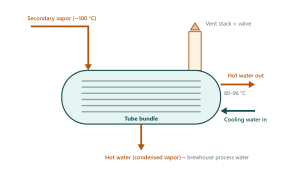
The numbers are impressive. For every 100 L of wort boiled, the condenser typically yields around 80 L of 80 °C hot water. The outlet temperature depends on the boiling method:
- Atmospheric boiling: outlet water temperatures up to 96 °C are achievable.
- Low-pressure boiling: because the vapor is hotter, water up to 102 °C can be produced.
And where does all this hot water go? Straight back into the brewing process. It can be used as mashing-in water or as sparging water in the lauter tun, which displaces large amounts of primary steam that would otherwise be needed to heat cold brewing liquor. Meanwhile, the vapor itself condenses into hot water — so nothing is wasted.
One-stage or two-stage condensation?
Depending on the intended use, vapor condensation can be designed as a one-stage or two-stage system. In two-stage condensation, the first stage heats water to a high temperature, while the second stage uses the remaining low-grade heat to warm cold water — extracting the maximum possible heat from the vapor. In theory this is the most efficient solution.
In practice, however, a brewery that brews several batches per day produces more hot water than the brewhouse can consume. Hot water is only “saved” energy if somebody actually uses it. That is why most breweries deliberately choose the simpler one-stage condenser — matching heat recovery to their real hot-water balance rather than chasing maximum theoretical efficiency.
Rule of thumb: a condenser is only as valuable as the hot-water demand behind it. Before investing, map your brewhouse’s daily hot-water consumption — mashing-in, sparging, CIP, cleaning — and size the condenser to match.
Vapor compression: can you boil wort with the steam you already have?
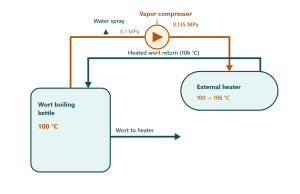
Condensing vapor into hot water recovers heat — but what if you could reuse the vapor as heating steam directly? That is exactly what a vapor compression system does. A compressor takes the kettle’s own vapor (at about 0.1 MPa) and compresses it to 0.135 MPa of superheated steam. This raises the steam temperature above 100 °C, allowing it to condense against boiling wort and give its latent heat back to the very same kettle — a beautifully closed loop.
Vapor compression with an external boiler (external wort boiling)
Most vapor compression installations use an external wort heater, because the heat-transfer surface must be very large to condense the compressed steam efficiently. The wort circulates rapidly between the kettle and the external heater, where the compressed vapor delivers its energy.
Vapor compression with an internal heater
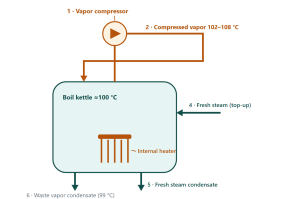
An internal-boiling kettle can also be fitted with a vapor compressor. In this arrangement, the compressed vapor (102–108 °C) is fed directly into the internal heater of the kettle, where it condenses and drives the wort fountain.
What are the real advantages — and the catches?
The benefits are compelling:
- Large savings in primary steam — the kettle largely heats itself with its own vapor.
- No surplus hot water to dispose of, unlike a condenser installation.
- No odor emissions and no environmental pollution from vented vapor.
- Easy retrofit — the compressor can be added to existing wort boiling equipment, which makes it attractive for breweries that do not want to switch to low-pressure boiling.
But be honest about the challenges too:
- The compressor consumes a significant amount of electricity — the economics depend heavily on your steam-to-power price ratio.
- No air may enter the compression system. Air is incondensable; even small leaks dramatically reduce the heat-transfer coefficient and system performance. The kettle must run at a slight vacuum of about 0.003 MPa below atmospheric, so equipment and seals face stricter requirements, along with extra maintenance and monitoring.
- Startup energy is needed. Because the system runs on low pressure, a jet pump using roughly 1 MPa of high-pressure primary steam is employed at start-up to draw vapor out of the boil kettle and get heating going.
Low-pressure boiling with thermal energy storage: the game-changer?
Here is a paradox every brewer knows: the brewhouse produces enormous quantities of low-grade hot water — far more than it needs — while simultaneously burning primary steam to produce the high-grade hot water that mashing and boiling actually demand. Low-grade heat cannot meet process temperature requirements, so it is discarded, and energy is wasted twice.
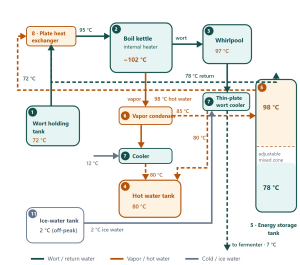
The low-pressure boiling system with energy storage solves this problem elegantly. Its heart is a tall, stratified energy storage tank — typically 10–20 m high — in which 98 °C high-grade water floats on top of 78 °C low-grade water, separated by an adjustable mixed zone. The height of this interface can be tuned to the brewery’s needs, because the tank structure allows it. Through this thermal battery, surplus heat can be stored for long periods and reused whenever required.
How does the energy flow through the system?
Follow the heat, step by step:
- Vapor condensation (charging the battery). Vapor from the boil kettle (2) enters the vapor condenser (6) and is cooled to 85 °C. This vapor heat warms the 78 °C water in the lower half of the energy storage tank (5) up to 98 °C, which then flows into the tank’s upper half.
- Cold-water preheating (harvesting the leftovers). The 85 °C water leaving the condenser is cooled further — to 30 °C — in the condensate cooler (7), and in doing so heats 12 °C cold water up to 80 °C for the hot water tank (4).
- Wort preheating (discharging the battery). Wort stored in the holding tank (1) at about 72 °C is heated in the plate heat exchanger (8) by 98 °C water from the storage tank’s upper half to 95 °C before entering the kettle — cutting the kettle’s own heating workload dramatically. The 98 °C water leaves the exchanger cooled to 78 °C and returns to the lower half of the tank.
- Wort cooling with ice water (the second recovery loop). Clear wort at 95 °C leaves the whirlpool (3) and enters a one-stage thin-plate cooler (7), where 2 °C ice water brings it to pitching temperature (about 7 °C). The ice water warms to 80 °C on the way and flows into the hot water tank (4). The 2 °C ice water itself is produced during off-peak, low-tariff hours and stored in a well-insulated ice-water tank — another quiet cost saver.
Why does tank height matter so much?
Stratification is physics doing free work: hot water is less dense and stays on top, cold water stays below, and the boundary between them — the mixed zone — is the system’s “state of charge”. The taller the tank, the more precisely the 98 °C/78 °C interface can be positioned to match the day’s production plan. That is why these storage tanks are built 10 to 20 m tall, and why the mixed-zone height is treated as an adjustable operating parameter rather than a fixed property.
How much energy does wort boiling actually consume?
In wort production, the boil kettle is the single largest steam consumer, so any energy-saving program starts there. Energy consumption is usually expressed in kW·h or kJ (1 kW·h = 3,600 kJ). If you compare fuels, their calorific values make the differences concrete:
Table 1. Calorific values of common industrial fuels
| Fuel |
Calorific value |
| Natural gas |
11.2 kW·h/m³ |
| Fuel oil |
10.14 kW·h/L |
| Heavy oil |
11.16 kW·h/kg |
| Coal |
8.95 kW·h/kg |
Now compare the boiling systems themselves. For a traditional boil at 100 °C over 90 minutes with 12% total evaporation, every 100 L of cast wort requires roughly 14 kW·h (50,400 kJ) of heat. Low-pressure boiling shortens the boil to 60–70 minutes and trims total evaporation from 12% (10–15%) down to 5–7%, cutting consumption to about 9 kW·h per 100 L. And a brewhouse equipped with an energy storage system reaches approximately 5 kW·h (18,000 kJ) per 100 L — a 64% saving against the traditional benchmark:
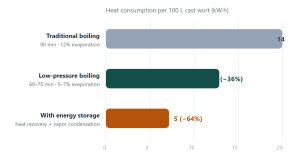
The energy-storage route deserves a closer look. In this configuration, the 78 °C water from the lower half of the storage tank is heated to 96 °C by kettle vapor in the condenser, then parked in the upper half of the tank. The vapor’s heat is thus stored as high-grade hot water and used as the mashing-in water for the next batch — which slashes the brewhouse’s hot-water demand at the source. Measured against conventional boiling without recovery (at 5% evaporation), the energy-storage system saves about 9 kW·h per hectoliter of cast wort, leaving a net heat consumption of only about 5 kW·h per 100 L. That is the difference between an energy bill you tolerate and one you have optimized.
Which energy-saving system fits your brewery best?
Each of the three technologies answers a different question — so the right choice depends on your priorities, your existing equipment, and your utility prices:
Table 2. Comparison of wort boiling energy-saving systems
| Sistema |
Investment & complexity |
Main benefit |
Watch out for |
Best suited for |
| Vapor condenser |
Low investment, simple technology |
~80 L of 80–96 °C hot water per 100 L wort boiled; fast payback |
Hot water surplus if brewhouse demand is small |
Most breweries; the default first step |
| Vapor compression |
Medium–high; compressor + tight air-sealing, extra maintenance |
Reuses vapor as heating steam directly; no surplus hot water; no odor emissions |
Electricity consumption; strict vacuum (0.003 MPa) and sealing; jet-pump startup steam |
Breweries retrofitting existing kettles that don’t want low-pressure boiling |
| Low-pressure boiling + energy storage |
Highest; tall stratified tank (10–20 m) plus condenser and exchangers |
Up to 9 kW·h saved per hL; heat stored for reuse anytime; shorter boil (60–70 min) |
Space for the tall tank; more sophisticated controls |
New brewhouses and multi-brew days with large hot-water swings |
A practical energy audit checklist for your brewhouse
- Measure before you buy. Log kettle steam consumption per batch for at least two weeks — you cannot optimize what you have not measured.
- Map your hot-water balance. List mashing-in, sparging, CIP and cleaning demand per day, and compare it with what a condenser would produce.
- Check your evaporation rate. If you boil at 12% evaporation out of habit, low-pressure boiling at 5–7% may deliver savings before any hardware is installed.
- Hunt air leaks. For vapor compression, even minor air ingress destroys performance — inspect seals, gaskets and valve stems.
- Exploit off-peak tariffs. Ice-water generation and hot-water storage can be scheduled into cheap hours, compounding the thermal savings with price arbitrage.
Frequently asked questions about wort boiling energy savings
How much hot water does a vapor condenser really produce?
As a rule of thumb, every 100 L of wort boiled yields about 80 L of 80 °C hot water. With atmospheric boiling the outlet can reach 96 °C, and with low-pressure boiling up to 102 °C — hot enough for mashing-in and sparging without further heating.
Why do most breweries choose one-stage condensation over the more efficient two-stage design?
Because multi-brew days generate more hot water than the brewhouse can use. Two-stage extraction maximizes heat recovery, but unrecovered hot water is wasted value. One-stage systems match production reality and cost less — so they dominate in practice.
Can a vapor compressor be retrofitted to an existing boil kettle?
Yes. Vapor compression systems can be installed on existing wort boiling equipment, which is precisely why they appeal to breweries that don’t want to switch to low-pressure boiling. The main requirements are a large heat-transfer surface (usually an external heater) and an absolutely airtight vapor circuit.
Why must no air enter a vapor compression system?
Air is incondensable. It accumulates on the condensing surface and acts as an insulation layer, sharply reducing heat transfer and system performance. That is why the kettle operates at a slight vacuum (~0.003 MPa) and why sealing quality is a top maintenance priority.
How tall is a stratified energy storage tank, and why?
Typically 10–20 m. Height creates stable thermal stratification: 98 °C water floats above 78 °C water with a thin, adjustable mixed zone. The interface height acts as the “state of charge” and can be tuned to the brewery’s production schedule.
What is the single biggest energy consumer in wort production?
The boil kettle. Traditional 90-minute boiling with 12% evaporation needs about 14 kW·h per 100 L of cast wort — which is exactly why every serious energy-saving program starts with the boiling system.
Conclusion: stop venting profit into the sky
Every kilogram of vapor carries about 2,260 kJ of heat, and a traditional boil releases hundreds of kilograms of it per batch. Whether you start with a simple vapor condenser, retrofit a vapor compressor, or design a low-pressure boiling system with thermal energy storage from day one, the physics is on your side: the same heat that boils your wort can mash your next batch, sparge your lauter tun, and warm your brewing liquor — almost for free. Cut boiling energy by up to 64%, shrink your carbon footprint, silence the odor complaints, and let thermal stratification work the night shift at off-peak tariffs. In modern brewing, the question is no longer whether to recover boiling heat — but how quickly you can start.


 Publicado