Cloudy beer, unwanted sediment, and inconsistent clarity can create problems just before packaging. Choosing the wrong filter may also cause product loss, slow filling, and unnecessary operating costs. A properly selected plate and frame filter for beer helps breweries improve final clarification while keeping filtration practical and manageable.
A plate and frame beer filter is a filtration system that uses replaceable filter sheets between stainless steel plates to remove residual yeast, fine particles, and haze-forming material. It is commonly used for final beer polishing before keg filling. The correct filter size and sheet grade depend on beer style, incoming turbidity, required flow rate, and packaging conditions.
1. What Is a Plate and Frame Filter for Beer?
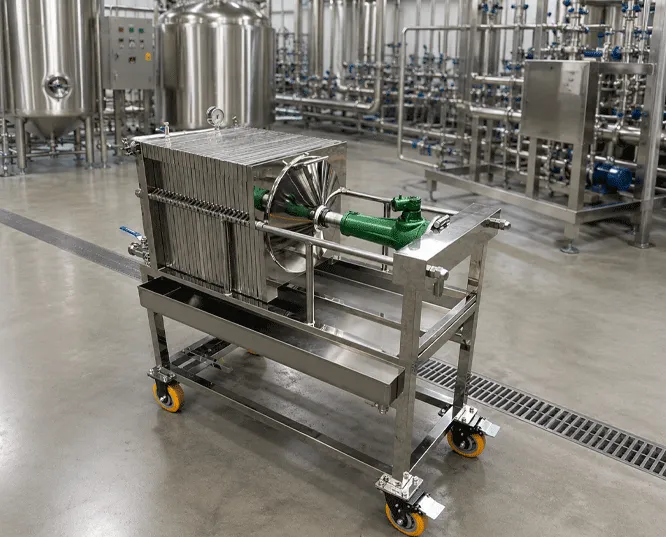
A plate and frame filter, also called a square panel filter, beer sheet filter, or filter press for beer, is a liquid filtration system designed to separate suspended particles from beer.
It uses a series of plates and frames that hold replaceable filter sheets. Beer passes through the filtration media, while suitable particles and haze-forming material are retained.
The result is a clearer product that can move to the next stage of production.
This equipment is commonly used in craft breweries, microbreweries, and commercial beer production facilities that need additional clarification before packaging.
Where Does It Fit in the Brewing Process?
A typical filtered beer production line may follow this sequence:
Brewhouse → Fermentation Tank → Conditioning Tank → Primary Filtration → Plate and Frame Filter → Bright Beer Tank or Keg Filling
The exact arrangement depends on the brewery’s process design.
Some breweries use sheet filtration after diatomaceous earth filtration. Others use it as their main clarification step when the incoming beer is already relatively clear.
At ZR Brew, our Square Panel Filter for Beer Polishing is positioned primarily as a final clarification solution for beer before keg filling.
Its mobile design allows operators to place the filter near the packaging area without requiring a permanently fixed installation.
2. How Does a Plate and Frame Beer Filter Work?
The operating principle is straightforward.
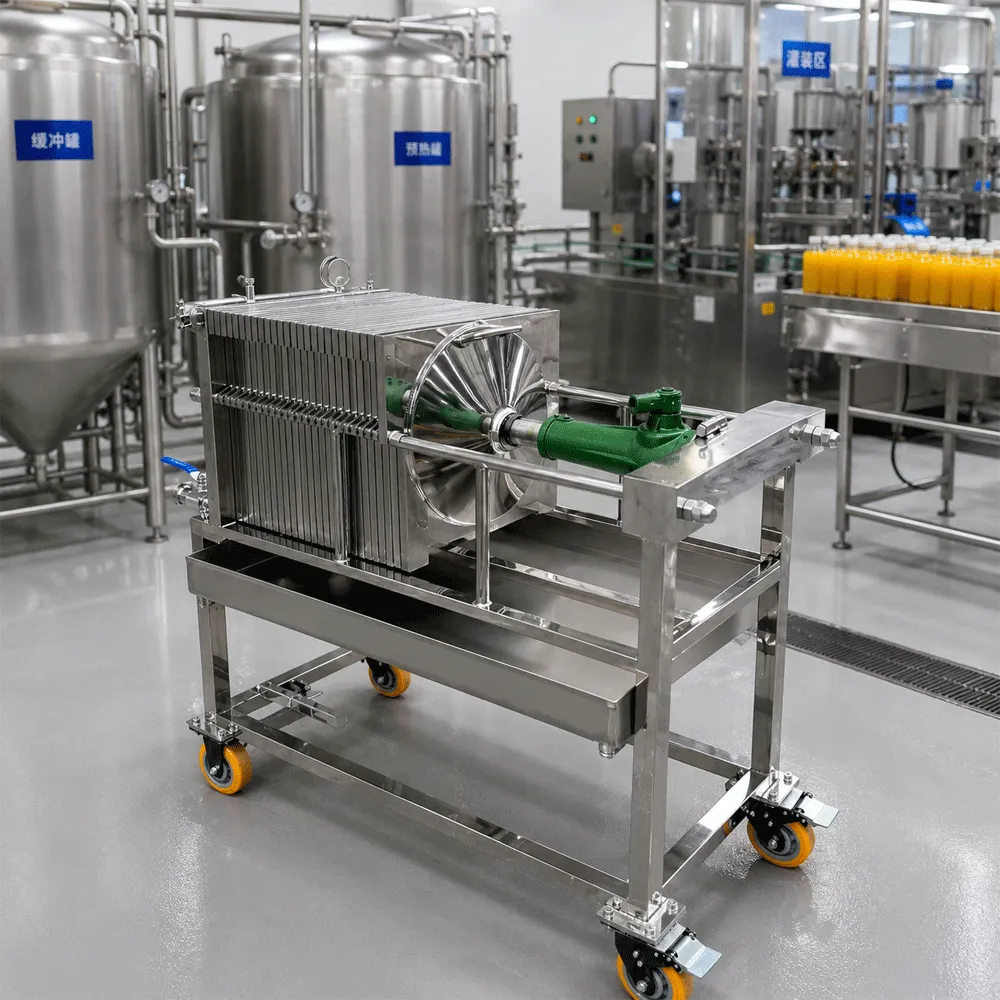
A pump moves beer into the filter assembly. The liquid passes through filter sheets held between the plates. The filtration media retains particles according to its structure and selected retention grade.
Clarified beer exits through the outlet and moves to the next process stage.
Basic Filtration Steps
- Prepare the filter: Inspect the plates, seals, and selected filter sheets.
- Install the sheets: Position the correct filtration media according to the manufacturer’s instructions.
- Close the assembly: Secure the plates and frames to create the required seals.
- Prepare the flow path: Follow the approved flushing and sanitation procedure.
- Start filtration: Introduce beer at a controlled flow rate and pressure.
- Monitor operation: Check pressure differential, flow, leaks, and product condition.
- Complete the run: Recover product where appropriate and follow the shutdown procedure.
- Clean the system: Remove used sheets and clean the reusable components.
The key is to maintain suitable operating conditions throughout the run.
Excessive pressure, incorrect sheet installation, or unsuitable filtration media can reduce performance and increase product loss.
What Happens Inside the Filter?
Beer filtration can involve several particle-retention mechanisms, depending on the filter sheet construction.
Larger particles may be retained near the surface, while smaller particles can be captured within the depth of the filtration media.
As retained solids accumulate, resistance to liquid flow increases.
This is why the pressure difference across the filter is an important operating measurement.
A rising differential pressure may indicate that the sheets are becoming loaded and approaching the end of their useful filtration cycle.
3. Why Do Breweries Need Beer Clarification and Polishing?
Not every beer needs to be visually clear.Some beer styles are intentionally hazy. Others are expected to have a bright, transparent appearance.
For breweries producing filtered lager, pilsner, or other bright beer styles, final clarification can be an important part of product preparation.
Removing Residual Yeast and Fine Particles
After fermentation and conditioning, beer may still contain:
- Suspended yeast cells
- Fine grain-derived particles
- Protein aggregates
- Hop-derived particles
- Other haze-forming material
A suitable beer clarification filter can reduce these particles and improve visual clarity.
However, filtration performance depends on the incoming beer condition, filter media, and operating parameters.
Supporting Consistent Product Appearance
Consumers often expect the same beer to look similar from one package to another.
If one keg contains visible sediment while another appears clear, the difference may create quality concerns.
A properly controlled polishing step can help reduce unwanted variation in beer appearance.
Filtration is only one part of this process. Upstream conditioning, storage temperature, ingredient selection, and packaging practices also influence finished product quality.
Does Filtration Improve Beer Shelf Life?
Filtration can remove some suspended material that may contribute to haze or sediment.
However, it does not automatically guarantee longer shelf life or microbiological stability.
Shelf life also depends on microbial control, dissolved oxygen, packaging hygiene, storage temperature, and the characteristics of the beer itself.
For this reason, buyers should distinguish between visual clarification, fine filtration, and validated microbial reduction.
These are different technical objectives.

4. What Are the Main Components of a Beer Filtration System?
A plate and frame beer filtration machine consists of several connected components.
Understanding these parts helps buyers compare equipment specifications and maintenance requirements.
| Componente |
Función Principal |
Purchasing Consideration |
| Filter Plates |
Support the filtration media and direct liquid flow |
Material, design, cleaning access |
| Filter Frames |
Hold the filter sheets in position |
Frame quantity and filtration area |
| Filter Sheets |
Capture particles and haze |
Retention grade and beverage compatibility |
| Pump |
Moves beer through the system |
Flow range, pressure, sanitary design |
| Inlet and Outlet |
Connect the filter to process piping |
Diameter and connection standard |
| Seals and Gaskets |
Help prevent leakage and bypass |
Material compatibility |
| Pressure Instruments |
Help monitor operating conditions |
Pressure range and placement |
| Mobile Frame |
Supports and positions the equipment |
Stability, casters, floor space |
Stainless Steel Construction
ZR Brew offers SUS304 and SUS316 material options for its square panel filter.
Both materials are commonly used in beverage processing equipment, although the appropriate grade depends on cleaning chemicals, product conditions, and operating environment.
Sanitary equipment design also involves weld quality, surface finish, connection details, and accessibility for inspection.
Replaceable Filter Sheets
The filter sheet is the main consumable component.
Different grades are designed for different clarification objectives.
Selecting the correct sheet is essential because the finest available grade is not always the most practical choice.
A very fine sheet can load rapidly when processing beer with high suspended solids.
This may increase pressure differential, reduce throughput, and raise consumable costs.
Mobile Filtration Design
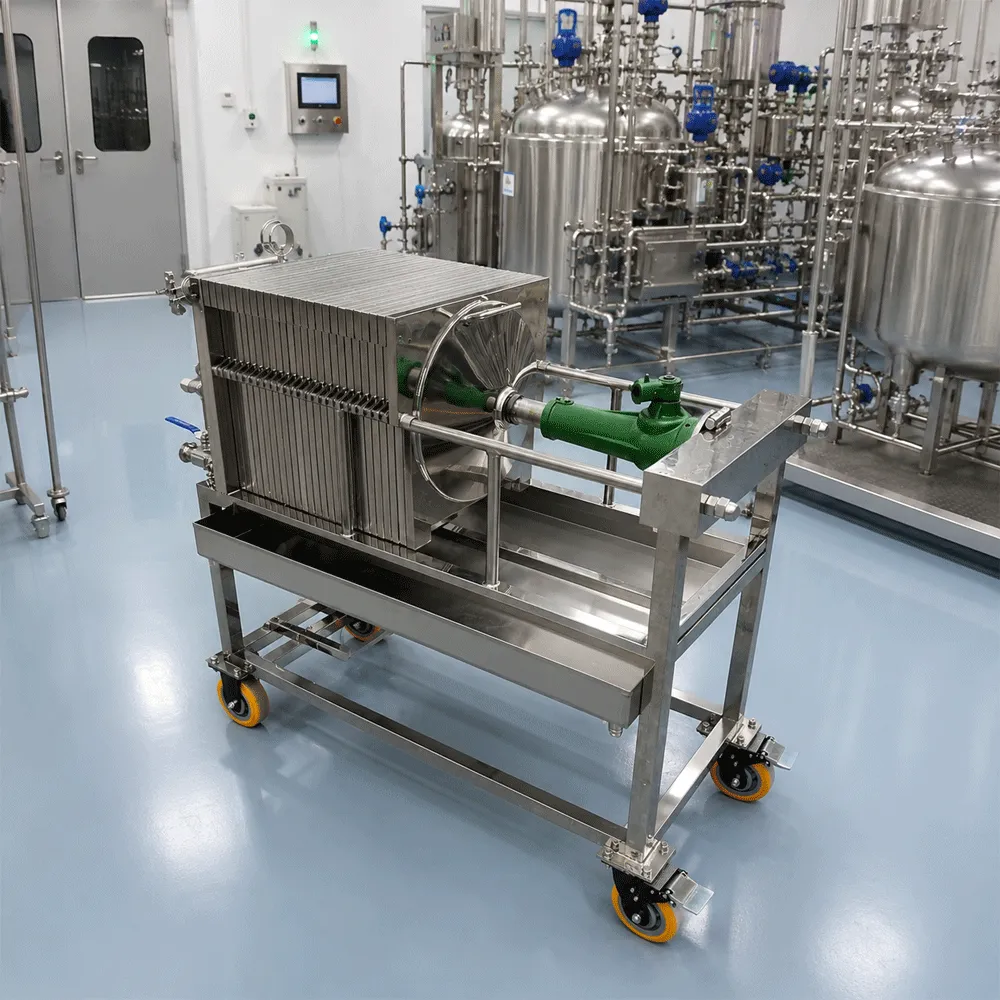
De ZR Brew’s square panel filter uses a mobile base with casters.
This is useful for breweries with limited floor space or changing production arrangements.
A mobile unit may be positioned near a keg filling station and moved when the equipment is not required.
Before ordering, buyers should confirm the equipment dimensions, safe movement conditions, and connection requirements.
5.How Does Beer Filtration Connect with Keg Filling?
For many cervecerías comerciales, filtration is part of the packaging workflow.
The goal is to move beer from the conditioning stage to the filling equipment while maintaining the required product characteristics.
ZR Brew’s square panel filter is designed for integration into a beer polishing and keg filling arrangement.
Its product page identifies compatibility with a single-head keg filling machine rated at 20–50 kegs per hour, depending on beer pressure and keg size.
This figure refers to the associated filling machine, not a guaranteed filtration capacity for the square panel filter.
Example of a Filtration-to-Filling Workflow
A practical arrangement may include:
- Conditioning or bright beer tank
- Sanitary product transfer connection
- Plate and frame polishing filter
- Appropriate downstream buffer or pressure-control arrangement
- Single-head keg filling machine
- Finished keg handling
The exact layout must account for the filter’s pressure limits and the filler manufacturer’s operating requirements.
Why Oxygen Control Matters
Oxygen exposure during beer transfer can contribute to unwanted flavor changes and reduced product stability.
Breweries should therefore consider oxygen pickup throughout the entire filtration and packaging process.
Relevant measures may include suitable line preparation, leak prevention, compatible sealed connections, and validated transfer procedures.
A plate and frame filter does not automatically prevent oxygen pickup. Its installation and operating procedure must be designed to manage this risk.
6. How Do You Clean and Maintain a Plate and Frame Filter?
Proper maintenance helps preserve filtration performance and reduce hygiene risks.
Because a sheet filter uses replaceable media, operators need a routine for inspecting the plates, replacing sheets, cleaning reusable components, and checking the sealing surfaces.
Routine Maintenance Checklist
| Maintenance Task |
Purpose |
| Inspect Filter Plates |
Check for damage and residue |
| Replace Used Sheets |
Restore the required filtration media |
| Inspect Gaskets |
Reduce leakage and bypass risks |
| Check Pump Operation |
Maintain suitable flow conditions |
| Inspect Connections |
Identify loose or damaged fittings |
| Monitor Pressure |
Detect increasing filtration resistance |
| Clean Product-Contact Surfaces |
Reduce contamination risks |
| Record Filtration Runs |
Track media use and operating conditions |
Can a Plate and Frame Filter Use CIP?
Some reusable components and compatible flow paths may be cleaned using an appropriate clean-in-place procedure.
However, not all disposable filter sheets tolerate cleaning chemicals, elevated temperatures, or repeated use.
The actual cleaning method must follow the equipment and filter media manufacturers’ instructions.
Operators may need to remove and discard the used sheets before cleaning the reusable assembly.
A brewery CIP system can support cleaning of compatible tanks, pipes, and equipment, but the cleaning procedure should be confirmed for each component.
Reducing Filter Sheet Consumption
Filter media consumption depends heavily on incoming beer quality.
Allowing yeast and suspended particles to settle during conditioning may reduce the load on the polishing filter.
Where appropriate, upstream clarification can also help extend the useful operating period of the final filter sheets.
Operators should monitor filtration results rather than replacing sheets according to an arbitrary fixed time interval.
7.Why Work with a Complete Brewery Equipment Supplier?
A filter must fit the rest of the production system.
ZR Brew also provides stainless steel brewing systems, fermentation tanks, bright beer tanks, brewery support equipment, and turnkey brewery solutions.
This broader equipment scope allows buyers to discuss filtration alongside tank connections, transfer requirements, packaging arrangements, and available production space.
For new facilities and equipment upgrades, integrated planning can help reduce compatibility problems and unnecessary modifications.
Frequently Asked Questions About Plate and Frame Beer Filters
What is the difference between a plate and frame filter and a beer filter press?
The terms are sometimes used interchangeably. In brewery applications, a plate and frame filter typically refers to a sheet filtration unit that holds filter pads between plates and frames. Industrial filter presses may use different designs and are often intended for separating larger quantities of solids from liquids.
Can a plate and frame filter remove yeast from beer?
Yes, suitable filter sheets can reduce residual yeast and other suspended particles. The degree of removal depends on the selected media, beer condition, and operating parameters. Complete yeast removal should not be assumed without validated performance data.
What micron rating should I choose for beer polishing?
There is no universal micron rating for every beer. The appropriate grade depends on incoming turbidity, beer style, desired clarity, and whether microbial reduction is required. Buyers should consult the filter sheet’s technical specifications and confirm the retention performance needed for their process.
Is a plate and frame filter suitable for craft breweries?
Yes. Compact plate and frame filters can suit craft breweries and microbreweries that need fine clarification before packaging. The equipment must be sized according to production volume, available filtration time, and beer characteristics.
Can this beer filter connect directly to a keg filling machine?
ZR Brew’s square panel filter is intended for integration with suitable keg filling lines, including single-head filling arrangements. However, pressure compatibility, flow rate, connection size, and oxygen-control requirements must be confirmed before installation.
How often should filter sheets be replaced?
Replacement frequency depends on the solids load, filter media, filtration volume, and pressure differential. Used disposable sheets should be replaced according to the media manufacturer’s instructions and the brewery’s validated operating procedure.


 Publicado