A practical guide to mashing temperature, pH, extract yield, and wort composition for craft and industrial breweries.
Mashing is the bridge between malt milling and wort boiling. It is where enzymes convert starch into fermentable sugars, proteins into soluble nitrogen, and insoluble grain particles into the extract that becomes beer. Understanding the mashing process in brewing—and how temperature, pH, time, and equipment interact—is essential for any brewer who wants consistent wort quality, high extract yield, and stable beer flavor.
What Is Mashing?
Mashing is the enzymatic conversion of insoluble high-molecular-weight substances in malt and adjuncts into soluble low-molecular-weight compounds. It happens when crushed malt is mixed with water and held at controlled temperatures and pH levels. The resulting liquid—the wort—contains the sugars, amino acids, minerals, and flavor compounds that yeast will later ferment into beer.
The soluble material recovered from malt and adjuncts is called extract. Extract consists mainly of fermentable sugars (maltose, maltotriose, glucose, sucrose, fructose), non-fermentable dextrins, proteins, gums, pentosans, minerals, and other substances. In a typical 11–12 °P wort, fermentable sugars account for roughly 61–65% of total extract, a ratio that largely determines the beer’s final attenuation.
Key performance metric: Extract yield. During a well-run mash, about 75–80% of the grain’s dry substance is dissolved. The remainder leaves the brewhouse with the spent grains.
Figure 1: The Mashing Process Flow
Figure 1 shows the main production steps of a modern mashing process. The flow moves from raw-material conditioning through mashing-in, rest periods, boiling, recombination, and finally transfer to the lauter tun or mash filter.
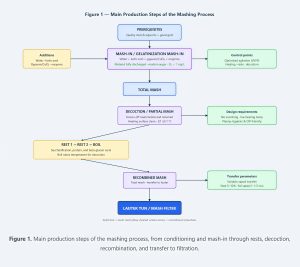
Figure 2: Wort Extract Composition
Figure 2 illustrates how the dry matter in malt is split between dissolved extract and spent-grain residue, and what the extract itself contains. About 75–80% of the grain becomes extract; the rest is insoluble husk and cell-wall material that remains in the spent grains.
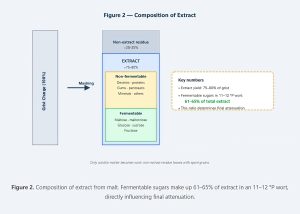
The balance between fermentable sugars and non-fermentable dextrins determines beer body, sweetness, and alcohol content. High mashing temperatures (around 70–72 °C / 158–162 °F) favor alpha-amylase and produce more dextrins, giving the beer a fuller mouthfeel. Lower temperatures (around 62–65 °C / 144–149 °F) favor beta-amylase and produce more maltose, yielding a drier, more fermentable wort.
Table 1: Overall Goals and Requirements of Mashing
Table 1 summarizes what a mashing process must achieve. The targets are grouped into overall objectives, process objectives, numerical targets, and the main factors that influence them.
| Overall Goals |
Process Objectives |
Numerical Targets |
Main Influencing Factors |
| Optimal wort composition |
Good filterability |
Difference between real and apparent attenuation < 2% |
Malt quality |
| High extract yield |
Rapid primary and secondary fermentation |
Light wort color |
Good grist quality |
| High raw-material utilization |
Good yeast sedimentation |
Strong reducing power in beer |
Optimized enzyme conditions via temperature, time, pH, and concentration |
| Good yeast flocculation |
Good beer stability |
Good flavor stability |
(Text partially obscured in source) |
| Good beer stability |
|
Reduced DMS, fatty acids, and carbonyl compounds |
(Text partially obscured in source) |
| Reduced energy consumption |
|
|
(Text partially obscured in source) |
Source: Table 1 from the mashing chapter. Some items in the “Main Influencing Factors” column were not fully legible in the provided image.
Key Mashing Parameters Every Brewer Controls
Mashing Temperature
Mashing temperature is the most powerful lever for controlling wort fermentability. A single-temperature infusion mash around 65–67 °C (149–153 °F) balances alpha- and beta-amylase activity. Step mashes use lower rests for protein and beta-glucan degradation and higher rests for gelatinization and dextrinization. Decoction mashes, shown in Figure 1, boil a portion of the thick mash to increase color and flavor development.
Mash pH
The optimal mash pH for enzyme activity is 5.2–5.6 at room temperature, which corresponds to approximately 5.4–5.8 in the hot mash. Brewers adjust pH with lactic acid, calcium sulfate (gypsum), or calcium chloride. Proper pH improves enzyme efficiency, reduces polyphenol extraction, and produces a brighter, more stable wort.
Mash Thickness and Water Chemistry
A thinner mash (more water per kilogram of grist) improves enzyme mobility and extract yield but requires larger vessels and more energy. A thicker mash protects enzymes from thermal denaturation and can improve body. Water mineral content affects pH and beer flavor: calcium supports enzyme activity and yeast health, while chloride and sulfate influence malt sweetness versus hop bitterness.
Time and Agitation
Most modern mashes complete conversion in 30–60 minutes. Over-mashing can extract unwanted tannins and oxidize wort. Controlled agitation prevents dough balls, evens temperature, and improves heat transfer, but excessive shear can damage husk structure and release astringent compounds. Variable-frequency drives (VVVF) let brewers match agitation speed to each phase of the mash.
Equipment Considerations for Mashing
Brewery mash tuns and lauter tuns differ from cereal cookers and decoction kettles. The mashing vessel must provide:
- Uniform heating without scorching the grain bed
- Temperature stability within ±0.1 °C where required
- Hygienic, CIP-compatible piping and pumps
- Oxygen exclusion during mash-in and transfer
- Variable-speed transfer pumps for gentle movement of the mash
Steam-jacketed or direct-fire vessels require careful design to prevent caramelization on hot surfaces. Sloped bottoms, tangential inlets, and low-shear pumps all help preserve wort quality.
Mashing FAQ
What is the ideal mashing temperature?
Most infusion mashes run at 65–67 °C (149–153 °F). Lower temperatures favor fermentable sugars; higher temperatures favor body and residual sweetness. The exact target depends on beer style and yeast strain.
How does mash pH affect the final beer?
Correct mash pH (5.2–5.6) optimizes enzyme activity, improves protein and polyphenol precipitation, and produces brighter wort with better flavor stability. High pH can extract tannins and darken wort.
Why is oxygen control important during mash-in?
Oxygen exposure during mashing promotes lipid oxidation and stale flavors. Keeping dissolved oxygen below 1 mg/L—using modern augers, inert-gas blanketing, and bottom filling—protects beer freshness.
What is the difference between infusion and decoction mashing?
Infusion mashing holds the entire mash at one or more temperatures. Decoction mashing removes part of the thick mash, boils it, and returns it to raise the main mash temperature. Decoction improves melanoidin development and is common in traditional lager styles.
Use a well-modified malt, optimize mill gap for intact husks and fine endosperm, control mash pH and temperature, extend conversion time if needed, and verify complete conversion with an iodine test. Good lautering technique also recovers more wort.
Fazit
Mashing is where brewing science and brewing art meet. By controlling mashing temperature, mash pH, time, thickness, and agitation, brewers shape the fermentability, body, color, and flavor stability of the final beer. The process flow in Figure 1, the extract composition in Figure 2, and the quality targets in Table 1 give a clear framework for designing or troubleshooting any mashing system.
Whether you are commissioning a new brewhouse or refining an existing recipe, treat mashing as a process that deserves the same attention as fermentation. Small improvements in mash control often produce outsized gains in yield, consistency, and beer quality.


 Veröffentlicht