A still that is too small can limit production, while an oversized system may leave expensive equipment underused. For craft distilleries, choosing between 100L, 300L, and 500L equipment is more than a capacity decision. The right size must fit your production schedule, available space, and business growth plans.
A 100L commercial still is a practical starting point for pilot batches and small craft operations. A 300L still suits producers seeking larger batches and multifunctional equipment, while a 500L still supports higher-volume production. The best choice depends on usable batch volume, fermentation capacity, cycle time, product range, and available utilities.
1. What Is the Difference Between 100L, 300L and 500L Commercial Stills?
The most obvious difference is vessel capacity. However, capacity alone does not tell you how a distillation system will perform in daily production.A 100L system may be useful for small batches, product trials, and limited commercial output. A 300L system offers more processing volume per batch, while a 500L system may reduce the number of batches needed to process a given quantity of fermented wash.The equipment configuration also matters. A traditional copper pot still and a multifunctional distiller may have different columns, accessories, and operating capabilities, even when their capacities are similar.
ZR Brew Commercial Still Comparison
| Specification |
100L Copper Pot Still |
300L Commercial Spirit Distiller |
500L Commercial Spirit Distiller |
| Model |
ZR-DT-100L |
ZR-DT-300L |
ZR-DT-500L |
| Published Capacity |
100L nominal model |
300L effective volume |
500L effective volume |
| Main Configuration |
Twin pot-still arrangement |
Multifunctional column system |
Multifunctional column system |
| Copper Components |
Copper vapor paths |
Copper pot and column |
Copper pot and column |
| Fractionating Column |
Not specified for this configuration |
Five-plate copper column |
Five-plate copper column |
| Gin Basket |
Not confirmed |
Included |
Included |
| Integrated Agitator |
Not confirmed |
Described |
Not confirmed |
The comparison reflects ZR Brew’s published configurations. Final equipment specifications should be confirmed against the quotation and approved drawings.
Why Capacity Is Only the Starting Point
A larger still processes more liquid per batch, but that does not guarantee proportionally higher daily production.Actual throughput depends on heating time, distillation time, cleaning, cooling, and the number of operating shifts.The right still is the one that matches your complete production workflow—not simply the largest vessel within your budget.
2. Is a 100L Still Enough for a Micro Distillery?
A 100L still can be a sensible option for a micro distillery, especially when production volumes are limited or recipes are still being developed.Smaller equipment allows producers to run more controlled batches without committing large amounts of raw material to every production cycle.It may also suit a brewery or winery exploring commercial spirits production as an additional business line.
Where a 100L Still Makes Sense
A 100L system may be appropriate for:
- Pilot batches and product development
- Boutique spirits production
- Limited-edition releases
- Small commercial operations
- Production trials before purchasing larger equipment
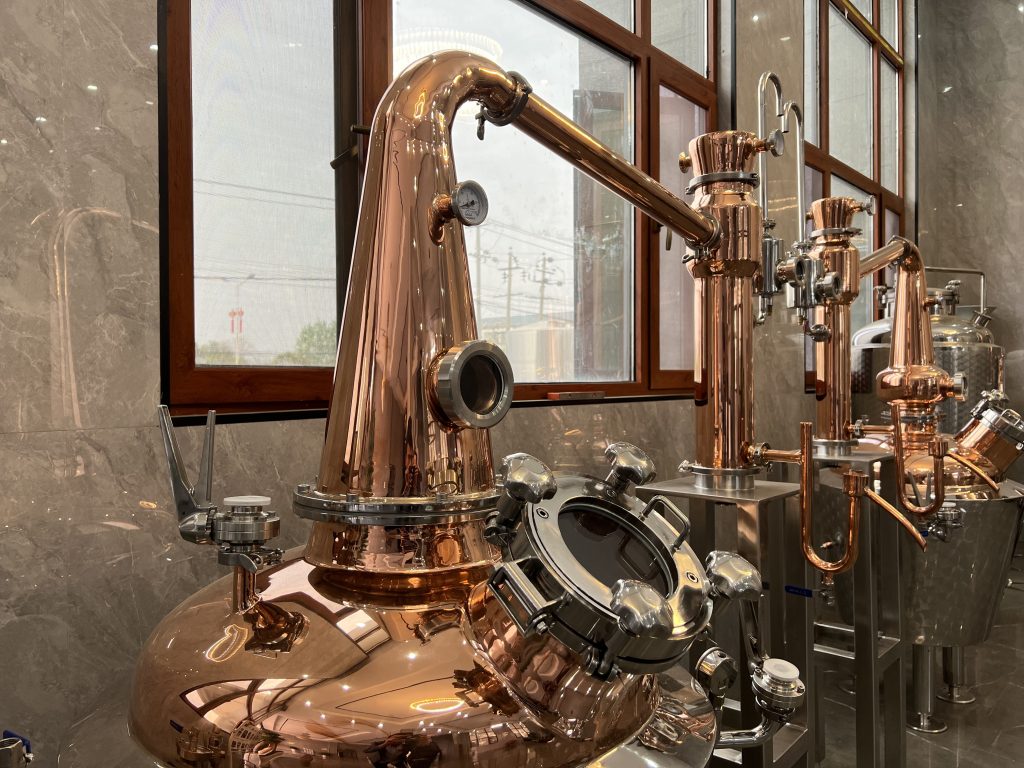
ZR Brew’s Alambique de cobre de 100 L para a destilação de uísque is presented with two independent distillation vessels, copper vapor paths, and dedicated condenser assemblies.
This arrangement differs from a multifunctional column distiller.Buyers should therefore compare the actual equipment configuration rather than assuming all 100L systems have the same capabilities.
What Are the Limitations?
A smaller still requires more batches to process the same volume of fermented wash.For example, processing 1,000L of liquid would require ten 100L batches at full nominal capacity, before accounting for permitted fill levels.If the business expects frequent production or rapid sales growth, those additional batches may create labor and scheduling pressure.
Best fit: Producers who value small-batch flexibility more than maximum daily throughput.
3. When Should You Upgrade to a 300L Commercial Spirit Distiller?
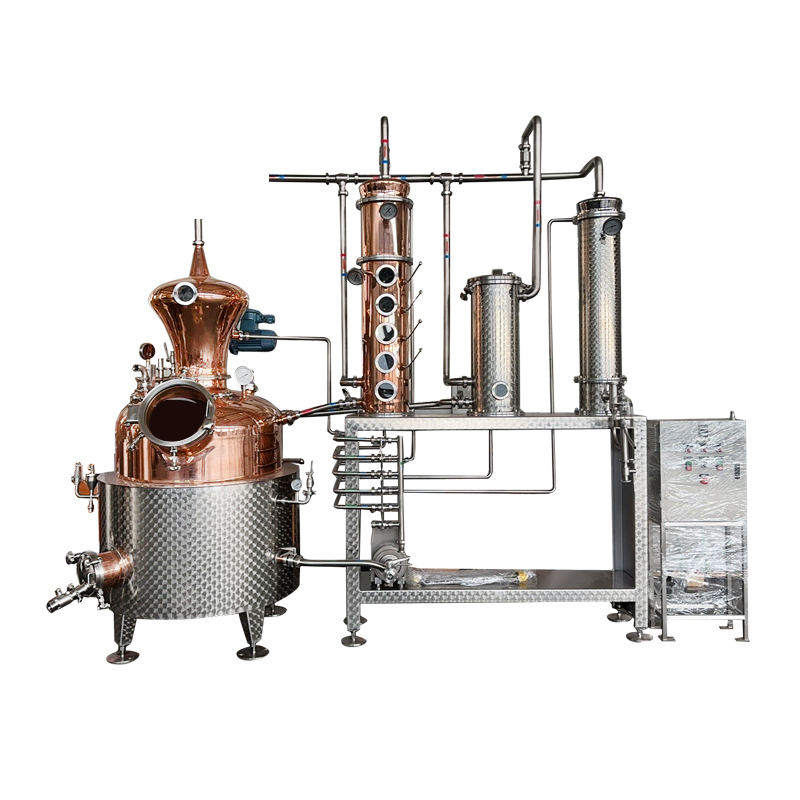
A 300L still becomes attractive when a producer needs more batch volume without moving directly to a larger commercial system.It can be a useful middle option for established craft distilleries, beverage startups preparing to scale, and producers developing several spirit products.ZR Brew’s 300L Commercial Spirit Distiller combines a 300L effective vessel capacity with a configurable distillation arrangement.
Published 300L Equipment Features
| Componente |
Configuration |
| Still Pot |
300L red copper pot |
| Dome |
Onion-head design |
| Agitator |
Integrated |
| Fractionating Column |
Five-plate copper column |
| Botanical Processing |
Stainless steel gin basket |
| Condenser |
Shell-and-tube design |
| Process Observation |
Sight glasses |
| Frame |
Stainless steel skid |
| Controls |
Dedicated panel; PID or PLC options |
This configuration offers more than additional volume.The column and botanical basket allow buyers to consider different spirit-production methods within one equipment platform.
Why Choose 300L Instead of 100L?
At the same assumed working-volume percentage, a 300L vessel holds three times as much liquid as a 100L vessel.That can reduce the number of batches required to process a fixed volume of fermented wash.However, the larger batch may require more heating energy and a longer operating cycle.A 300L system is most attractive when the producer has enough fermented liquid, storage capacity, and demand to use it regularly.
Best fit: Growing craft producers who need greater batch capacity and configurable equipment.
4. What Makes a 500L Still Suitable for Growing Distilleries?
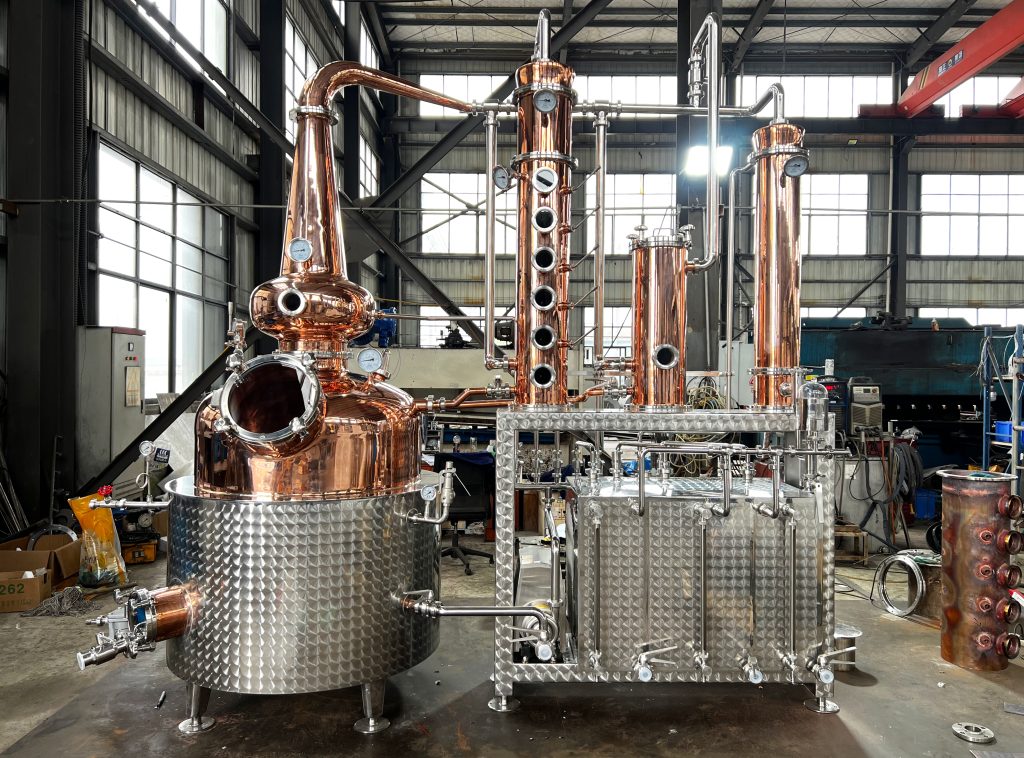
A 500L commercial still is designed for producers who need larger batch volumes and have a more established production schedule.It may suit facilities producing spirits for wholesale distribution, hospitality customers, or a growing retail network.The larger vessel can help reduce the number of individual distillation batches needed to process a given quantity of wash.
ZR Brew 500L Commercial Spirit Distiller
The 500L Commercial Spirit Distiller includes several features relevant to commercial production.
Its published configuration includes:
- 500L effective capacity
- Red copper still pot and onion-head dome
- Five-plate copper fractionating column
- Stainless steel gin basket
- Shell-and-tube condenser
- Integrated transfer pump
- Skid-mounted stainless steel frame
- Temperature and pressure monitoring instruments
The product is described as supporting pot-still and column operating modes.
What Changes When You Move to 500L?
The main advantage is greater processing volume per batch.For example, at the same assumed fill percentage, a 500L vessel holds approximately 67% more liquid than a 300L vessel.However, a larger system also requires sufficient utility capacity, cooling performance, liquid handling, and operator access.Before choosing 500L, confirm that your fermentation equipment can supply enough wash to keep the still productive.
Best fit: Established producers who need higher batch throughput and have the supporting infrastructure to operate a larger system.
5. How Much Spirit Can Different Still Sizes Produce?
One of the most important questions buyers ask is how much finished spirit a still can produce.The answer depends on more than vessel capacity.The alcohol content of the fermented wash, permitted fill level, recovery efficiency, spirit cuts, and final bottling strength all affect output.
Example: Comparing Theoretical Alcohol Content
Assume each still operates at 80% of its stated capacity and processes fermented wash containing 10% alcohol by volume.For illustration, assume the collected spirit is eventually adjusted to 40% ABV.
| Still Size |
Assumed Wash Volume |
Pure Alcohol in Wash |
Theoretical Volume at 40% ABV |
| 100L |
80L |
8L |
20L |
| 300L |
240L |
24L |
60L |
| 500L |
400L |
40L |
100L |
Important: These are mathematical examples, not ZR Brew equipment performance figures.They assume complete alcohol recovery, which is not achievable in normal commercial production.
Actual finished output will be lower or otherwise different because of spirit cuts, process losses, and production requirements.
6. How Does Fermentation Capacity Affect Still Selection?
Fermentation capacity and still capacity must work together.If fermentation tanks produce more wash than the still can process, liquid may wait longer than planned before distillation.
If the still is much larger than the available wash supply, equipment utilization may remain low.
7. What Factory Space and Utilities Does Each Still Require?
Still size affects more than production volume.It also influences equipment height, service access, heating demand, cooling-water requirements, and installation planning.A 300L or 500L multifunctional system may include a tall copper column, condenser assemblies, a control cabinet, and a skid frame.These components can make overall equipment dimensions more important than vessel capacity alone.
Factory Planning Checklist
| Requisito |
What to Confirm |
| Floor Space |
Equipment footprint and operating clearance |
| Ceiling Height |
Column height and maintenance access |
| Aquecimento |
Electrical, steam, or gas requirements |
| Arrefecimento |
Water flow, temperature, and connections |
| Drenagem |
Washdown and process discharge arrangement |
| Electrical Supply |
Voltage, frequency, and installed load |
| Ventilation |
Suitable design for the intended facility |
| Limpeza |
CIP connections and operator access |
| Safety |
Applicable fire, pressure, and alcohol-production requirements |
Heating Options for 300L and 500L Systems
ZR Brew lists electric heating, steam heating, and optional gas direct-fire heating for its 300L and 500L commercial distillers.The correct choice depends on local utility availability and the final equipment design.For example, a site with an existing steam supply may evaluate steam heating, while a new facility may need to compare the installation requirements of different options.
10. How Can ZR Brew Help You Specify the Right Still?
Choosing a commercial still is easier when the equipment supplier understands the entire production process.ZR Brew manufactures brewery and beverage processing equipment, including copper distillers, stainless steel fermentation tanks, and customized production systems for international B2B customers.Our published distillery range includes 100L, 300L, and 500L equipment with different configurations.
Equipment Selection Based on Your Project
We can discuss equipment requirements around:
- Target spirit types
- Planned batch capacity
- Available fermented wash
- Heating and cooling utilities
- Factory dimensions
- Material preferences
- Column and accessory requirements
- Control-system options
- Installation and commissioning needs
The aim is to develop an equipment specification that fits the project rather than recommending a model based only on capacity.
Custom Manufacturing and Project Support
ZR Brew provides configurable copper and stainless steel equipment, including selected SUS304 and SUS316 material options.Depending on the project scope, customers can discuss production layouts, equipment drawings, manufacturing, inspection, and installation support.For overseas buyers, confirming these requirements early helps reduce uncertainty during procurement.
Perguntas frequentes
Is a 100L still suitable for commercial spirits production?
A 100L still may suit pilot production, small craft businesses, and limited commercial batches. Its suitability depends on the operating schedule, local regulations, and required output.
How much more can a 300L still process than a 100L still?
At the same assumed fill percentage, a 300L vessel holds three times as much liquid per batch. Actual daily throughput depends on cycle time, equipment configuration, and operating conditions.
Is a 500L still always more efficient than a 300L still?
Not necessarily. A 500L still offers greater batch capacity, but efficiency depends on equipment utilization, heating and cooling performance, labor, and the production schedule.
Can a 300L or 500L commercial still produce different spirits?
ZR Brew’s published 300L and 500L multifunctional configurations support different operating arrangements for selected spirits, including whiskey, gin, rum, and vodka. Final suitability depends on the required process and equipment specification.
How do I calculate the still capacity my business needs?
Start with your weekly fermented wash volume, planned operating days, permitted fill level, and estimated batch cycle time. Then calculate how many batches each still size would require.
Can ZR Brew customize commercial distilling equipment?
Yes. ZR Brew offers configurable commercial distillers with material, heating, column, and control-system options. The final configuration should be confirmed through the quotation and approved technical drawings.
Find the Right Commercial Still for Your Project
A 100L, 300L, or 500L commercial still can each be the right investment under different production conditions.
The best choice is the system that matches your wash supply, operating schedule, product range, factory utilities, and business plans.
Request a Customized Commercial Still Quote
ZR Brew works with craft distilleries, beverage producers, and international project buyers to discuss suitable equipment configurations.


 Publicado