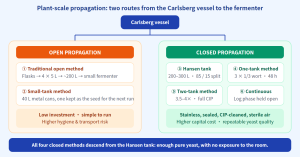
Where does production yeast actually come from? After the Carlsberg vessel, the culture enters plant-scale (production-site) propagation, where the method is chosen to suit the individual brewery’s conditions. Most breweries operate a Hansen tank system: one strain can be used repeatedly for many propagation cycles without changing the culture, until the yeast shows signs of degeneration or contamination.
So how do you classify all the options? By whether the culture is ever exposed to the room. Plant-scale yeast propagation splits into two families — open systems e closed systems — and the closed family has evolved into four distinct methods. Figure 1 maps the whole landscape.
2. How Does Open Yeast Propagation Work in a Small Brewery?
What if your brewery has no dedicated pure-culture equipment at all? Small breweries often skip it and simply buy yeast slurry from a larger brewery. It is a convenient way to start production, but container hygiene and transport make yeast quality genuinely hard to guarantee. So why not run a simple propagation in-house instead? Two low-cost methods make that possible.
The traditional open method: a ladder of flasks and open tanks
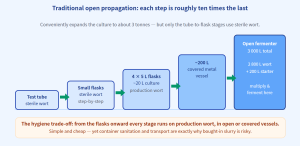
The traditional open method works much like laboratory propagation: from a test tube to small Erlenmeyer flasks, then to large flasks of 4 × 5 L, the yeast quantity grows step by step. Finally a covered metal vessel of about 200 L is used for propagation, after which the culture enters production and continues multiplying and fermenting in a relatively small open fermenter. Figure 2 shows the ladder; Table 1 gives the classic fermenter volumes.
| Artigo |
Volume |
What it means in practice |
| Fermenter volume |
3 000 L |
Total capacity of the small open fermenter |
| Boiled & cooled wort |
2 800 L |
Production wort, not laboratory sterile wort |
| Inoculated young beer (starter) |
200 L |
The propagated yeast culture added to the wort |
| Volume total |
3 000 L |
~3 t of culture — a practical small-brewery batch |
Table 1 Fermenter volume and yeast starter quantity for open propagation.
The small-tank method: five cans and one permanent seed
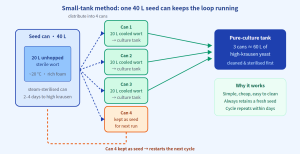
Want something more manageable than a 200 L open tank? In the small-tank method the yeast multiplies in a 40 L, easy-to-clean metal can. Depending on production scale you can use several cans — but one of them must always be kept as the seed can for the next run. It is simple, convenient and genuinely practical.
How does one cycle run? A can is thoroughly cleaned and steam-sterilised, then filled with 20 L of high-temperature-sterilised, unhopped wort. At about 20 °C the yeast multiplies rapidly and forms a rich foam. That culture is distributed into four more cans, each already holding 20 L of cooled wort. After roughly 2–4 days all cans reach high krausen. Then the contents of three cans (about 60 L) go into a thoroughly cleaned and sterilised pure-culture tank — while the fourth can is retained as the inoculum for the next propagation. Figure 3 shows the loop, which is why this method can repeat almost indefinitely.
3. Why Did Modern Breweries Move to Closed Propagation Systems?
What changes when a brewery outgrows open cans? Modern yeast propagation equipment is almost all developed from the Hansen tank: a set of sealed stainless-steel vessels of different sizes, in which the culture is enlarged inside a closed system until it reaches the yeast quantity required by the fermenter. Because every brewery’s reality differs, equipment and methods vary — but four classic approaches dominate: the Hansen tank method, one-tank method, two-tank method and continuous propagation.
The Hansen tank: 85 % out, 15 % kept
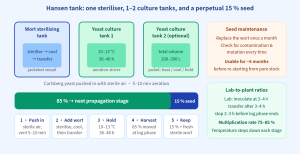
A Hansen tank system consists of one wort sterilising tank plus one or two yeast culture tanks, with a total volume of 200–300 L. Each vessel has a jacket for sterilising, cooling and holding temperature, and is fitted with a finger-type agitator or an aeration stirrer. How does the operating cycle work? Figure 4 shows the loop; Table 2 lists the numbers.
| Parâmetro |
Valor |
Why it matters |
| System volume |
200–300 L |
1 wort steriliser + 1–2 culture tanks, all jacketed |
| Initial aeration |
5–10 min |
Disperses the yeast pushed in from the Carlsberg vessel |
| Culture temperature |
10–13 °C |
Already close to plant fermentation conditions |
| Culture time |
36–48 h |
Long enough to reach the log growth phase |
| Intermittent aeration |
10 min every 2 h |
Supplies O₂ without over-oxygenating the culture |
| Harvest / seed split |
85 % / 15 % |
85 % scales up; 15 % restarts the tank with fresh sterile wort |
| Seed shelf life |
~6 months |
Replace wort monthly; check purity and mutation each time |
Table 2 Operating parameters of the Hansen tank propagation method.
4. Can One Tank Really Do the Whole Job? The One-Tank Method
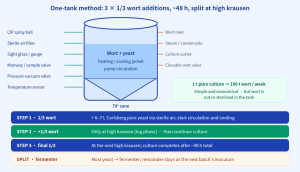
What if you could eliminate the whole cascade? As the name suggests, the one-tank method uses just one propagation vessel, fitted with heating and cooling jackets. Its defining features: wort is continuously added during propagation and generally not re-sterilised; and at the end, not all the yeast is sent to fermentation — a portion stays in the tank as the inoculum for the next batch. The trick, according to the textbook, is to split the culture during the log growth phase.
How does a run unfold? About 1/3 of the wort is sent into a rigorously cleaned and sterilised propagator; then 6–7 L of pure yeast from the Carlsberg vessel is pushed in through the sampling valve with sterile air, and the pump circulation starts with cooling as needed. When the culture reaches high krausen — the log phase — a second 1/3 of wort is added; at the next high krausen, the final 1/3. After about 48 h of continuous culture, most of the yeast is pumped to the fermenter and the remainder is retained as the next seed. Figure 5 shows the vessel and the three-step feed.
5. What Does the Two-Tank System Add — and When Is It Worth the Cost?
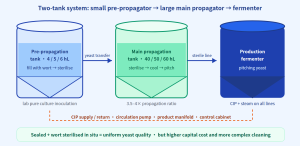
Why would anyone buy two tanks when one can do the job? The two-tank method is the traditional approach: aeration happens at the start of each propagation, so the yeast experiences both aerobic and anaerobic conditions — much like the fermentation that follows. Because the cells must adapt to anaerobic metabolism with a lower energy yield, the propagation ratio is lower, typically 3.5–4×. Every cycle needs a fresh laboratory pure-culture inoculation, and after the batch goes to production the whole system is completely emptied and sterilised before the next run.
What is actually in the system? As Figure 6 shows, it comprises a pre-propagation tank (small: 4, 5 or 6 hL), a main propagation tank (large: 40, 50 or 60 hL), a circulation pump, yeast addition, CIP supply and return, plus a product distribution manifold, its own CIP unit, piping and a control cabinet. Wort is sterilised inside the system, so contamination is designed out — but the capital cost is higher and cleaning and operation are more complex.
| Method |
Core idea |
Propagation ratio |
Sterility strategy |
O mais adequado |
| Hansen tank |
200–300 L, 85 % out / 15 % seed kept |
3–4× at lab stage |
Closed, jacketed, wort sterilised separately |
Traditional breweries, repeated cycles from one strain |
| One-tank |
3 × 1/3 wort feed, ~48 h, split at log phase |
High (continuous feed) |
Closed, but wort not re-sterilised |
Simple, low-investment plants; short pipe runs |
| Two-tank |
Small pre-tank → large main tank → fermenter |
3.5–4× |
Fully sealed, wort sterilised in situ, full CIP |
Quality-driven breweries with automation |
| Continuous |
Repeated high-krausen harvest, residual culture reused |
Continuous addition |
Sterile wort + sterile air throughout |
Large plants wanting uniform yeast around the clock |
Table 3Comparing the four closed commercial yeast propagation methods.
6. How Does Continuous Propagation Keep Yeast in the Log Phase?
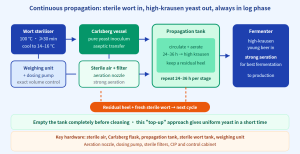
Can you avoid restarting the growth curve for every batch? The continuous propagation method (also called the assimilation method) does exactly that. Wort is first sterilised in a wort sterilising tank at 100 °C for at least 30 min, then cooled to 14–16 °C. Under aseptic conditions, yeast from the Carlsberg vessel is added to a small propagation tank, and sterile wort is pumped in from the sterilising tank until the required volume is reached; the culture is then circulated and strongly aerated. Volume is controlled with a weighing unit.
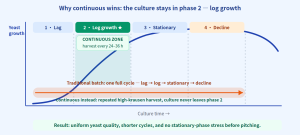
What happens next? After about a day — 24–36 h — when the culture reaches high krausen, it is pumped aseptically into the next propagation tank, and the process repeats until the required yeast quantity is reached. When the final tank hits its maximum cell count, the high-krausen young beer is pumped into the fermenter, where strong aeration is applied once more for a healthy start. Crucially, a certain amount of high-krausen residual culture is left in the propagation tank and immediately topped up with sterile wort to begin the next cycle. Figure 7 shows the flow; Figure 8 explains why it produces such uniform yeast.
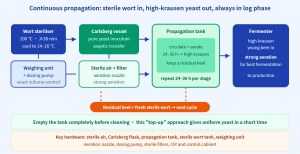
So why is the yeast so consistent? Because the culture is never allowed to leave the log growth phase. Figure 8, redrawn from the textbook’s Figure 4-23, contrasts a conventional batch — which drags the culture through lag, log, stationary and decline phases — with continuous propagation, which repeatedly harvests and re-feeds at high krausen.
7. What Are the Five Design Requirements of a Yeast Propagation Tank?
What should you actually specify when buying a yeast propagation system? The goal is simple — get a high cell count and high-quality yeast in the shortest possible time — but the equipment has to be matched to the brewery’s real working conditions. Five basic requirements follow, and they are worth turning into a purchasing checklist.
| # |
Requisito |
What to look for in the vessel |
| 1 |
Sufficient aeration & oxygen supply |
Continuous or intermittent aeration matched to the chosen cycle; sterile air filter and bottom-entry nozzle |
| 2 |
Uniform mixing & distribution |
Circulation pump or agitator that keeps yeast cells, wort and bubbles in constant contact |
| 3 |
Temperature control at both ends |
Jackets for the early propagation stage and for cooling to pitching temperature at the end |
| 4 |
Good microbiological conditions |
Sealed construction, CIP spray ball, sterilise-in-place capability, hygienic valves and piping |
| 5 |
Appropriate measurement & control |
Reproducible process through reliable volume/flow measurement and documented parameters |
Table 4 The five basic design requirements for a commercial yeast propagation vessel.
How do you measure the volume reliably? Three methods are available — differential pressure, weighing, and flow measurement. With differential pressure, the bottom sensor must be positioned correctly or the display will fluctuate, and the instrument must still respond at low volumes. A flow meter determines quantity accurately, but needs flexible connections so pipework carries no mechanical load — which raises fabrication cost — and bubbles or foam in the mixture will upset the reading. Weighing units, as used in continuous propagation, sidestep both problems.
Should you re-sterilise the wort at the propagator? Some breweries have a wort heater on the tank but never use it in practice. A pragmatic compromise is to install a heat exchanger for pasteurisation in the line to the yeast room — whether you need it depends on your own pipe runs and hygiene record. Cold production wort travelling a long distance is a classic contamination route.
8. How Much Oxygen — and How Often? Aeration, Temperature & Quality Targets
Why aerate at all? Sterile air does two jobs at once: it replenishes the oxygen the yeast needs and it strips out the CO₂ the culture produces. But how much, and on what schedule? Three practical regimes are widely used, and Table 5 collects them alongside the target dissolved oxygen.
| Aeration regime |
Pattern |
When it is used |
| Steady intermittent |
1 min aeration every 5 min |
Simple, repeatable baseline for smaller vessels |
| Two-stage intermittent |
First 24 h: 1 min every 15 min · second 24 h: 1 min every 5 min |
Matches rising oxygen demand as cell count climbs |
| Maximum-rate |
Up to 120 L/min, targeting 10–15 mg/L O₂ in the wort |
Strong aeration for fast multiplication |
| After each wort addition |
Moderate aeration to reach 8–10 mg/L O₂ |
Standard practice once the culture moves to the plant |
Table 5 Practical aeration strategies for plant-scale yeast propagation.
Does aeration have to be continuous? Not necessarily — and here is where brewing science pushes back. Because yeast multiplication runs on the biological oxidation of sugar, and because high glucose levels at the start trigger the Crabtree effect, continuous aeration does not always deliver the best growth; intermittent aeration is often preferable in the early stage. In the laboratory (flask to Carlsberg vessel) oxygen contact comes only from timed shaking or the air in the headspace. Once the culture is in the plant, however, every wort addition needs a measured dose of air. Traditionally, top-fermenting yeast gets continuous aeration while bottom-fermenting yeast does not — plausibly linked to their different temperatures (20 °C vs 9 °C) and fermentation times (3 days vs 10 days).
What temperature and what cell count should you aim for?
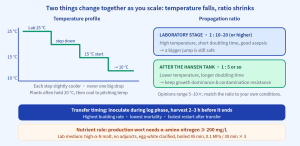
The recommended profile is to start propagation at 15 °C and slowly cool to 10 °C — though in real plants the culture is often held at 20 °C and only cooled to pitching temperature at the end. What matters is the direction of travel: the laboratory stage starts at the yeast’s optimum 25 °C, e every scale-up step lowers the temperature a little so the cells adapt gradually to cold fermentation. Never drop it too sharply in one step, or yeast activity is inhibited; and as temperature falls, culture time must lengthen in proportion to the dilution ratio.
How do the ratios change? Figure 9 brings temperature and propagation ratio together — a point that many breweries get wrong when they copy laboratory ratios into the brewhouse.
And what should the finished culture actually look like? Table 6 turns the textbook’s quality targets into an acceptance sheet you can hand to a lab technician.
| Indicator |
Target |
Why it matters |
| Cell count (traditional target) |
(0.8–1.0) × 10⁸ cells/mL |
Enough biomass to pitch without a long lag |
| Upper cell-count limit |
≤ 1.5 × 10⁸ cells/mL |
Above this, wort nutrients limit growth and yeast becomes malnourished |
| High-performance target |
(1.0–1.5) × 10⁸ cells/mL |
Combined with high fermentation power and low mortality |
| Dead cells in pitching yeast |
< 1 % (methylene blue) |
General management target: mortality below 3 % |
| pH |
3.8–4.2 |
Confirms a healthy, normally acidified culture |
| CO₂ / ethanol |
1.0–2.0 % each (by mass) |
Signals normal metabolism, not an over-fermented culture |
| Usable fraction after 24 h |
80–85 % of total |
Enables a repeatable 24 h cycle when conditions are held |
| α-amino nitrogen in plant wort |
≥ 200 mg/L |
Fuel for rapid protein and cell synthesis |
Table 6 Yeast quality targets for commercial propagation — a practical acceptance checklist.
9. What Are the Seven Golden Principles of Yeast Scale-Up?
Is there a single rulebook that survives all four methods? Yes — seven principles, and they matter more than the choice of vessel. Table 7 summarises them; the paragraphs below explain the ones most often ignored.
| # |
Principle |
The rule in one line |
| 1 |
Strain condition |
Start from an identified, high-performing single cell; verify no contamination and no mutation after every step — including the retained residue |
| 2 |
Culture temperature |
25 °C in the lab, then slightly cooler at each step; never one large drop; lengthen culture time as the ratio grows |
| 3 |
Culture time |
Transfer during log phase, 2–3 h before it ends — peak budding, lowest death rate |
| 4 |
Aeration & oxygen |
Intermittent early (Crabtree effect); 8–10 mg/L O₂ after each wort addition in the plant |
| 5 |
Nutrients |
α-amino nitrogen ≥ 200 mg/L in production wort; rich, clarified lab medium |
| 6 |
Propagation ratio |
1:10–20 in the lab, about 1:5 after the Hansen tank |
| 7 |
Wort sterility |
Cold production wort picks up contamination in long pipe runs — shorten, protect or pasteurise the line |
Table 7 The seven principles of brewery yeast scale-up.
Which one is most often skipped? Principle 1. Every retained heel — whether it is 15 % in a Hansen tank or the residual high-krausen culture in a continuous propagator — must be checked for contamination and mutation before it seeds the next batch. That is precisely what makes a six-month Hansen seed possible, and it is also what makes a careless one dangerous.
Do you have to follow one method rigidly? No. In practice breweries rarely distinguish the methods strictly; hybrid approaches are entirely legitimate, provided you define the parameters that matter — propagation temperature, aeration duration and interval, wort addition volume, and the growth phase at each stage. Done well, even a two-tank system can keep its yeast in the log phase, just like a one-tank system.
10. How Do You Choose the Right Propagation System for Your Brewery?
So which system belongs in your brewhouse? Start from batch size and hygiene ambition, not from a catalogue. Table 8 is a practical selection guide; Table 9 is a troubleshooting sheet for the problems that show up after commissioning.
| Brewery situation |
Recommended route |
Reasoning |
| Microbrewery, no lab, buying slurry |
Traditional open or small-tank method |
Minimal capital; gains control over yeast hygiene at low cost |
| Small brewery, short pipe runs |
One-tank method |
Simple and economical; 1 t of culture can seed 100 t of wort per week |
| Established brewery, repeated cycles |
Hansen tank system |
One strain for ~6 months with a permanent 15 % seed |
| Quality-driven, automated plant |
Two-tank system |
Wort sterilised in situ, full CIP, uniform and traceable yeast |
| Large plant, continuous demand |
Continuous propagation |
Log-phase harvest every 24–36 h, highly uniform yeast quality |
Table 8 Choosing a yeast propagation method by brewery scale and quality goals.
| Symptom |
Most likely cause |
Corrective action |
| Contamination after several cycles |
Cold wort travelling long pipe runs; no in-line pasteurisation |
Shorten or protect the line, add a heat exchanger, verify CIP coverage |
| Slow start after transfer |
Ratio too large for the plant stage; yeast past log phase |
Reduce to ~1:5 after the Hansen tank; harvest 2–3 h before log phase ends |
| High mortality / weak attenuation |
Temperature dropped too sharply; insufficient α-amino N |
Step the temperature down gradually; check wort α-N ≥ 200 mg/L |
| Excessive foaming |
Over-vigorous continuous aeration at high glucose |
Switch to intermittent aeration; consider a distribution valve in the tank |
| Unstable volume readings |
Pressure sensor misplaced, or foam in a flow meter |
Reposition the sensor, use weighing, or fit flexible connections |
| Drifting beer flavour over months |
Seed culture mutation or unnoticed contamination |
Test the retained residue each cycle; restart from pure stock on a schedule |
Table 9 Troubleshooting commercial yeast propagation.
Frequently Asked Questions About Brewery Yeast Propagation
1. What is the difference between open and closed yeast propagation?
Open propagation exposes the culture to the room in flasks, covered metal vessels or small open fermenters — cheap and simple, but with higher hygiene risk. Closed propagation uses sealed stainless-steel vessels with sterile air, CIP cleaning and in-situ wort sterilisation, giving repeatable yeast quality at higher capital cost.
2. What is a Hansen tank and how long can its seed be reused?
A Hansen tank system has one wort sterilising tank plus one or two jacketed culture tanks of 200–300 L total. With 85 % of the culture harvested and 15 % retained as seed, the wort replaced monthly, and purity checks each cycle, the same strain can normally be used for about six months.
3. How does the one-tank method work?
One jacketed propagator receives 1/3 of the wort plus 6–7 L of Carlsberg pure yeast, then a second and third 1/3 of wort at successive high-krausen (log-phase) points. After about 48 h, most of the yeast goes to the fermenter and the rest remains as the next batch’s inoculum.
4. Why is the two-tank propagation ratio only 3.5–4×?
Because aeration occurs mainly at the start, the yeast experiences both aerobic and anaerobic conditions, similar to real fermentation. Adapting to lower-energy anaerobic metabolism limits multiplication, so each step only achieves roughly 3.5–4×.
5. What makes continuous propagation produce more uniform yeast?
Sterile wort at 14–16 °C is added and the culture is harvested at high krausen every 24–36 h, with a residual heel immediately re-fed. The culture therefore stays in the log growth phase instead of passing through stationary and decline phases as a conventional batch does.
6. How much oxygen does yeast need during propagation?
Common regimes are 1 min of aeration every 5 min, or 1 min every 15 min in the first 24 h and every 5 min in the second 24 h. Maximum aeration can reach 120 L/min for 10–15 mg/L O₂ in the wort; after each wort addition, 8–10 mg/L is the usual target.
7. What cell count and viability should pitching yeast reach?
A traditional target is (0.8–1.0) × 10⁸ cells/mL, never above 1.5 × 10⁸ cells/mL or the yeast becomes malnourished. Dead cells should stay below 1 % by methylene blue (general mortality below 3 %), with pH 3.8–4.2 and CO₂ and ethanol each around 1.0–2.0 %.
8. Why should the propagation ratio shrink after the Hansen tank?
In the laboratory, high temperature, short doubling time and good asepsis allow ratios of 1:10–20 or more. After the Hansen tank, falling temperature lengthens doubling time, so a ratio near 1:5 helps the yeast take off quickly, keep its growth advantage and resist contamination.
So, Is Your Propagation System Protecting the Strain?
Every method in Figure 1 is really answering one question: how do you get from a pure lab culture to a full fermenter without ever giving contamination or stress an opening? Hold the temperature curve, the 1:5 plant ratio, the log-phase harvest, measured aeration and a nutrient-rich wort, and any of these systems will deliver yeast that ferments the same way batch after batch. Skip those rules, and no amount of stainless steel will save the beer.
Planning a Yeast Propagation System for Your Brewery?
Whether you need a compact one-tank propagator, a two-tank system with full CIP and in-situ wort sterilisation, or a complete propagation train feeding conical fermenters, the vessel design decides how safely your strain scales. ZR Brewing manufactures stainless-steel yeast propagation tanks, pre-propagation vessels, wort sterilisers, conical fermenters and complete fermentation systems — with sterile-air filtration, jacket temperature control, weighing or flow measurement, and hygienic CIP design.
Tell us your fermenter volume and pitching target — our engineers will size the propagation train around it.


 Publicado