2. Why Is the Exponential Growth Phase the Golden Window of Yeast Propagation?
Yeast is a facultative microorganism: its metabolism and reproduction can proceed both aerobically and anaerobically. That single fact shapes everything in a propagation lab. Under aerobic conditions yeast respires and builds new cells; under oxygen shortage it ferments — producing CO₂ and alcohol instead of new biomass, so the count of vital cells falls.
When you inoculate wort and watch the cell count, the culture passes through four distinct phases:
- Lag phase — nutrients are present, but the yeast barely reproduces as cells adapt;
- Exponential (log) growth phase — reproduction at full speed, cell numbers rising geometrically;
- Stationary phase — accumulating metabolic products (CO₂ and alcohol) slow reproduction, while the viable cell count peaks;
- Decline phase — nutrients are exhausted and toxic products accumulate, the death rate climbs, viable cells decrease.
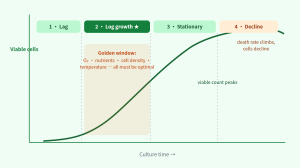
The most important phase in yeast cultivation is precisely the exponential growth phase — and at that moment, oxygen, nutrients, yeast cell concentration and temperature must all reach their optimum:
- Continuous sterile aeration is mandatory. Because yeast constantly consumes oxygen, the lab must keep feeding enough sterile air into the culture;
- Oxygen shortage is the silent killer: deprived of O₂, part of the culture switches to fermentation, yielding CO₂ and alcohol rather than new cells — the number of active cells you harvest shrinks;
- Temperature and wort nutrition set the pace of the log phase; drift in either stretches the lag phase and shifts the culture toward the stationary phase before you are ready.
| Phase |
Cell activity |
Oxygen demand |
Management focus |
| 1 · Lag |
Adaptation; almost no reproduction |
Moderate uptake begins |
Pitch healthy cells; don’t rush inoculation |
| 2 · Log growth |
Geometric increase in cell numbers |
Highest — continuous sterile air |
Optimal O₂, nutrients, density, temperature |
| 3 · Stationary |
CO₂ & alcohol accumulation slows growth; viable count peaks |
Falling |
Harvest timing — catch the viability peak |
| 4 · Decline |
Nutrients exhausted; death rate rises |
Minimal |
Avoid holding culture; transfer to next stage |
Table 2The four growth phases and what to manage in each.
3. How Does Yeast Separation Culture Work — and Where Does the Original Strain Come From?
Separation culture uses specialized techniques to pick strong, superior single yeast cells out of a mixed population, then enlarge them into a pure working culture for production. But before you can separate, you need a source strain. There are two ways to obtain the original culture:
- From the laboratory stock strain — the stock must first be revitalized through several rounds of cultivation before separation;
- From production itself — separating from yeast slurry or from the primary fermentation broth.
Factory practice relies on three classic methods: the plate separation method, the streak method, and the Lindner single-cell (small-drop) method. Let’s walk through each.
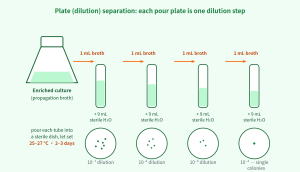
The plate separation method (dilution separation) — simple, field-proven
This is the workhorse of the brewery lab because it is simple, robust and suited to on-site use. The procedure:
- Melt wort-agar test-tube medium in hot water, then cool it to 42–45 °C;
- Transfer the yeast source with a platinum needle into the melted medium. If separating from fermentation broth, add a small amount of broth, mix well and inoculate; if from yeast slurry, first add a little sterile water or wort, shake evenly and then inoculate;
- Shake thoroughly, then transfer a loopful from tube 1 to tube 2 — and pour tube 1’s medium into a sterile Petri dish, distributing it evenly over the bottom to set. Repeat from tube 2 to 3, 3 to 4, pouring each dilution into its own dish;
- Incubate at 25–27 °C for 2–3 days, inspecting colony growth daily;
- Discard colonies that changed in appearance; select normal-looking colonies with uniform cell size for subculture. Repeat the whole separation 2–3 times when necessary.
4. What About the Streak Method — When Is It the Better Choice?
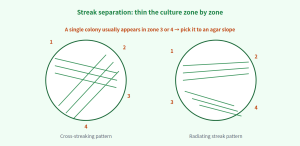
The streak separation method shares its principle with the plate method, but each has its own edge: streaking is simpler and faster, while the plate method — spreading colonies singly and evenly over the whole surface — offers a slightly higher probability of obtaining a truly pure strain.
The operation is delightfully direct: pick up an appropriate amount of diluted culture with an inoculating needle and streak it directly across the surface of a sterile plate medium. By the 3rd or 4th streak zone, cells have been thinned out enough that a single isolated colony may appear. The colony you need is then transferred to an agar-slope medium for further checking.
Typical use: the streak method is generally employed to purify strains already in production — a fast health-check for your working culture rather than a full re-isolation.
5. What Is the Lindner Single-Cell (Small-Drop) Method — the Gold Standard of Purity?
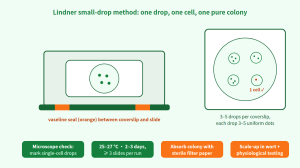
When a strain must be provably pure — new strain introduction, strain cleanup, lab breeding — breweries turn to the Lindner single-cell separation method, also called the small-drop culture method, evolved from the Hansen single-cell technique. Instead of diluting to “some cells per drop,” you dilute until each single drop of wort contains just one cell.
The procedure rewards patience and steady hands:
- Transfer the yeast or fermentation broth to be separated into sterile wort medium and dilute repeatedly until one drop holds one cell;
- In an aseptic room, use a platinum needle to place the diluted culture as drops on a coverslip or into the well of a concave slide — 3–5 drops per slide, each drop containing 3–5 tiny dots, dots uniform and evenly spaced;
- Turn the coverslip over so the drops face the well of the concave slide; add 1 drop of sterile water into the well and seal the coverslip to the slide with vaseline;
- Examine every drop under the microscope and record the position of drops holding exactly one cell;
- Incubate the slide at 25–27 °C for 2–3 days, checking yeast cell growth daily;
- Prepare at least 3 inspection slides per run, then select after incubation;
- Pick well-developed, normal colonies — absorb the colony out with sterile triangular filter paper — and transfer it into sterile wort for scale-up propagation, followed by physiological characterization before the strain is released for production use.
6. Which Separation Method Should Your Brewery Choose?
All three methods reach toward the same goal — a pure, healthy, production-ready strain — but they differ sharply in equipment, skill and certainty:
| Method |
Principle |
Strengths |
Watch-outs |
Typical use |
| Plate (dilution) |
Serial dilution → pour plates → pick isolated colonies |
Simple, field-friendly; colonies spread singly and evenly, slightly higher odds of purity |
Needs sterile dishes and careful 42–45 °C handling; repeat 2–3× |
Routine lab work, on-site checks |
| Streak |
Streak diluted culture across a sterile plate in zones |
Simplest and fastest; minimal equipment |
Purity odds slightly lower than plate method |
Purifying strains already in production |
| Lindner small-drop |
Dilute to one cell per drop; hanging-drop microscopy |
Provably single-cell origin — the gold standard |
Aseptic room, microscope, patience; ≥ 3 slides per run |
New strains, breeding, strain cleanup |
Table 3Comparing the three separation methods — match rigor to the job.
Whichever method you choose, the follow-through is identical: verify colony morphology, keep records, and never skip the physiological characterization before a strain re-enters production. A pure culture plus disciplined propagation is what keeps every batch tasting like the last one.
Frequently Asked Questions About Yeast Propagation & Pure Culture
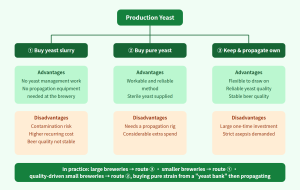
1. What are the three ways a brewery can obtain production yeast?
Buying yeast slurry, buying pure (sterile) yeast, and maintaining and propagating its own strain. Large breweries usually propagate their own; smaller ones buy slurry; quality-focused small breweries buy pure strain from a yeast bank and propagate it in-house.
2. Why is yeast called a facultative microorganism?
Because yeast cells can metabolize and reproduce both aerobically and anaerobically. With oxygen they build new biomass; without it they ferment, producing CO₂ and alcohol instead of new cells.
3. Which growth phase matters most in yeast propagation?
The exponential (log) growth phase — cell numbers rise geometrically and the viable culture is built. Oxygen supply, nutrients, cell concentration and temperature must all be optimal at this stage.
4. Why must sterile air be continuously supplied during propagation?
Yeast consumes oxygen constantly. If oxygen runs short, part of the culture switches from cell-building respiration to fermentation, so the number of vital new cells decreases.
5. What temperature and duration are used for plate separation incubation?
Melted wort-agar medium is cooled to 42–45 °C before inoculation, poured plates are incubated at 25–27 °C for 2–3 days, with colonies inspected daily and abnormal ones discarded.
6. How does the streak method differ from the plate method?
Both separate colonies on sterile plates, but streaking is simpler and faster while the plate method spreads colonies singly and evenly, giving a slightly higher probability of obtaining a pure strain. Streaking is generally used to purify strains already in production.
7. What makes the Lindner small-drop method the most rigorous?
The culture is diluted until each drop of wort contains exactly one cell; drops are sealed hanging-drop style, the single-cell drops are marked under the microscope, and each resulting colony provably descends from one cell. At least 3 slides are prepared per run.
8. What happens after a colony is picked in the small-drop method?
The well-developed colony is absorbed with sterile triangular filter paper, transferred into sterile wort for scale-up propagation, and passes physiological characterization before being released for production use.
Building or Upgrading Your Yeast Propagation Line?
Healthy pure yeast deserves hardware that protects it: hygienic propagation vessels, precise temperature control, sterile-air aeration and clean-in-place design. ZR Brewing manufactures stainless-steel yeast propagation tanks, conical fermenters and complete fermentation systems for breweries that take strain quality seriously.
Tell us your strain and batch size — our engineers will match the equipment.


 Gepubliceerd