

견적 받기
24시간 이내에 답변해 드리겠습니다. 긴급한 사안이신 경우, WhatsApp/WeChat(+8613188932181)으로 연락해 주시기 바랍니다.
*당사는 귀하의 개인정보를 존중하며, 모든 정보는 안전하게 보호됩니다.
당사는 귀하의 정보를 오직 문의에 답변하는 용도로만 사용하며, 원치 않는 이메일이나 홍보 메시지를 절대 보내지 않습니다.
 게시됨
Yeast decides 40% of your beer’s character — but where does production yeast actually come from? This guide compares the three sourcing routes breweries use, explains why the exponential growth phase is the golden window of propagation, and walks through the plate, streak and Lindner single-cell separation methods that turn a mixed culture into a reliable pure strain.
A brewery can obtain its pitching yeast in three ways: buying yeast slurry, buying pure (sterile) yeast, or maintaining and propagating its own strain. Each route trades convenience against control — and the trade-offs matter more the larger your operation grows.
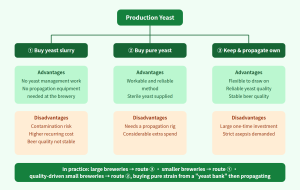
How do real breweries choose? In China, large breweries generally propagate their own yeast (route ③) because volume justifies the investment; smaller breweries usually buy yeast slurry (route ①); and a share of small breweries that prioritize beer quality stability take route ② — purchasing pure culture from a yeast bank and propagating it in-house before pitching.
| Route | Best suited for | Key advantage | Key risk |
|---|---|---|---|
| ① Buy yeast slurry | Small breweries without lab capacity | Zero yeast-management workload, no propagation equipment | Contamination danger, higher cost, unstable beer quality |
| ② Buy pure yeast | Small breweries chasing quality stability | Reliable method; sterile culture from a yeast bank | Requires propagation apparatus and considerable spend |
| ③ Keep & propagate own | Large breweries with lab + brewhouse support | Flexible draw-down, dependable strain, consistent beer | Large one-time investment; very strict asepsis required |
Table 1Choosing a yeast sourcing route by brewery size and quality goals.
Yeast is a facultative microorganism: its metabolism and reproduction can proceed both aerobically and anaerobically. That single fact shapes everything in a propagation lab. Under aerobic conditions yeast respires and builds new cells; under oxygen shortage it ferments — producing CO₂ and alcohol instead of new biomass, so the count of vital cells falls.
When you inoculate wort and watch the cell count, the culture passes through four distinct phases:
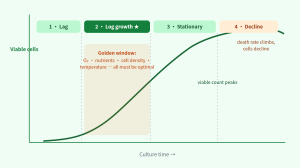
The most important phase in yeast cultivation is precisely the exponential growth phase — and at that moment, oxygen, nutrients, yeast cell concentration and temperature must all reach their optimum:
| Phase | Cell activity | Oxygen demand | Management focus |
|---|---|---|---|
| 1 · Lag | Adaptation; almost no reproduction | Moderate uptake begins | Pitch healthy cells; don’t rush inoculation |
| 2 · Log growth | Geometric increase in cell numbers | Highest — continuous sterile air | Optimal O₂, nutrients, density, temperature |
| 3 · Stationary | CO₂ & alcohol accumulation slows growth; viable count peaks | Falling | Harvest timing — catch the viability peak |
| 4 · Decline | Nutrients exhausted; death rate rises | Minimal | Avoid holding culture; transfer to next stage |
Table 2The four growth phases and what to manage in each.
Separation culture uses specialized techniques to pick strong, superior single yeast cells out of a mixed population, then enlarge them into a pure working culture for production. But before you can separate, you need a source strain. There are two ways to obtain the original culture:
Factory practice relies on three classic methods: the plate separation method, the streak method, and the Lindner single-cell (small-drop) method. Let’s walk through each.
This is the workhorse of the brewery lab because it is simple, robust and suited to on-site use. The procedure:
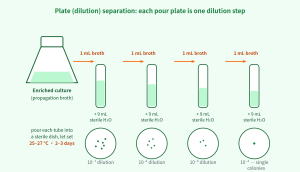
The streak separation method shares its principle with the plate method, but each has its own edge: streaking is simpler and faster, while the plate method — spreading colonies singly and evenly over the whole surface — offers a slightly higher probability of obtaining a truly pure strain.
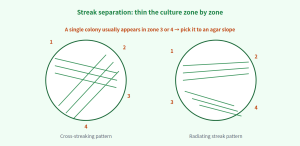
The operation is delightfully direct: pick up an appropriate amount of diluted culture with an inoculating needle and streak it directly across the surface of a sterile plate medium. By the 3rd or 4th streak zone, cells have been thinned out enough that a single isolated colony may appear. The colony you need is then transferred to an agar-slope medium for further checking.
Typical use: the streak method is generally employed to purify strains already in production — a fast health-check for your working culture rather than a full re-isolation.
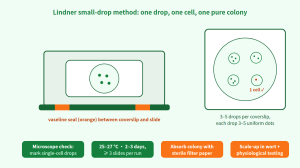
When a strain must be provably pure — new strain introduction, strain cleanup, lab breeding — breweries turn to the Lindner single-cell separation method, also called the small-drop culture method, evolved from the Hansen single-cell technique. Instead of diluting to “some cells per drop,” you dilute until each single drop of wort contains just one cell.
The procedure rewards patience and steady hands:
All three methods reach toward the same goal — a pure, healthy, production-ready strain — but they differ sharply in equipment, skill and certainty:
| Method | Principle | Strengths | Watch-outs | Typical use |
|---|---|---|---|---|
| Plate (dilution) | Serial dilution → pour plates → pick isolated colonies | Simple, field-friendly; colonies spread singly and evenly, slightly higher odds of purity | Needs sterile dishes and careful 42–45 °C handling; repeat 2–3× | Routine lab work, on-site checks |
| Streak | Streak diluted culture across a sterile plate in zones | Simplest and fastest; minimal equipment | Purity odds slightly lower than plate method | Purifying strains already in production |
| Lindner small-drop | Dilute to one cell per drop; hanging-drop microscopy | Provably single-cell origin — the gold standard | Aseptic room, microscope, patience; ≥ 3 slides per run | New strains, breeding, strain cleanup |
Table 3Comparing the three separation methods — match rigor to the job.
Whichever method you choose, the follow-through is identical: verify colony morphology, keep records, and never skip the physiological characterization before a strain re-enters production. A pure culture plus disciplined propagation is what keeps every batch tasting like the last one.
Buying yeast slurry, buying pure (sterile) yeast, and maintaining and propagating its own strain. Large breweries usually propagate their own; smaller ones buy slurry; quality-focused small breweries buy pure strain from a yeast bank and propagate it in-house.
Because yeast cells can metabolize and reproduce both aerobically and anaerobically. With oxygen they build new biomass; without it they ferment, producing CO₂ and alcohol instead of new cells.
The exponential (log) growth phase — cell numbers rise geometrically and the viable culture is built. Oxygen supply, nutrients, cell concentration and temperature must all be optimal at this stage.
Yeast consumes oxygen constantly. If oxygen runs short, part of the culture switches from cell-building respiration to fermentation, so the number of vital new cells decreases.
Melted wort-agar medium is cooled to 42–45 °C before inoculation, poured plates are incubated at 25–27 °C for 2–3 days, with colonies inspected daily and abnormal ones discarded.
Both separate colonies on sterile plates, but streaking is simpler and faster while the plate method spreads colonies singly and evenly, giving a slightly higher probability of obtaining a pure strain. Streaking is generally used to purify strains already in production.
The culture is diluted until each drop of wort contains exactly one cell; drops are sealed hanging-drop style, the single-cell drops are marked under the microscope, and each resulting colony provably descends from one cell. At least 3 slides are prepared per run.
The well-developed colony is absorbed with sterile triangular filter paper, transferred into sterile wort for scale-up propagation, and passes physiological characterization before being released for production use.
Healthy pure yeast deserves hardware that protects it: hygienic propagation vessels, precise temperature control, sterile-air aeration and clean-in-place design. ZR Brewing manufactures stainless-steel yeast propagation tanks, conical fermenters and complete fermentation systems for breweries that take strain quality seriously.
Tell us your strain and batch size — our engineers will match the equipment.
24시간 이내에 답변해 드리겠습니다. 긴급한 사안이신 경우, WhatsApp/WeChat(+8613188932181)으로 연락해 주시기 바랍니다.
*당사는 귀하의 개인정보를 존중하며, 모든 정보는 안전하게 보호됩니다.
당사는 귀하의 정보를 오직 문의에 답변하는 용도로만 사용하며, 원치 않는 이메일이나 홍보 메시지를 절대 보내지 않습니다.