# Brewery Equipment Installation: Site Readiness Guide
**ZR Brew Technical Team**
Brewing, Fermentation and Beverage Equipment Engineering Team
Updated: August 28, 2026
Brewery equipment installation starts before the tanks arrive. The building must accept the shipment, support the equipment loads, drain wash water, supply the specified utilities and give installers enough room to position and connect every vessel. A missed doorway dimension or utility mismatch can stop work even when the equipment itself is complete.
This guide is a pre-delivery checklist for brewery owners, project managers and contractors. It does not claim project-specific installation results that have not been publicly disclosed. Final foundations, pressure systems, electrical work, gas work, fire protection and structural decisions must be approved by qualified professionals under the rules applying at the installation site.
## Step 1: Freeze the equipment list and responsibility matrix
Do not release the site for construction from a sales quotation alone. Obtain the latest approved equipment list, general arrangement drawing, vessel dimensions and weights, connection schedule, electrical load list and utility requirements.
Create a responsibility matrix with one owner for every interface:
| Work package | Information required before installation | Typical responsible party to confirm |
|—|—|—|
| Equipment supply | Vessel, pump, platform and control-panel scope | Brewery and equipment supplier |
| Building structure | Floor loading, anchors, openings and roof clearance | Local structural engineer |
| Drainage | Trench locations, slopes, discharge limits and cleanouts | Local civil/plumbing contractor |
| Utilities | Voltage, steam, gas, water, glycol and compressed air | Local licensed contractors |
| Rigging | Unloading equipment, lift plan, route and insurance | Qualified rigging company |
| Process piping | Materials, slope, insulation and sanitary connections | Brewery piping contractor |
| Controls | Cable routes, field devices, network and interlocks | Supplier and local electrician |
| Commissioning | Test media, chemicals, operators and acceptance records | Brewery and supplier |
ZR Brew publicly describes remote installation guidance and on-site installation or commissioning where agreed. The contract should state which services are included, how travel and local labor are handled, and which site conditions must be ready before a technician arrives.
## Step 2: Verify the delivery and rigging route
Measure the entire route, not only the main door. Record container access, turning radius, unloading area, dock height, doorway width and height, corridor corners, overhead services, floor transitions and final vessel location. Compare the smallest clear opening with the shipping dimensions, including protective packing and lifting attachments.
The rigging plan should identify each lift point, equipment weight, center of gravity where available, lifting device, spreader or sling arrangement, temporary floor protection and exclusion zone. Tanks must not be lifted from fittings, jackets or unapproved points. Confirm whether platforms, legs or accessories ship separately and whether assembly changes the required ceiling clearance.
For projects in Great Britain, the lifting plan should also follow the UK Health and Safety Executive’s guidance on planning and organising lifting operations; projects elsewhere must follow the corresponding local rules.
Check the complete unloading and positioning route before delivery, including final ceiling and service clearances.
## Step 3: Prepare floors, foundations and anchors
Ask the equipment supplier for empty, operating and test weights. A water-filled hydrostatic test can impose a substantially different load from an empty tank. The local structural engineer must evaluate point loads at legs, platform reactions, dynamic loads from pumps or mills, and any seismic or wind requirements relevant to the site.
Confirm these items before drilling anchors:
1. Finished floor elevations and slopes match the approved layout.
2. Tank legs and platform columns land on suitable structural zones.
3. Anchor type, edge distance, embedment and corrosion resistance are approved locally.
4. Floor coatings have cured and can tolerate installation traffic.
5. Equipment can be leveled without blocking drainage paths.
Do not use tank legs to correct major floor errors. Excessive shimming, misaligned anchors or an out-of-level vessel can affect piping fit-up, drainage and platform connections.
## Step 4: Complete drainage before tanks block access
Breweries release hot water, cleaning solution and product residues in different areas. Locate trench drains and floor sinks around actual cleaning and transfer tasks rather than placing one drain in the center of the room.
Check drain capacity, floor slope, grate loading, cleanout access and local wastewater restrictions. Keep electrical cabinets and sensitive devices away from splash zones. Where hoses cross walking routes, add managed hose paths or connection points so routine cleaning does not create a trip hazard.
Drain design must account for the maximum credible simultaneous discharge, but that value is project-specific. Obtain cleaning-system flow, vessel dump and utility data instead of copying a generic brewery figure.
## Step 5: Match every utility to the approved connection schedule
Mark each utility termination on the latest layout. Label connection size, pressure, temperature, flow, electrical characteristics and responsibility for the final connection.
### Electrical power and controls
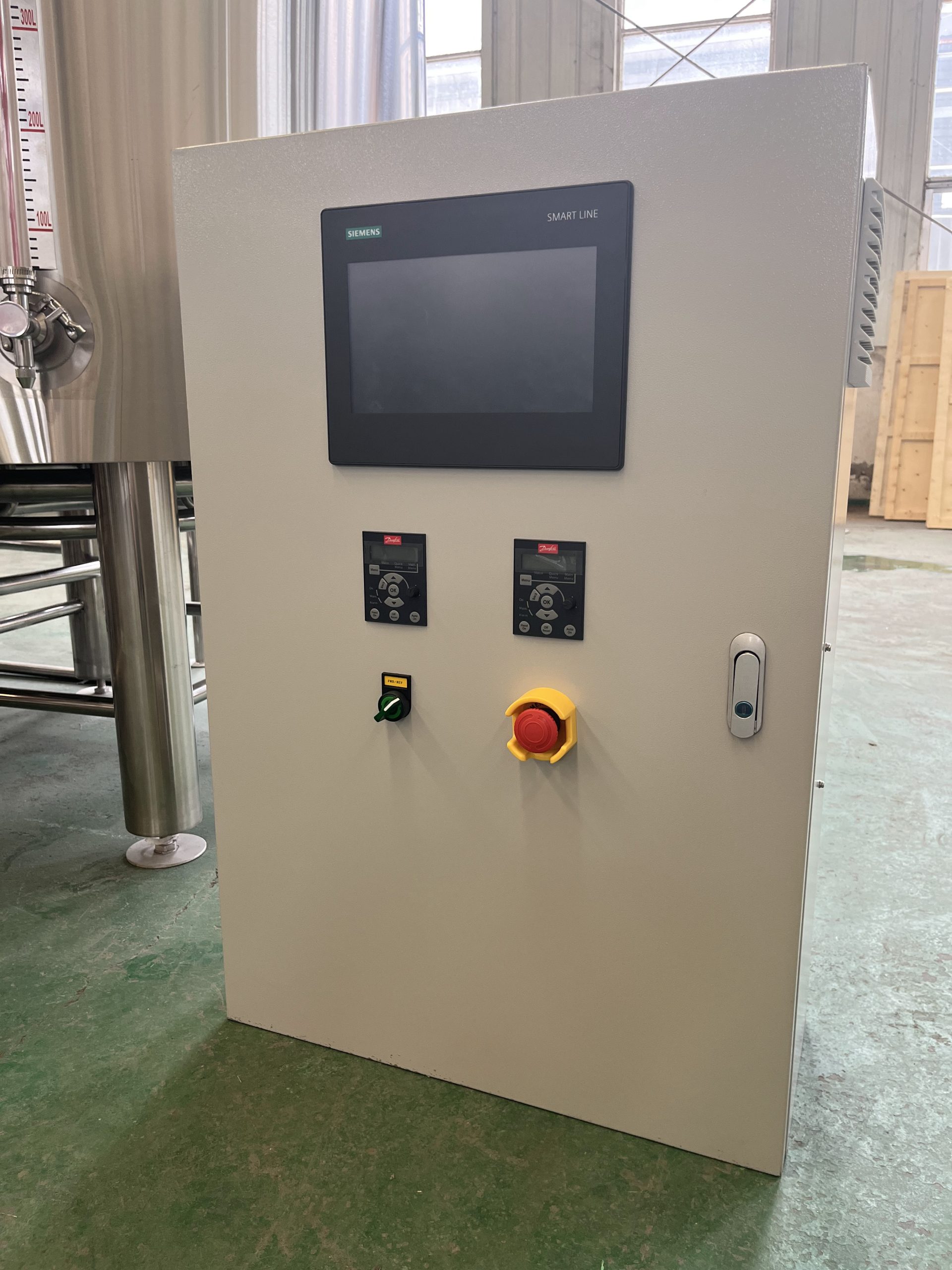
Verify voltage, phase, frequency, available fault current, protective devices, grounding and local panel requirements. ZR Brew lists PID and PLC control options, with project-dependent component selections such as Siemens, Schneider or Allen-Bradley. The installed supply must match the actual panel nameplate and approved drawings, not an earlier proposal.
Provide cable trays and separation for power, control and communication wiring. Confirm emergency-stop locations and the safe state of pumps, heaters and actuated valves after power loss.
### Heating
For steam systems, confirm the specified pressure and flow, pipe material, isolation, trapping, condensate return and local safety requirements. Direct-fire or gas-fired systems require locally approved fuel trains, ventilation, combustion air and exhaust arrangements. Electric heating requires enough service capacity for simultaneous loads.
### Cooling
Confirm glycol supply and return sizes, design temperatures, pump duty, expansion capacity and connection locations. The European project archive includes 10HL and 20HL breweries with glycol cooling, CIP and mixed fermenter capacities, showing why the cooling system must be sized from the selected tank schedule rather than the brewhouse size alone.
### Water and compressed air
Separate potable, treated and process-water requirements where applicable. Confirm pressure, flow, temperature and water quality. Instrument or valve air must meet the equipment specification for pressure, dryness and cleanliness.
Utility terminations should be placed from the approved connection schedule, leaving access for operation and maintenance.
## Step 6: Check sanitary piping and maintenance access
Lay out process piping so it drains as designed, avoids unsupported loads on vessel nozzles and remains accessible for inspection and cleaning. Confirm pipe material, connection standard, valve orientation, insulation and identification before fabrication.
Leave enough space to remove pump motors, open manways, pull heating elements, service valves and access instruments. A compact layout may reduce pipe length, but insufficient maintenance clearance transfers cost into every later repair.
Where fixed CIP circuits are used, verify supply and return paths for each vessel. Do not assume a connection is cleanable merely because it can carry product. Dead legs, trapped sections and poorly oriented valves require review during the piping design stage.
## Step 7: Inspect equipment before final connection
Record the condition of each item as it is unloaded. Compare labels and packing lists with the approved equipment schedule. Photograph shipping damage before removing protective materials and follow the agreed claims process.
Before making permanent connections:
– Confirm vessel identity, orientation and working position.
– Check accessible welds, fittings, jackets, insulation cladding and ports for transit damage.
– Verify pumps, valves, instruments, platforms and loose accessories against the packing list.
– Remove shipping braces only according to supplier instructions.
– Protect open sanitary connections from construction debris.
– Confirm that equipment has been leveled and anchored as approved.
Never use an equipment pressure test as a substitute for site piping inspection. The installed system includes new field connections and must follow the applicable local inspection and test requirements.
## Step 8: Test in stages before brewing product
Commissioning should progress from individual components to the complete process. Agree on acceptance records before testing starts.
1. **Documentation check:** confirm drawings, manuals, equipment tags and test prerequisites.
2. **Mechanical inspection:** verify guards, fasteners, lubrication, valve movement, pump rotation readiness and unobstructed piping.
3. **Electrical checks:** test grounding, protective devices, emergency stops, inputs, outputs and interlocks.
4. **Dry functional test:** operate controls and actuators where safe without process liquid.
5. **Water test:** check filling, transfer, heating, cooling, level response, drainage and visible leakage using an approved procedure.
6. **Cleaning cycle:** confirm chemical compatibility, circulation paths, return flow and complete rinsing.
7. **Operator trial:** run the approved sequence with trained staff and record deviations.
8. **Handover:** close punch-list items and archive settings, backups, training and acceptance records.
Pressure, temperature and chemical tests can create serious hazards. Use project-specific procedures, isolate personnel from test zones and follow the equipment documentation and local rules.
## Common installation mistakes to prevent
### Building from an outdated drawing
Revision control matters whenever tank quantity, orientation, platform position or utility scope changes. Mark one drawing set as approved for construction and withdraw superseded copies.
### Connecting utilities before checking nameplates
A voltage, frequency, steam-pressure or connection-standard mismatch can damage equipment or delay commissioning. Verify the delivered equipment and approved documents before energizing or pressurizing anything.
### Treating commissioning as a single startup day
Commissioning depends on completed utilities, safe access, test media, chemicals, trained operators and resolved construction defects. Schedule staged checks and allow time to correct punch-list items.
### Ignoring future cellar expansion
Reserve practical floor space, glycol capacity, pipe-header branches, electrical capacity and control-panel provisions if additional tanks are planned. The initial cost must be weighed against the disruption of replacing undersized utilities later.
## Pre-delivery readiness sign-off
The project manager should not approve shipment or installer travel until the responsible parties sign off access, structural work, drainage, utility terminations, rigging, safety controls and test prerequisites. Attach current drawings and photographs to the sign-off so “ready” refers to observable conditions.
For a project-specific brewery equipment installation review, send ZR Brew the approved layout, equipment schedule, building access dimensions, utility data and intended production plan. See ZR Brew’s brewery equipment cost guide or contact the project team before finalizing the site interfaces.
### Author bio
The ZR Brew Technical Team supports the planning, engineering, manufacturing, installation and commissioning of brewery, fermentation, distillation and beverage-processing projects. ZR Brew states that its key engineers and project leaders average more than 13 years of practical industry experience, working with projects from 50L pilot systems to 150HL commercial breweries.


 Gepubliceerd