An automated beer brewing system uses PLC controls, sensors, an HMI, pumps, VFDs, and automatic valves to manage key brewing stages such as mashing, lautering, boiling, cooling, and wort transfer. For commercial breweries, automation can improve process repeatability, reduce routine manual work, record production data, and make multi-batch brewing easier to manage.
Article Outline
- What Is an Automated Brewing System?
- How Does an Automated Beer Brewing System Work?
- Which Brewing Process Steps Can You Automate?
- Semi-Automatic vs Fully Automated Brewing Systems
- What Components Drive Brewery Automation?
- All-in-One Brewing vs Three-Vessel and Four-Vessel Systems?
- What Are the Benefits of Automated Brewing?
- How Do You Choose the Right Automated System by Brewery Size?
- What Should You Check Before Buying an Automated Brewing System?
- How Does ZR Brew Customize Automated Brewery Projects?
What Is an Automated Brewing System?
An geautomatiseerd brouw systeem is brewing equipment that uses electronic controls and mechanical components to perform or regulate repeatable parts of the brewing process. Instead of asking the brewer to manually watch every temperature, start every pump, and operate every process valve, the system can follow predefined brewing parameters.
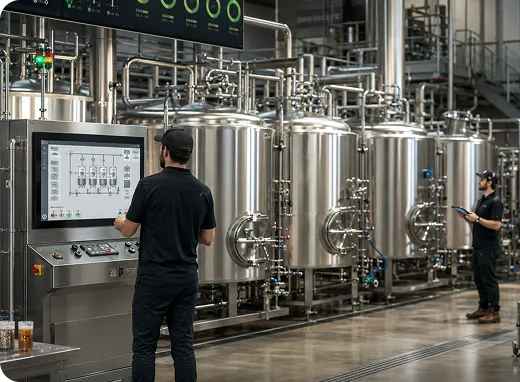
At commercial scale, automation normally centers on an industrial PLC connected to an HMI touchscreen. Sensors provide real-time process information, while pumps, motors, pneumatic valves, and other devices respond to control commands. ZR Brew’s current systems, for example, can use Siemens PLC controls, an HMI, PT100 temperature sensors, pressure, level and flow sensors, pneumatic valves, and VFD-controlled pumps.
This is very different from what consumers may know as an automated home brewing system or countertop brewing appliance. Products historically associated with homebrewing, such as Grainfather-style systems or the former PicoBrew concept, focus on compact batches and ease of use. A commercial brewery requires larger vessels, sanitary process piping, cellar integration, utilities, CIP planning, and much more robust automation.
How Does an Automated Beer Brewing System Work?
A modern beer brewing system starts with a recipe. The brewer defines the process parameters, while the control system manages selected brewing stages according to those settings.
For example, during the mash, a PLC can follow programmed temperature steps and control the agitator. During lautering, the automated system can manage pumps and process conditions. The kettle stage can use programmed heating and timing, while optional dosing systems can support scheduled hop additions.
After boiling, automation can continue through cooling. ZR Brew’s commercial platform regulates hot wort and cooling-water flow through the heat exchanger so the wort reaches the required transfer conditions before entering the fermenter.
A simplified automated brew day looks like this:
Recipe Input → Mash → Lauter → Boil → Hop Addition → Whirlpool → Wort Cooling → Fermenter Transfer
The brewer still matters. Automation handles repeatable instructions; the brewer decides what those instructions should be.
Which Brewing Process Steps Can You Automate?
The answer depends on how far the brewery wants to take automation. There is a large difference between automated temperature control and a fully automated brewhouse.
Automated Mashing
Temperature is critical during the mash because the brewer follows a defined recipe and temperature profile. Sensors report current conditions to the control system, which can regulate the heating element, steam valve, or other heating arrangement according to the equipment configuration.
The system can also control agitator speed and programmed mash steps. This reduces the need for constant manual adjustments during a typical brew day.
Automated Lautering and Wort Movement
Pump speed and liquid routing can also be automated. In a more advanced system, pneumatic valves replace repeated manual valve operation.
This is useful in larger breweries because the liquid may travel through a network of vessels, pumps, and sanitary piping. Automated routing can make the workflow easier to repeat.
Automated Boiling and Cooling
The kettle can follow programmed heating intensity and duration. Optional hop dosing can further automate selected recipe steps.
Once the brew leaves the hot side, controlled wort cooling becomes important. Sensors, pumps, and valves can work together to manage flow through the heat exchanger.
The result is not an entirely hands-free brewery. Rather, automation handles routine process actions so the brewer can spend more time monitoring quality and making production decisions.
What Is an Automated Brewing System?
An automated brewing system is brewing equipment that uses electronic controls and mechanical components to perform or regulate repeatable parts of the brewing process. Instead of asking the brewer to manually watch every temperature, start every pump, and operate every process valve, the system can follow predefined brewing parameters.
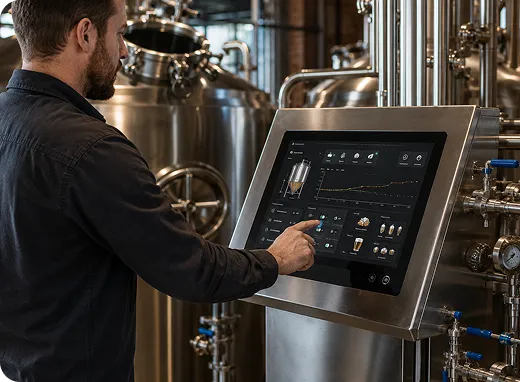
At commercial scale, automation normally centers on an industrial PLC connected to an HMI touchscreen. Sensors provide real-time process information, while pumps, motors, pneumatic valves, and other devices respond to control commands. ZR Brew’s current systems, for example, can use Siemens PLC controls, an HMI, PT100 temperature sensors, pressure, level and flow sensors, pneumatic valves, and VFD-controlled pumps.
This is very different from what consumers may know as an automated home brewing system or countertop brewing appliance. Products historically associated with homebrewing, such as Grainfather-style systems or the former PicoBrew concept, focus on compact batches and ease of use. A commercial brewery requires larger vessels, sanitary process piping, cellar integration, utilities, CIP planning, and much more robust automation.
How Does an Automated Beer Brewing System Work?
A modern beer brewing system starts with a recipe. The brewer defines the process parameters, while the control system manages selected brewing stages according to those settings.
For example, during the mash, a PLC can follow programmed temperature steps and control the agitator. During lautering, the automated system can manage pumps and process conditions. The kettle stage can use programmed heating and timing, while optional dosing systems can support scheduled hop additions.
After boiling, automation can continue through cooling. ZR Brew’s commercial platform regulates hot wort and cooling-water flow through the heat exchanger so the wort reaches the required transfer conditions before entering the fermenter.
A simplified automated brew day looks like this:
Recipe Input → Mash → Lauter → Boil → Hop Addition → Whirlpool → Wort Cooling → Fermenter Transfer
The brewer still matters. Automation handles repeatable instructions; the brewer decides what those instructions should be.
Semi-Automatic vs Fully Automated Brewing Systems: What Is the Difference?
This distinction matters when comparing equipment quotations.
A semi-automatic brewing system may automate temperature management and pump operation while leaving liquid routing to the operator. The brewer still opens and closes manual valves and remains closely involved in each process stage.
A fully automated system adds more control hardware. Pneumatic valves, additional sensors, PLC logic, and process sequences allow more of the brewhouse to operate according to the programmed recipe. ZR Brew describes its fully automatic configuration as covering mashing, lautering, boiling, and cooling through integrated PLC control.
| Functie |
Semi-Automatic |
Fully Automated |
| Temperature monitoring |
Yes |
Yes |
| Automatic heating control |
Available |
Yes |
| Pump control |
Yes |
Yes |
| Manual valves |
Common |
Reduced |
| Pneumatic valves |
Limited/optional |
Core component |
| Recipe storage |
Configuration dependent |
Available |
| Automated process sequences |
Limited |
Extensive |
| Sensor integration |
Basic |
Extensive |
| Operator involvement |
Higher |
Lower |
For a small brewpub, paying for every possible automation feature may not make financial sense. For a high-output brewery running several batches per day, the calculation changes.
The best automation level is the one that matches production volume, labor strategy, process complexity, and budget.
What Components Drive a Commercial Brewing Automated System?
Automation only works when the control hardware receives reliable information and can act on it.
A commercial brewing system may use the following components:
| Component |
Role in the Brewing Process |
| PLC |
Executes control logic and process sequences |
| HMI touchscreen |
Lets the brewer view and adjust recipes and parameters |
| PT100 sensor |
Measures process temperature |
| Level sensor |
Monitors liquid level |
| Flow sensor |
Measures liquid movement |
| Pressure sensor |
Monitors relevant process pressure |
| Pneumatic valve |
Automatically routes wort, water, or cleaning liquid |
| VFD |
Adjusts pump and agitator motor speed |
ZR Brew uses this architecture in its commercial automated systems, with Siemens PLC technology available for fully automatic configurations.
The sensor layer is particularly important. A controller cannot make a useful adjustment if its process data is inaccurate. The same applies to mechanical components: poor valve selection, incorrect pump sizing, or unsuitable piping can limit an otherwise advanced control system.
For B2B buyers, this is why evaluating only the touchscreen is a mistake. The real system includes vessels + piping + sensors + actuators + controls + software logic.

All-in-One Brewing System or Three-Vessel Brew System?
The phrase all-in-one brewing system appears frequently in searches, but its meaning changes dramatically with scale.
For home brewing, an all-in-one system or single vessel system may combine several brewing functions into one unit. The appeal is obvious: compact size, fewer separate pieces of equipment, and easier setup for home brewers who want to brew beer at home.
Commercial equipment follows a different logic. As production grows, separating processes across vessels can allow operations to overlap.
A simplified comparison is:
| Configuratie |
Main Strength |
Typical Use |
| Single/multifunction vessel |
Compact footprint |
Pilot and very small batches |
| 2-vessel |
Balance of space and production |
Nano brewery / brewpub |
| 3-vessel |
Greater process separation |
Microbrewery |
| 4-vessel |
Higher workflow efficiency |
Commercial production |
| 5-vessel |
High-throughput process separation |
Large commercial brewery |
ZR Brew’s larger commercial equipment can use four- or five-vessel configurations. Its 5000L ZR-5000, for example, uses a four-vessel brewhouse with Siemens PLC automation, while its 10BBL platform offers multi-vessel configurations designed for higher production throughput.
So, there is no true all-in-one system that is automatically best for every buyer. Compact integration favors smaller projects. Separate vessels become more valuable when throughput increases.
What Are the Benefits of Automated Beer Brewing?
The main benefits of automated brewing are not that the machine replaces the brewer. They come from controlling repetitive tasks more consistently.
1. Better Process Repeatability
Automation can repeat programmed temperature curves, timing, pump settings, and valve sequences. That gives the brewery a stronger process foundation from one batch to another.
The Brewers Association describes beer quality in terms that include consistent brewing techniques and good manufacturing practices. It also emphasizes that fermentation requires careful control of variables such as time and temperature.
Automation supports that goal, but it does not guarantee identical beer. Raw materials, yeast health, fermentation, oxygen exposure, cleaning, and packaging still affect the finished product.
2. Lower Routine Manual Work
Imagine a brew day where the brewer repeatedly:
- Watches temperature
- Starts and stops pumps
- Adjusts motor speed
- Opens valves
- Tracks process time
- Records parameters
An automated system can handle many of these repeatable actions.
That gives the brewing team more time for recipe management, quality checks, cellar work, and production planning.
3. Better Production Records
PLC-based systems can store recipes and process information, depending on the selected configuration. This becomes increasingly useful as the brewery grows.
If one batch differs from another, process records give the team more information to investigate what changed.
What Is the Best Automated Brewing System for Your Brewery Size?
There is no universal best automated brewery. The right configuration depends on batch size, daily production, beer portfolio, labor, utilities, floor space, and future expansion.
ZR Brew currently structures its automation range from 50L pilot equipment through 5000L/50HL industrial brewery systems.
50L–200L: Pilot and Small-Batch Brewing
These systems are suitable for:
- Recipe testing
- R&D
- Training
- Small brew projects
- High-end homebrewing
ZR Brew’s ZR-50 uses SUS304 stainless steel, a multifunctional brewhouse, two conical fermenters, electric heating, and Schneider PID semi-automatic control.
This is closer to a professional pilot platform than a consumer home brewing system.
300L–1000L: Brewpub and Microbrewery
This range suits businesses that need commercial output but still value recipe flexibility.
Automation may progress from PID-based control toward Siemens PLC systems with more sensors and pneumatic valves.
1500L–5000L: Commercial Production
At this level, workflow becomes increasingly important. Separate vessels allow different brewing stages to overlap, while automation helps coordinate a larger brewhouse.
ZR Brew’s ZR-5000 provides 5000L/50HL effective batch capacity, a four-vessel layout, and Siemens PLC full automation. The published configuration supports up to six batches per day under the stated system design.
These are floor-sized systems built around production throughput, not countertop convenience.
How Does ZR Brew Customize Automated Brewing Projects?
As a brewery and beverage equipment manufacturing plant, we approach automation as part of the complete production system. The PLC alone cannot solve a poor vessel layout, undersized cooling loop, unsuitable pump, or badly planned workflow.
ZR Brew manufactures systems from pilot-scale equipment through commercial automated breweries. Depending on project requirements, a solution can integrate stainless steel brewhouse vessels, fermenters, bright tanks, glycol cooling, CIP, Siemens PLC controls, HMI panels, pneumatic valves, and process sensors.
Real projects also show why configuration matters. ZR Brew’s published automated projects include a German 10HL microbrewery with a three-vessel brewhouse, pneumatic valves, PLC control and 12 × 20HL CCT fermenters; a Swedish 20HL turnkey brewery with a steam-heated three-vessel brewhouse, six 40HL CCTs and PLC control; and a 2000L French commercial brewery covering mashing through fermentation and CIP.
When discussing a project with us, the useful starting point is:
What do you want to brew, how much do you need per batch, how many batches must you produce, and what utilities and space are available?
From there, we can determine whether semi-automatic controls, a fully automated system, two vessels, three vessels, or a larger multi-vessel configuration makes practical sense.


 Gepubliceerd