How heating method, caramelization, and boiling pressure shape the beer in your glass.
Have you ever wondered why two breweries can run identical recipes and still end up with wort that tastes — and ages — completely differently? Very often the answer hides inside the wort boiling equipment itself. Whether heat arrives through a jacket, an internal heater, or an external wort boiler decides where caramelization happens, how much energy you burn, and which flavor compounds survive the boil. This guide walks through every major kettle design, using the temperature physics that brewers’ textbooks rarely make easy to read.
1. Why Does the Heating Method Matter So Much?
The oldest kettles were heated directly by fire under the vessel — simple, but almost impossible to control. Because the flame temperature cannot be regulated precisely, burning grain dust and soot can foul the heat surface, and localized overheating is inevitable. Modern breweries therefore heat with steam, either through a jacket welded to the vessel wall or through dedicated heater surfaces. Does the steam side really differ that much from the wort side? The numbers are striking.
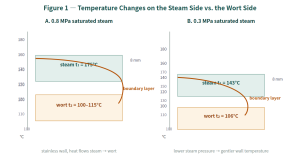
Why does this matter for beer quality? The wort in contact with the hot wall is overheated relative to the bulk liquid, and everything happens inside that thin film: the higher the steam pressure (and therefore the wall temperature), the more intensely the film is overheated, the faster the wort circulates, and the more caramel-style Maillard products form. But here is the trap — if the wort boils too gently or circulates too slowly, that film burns anyway. Heat transfer, film temperature, and wort velocity must be balanced together; a kettle designed around only one of them will fail on the other two.
2. What Is Caramelization Doing to Your Kettle Walls?
Once a caramelized layer builds up on the heating surface, what happens to the beer? The deposits act as insulation: the wall temperature behind the layer climbs, nitrogen-containing heterocyclic compounds form inside the burnt layer, and unwanted “cooked” flavors migrate into the wort. Textbook measurements show the effect clearly — with a clean surface the wort-side temperature stays moderate, but once caramel deposits coat the wall, surface temperature jumps to as high as 158 °C and harsh, aged-malt off-flavors accelerate during storage.
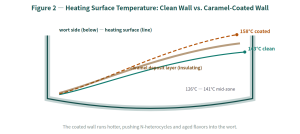
The damage does not stop at the kettle. Caramelization products carried into fermentation measurably change yeast by-products: textbooks show that wort with heavy loads ferments with elevated fusel alcohols, higher alcohols, and esters such as ethyl acetate and isoamyl acetate — sometimes doubling over the first 24 hours of fermentation. So can you afford to ignore the burnt film on your kettle floor? Absolutely not. Regular CIP of the heating surface is a flavor-stability measure, not just a cleaning task.
3. The Jacketed Steam Kettle: What Can It Really Do?
As craft breweries grew from small plants into mid-sized operations, the jacketed steam kettle became the workhorse of the industry. Steam — usually at 0.2–0.3 MPa — condenses in a welded jacket around the lower vessel shell, and a steam ring pipe distributes it evenly; the design also favors modern multi-zone jackets. Why do small and mid-size breweries prefer it? The answer is mostly economics and simplicity.
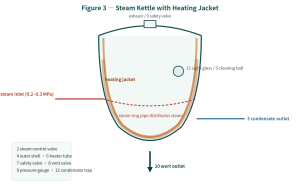
How does it actually work? Live steam enters the jacket and condenses on the inner wall; condensate collects at the lowest point of the jacket and drains out. If air is not vented thoroughly, it accumulates in the upper jacket zone and insulates the surface, so an exhaust valve must stay open at start-up — opening it 1–4 times per batch until pure steam escapes. Because the jacket pressure is low and the vessel must tolerate vacuum, safety valves are mandatory. Textbooks also warn about one counterintuitive failure mode: when the kettle boils violently, foam and splashing wort can lift the boil over into the vent line, and the moving liquid level can trigger pressure pulses in the jacket — so condensate drainage must be unobstructed at all times. When wort boils inside a jacketed kettle it can also be vacuum-cooled and evacuated afterwards, which is gentler on the wort.
And the verdict? Jacketed kettles are the most traditional design — low-pressure boiling (0.11–0.12 MPa) is essentially their specialty, saving significant thermal energy while accelerating protein coagulation and hop isomerization.
What if you need faster heating without a bigger vessel? The internal heater places a tube bundle directly inside the kettle, below the wort surface. Steam condenses inside the tubes while wort flows around them — the temperature difference between steam and wort can be adjusted freely, and multiple heating zones can run at different pressures. Do the advantages outweigh the drawbacks? Textbooks list seven characteristic strengths and weaknesses:
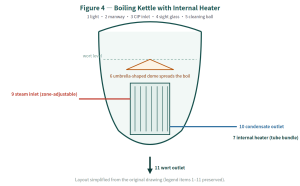
What Are the Strengths of the Internal Heater?
- Wort boils under pressure inside the heater at a higher temperature, shortening boiling time, saving energy, and improving bitter-substance utilization while precipitating coagulable nitrogen more completely.
- Each cleaning cycle can be tuned per zone; heating performance can be verified batch by batch.
- Because every heater zone can be fed steam separately, the temperature difference is flexible and controllable.
- The kettle can be operated at atmospheric, low-pressure (0.11–0.12 MPa, up to 120 °C), or even dynamic low-pressure mode.
- Using low-pressure steam (≤ 0.1 MPa) in individual zones is possible for delicate stages.
- It fits easily into a modern high-capacity, short-cycle brewhouse.
- Low electricity demand — no wort circulation pump is required.
And the Drawbacks?
- Cleaning the tube bundle inside the vessel is difficult, so CIP coverage of the heater is critical.
- Wort quality depends strongly on the kettle’s internal geometry — a poor dome design causes uneven boiling.
- The heater occupies vessel volume, reducing effective working capacity per batch.
- Evaporation inside the vessel must be balanced carefully; excessive surface loading increases foam-over risk.
- Inspection requires confined-space entry through the manway, complicating maintenance.
- Heating is limited to the installed surface — you cannot “add capacity” later.
- Sensitive hop aroma additions need care: violent near-heater boiling can strip volatile oils prematurely.
5. Atmospheric, Low-Pressure, or Dynamic Low-Pressure Boiling — Which Process Fits?
The kettle hardware only matters in combination with the boiling program. Three textbook processes dominate modern brewhouses, and their temperature curves look completely different. Which one matches your energy budget and your beer style?
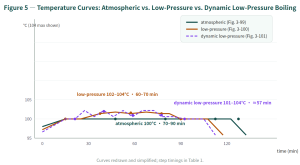
Table 1 — The Three Boiling Processes Step by Step
| Stage |
Atmospheric boiling |
Low-pressure boiling |
Dynamic low-pressure boiling |
| Mash-in heat-up |
Wort reaches 100 °C within 15–20 min |
100 °C within 15–20 min, pre-boil ~10 min |
72 → 100 °C within ~15 min, pre-boil ~5 min |
| Pressurized phase |
— (stays at 100 °C) |
10 min to 102–104 °C, hold ~15 min |
Pressure–vent cycles 5–6 times, 101–104 °C, 3–4 min per cycle |
| Final phase |
Hold 100 °C, 25–30 min per stage |
Depressurize ~15 min back to 100 °C, then boil ~10 min |
Depressurize to 100 °C within 15 min, boil ~10 min |
| Total boiling time |
70–90 min |
60–70 min |
≈ 57 min |
| Total evaporation |
8–12% |
≈ 4–6% (reduced ~50%) |
lowest of the three |
| Key benefit |
Simple, robust, classic profiles |
Faster protein coagulation & hop isomerization, big energy saving |
Volatile off-flavors stripped at each vent cycle, shortest schedule |
Brewing tip: Low-pressure boiling at 0.11–0.12 MPa reaches ~120 °C inside the heater — enough to speed protein coagulation and hop isomerization so that boiling time can be shortened while evaporation drops by half. If your kettle can hold pressure, why keep boiling at 100 °C?
6. The External Heater Kettle: Why Do Big Brewhouses Swear By It?
The third design moves the heat source out of the vessel entirely. A tubular or plate heater — made of stainless steel and installed outside the kettle — circulates wort at roughly 2.5 m/s from bottom to top, or back-and-forth through parallel passes. Because the circulation loop needs a dedicated wort transfer pump, pump capacity is sized for 8–12 wort circulations per hour. Heated wort re-enters the kettle tangentially or through a central spreader pipe below the liquid surface; the boiling temperature is regulated by the inlet valve, typically holding 107–110 °C in the heater.
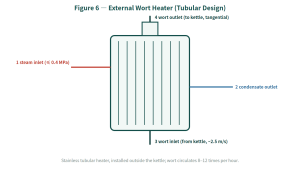
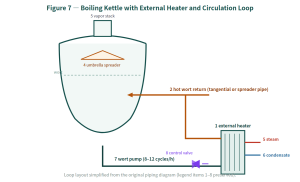
Uniformity of boiling deserves its own mention — textbooks stress that wort must enter the kettle evenly through a small-diameter pipe or tangential inlet, otherwise circulation dead zones form. The external loop also makes one heater shareable: it can be combined with two or three kettles that double as wort holding tanks, hot wort tanks, or whirlpools, minimizing air pickup. To limit thermal losses, both heater and kettle should be insulated; steam pressure is best kept at or below 0.4 MPa, because excessive heating surface temperatures push wort color up and hurt both the external system and “conventional” boiling performance.
What Are the External Heater’s Strengths?
- 20–30% shorter boiling time — wort boils under pressure inside the heater, saving energy, improving bitter-substance utilization, and precipitating coagulable nitrogen more completely.
- Circulation count can be adjusted freely to match process requirements.
- Needs only low saturated steam pressure — 0.3 MPa is sufficient.
- Boiling strength and wort temperature are easy to regulate independently.
- With pump assistance, more undesirable volatiles are stripped (hop oil fractions, volatile sulfur compounds, dimethyl sulfide).
- Stronger boil lowers wort pH slightly, so finished wort color is lighter.
And the Weaknesses You Should Plan For?
- The circulation pump consumes significant electricity.
- The external heater radiates substantial heat to the surroundings.
- High wort velocity through the heater creates shear forces that can degrade foam-positive proteins and flavor stability.
- Equipment investment costs are comparatively high.
Table 2 — Three Heating Systems at a Glance
| Criterion |
Jacketed kettle |
Internal heater |
External heater |
| Heat surface location |
Vessel wall jacket |
Tube bundle inside vessel |
Stainless heater outside vessel |
| Boiling temperature |
≈ 100 °C (low-pressure up to ~120 °C) |
Up to 120 °C under 0.11–0.12 MPa |
107–110 °C in heater loop |
| Boiling time |
Longest (70–90 min atmospheric) |
Shortened; supports low-pressure process |
20–30% shorter than conventional |
| Energy profile |
Moderate; vacuum option available |
Low electricity, thermal savings in low-pressure mode |
High pump electricity + radiation losses |
| Wort quality risk |
Jacket wall caramelization if circulation stalls |
Cleaning difficulty near heater |
Shear forces may reduce foam & flavor stability |
| Best fit |
Small & mid-size breweries, classic brewhouses |
Compact brewhouses wanting pressure boiling |
Large brewhouses; heater shared by 2–3 vessels |
7. How Should You Choose Your Kettle — and Keep It Clean?
Does one design win outright? No — the right choice is a match between batch size, energy strategy, and beer style. As a practical selection guide:
- Microbreweries and taprooms (up to ~20 hL): a direct-fire or simple jacketed kettle is usually enough; prioritize even steam distribution and reliable venting over exotic features.
- Regional breweries: internal heater kettles running the low-pressure program combine short boil times with 4–6% evaporation — a strong energy story.
- Large industrial brewhouses: external heater systems shine when one heater serves two or three kettles, maximizing utilization per euro invested.
- Hop-forward beers: dynamic low-pressure boiling strips DMS efficiently while pressure cycles protect delicate late-hop aroma better than a long hard boil.
Whichever system you run, the caramelization lesson from Figure 2 applies to all of them. A practical audit routine: check the heating surface every shutdown, log wall temperature versus steam pressure, verify that condensate drains freely, confirm the jacket vent valve is cycled at start-up, and schedule CIP of the heater after every brew — not just when visible deposits appear. The extra 20 minutes of cleaning is always cheaper than a batch of stale-tasting beer three weeks later.
Frequently Asked Questions
- Q1: Why does steam pressure change the flavor of my beer?
- Higher steam pressure raises the wall temperature behind the wort film. A hotter wall accelerates caramelization and Maillard reactions, forming N-heterocyclic compounds that push harsh, aged flavors into the wort. Lower pressure with good circulation gives the same evaporation with a cleaner flavor profile.
- Q2: Is low-pressure boiling worth the extra equipment?
- For most mid-size breweries, yes. Boiling at 102–104 °C shortens the schedule by 10–20 minutes and cuts evaporation roughly in half (from 8–12% to 4–6%), which directly reduces energy cost per brew and thermal load on the wort.
- Q3: What wort velocity should my external heater run at?
- Around 2.5 m/s through the heater, with pump capacity sized for 8–12 full wort circulations per hour. Too slow, and film boiling plus caramelization risk rises; too fast, and shear forces begin to damage foam proteins.
- Q4: Can one external heater serve several kettles?
- Yes — that is one of its biggest advantages. A single heater can be combined with two or three kettles that act as wort buffer, hot wort holding tank, or whirlpool, minimizing air pickup and capital cost.
- Q5: How often should the heating surface be cleaned?
- After every brew. Caramel deposits insulate the wall, push surface temperatures toward 158 °C, and feed off-flavor formation — cleaning is a flavor-stability measure, not just hygiene.
Conclusion: So Which Kettle Should You Buy?
Every wort boiling system trades heat intensity against wort quality. Jacketed kettles remain the dependable classic; internal heaters pack pressure boiling into a compact footprint; external heaters buy speed and flexibility at the cost of pump energy and shear. What they all share is the physics of Figure 1: wherever a hot wall meets a stagnant wort film, caramelization begins. Control the film — through steam pressure, wort velocity, and clean surfaces — and the same hardware delivers brighter, more stable beer.


 Published