Gisting looks simple from the tank window — a rising foam cap and a falling Plato line. Inside the wort, however, yeast is running a strict eating schedule: which sugars it touches first, why maltose waits its turn, and why a shortage of one single amino acid can push your beer full of fusel alcohols. Have you ever wondered what really decides the speed and flavour of your fermentation? The answer lies in two metabolisms: sugar and nitrogen. Let’s open both.
What is on the yeast’s menu — and in what proportion?
Wort is a rich growth medium for yeast cells: they absorb nutrients and excrete metabolic products. Carbohydrates account for about 90% of wort extract. Among them, glucose, fructose, sucrose, maltose, maltotriose and raffinose are the fermentable sugars — the yeast’s principal carbon nutrients. The dextrin-range sugars (DP₃–DP₉ oligosaccharides up to maltose-nonose and beyond) are unfermentable, and they stay in the beer to give it body.
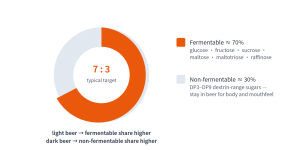
In production, the ratio of fermentable sugar to non-fermentable sugar is generally controlled at about 7 : 3. For light-coloured beers the fermentable share is set slightly higher — more alcohol, a drier and lighter mouthfeel. For dark beers the non-fermentable share rises a little, adding body and malty fullness. Does your gravity specification secretly encode this ratio? It does.
Table 1 — Fermentable sugar composition of all-malt wort
| Component |
Share of extract (%) |
Role in fermentation |
| Maltose |
4–6 (core fraction of wort) |
Main fermentation sugar — consumed after glucose is exhausted |
| Maltotriose |
1.1–1.8 |
Slowest main sugar — often lingers into maturation |
| Glucose |
0.5–1.0 |
First sugar fermented — represses maltose uptake while present |
| Fructose |
0.1–0.5 |
Early-stage sugar, taken up with glucose |
| Sucrose |
0.1–0.5 |
Split outside the cell wall by invertase, then fermented |
What does yeast do with the fermentable share?
In oxygen-free (but ventilated, chilled) wort, yeast consumes the fermentable sugars — about 96% of them are broken down to ethanol and CO₂ through the EMP pathway. A share also runs through the tricarboxylic acid cycle (aerobic respiration), where sugar is decomposed to water and CO₂, yielding large amounts of bioenergy that let yeast cells multiply rapidly and release heat. This dual behaviour is precisely the mechanism we traced in the previous article on fermentation energetics.
Why does maltose politely wait for glucose to finish?
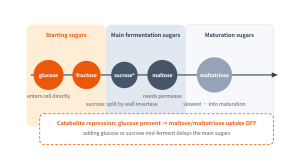
Yeast does not attack all wort sugars simultaneously. Fermentable sugars are taken up in a strict sequence, which divides fermentation into three sugar phases:
- Starting sugars — glucose and fructose enter the cell directly and are fermented first;
- Main fermentation sugars — maltose, then maltotriose;
- Maturation sugars — the slow maltotriose tail that conditions the beer.
Sucrose is a special case: it cannot enter the cell directly, so an invertase (splitting enzyme) on the yeast cell wall splits it into glucose and fructose at the surface — which is why sucrose behaves like a starting sugar.
Two control effects every brewer should know:
1. Catabolite repression (葡萄糖阻遏效应, the “glucose effect”). For bottom-fermenting yeast, when wort contains relatively much glucose, the cells secrete maltose permease — the transporter that carries maltose into the cell — only after glucose and fructose concentrations have fallen to a low level does maltose uptake begin. Maltotriose behaves the same way. In a normal wort this suppression passes unnoticed — but add extra glucose or sucrose and you will seriously delay maltose and maltotriose fermentation. Chasing attenuation with a bag of sugar? Mind the order of the queue.
2. The Crabtree effect (克拉勃垂效应). Even when oxygen is plentiful, yeast prefers to ferment sugar into alcohol rather than respire it — sugar represses the respiratory machinery itself. That is why beer fermentation stays alcoholic even in aerated wort.
Some top-fermenting yeasts keep their ability to ferment maltose and maltotriose even in the presence of glucose — one reason their fermentations run comparatively fast.
What sets the speed of sugar conversion?
Six factors decide how fast the sugar line falls:
- Wort character — first of all how completely cold and hot break were separated, plus wort gravity and composition;
- Fermentation temperature — alcoholic fermentation clearly accelerates with rising temperature and slows at low temperature;
- Yeast concentration — the contact area between cells and wort is what matters. Pitching doses in cells-per-ml: typically (3–4) × 10⁷ cells/ml, and in peak condition up to 10⁸;
- Mechanical action — circulation, stirring and similar motion increase cell–wort contact and intensify fermentation;
- Yeast strain — fermentation speed is a genetic trait of each strain;
- Pressure — as pressure rises during fermentation, dissolved CO₂ accumulates and fermentation, yeast growth and by-product formation all gradually slow.
Nitrogen metabolism — why does the amino acid bill decide your flavour?
Growing yeast needs nitrogen. At the very start of fermentation the cells absorb amino acids directly; during the main fermentation amino acids are transformed into new substances used to build cell protein and other nitrogenous compounds. Wort carries a whole family of nitrogen compounds — amino acids, peptides, proteins, purines, pyrimidines and more — which yeast assimilates and which dominate the beer’s physico-chemical behaviour and flavour profile.
Do all amino acids feed yeast equally?
No — assimilation differs sharply by amino acid. Aspartic acid, glutamic acid and asparagine can serve as the yeast’s sole nitrogen source. Glycine, lysine and cysteine cannot be used as sole nitrogen sources. Notably, in a single-amino-acid medium assimilation rates rise ~10%, and with a three-amino-acid medium a further ~8% — a mixed amino-acid wort assimilates best.
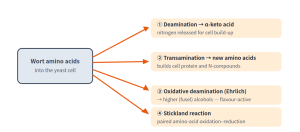
Yeast converts wort amino acids in four possible ways:
① deamination · ② transamination · ③ oxidative deamination — the Ehrlich reaction, producing higher (fusel) alcohols · ④ the Stickland reaction
Groups A to D — how do amino acids line up at the yeast’s dinner table?
Just like sugars, amino acids are absorbed in a fixed order. Classified by assimilation time and rate, wort amino acids fall into 4 groups (Table 3) — and regrouping them by importance during yeast metabolism gives the 3-group scheme (Table 4).
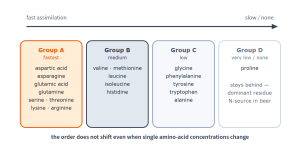
Table 2 — Three-group classification of amino acids by importance in yeast metabolism
| Group |
Amino acids |
Practical meaning |
| First group |
aspartic acid, asparagine, glutamic acid, glutamine, serine, threonine |
Concentration in wort hardly matters — yeast synthesises these easily |
| Second group |
isoleucine, methionine, phenylalanine, glycine, valine, tyrosine |
Wort concentration is fairly important — synthesis happens only when fermentation leaves them short; their level strongly shapes finished-beer quality |
| Third group |
alanine, tryptophan, arginine, leucine |
Most important — yeast must absorb them from outside. If wort lacks them, metabolism shifts toward higher alcohols and α-keto acids and beer quality suffers. If wort carries them in excess, by-products surge and quality also suffers — control total amino acids and the group-2/3 fractions |
What happens when the yeast’s pantry runs empty?
Wort must supply not just amino acids but the whole nutrient set. Table 4 reads like a diagnostic chart for a failing fermentation:
Table 3 — Yeast nutrients, their roles, and the symptoms of deficiency
| Nutrient |
Role |
Symptoms when lacking |
| Assimilable substances (main amino acids) |
Build cell protein and nucleic acids — the backbone of cytoplasm and yeast’s principal nutrient |
Yeast growth and reproduction badly impaired; fermenting power drops; diacetyl reduction suffers |
| Growth factors (purines, vitamins) |
Essential components of yeast cell enzyme active groups |
Intracellular enzyme activity falls; fermentation weakens |
| Mineral: phosphorus |
Absorbed as phosphate, rapidly built into organic compounds — nucleic acids, high-energy phosphates; phosphate buffers wort strongly |
Yeast growth slows, fermentation stalls, fermenting power declines |
| Mineral: zinc |
Active group of ethanol dehydrogenase and lactate dehydrogenase; activator of many enzymes |
Slow fermentation, low attenuation, sluggish diacetyl reduction |
Brewer’s takeaway: a “slow fermentation” is rarely one problem. Before blaming the yeast, check the menu — break separation, temperature curve, pitching rate, pressure profile, and above all the amino-acid bill of your wort. A grist or mashing program that short-changes the third-group amino acids will surface days later as fusel-heavy beer no filtration can fix.
The big picture — how does one yeast cell transform an entire wort?
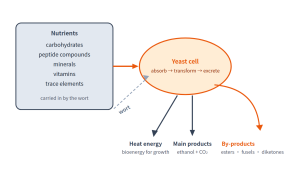
Before diving deeper, step back and look at the whole conversion map (redrawn from Fig 4-4): five nutrient streams enter one yeast cell, and three streams leave it. Every flavour decision in fermentation happens somewhere on this diagram.
How can you put sugar and nitrogen metabolism to work in your own brewhouse?
Three levers you actually control
- Adjunct dosing discipline. Because of catabolite repression, glucose or sucrose syrups should be part of the kettle — not a mid-fermentation rescue. If you must dose late, expect the maltose queue to stall and plan a longer fermentation or a more vigorous yeast strain.
- Amino-acid profile through mashing. Protein modification during malting and mashing conditions (45–50 °C peptidase rests) determine how rich the group-2 and group-3 amino acids are. Under-modified malt or a skipped protein rest shows up as stressed yeast and fusel-heavy beer.
- Pitching rate and aeration. The 3–4 × 10⁷ cells/ml target is not a ritual — it sets the contact area between yeast and wort that governs sugar conversion speed. Under-pitching pushes individual cells to multiply too hard (more by-products); over-pitching leaves too little growth for a clean profile.
What does the sugar queue mean for attenuation and diacetyl?
A beer that “hangs” at 3 °P usually has maltotriose still waiting: either the strain is a weak maltotriose eater, pressure and CO₂ have climbed too high, or zinc is short (Table 3). Before adding sugary priming, measure — the slowest sugar in the queue is often the whole story of your final gravity.
Why does pressure matter more in tall tanks?
In a cylindroconical tank the hydrostatic head plus active CO₂ evolution raise the pressure the yeast experiences. Dissolved CO₂ rises, and fermentation, cell multiplication and by-product formation all slow down. That is exactly how pressure-fermented beers achieve low ester levels — and why the same strain tastes different at 2 m and at 20 m of liquid column.
Quick self-check before your next brew day
- Is the fermentable : non-fermentable ratio matched to the style (≈7 : 3 baseline)?
- Is any glucose/sucrose syrup dosed in the kettle, not mid-fermentation?
- Is free amino nitrogen adequate — especially group-3 amino acids?
- Is pitching rate on target (3–4 × 10⁷ cells/ml) with oxygen to 8–10 mg/L?
- Are zinc and phosphate levels sufficient for enzyme activity and buffering?
Frequently asked questions about fermentation sugar and nitrogen metabolism
1. Which wort sugars can brewing yeast actually ferment?
Glucose, fructose, sucrose, maltose, maltotriose and raffinose. The DP₃–DP₉ dextrin-range sugars are unfermentable by normal brewer’s yeast and remain in the beer for body.
2. Why is my fermentation stuck around 3 °P?
Usually slow maltotriose consumption — a strain trait, high CO₂ pressure, low yeast vitality, or a zinc/phosphate deficiency. Check the slowest sugar in the queue before adding anything to the tank.
3. Does adding glucose speed up fermentation?
Early and moderately, yes. But extra glucose or sucrose mid-ferment triggers catabolite repression: maltose and maltotriose uptake switch off until the glucose is gone, so total fermentation time often stretches instead of shrinking.
4. What is the glucose effect?
Catabolite repression: while glucose concentration stays high, yeast does not produce maltose permease, so maltose cannot even enter the cell. In normal wort it passes unnoticed; with heavy adjunct dosing it dominates the fermentation schedule.
5. Why can’t yeast use proline as a nitrogen source during fermentation?
Group-D amino acids like proline lack the transporter activity under brewing (anaerobic) conditions, so proline is barely assimilated and dominates the residual nitrogen of finished beer.
6. Which amino acids matter most for beer quality?
The third group — alanine, tryptophan, arginine, leucine. Yeast must absorb them from the wort; too few pushes metabolism toward higher alcohols and α-keto acids, too many floods the beer with by-products.
7. What is the Ehrlich reaction?
Oxidative deamination of amino acids by yeast, producing the corresponding higher (fusel) alcohols. It is the main route from wort amino acids to flavour-active alcohols like isoamyl alcohol.
8. How high should pitching rate be?
Typically (3–4) × 10⁷ cells per ml of wort, rising to about 10⁸ cells/ml at peak growth. Pitching rate sets the yeast–wort contact area that governs sugar conversion speed — and the by-product balance.
Building a brewhouse that feeds yeast exactly what it wants?
Sugar queues and amino-acid bills are decided long before pitching — in your mashing program, your adjunct strategy and your wort separation. ZR Brewing designs mashing, lautering and fermentation equipment that gives brewers precise control over every one of these levers.
Questions about wort composition or fermentation control? Contact us at [email protected] or visit www.zrbrewing.com.


 Gepubliceerd