Vessel choice is not a materials question first. It is a cap-management, temperature-control, and cleaning-burden question, and the material follows from those three answers. This guide compares the vessel types wineries and cideries actually choose between, then narrows to what a stainless fermenter needs to specify once you know your process.
What “Vessel Type” Actually Decides on the Cellar Floor
Ask five winemakers what vessel type they prefer and you’ll get five answers built on different priorities. That’s because “vessel type” is really shorthand for three separate operational decisions:
Cap management — how you keep skins and solids in contact with juice during red wine or some cider fermentations. An open-top tank lets you punch down by hand or mechanically. A closed tank forces you into pump-over or rotary designs instead.
Temperature control — whether the vessel has a cooling jacket, relies on ambient cellar temperature, or needs supplemental heating for cold-climate cider work. This matters more for wine and cider than for beer, because fermentation temperature swings affect aromatic retention in ways a brewer’s process doesn’t have to manage in the same way.
Cleaning burden — how much labor and downtime each cleaning cycle costs. A vessel with internal fittings, a manway, and complex geometry takes longer to clean than a simple cylindrical tank, and that difference compounds across a harvest season with back-to-back lots.
Most comparison content sorts vessels by shell material and treats cap management, temperature control, and cleaning as secondary notes. That ordering gets the decision backwards for most commercial operations, where the process constraint should select the vessel type first.
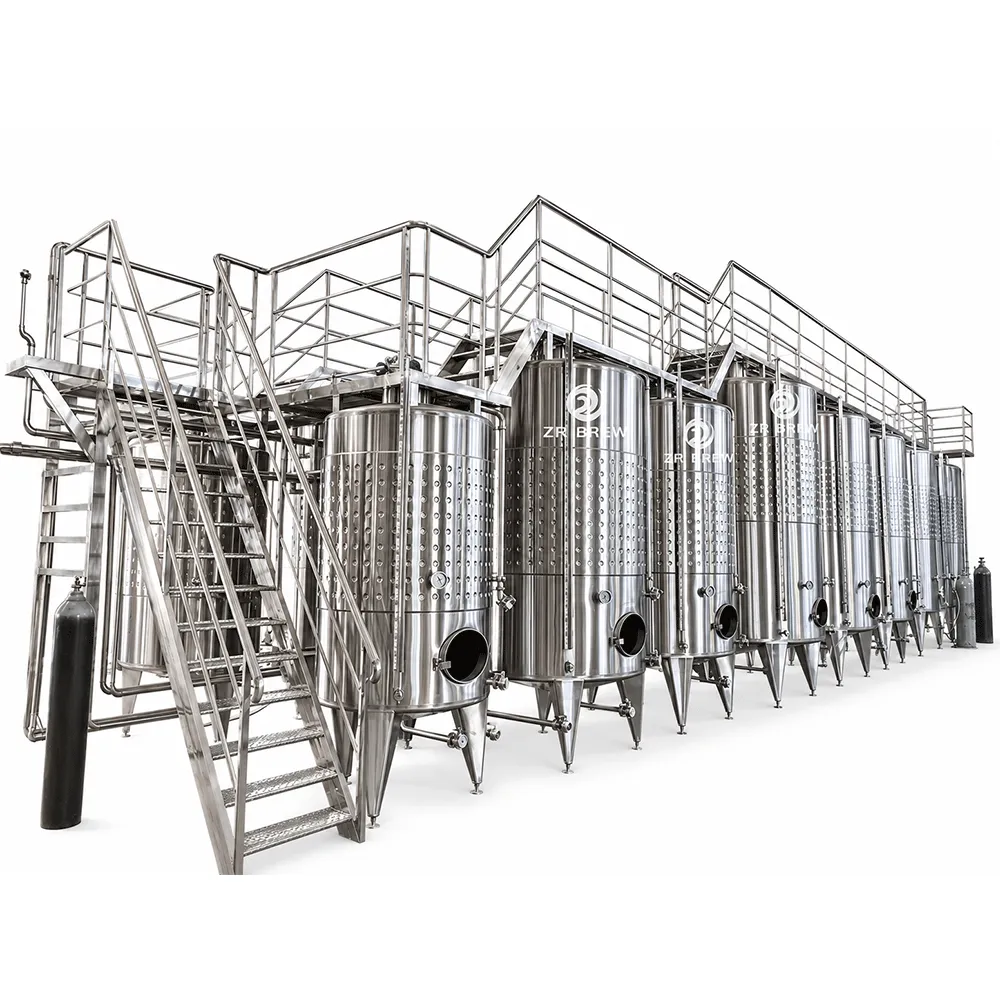
Open-Top vs. Closed-Top Fermenters
This is the split that determines your cap-management method before anything else.
Open-top vessels expose the must directly, which supports manual or mechanical punch-down and easier visual monitoring during active fermentation. They’re common for red wine programs and for ciders that ferment with pulp contact. The tradeoff is CO₂ off-gassing into the cellar and no pressure capability, which rules them out for any process step needing counter-pressure or extended sealed aging.
Closed-top (sealed) fermenters support pump-over and rotary cap-management systems, plus post-fermentation options like carbonic maceration under controlled headspace or sealed aging without oxygen pickup. They cost more to fabricate because of the manway, fittings, and pressure-rated construction, and cap monitoring requires sampling ports rather than a direct look.
| Vessel Type |
Cap Management |
Temperatuurregeling |
Cleaning Burden |
Typical Fit |
| Open-Top Tank |
Manual or mechanical punch-down; direct visual access |
Jacket optional; often ambient-dependent |
Lower — simple geometry and easy access from the top manway |
Red wine with active cap management; small-batch pulp cider |
| Closed Conical/Sealed Tank |
Pump-over or rotary systems; sampling ports only |
Jacket standard on most commercial builds |
Higher — internal fittings and sealed access add cleaning steps |
Sealed fermentation, carbonic maceration, and pressure-tolerant processes |
| Variable-Capacity (Floating-Lid) Tank |
Limited — lid rides on the liquid level, restricting mechanical cap tools |
Jacket optional; less common |
Moderate — fewer internal fittings, but lid seals require regular inspection |
Partial-lot storage and topping-sensitive small runs |
| Insulated, Non-Jacketed Tank |
Vessel-dependent |
Relies on cellar ambient temperature or seasonal timing |
Lower to moderate |
Cold cellars with stable ambient temperatures; budget-constrained builds |
Variable-capacity tanks deserve a separate note because they solve a problem the other two don’t: partial-lot storage without excess headspace. A floating lid rises and falls with liquid level, which limits topping losses when you’re not filling a tank to capacity. The cost is reduced compatibility with mechanical cap-management equipment, since most punch-down and pump-over hardware assumes a fixed-volume, fixed-headspace vessel.

Cap Management: What Each Vessel Type Assumes You’ll Do Manually
Cap management is where vessel choice creates downstream labor consequences that don’t show up on a spec sheet.
- Manual punch-down requires open-top access and enough clearance above the tank for a worker or platform. It’s labor-intensive per cycle but needs no additional equipment, and it’s the default for small-lot programs.
- Mechanical punch-down automates the same motion with a hydraulic or pneumatic ram, still requiring open-top geometry, and reduces labor per cycle but adds equipment cost and maintenance.
- Pump-over circulates juice from the bottom of a closed tank back over the cap through a top-mounted sprinkler, which works in sealed vessels but needs a pump, piping, and enough tank height to generate flow.
- Rotary fermenters rotate the entire vessel to submerge the cap mechanically, eliminating pumping but requiring a purpose-built rotating shell that most standard tank fabrication doesn’t produce.
If your process calls for pump-over or rotary cap management, an open-top tank is the wrong starting point regardless of how the rest of the spec looks — the vessel geometry has to support the method before capacity or material selection matters.

Temperature Control: Jacketed vs. Ambient-Dependent Vessels
Wine and cider fermentations are more temperature-sensitive than most beer fermentations for one specific reason: aromatic compounds in fruit-forward beverages degrade or shift character faster outside a narrow temperature band, and there’s no boil step afterward to reset the profile. A jacketed vessel with glycol cooling holds that band regardless of ambient cellar conditions or seasonal harvest heat. A non-jacketed vessel depends on cellar design — thick walls, underground siting, or mechanical cellar cooling — to do the same job indirectly.
The practical dividing line is harvest timing and climate. A cidery processing fruit in a cool autumn with a stable cellar can often run ambient-dependent tanks without issue. A winery crushing in warm-climate conditions, or any operation running back-to-back lots where cap heat from active fermentation stacks up, generally needs jacket cooling to avoid temperature spikes that a single ambient-controlled cellar can’t absorb fast enough.
Cleaning Burden: The Cost That Shows Up After Harvest, Not During It
Cleaning burden is the factor most comparison guides skip, and it’s the one that determines labor cost across an entire season rather than a single fermentation.
CIP (clean-in-place) compatible tanks reduce manual cleaning to a programmed cycle, but the geometry has to support it — spray-ball coverage, drainable bottoms, and minimal internal obstructions. Vessels with extensive internal fittings, cooling coils, or complex manway hardware take longer to clean manually and are harder to fit with an effective CIP spray pattern. Compared with fixed-configuration setups that many suppliers present as a single standard build, tank geometry, fitting placement, and CIP compatibility should be confirmed as a project-specific configuration rather than assumed from a general product category.
For an operation running multiple lots through the same tank in a compressed harvest window, cleaning turnaround between lots can matter as much as fermentation capacity itself. A tank that ferments well but takes an extra two hours to clean between batches effectively reduces your usable capacity during the busiest weeks of the year.
Common Misconception: “Any Stainless Tank Works for Wine and Cider”
The most common assumption we hear from buyers moving from beer or general beverage production into wine or cider is that a stainless fermentation tank is a stainless fermentation tank. It isn’t, for three specific reasons.
First, cap-management compatibility is not universal — a tank built for closed, pressure-tolerant fermentation won’t support manual punch-down without modification, and vice versa. Second, fruit-based fermentations often need lower or more tightly held temperature ranges than typical ale or lager fermentation, which changes jacket coverage and glycol capacity requirements even at the same nominal volume. Third, wine and cider processes frequently need different port placement for juice transfer, pomace removal, or must additions than a beer-oriented fermenter layout assumes.
None of this means wine and cider fermenters require exotic materials. SUS304 stainless steel remains the standard base material across beverage fermentation generally. It means the vessel needs to be specified against your actual cap-management method, temperature target, and cleaning workflow — not selected from a generic beverage-tank catalog and assumed to fit.
Specifying a Fermentation Vessel: ZR-WF Series Parameters
Within ZR Brew’s published catalog, the ZR-WF Series covers winery and cidery processing vessels at four disclosed capacity points: ZR-WF-500L, ZR-WF-2000L, ZR-WF-20T, and ZR-WF-32T. Construction is stainless steel, with glycol cooling or project-specific temperature-control systems available depending on the configuration, and CIP-compatible builds offered for operations that want programmed cleaning cycles rather than manual clean-out.
The series is supplied both as individual tanks and as part of integrated turnkey processing systems, which matters if you’re specifying a full cellar buildout rather than a single fermenter — grape wine, fruit wine, cider, and juice fermentation are all listed applications, so the same base series covers multiple beverage categories rather than requiring a separate product line per beverage type.
Dimensions, pressure ratings, cooling-jacket area, and detailed process-stage configuration are confirmed per project rather than published as fixed specifications across the series, which is consistent with how cap-management method and temperature-control needs vary by winery or cidery even at the same nominal capacity. If your process calls for a specific cap-management design or a defined temperature-control tolerance, that detail needs to go into the project brief rather than being assumed from the capacity figure alone.

Certification and Compliance Notes
ZR Brew holds CE and ISO 9001 status at the company level rather than as a per-model certificaat, which is a distinction worth checking with any supplier: a company-level ISO 9001 quality management claim, governed by the International Organization for Standardization, describes how the manufacturer’s processes are managed — it is not the same as a machine-specific pressure or safety certificate. If your project needs a specific vessel-level certificate, material certificate, or pressure-test report, confirm that document is available before finalizing an order rather than assuming a company-level claim covers it.
Cost Considerations
Vessel pricing depends on capacity, cap-management hardware, jacket configuration, material grade, fittings, and whether the tank is quoted standalone or as part of an integrated system — there is no fixed per-liter figure that holds across configurations. Request an itemized quotation against your specific cap-management method and temperature-control requirement rather than comparing headline capacity prices across suppliers, since two tanks at the same nominal volume can carry very different costs depending on jacket coverage and internal fittings alone.
FAQ
Do I need a jacketed tank for small-batch cider production?
Not necessarily. If your cellar holds a stable, cool ambient temperature through the fermentation window, a non-jacketed insulated tank can work. Jacket cooling becomes more important with warmer ambient conditions, back-to-back lot scheduling, or when you need to hold a tighter temperature band than the cellar can maintain on its own.
Can an open-top tank be converted for sealed, pressure-tolerant fermentation later?
Generally no without significant rework — open-top vessels aren’t built to the pressure-rated specification a sealed tank requires. If there’s a chance your process will move toward pump-over, rotary cap management, or sealed aging, specify the closed-top configuration from the start.
What’s the practical difference between a variable-capacity tank and a standard fixed tank for a small winery?
A variable-capacity tank reduces topping and headspace management for partial lots, which matters most when lot sizes vary from harvest to harvest. A fixed tank is simpler to clean and typically less expensive at the same nominal capacity, but requires either topping additions or accepting extra headspace oxidation risk when it isn’t filled to capacity.
Is stainless steel always the right material for wine and cider fermenters?
For sanitary processing, temperature control, and cleaning efficiency, stainless steel is the standard base material across commercial wine and cider fermentation. The vessel-type decision — open-top vs. closed, jacketed vs. ambient, fixed vs. variable-capacity — matters more for your specific process outcome than a material choice away from stainless.


 Gepubliceerd