A commercial kombucha line is not a bigger jar. It needs a dedicated tea-brewing vessel, a fermentation section sized for weeks of dwell time, glycol cooling, CIP cleaning, and a control system that can repeat the same acid profile batch after batch — most home-scale kits skip several of these entirely.
Core Subsystems of a Commercial Kombucha Line
A working commercial system is typically built around four connected sections rather than one multipurpose tank:
- Tea brewhouse section — heats water and steeps tea concentrate at a controlled temperature before it moves to fermentation.
- Fermentation section — holds the sweetened tea and SCOBY culture for the multi-day to multi-week fermentation window, with temperature stability as the main variable to control.
- Cooling system — brings the hot tea down to fermentation-safe temperature and helps hold that temperature through the cycle.
- CIP (clean-in-place) support — circulates cleaning and sanitizing solution through the vessel and lines between batches without full manual disassembly.
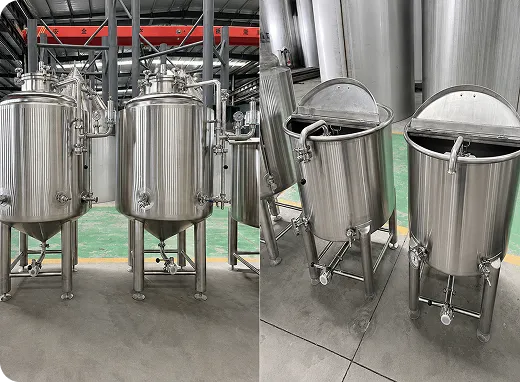
A published configuration in this category is the ZR-KBC-2500L Kombucha Brewing System, which packages these four functions into one line:
| Parameter |
Published Value |
| Production Capacity |
2,500 L per batch |
| Published Production Capability |
Up to 8 batches per day under the stated configuration |
| Vessel Material |
SUS304 stainless steel |
| Verwarmingsmethode |
Steam heating |
| Besturingssysteem |
PLC semi-automatic control |
| System Scope |
Brewhouse, fermentation section, cooling system, CIP support and control system |
That “up to 8 batches per day” figure is a published capability, not a guarantee — it depends on how long each brew and fermentation cycle actually runs, how many tanks are cycling in parallel, and how much time is set aside for cleaning between runs. A single-tank line brewing a 14-day ferment will never hit that number regardless of what the brewhouse can theoretically process; the batches-per-day ceiling only applies to the brewing and heating stage, not the full fermentation timeline.
Batch Volume and Production Planning
Before comparing equipment, most operators need to work backward from a target output rather than forward from a tank size:
- Estimate weekly sales volume in liters or gallons, including packaging losses.
- Divide by the fermentation dwell time your recipe requires (commercial kombucha fermentation commonly runs 7–30 days depending on culture and flavor profile).
- Multiply that by the number of parallel fermentation vessels needed to keep production continuous rather than batch-and-wait.
- Add a starter-tea reserve, since each new batch needs a portion of the previous batch to inoculate it — this is a volume line most first-time buyers forget to budget for.
Skipping step 4 is the most common planning mistake at this stage: a facility sized purely on retail demand often finds it’s short on tank capacity within the first few months, because part of every batch has to be held back as starter liquid for the next one rather than sold.
Material and Sanitation: Why Kombucha Is Harder on Equipment Than Beer
Kombucha’s fermentation is more acidic than most beer styles, and the culture itself is active rather than a controlled single-strain yeast. Two practical consequences follow.
First, food-grade stainless steel (commonly SUS304) is the standard vessel material for a reason — it resists the acid environment far better than mild steel or plastic over repeated cycles, though it isn’t immune to pitting if cleaning residue is left standing. Second, CIP isn’t optional the way it might be for a low-volume homebrew tank that gets hand-scrubbed between batches. At commercial batch counts, manual cleaning becomes the production bottleneck long before the fermentation tanks do.
Heating and Control: What “Semi-Automatic” Actually Means
Steam heating is common at this scale because it heats large tea volumes more evenly than direct electric elements, reducing the risk of scorching tea solids against a hot surface. PLC semi-automatic control, as used in the ZR-KBC-2500L configuration, typically means the system holds temperature and timing automatically once a cycle is started, while an operator still manually initiates each stage and confirms readings — it is not the same as a fully automatic line requiring no operator input at all. Buyers evaluating quotes should ask suppliers to specify exactly which stages are automated and which still require manual sign-off, since “PLC control” alone doesn’t tell you that.
Homebrew Kit vs. Commercial Kombucha System
| Dimension |
Homebrew / Small-Batch Kit |
Commercial Line (e.g., 2500L Class) |
| Typical Batch Size |
1–20 gallons |
Hundreds to thousands of liters |
| Vessel Material |
Glass, HDPE or light stainless steel |
Food-grade stainless steel (SUS304) |
| Verwarming |
None or manual stovetop heating |
Steam or another controlled heating source |
| Process Control |
Manual, based on feel and taste |
PLC-assisted with repeatable settings |
| Schoonmaken |
Manual scrubbing |
CIP circulation |
| Culture Management |
Single SCOBY, managed as needed |
Dedicated starter-tea reserve and scheduling |
Compared with the mixed homebrew-kit and generic-tank listings that currently dominate this search category, the distinction that actually affects a buying decision isn’t tank size alone — it’s whether heating, cooling, control, and cleaning are engineered as one connected system or left for the operator to improvise separately.
Evaluating a Commercial Kombucha Equipment Supplier
- Confirm the vessel material grade in writing (SUS304 vs. SUS316, and whether that varies by wetted-part contact).
- Ask which stages of the process are PLC-controlled and which require manual operator action.
- Request the CIP circulation method and cycle time, not just confirmation that “CIP is included.”
- Clarify batches-per-day figures against your actual fermentation dwell time, not the brewhouse throughput alone.
- Confirm heating method compatibility with your facility’s utilities (steam supply, electrical capacity, or gas).
- Ask for documentation on pressure ratings and material certificates for the specific vessel, not a general company brochure.
Pricing
Kombucha brewing systems at this scale are configured to order — batch volume, heating method, control level, and tank quantity all change the final cost. ZR Brew does not publish a standardized price list for the ZR-KBC-2500L system; production capacity, process requirements, and destination-country utilities are itemized in a project-specific quotation rather than a fixed catalog price.
FAQ
Can a homebrew kombucha kit be scaled up into a commercial line by just buying a bigger tank?
Not reliably. A bigger tank increases volume but doesn’t add heating control, CIP cleaning, or repeatable process settings — the gap is usually in those three areas, not tank size.
How many batches per day can a 2500L kombucha system actually produce?
The published capability for the ZR-KBC-2500L configuration is up to 8 batches per day, but that figure reflects brewhouse throughput. Actual output depends on fermentation dwell time, cleaning cycles, and how many tanks run in parallel.
Does PLC control mean the system runs without an operator?
Not necessarily. “PLC semi-automatic” typically means temperature and timing are automated once a stage starts, while an operator still initiates each stage and confirms readings.
Is SUS304 stainless steel sufficient for kombucha’s acidity, or is SUS316 required?
SUS304 is the standard material for published commercial kombucha configurations. SUS316 may be specified for particular wetted-part or corrosion-resistance requirements, subject to project confirmation with the supplier.
Is there a published price for a commercial kombucha system?
No standardized public price list exists for this equipment category. Batch volume, heating method, automation level, and destination utilities all affect the final quotation.


 Gepubliceerd