Brewing kombucha is simple at a small scale, but maintaining consistent flavor, acidity, and quality becomes harder as production grows. Without proper fermentation control and equipment, commercial producers may face inconsistent batches and higher operating costs.
To brew kombucha, prepare sweet tea, cool it, add an active SCOBY culture and starter liquid, and allow fermentation under suitable conditions. The finished beverage can then be flavored, clarified, and carbonated. Commercial kombucha production follows the same basic principles but requires sanitary stainless steel tanks, temperature control, reliable cleaning systems, and a well-planned production line.
1. What Is Kombucha and How Does Kombucha Brewing Work?
Kombucha is a fermented tea beverage made with tea, sugar, water, and a SCOBY, which stands for Symbiotic Culture of Bacteria and Yeast.
During fermentation, microorganisms convert part of the sugar into organic acids, carbon dioxide, and alcohol. This process gives traditional kombucha its slightly sour taste and distinctive flavor.
The main stages of the kombucha brewing process include:
- Tea preparation: Brew tea and dissolve sugar.
- Cooling: Reduce the tea temperature before adding the starter.
- Primary fermentation: Add SCOBY and starter liquid.
- Clarification: Remove unwanted particles where required.
- Flavoring: Add suitable fruit or botanical ingredients.
- Carbonation: Adjust dissolved CO₂ according to the product specification.
- Packaging: Fill the finished beverage into bottles, cans, or kegs.
Each stage influences the final product. For commercial producers, controlling these steps is essential for consistent beverage quality.
2. What Ingredients and Supplies Do You Need to Brew Kombucha?
A basic kombucha recipe requires only a few ingredients.
| Ingredient |
Functie |
| Tea |
Provides the beverage base and nutrients |
| Cane Sugar |
Supplies fermentable carbohydrates |
| Water |
Forms the liquid base |
| SCOBY |
Provides the microbial culture |
| Starter Liquid |
Introduces active microorganisms and acidity |
Black tea is commonly used, although other suitable teas can also support fermentation.
For home brewing, a clean glass jar, breathable cover, and basic monitoring tools may be sufficient for a small experimental batch.
However, making kombucha at home is different from producing it for commercial sale.
Larger operations require repeatable ingredient preparation, documented sanitation, controlled fermentation conditions, and product testing.
3. How to Brew Kombucha Step by Step
The basic process is similar whether you make kombucha at home or operate a commercial production facility.
Step 1: Prepare the Sweet Tea
Heat water, steep the tea, and dissolve the required sugar.
Allow the sweet tea to cool before introducing the microbial starter. Excessive heat can damage the culture.
Step 2: Add the SCOBY and Starter Liquid
Transfer the cooled tea into a suitable fermentation container.
Add the SCOBY culture and active starter liquid. The starter helps establish the acidic conditions needed for fermentation.
Traditional primary fermentation generally requires oxygen access for acetic acid bacteria.
Step 3: Allow Controlled Fermentation
A typical fermentation period may range from approximately 7–15 days, depending on temperature, starter activity, and recipe.
During this stage, monitor acidity, temperature, and product condition.
Commercial producers should also establish appropriate alcohol and microbiological testing procedures.
Step 4: Flavor, Carbonate, and Package
Once fermentation reaches the required endpoint, the beverage can undergo clarification, flavoring, and carbonation.
Natural carbonation may continue in bottles, but uncontrolled pressure and alcohol formation create safety and quality risks.
Commercial producers often use suitable pressure-rated tanks for controlled carbonation before filling.
4. How Do SCOBY and Fermentation Affect Kombucha Quality?
The SCOBY contains bacteria and yeast that work together during fermentation.
Yeast breaks down fermentable sugars and produces alcohol and carbon dioxide. Acetic acid bacteria can convert some of the alcohol into organic acids when oxygen is available.
Several factors influence the result:
| Factor |
Effect on Kombucha |
| Fermentation Temperature |
Influences microbial activity |
| Sugar Concentration |
Affects available fermentable material |
| Starter Quality |
Influences fermentation consistency |
| Oxygen Availability |
Supports aerobic microbial activity |
| Fermentation Time |
Changes acidity and flavor |
| Sanitation |
Helps reduce contamination risks |
A longer fermentation does not always produce a better beverage. Excessive acidity can make kombucha unpleasant to drink.
For commercial kombucha brewers, the goal is to establish a repeatable process that delivers the intended flavor and acidity.
Important: pH measurement alone does not guarantee beverage safety. Commercial production requires suitable process validation, sanitation, and quality testing.

5. How Do You Control Flavor and Carbonation?
Flavor development is an important part of kombucha making.
After primary fermentation, producers may add fruit juice, ginger, herbs, or other suitable ingredients to create flavored kombucha.
These additions can change sugar concentration, acidity, and microbial activity.
Natural vs. Forced Carbonation
| Method |
Beschrijving |
Main Consideration |
| Natural Carbonation |
Continued microbial activity produces CO₂ |
Pressure and alcohol may continue increasing |
| Kunstmatige koolzuiniging |
CO₂ is introduced using suitable equipment |
Requires pressure-rated tanks and controlled operation |
For commercial production, controlled carbonation can help maintain a more consistent finished product.
ZR Brew offers beverage finishing equipment configurations that can include flavoring tanks and carbonation vessels.The selected equipment must match the product’s pressure requirements, packaging format, and production process.
6. Home Brewing vs. Commercial Kombucha Production
Home brewing is useful for learning kombucha brewing basics, but scaling production requires additional equipment and process control.
| Requirement |
Home BrewingCommercial Production |
| Production Volume |
Small batches |
Hundreds or thousands of liters |
| Fermentation Vessel |
Glass jar |
Stainless steel fermentation tank |
| Temperatuurregeling |
Basic monitoring |
Jacketed tanks and sensors |
| Schoonmaken |
Manual |
Sanitary cleaning and CIP |
| Culture Management |
Small starter reserve |
Documented culture handling |
| Koolzuurtoevoeging |
Often natural |
Controlled finishing systems |
| Verpakking |
Manual bottling |
Commercial filling equipment |
| Quality Control |
Limited testing |
Documented process and product testing |
A larger tank alone does not guarantee consistent production.
Commercial producers must also consider liquid transfer, fermentation schedules, cleaning time, utilities, and packaging capacity.For beverage startups planning to expand, these factors should be evaluated before purchasing equipment.
7. What Equipment Is Needed for Commercial Kombucha Brewing?
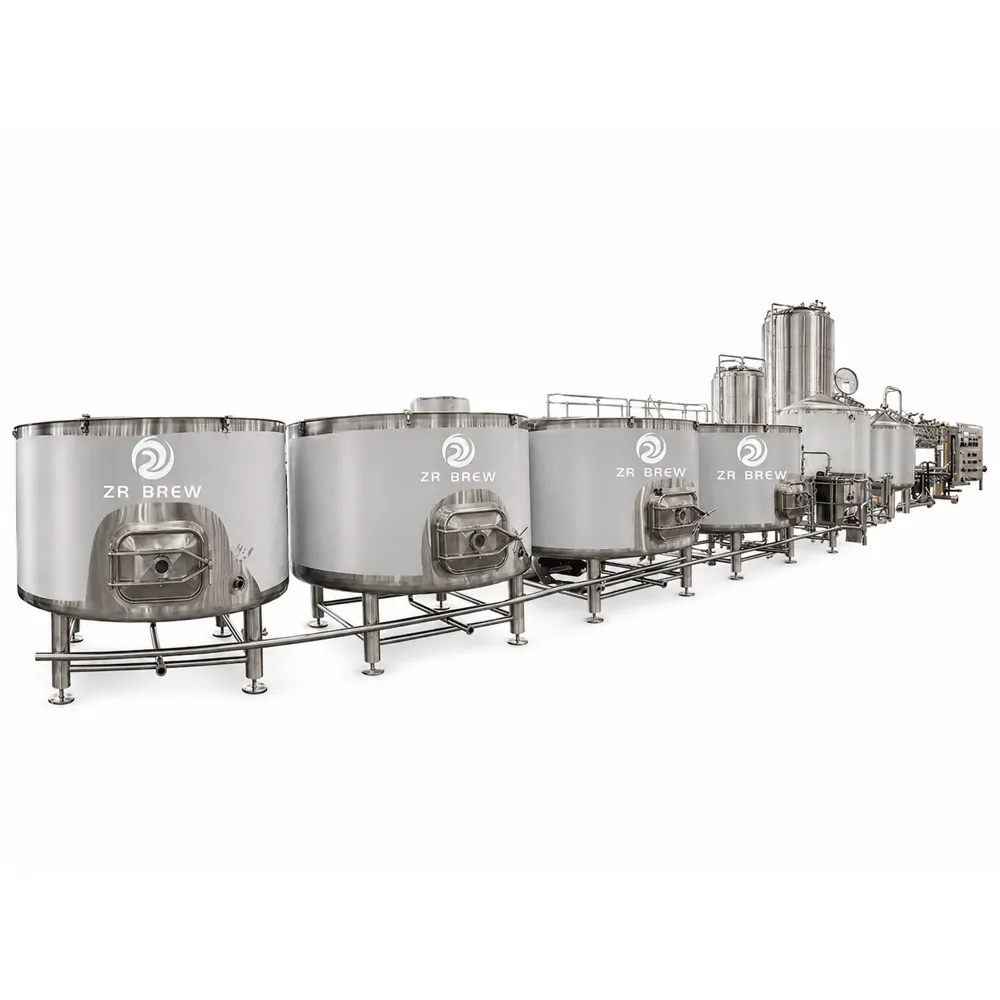
A complete kombucha production line connects tea preparation, fermentation, flavoring, and packaging.
ZR Brew manufactures customizable stainless steel beverage processing equipment for commercial producers.
Main Kombucha Brewing Equipment
| Apparatuur |
Functie |
| Tea Brewing Kettle |
Prepares the tea base |
| Sugar Mixing Tank |
Dissolves and blends sugar |
| Plaatwarmtewisselaar |
Cools tea before fermentation |
| Kombucha Fermentation Tanks |
Support controlled primary fermentation |
| Cooling Jacket |
Helps maintain process temperature |
| Flavoring Tank |
Mixes fruit or botanical ingredients |
| Carbonation Tank |
Supports controlled CO₂ addition |
| CIP System |
Cleans compatible tanks and piping |
| Besturingssysteem |
Monitors selected process parameters |
| Filling Equipment |
Packages the finished beverage |
Stainless Steel Fermentation Tanks
ZR Brew offers SUS304 and SUS316 material options for suitable beverage processing applications.
Commercial kombucha fermenters can be configured with open-top access, temperature-control jackets, and PT100 temperature sensors.
Open-top designs may support traditional aerobic fermentation, while closed vessels can be considered for appropriate processing stages.
The tank structure must match the actual fermentation method and operating pressure.
Explore ZR Brew Kombucha Brewing Equipment for available system configurations.
8. How Do You Choose the Right Kombucha Brewing System Capacity?
Choosing the correct production capacity is essential for controlling investment and planning future growth.
ZR Brew offers equipment configurations for pilot-scale, small commercial, and larger industrial production.
| Equipment Capacity |
Typical Application |
| 100–500L |
Pilot production and beverage startups |
| 500–1500L |
Small commercial producers |
| 2000–5000L+ |
Larger beverage manufacturing facilities |
How Many Fermentation Tanks Do You Need?
Consider a facility preparing 1000L of tea per day with a primary fermentation period of 10 days.
A simplified estimate is:
1000L × 10 days = 10,000L fermentation capacity
This represents the approximate occupied liquid volume before allowances for tank headspace, cleaning, scheduling, and spare capacity.
The example shows why commercial kombucha production needs sufficient fermentation storage rather than only a large tea brewing kettle.
9. What Affects Commercial Kombucha Brewing Equipment Cost?
The cost of commercial kombucha equipment depends on more than tank volume.
Two systems with the same nominal capacity may have different prices because of their material specifications, automation, and supporting equipment.
Main Cost Factors
| Cost Factor |
Purchasing Consideration |
| Production Capacity |
Batch volume and number of tanks |
| Tank Material |
SUS304 or SUS316 |
| Fermentation Design |
Open-top or closed configuration |
| Temperatuurregeling |
Cooling jackets and sensors |
| Automation |
PID or PLC control |
| Auxiliary Equipment |
Cooling, CIP, pumps, and piping |
| Verpakking |
Bottling, canning, or kegging |
| Installation |
Facility layout and commissioning requirements |
When requesting a quotation, buyers should confirm whether the price includes pumps, pipework, electrical controls, cooling systems, and installation support.
A complete equipment proposal helps avoid unexpected costs during project implementation.
10.Why Choose ZR Brew for Your Kombucha Production Line?
ZR Brew manufactures customized stainless steel brewing and beverage processing equipment for international B2B customers.
Our equipment scope includes kombucha brewing systems, fermentation tanks, mixing vessels, cooling systems, and supporting production equipment.
We work with beverage startups, commercial producers, project investors, and engineering contractors to develop equipment configurations based on actual production requirements.
Customized Equipment and Production Layout
Every beverage project has different requirements.A small startup may need a compact system with room for expansion, while a larger manufacturer may require multiple fermentation tanks and integrated process controls.
ZR Brew can discuss tank capacity, material selection, piping connections, automation, and production layout according to the customer’s project needs.
FAQ
How long does it take to brew kombucha?
Primary fermentation commonly takes approximately 7–15 days. The actual duration depends on temperature, starter activity, recipe, and the desired product characteristics. Commercial producers should use defined process endpoints rather than relying only on time.
Do you need a SCOBY to make kombucha?
You need an active microbial starter culture. The visible cellulose layer commonly called a SCOBY is not always necessary when suitable active starter liquid is available.
Can kombucha be brewed in stainless steel tanks?
Yes. Suitable food-grade stainless steel tanks are widely used in commercial kombucha production. Material selection, vessel design, oxygen access, and cleaning requirements should match the fermentation process.
What size kombucha brewing equipment is suitable for a startup?
Pilot-scale systems around 100–500L may suit early product development. The correct capacity depends on expected sales, fermentation duration, packaging requirements, and available utilities.
How do you carbonate kombucha for commercial sale?
Commercial producers may use suitable pressure-rated carbonation tanks with controlled CO₂ injection. Product stability, residual sugar, alcohol content, and packaging pressure must also be managed.
Can ZR Brew provide a complete kombucha production line?
ZR Brew provides customizable kombucha brewing equipment and supporting beverage processing systems. The equipment scope can be developed around the customer’s required capacity, fermentation method, production layout, and packaging needs.
Start Your Commercial Kombucha Project with ZR Brew
Moving from home brewing to commercial kombucha production requires reliable equipment, controlled fermentation, and careful production planning.
ZR Brew provides customized stainless steel kombucha brewing systems for beverage startups, commercial manufacturers, and international project investors.


 Gepubliceerd