Esters — the smallest fraction with the loudest voice?
Esters are the principal component of beer aroma: tiny in quantity, enormous in impact. The right ester level makes the flavour full and harmonious; excessive esters bring an unpleasant “solvent” or fruity-sour note. Most esters form in primary fermentation along with alcohol formation — after which their share changes only slightly during maturation. Esters arise mainly in yeast’s energy metabolism; in beer they increase only very slowly as wort gravity and ethanol concentration rise.
Which esters matter for taste?
Beer is now known to contain about 90 different esters, of which six matter most for flavour: ① ethyl acetate; ② ethyl isovalerate; ③ ethyl isobutyrate; ④ β-phenylethyl acetate; ⑤ hexyl (caproate) acetate; ⑥ phenethyl (and other) esters.
What controls how much ester you get?
- Yeast strain — ester-forming activity varies enormously between strains. Top-fermenting yeasts esterify far more than bottom-fermenting ones: wheat-beer yeasts are exploited exactly for this, producing the rich clove-banana ester character that made wheat beer famous.
- Fermentation temperature — warm fermentation favours esters: raising the temperature from 12.5 °C to 25 °C increases ethyl acetate by about 60% and ethyl isovalerate by about 30%.
- Fermentation pressure — ester content rises with pressure, because vessel height (hydrostatic head) and CO₂ accumulation both increase in tall fermenters.
- Wort composition — the ratio of amino acids to fermentable sugars steers ester formation: amino-acid-rich wort promotes esters; sugar-rich wort suppresses yeast activity and thus ester formation.
- Process measures — everything that accelerates yeast multiplication promotes esters (vigorous aeration, reduced pitching rate, and similar measures).
- Storage time — long storage promotes ester formation, though only in tiny increments.
How much ester ends up in the glass?
Ester content depends chiefly on wort gravity and beer type: top-fermented beers can reach 80 mg/L; bottom-fermented beers about 60 mg/L. The thresholds and normal ranges of the individual esters tell you how loud each one speaks:
Table 1 — Thresholds and content ranges of esters in beer (after Table 4-5, condensed)
| Ester |
Threshold (mg/L) |
Light beer |
Domestic famous lager |
Character |
| Ethyl acetate |
50 (light-beer basis 30) |
18–25 |
25–30 |
sweet-solventy, fruity |
| Ethyl isovalerate |
10 |
1–5 |
0.5–2 |
papaya/ banana fruitiness |
| Ethyl isobutyrate |
8 |
1–5 |
≈0.5 |
fruity, rummy |
| β-Phenylethyl acetate |
2 (4.7) |
1–5 |
1–15 |
roses, honey — strong aroma |
| Butyl acetate |
0.5 |
0.1–0.2 |
≈0.1 |
solventy |
| Isoamyl acetate |
0.03 |
0.05–0.1 |
0.1 |
banana — very loud |
| Hexyl acetate |
0.3 |
0.1–0.6 |
0.3–0.5 |
apple-like |
| Octyl acetate |
4.0 |
0.2–0.6 |
0.1–0.5 |
fruity-floral |
| Ethyl lactate |
15 |
1–5 |
2–3 |
acid-fruity |
| Ethyl phenylacetate |
5 |
0.2–1.5 |
1–2 |
honey, rose |
| Total esters |
— |
25–75 |
20–35 |
cannot be masked once off-flavour |
Note: ethyl acetate, ethyl isovalerate and 4-vinylguaiacol are the signature components of wheat-beer aroma; bracketed values refer to wheat-beer thresholds.
Sulphur compounds — why can micrograms of sulphur wreck a whole beer?
Sulphur is an indispensable trace element for yeast growth and metabolism, but some of its metabolic products bring flavour faults when excessive. Beer sulphur compounds split into non-volatile (94%, modest flavour impact — but the reservoir feeding the volatile pool) and volatile (6%, big impact, low thresholds — microgram changes move beer quality). Volatile sulphur off-notes can also come from heat-resistant bacterial contamination. The main volatile players: hydrogen sulphide (H₂S), dimethyl sulphide (DMS), thiols (R–SH), sulphur dioxide (SO₂) and methyl-sulphur compounds. Their thresholds are startlingly low:
Table 2 — Thresholds and content ranges of volatile sulphur compounds in beer (after Table 4-6)
| Compound |
Threshold |
In quality beer |
Flavour impact when over |
| H₂S (hydrogen sulphide) |
5–10 µg/L |
1–5 µg/L |
>10 µg/L: raw-egg, onion; >10 mg/L: unpleasant |
| SO₂ (sulphur dioxide) |
10 mg/L |
<8 mg/L |
sunlight-struck character |
| CH₃SH (methanethiol) |
5–10 µg/L |
1–2 µg/L |
sunlight-struck character |
| CH₃CH₂SH (ethanethiol) |
5–10 µg/L |
1–2 µg/L |
onion-garlic, putrid |
| CH₃SCH₃ (DMS, dimethyl sulphide) |
30–50 µg/L |
<30 µg/L |
corn / cooked-vegetable “malty-sweet” taint |
A little of these compounds is a necessary part of certain beer styles; excess is always harmful. Yeast needs sulphur to build cell protein, coenzyme A, glutathione and thiamine — so some sulphur presence as sulphur-containing amino acids is unavoidable, and most non-volatile sulphur compounds can be washed out through fermentation with CO₂.
Where does H₂S come from — and how do you keep it low?
Most beer sulphides come from yeast assimilation of cysteine, sulphate and sulphite, plus sulphate-reducing bacteria’s metabolic intermediates. H₂S formation depends on strain, wort sulphur-amino-acid content and fermentation temperature, and it decreases as CO₂ is scrubbed out during fermentation. Yeast’s own “autolyzed-yeast” smell is mainly H₂S — CO₂ washing lowers it. Different strains differ hugely in H₂S production: bottom-fermenting yeasts make more than top-fermenters; in general strains with poor vitality produce more H₂S, and H₂S output correlates with yeast propagation activity — higher growth rates mean more H₂S.
SO₂ reaches about 20 mg/L in primary fermentation and falls during secondary fermentation; reducing sugar content and CO₂ washing both lower free SO₂. SO₂ arises from yeast sulphite assimilation and plays a role in beer’s redox system — but excessive SO₂ risks a harsh “sunlight” note.
DMS — the enemy that starts in the malt house
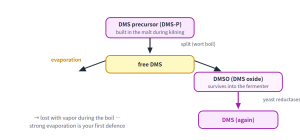
DMS spoils beer’s aroma chemistry: the SH group in sulphides reacts readily with beer’s sulphur-containing amino acids, producing 3-methyl-2-butene-1-thiol — the infamous “sunlight-struck” (skunky) smell. DMS itself gives the “malty-sweet”/corn/cooked-vegetable taint. Its formation pathway : DMS precursor (DMS-P) in the malt splits thermally during wort boiling into free DMS (partly stripped by evaporation), while another share is oxidised to DMSO — which yeast re-reduces back to DMS during fermentation.
What actually reduces DMS?
- Choose barley varieties low in protein, and use low-kilning, low-temperature malting schedules to cut DMS-P formation at the source.
- Raise boil intensity so free DMS strips off with the vapor.
- Adjust mashing water to pH 5.2–5.5 to suppress DMS-P hydrolysis.
- Choose yeast strains with higher sulphide demand — they scavenge more precursor.
- Control fermentation conditions: dissolved oxygen 8–10 mg/L, yeast cell count (1.0–1.5) × 10⁷ per mL, low-temperature pitching and fermentation.
- CO₂-wash the beer — cuts DMS content by about 50%.
- Protect finished beer from light: brown bottles or light-barrier packaging block the skunky photochemistry; store cool, and avoid over-long storage.
Organic acids — why is “clean acidity” a balancing act?
Beer contains more than 100 organic acids. Most originate in yeast metabolism — acids carry a sour taste and are precisely the substances that harmonise beer’s flavour: together with ethanol they form ester aftertaste, and suitable acidity makes beer taste refreshing rather than flat. Acids from wort (malic acid, pyruvic acid, citric acid and friends) set the base; acids from yeast metabolism matter even more for balance. Too little acidity leaves beer coarse, unharmonious and “rough”; too much tastes sour and thin, with poor foam.
Total acidity in beer is usually controlled at 1.7–2.3 mL NaOH. Production is affected by raw material, mashing method, fermentation conditions, yeast strain and more. The main members: pyruvic, citric, malic, succinic, lactic and higher fatty acids (C₆–C₁₈), plus unfermented lactic, succinic and oxalic acids.
Table 3 — Thresholds and content of acids produced in 12°P beer fermentation (after Table 4-7)
| Acid |
Threshold (mg/L) |
Normal content (mg/L) |
Titration (mmol/L NaOH diff.) |
| Lactic acid |
4.7 |
4–12 |
0.044–0.13 |
| Citric acid |
16 |
25 |
0.234 |
| Pyruvic acid |
25 |
15 |
0.04 |
| Malic acid |
7.0 |
3.5 |
0.05 |
| Succinic acid |
60 |
10 |
0.28 |
| Acetic acid |
10 |
8 |
0.1 |
| C₆–C₁₀ fatty acids |
8–16 |
8–4 (band) |
0.2 |
Beer acids come from three sources: ① the raw material — malt; ② hops; ③ yeast metabolism. The fatty acids in wort come mostly from malt, largely as long-chain unsaturated fatty acids; hops contribute small amounts of valeric, isovaleric and 2-methylbutyric acids. Most organic acids come from yeast’s EMP pathway. Acetic acid is the most abundant organic acid in beer — a product of normal beer fermentation, formed by acetaldehyde oxidation; bottom-fermented beers carry roughly one-third more acetic acid than top-fermented ones. Besides acetic acid, lactic acid is comparatively high; the formation of these acids parallels higher-alcohol formation during the first 4 days of primary fermentation — their precursors are the corresponding aldehydes. Fast fermentation methods (higher temperature, higher pitch, more aeration, stirring) raise the acid number — and fatty-acid levels in fast-fermented beer run about one-third lower than in conventionally fermented beer.
Aldehydes — is acetaldehyde the difference between “green” and “great”?
Beer contains several carbonyl compounds — aldehydes and ketones — whose flavours are highly objectionable; aldehydes form one important group of beer volatiles.
Table 4 — Aldehyde thresholds and content ranges in beer (after Table 4-8)
| Aldehyde |
Threshold (mg/L) |
Content range |
Normal content |
| Acetaldehyde |
15 |
3–35 |
6–8 |
| Propanal |
5 |
0.1–0.5 |
0.2–0.3 |
| Isobutyraldehyde |
1 |
0.1–0.5 |
0.2–0.3 |
| Isovaleraldehyde |
0.5 |
0.05–0.2 |
0.1 |
| n-Valeraldehyde |
0.1 |
0.05–0.1 |
0.05–0.07 |
| n-Hexanal |
0.4 |
0.05–0.3 |
0.1–0.2 |
| Furfural |
50 |
0.2–10 |
0.5–2 |
Acetaldehyde is the main aldehyde of beer fermentation and the most abundant — the intermediate of yeast’s ethanol fermentation, formed by pyruvate decarboxylation:
CH₃COCOOH —(decarboxylation)→ CH₃CHO (acetaldehyde)
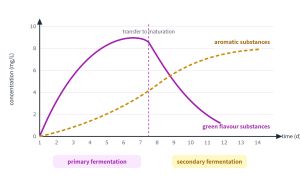
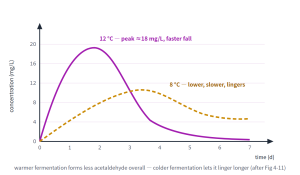
Acetaldehyde forms in large quantities at the start of primary fermentation and falls rapidly afterwards. Bottom fermentation reaches its acetaldehyde maximum at 35%–60% apparent attenuation, top fermentation at about 10%. Its threshold is 10 mg/L — above that, beer takes on a coarse, greener grain taste; at high levels a pungent, rotten-apple/grassy note. Normal beer stays under 10 mg/L; quality beer sits in the 1.5–2.5 mg/L band. In immature beer, acetaldehyde coexists with diacetyl and H₂S to build the green-beer character. Fermentation temperature, pressure, wort pH and pitching rate all shape acetaldehyde: higher temperature → less acetaldehyde; higher pressure → more; higher wort pH → more; higher pitching rate → more. So in late fermentation, adjust temperature and pressure to bring acetaldehyde to its normal level. During maturation acetaldehyde falls rapidly with CO₂ scrubbing — especially at packaging; CO₂ washing removes acetaldehyde too. Wort contamination or infected yeast also increases it.
Flavour indicators — which numbers tell you the whole beer story at a glance?
The flavour-active substances in beer (see Table 4-9) influence quality enormously, and their levels link directly to fermentation process conditions. Measuring them lets you diagnose the process — and change it where it hurts:
Table 5 — Indicator flavour substances of beer (after Table 4-9, condensed to the most diagnostic rows)
| Substance |
Normal (mg/L) |
Threshold |
Character |
What it indicates |
| Isoamyl alcohol |
5–20 |
10–200 |
solventy, fatty |
fermentation control — strain & temperature |
| 2-Methylbutanol / n-propanol / β-phenylethanol |
10–20 / 5–20 / 10–50 (wheat: 30–50) |
50–65 / 50–75 |
alcohol, solventy, rose-like |
fermentation control — strain & temperature |
| Ethyl acetate |
5–30 |
25–30 |
fruity-solventy |
fermentation control; wheat-beer signature (esters group) |
| Ethyl isovalerate |
<0.1 |
0.4–1.6 |
papaya fruitiness |
| 2-Phenylethyl acetate |
0.5–2.5 |
1–1.6 |
roses, honey |
| Butyric / isovaleric / hexanoic acids |
<0.3 / 0.1–0.3 / 0.1–0.3 |
≈0.4 / 1.2–2.2 / 3.5 |
sweaty, old-hop, cheese |
old hops, infected yeast; lauter & fermentation control |
| Hop components: humulones / linalool |
0.005–0.03 / 0.1 |
0.05–0.08 |
hop oil, floral-woody |
hop dosage & hopping method |
| Heat-load indicators: furfural / 2-furfuryl methyl (maillard) |
<0.1 / 0.5–3 |
>3000 (heat) |
burnt, woody |
heat load — wort boiling & handling of the wort |
| Maturation indicators: diacetyl / 3-hydroxy-2-butanone (acetoin) / DMS |
<0.1 / <3 / 0.03–0.12 |
0.10–0.15 / 8–20 / 0.10–0.12 |
yellow-fruit / fruity / celery |
maturation degree; after-boiling process control |
Reading the table like a dashboard: fusels point at strain/temperature; esters at fermentation vigour; fatty acids at hop freshness and hygiene; furfural at heat load in the brewhouse; VDK and DMS at maturation quality. One sample, five diagnoses.
Frequently asked questions about fermentation by-products
1. Why is diacetyl the key maturity indicator of beer?
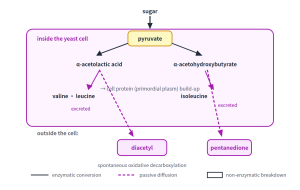
Its threshold is only 0.10–0.15 mg/L and it gives an immediate buttery “green” impression. Because its precursor α-acetolactic acid keeps converting into diacetyl outside the cell, total VDK + precursor below 0.10 mg/L is the accepted maturity standard.
2. Where does diacetyl actually form — inside or outside the yeast cell?
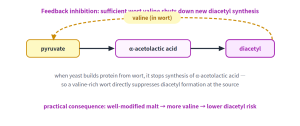
The precursor α-acetolactic acid forms inside the cell (valine/leucine synthesis branch), is excreted, and oxidatively decarboxylates spontaneously outside the cell. The resulting diacetyl must then be re-absorbed and reduced enzymatically inside yeast cells.
3. What temperature schedule best clears diacetyl?
Control apparent extract at 45%–55% before raising temperature, then run a warm VDK-reduction phase (up to 18 °C for bottom-fermenting beer). Diacetyl breakdown is strongly temperature-driven.
4. What does ALDC do?
α-Acetolactate decarboxylase converts α-acetolactic acid directly to acetoin and 2,3-butanediol, bypassing diacetyl entirely. Effective and viable — at the cost of added enzyme and some influence on yeast metabolism.
5. Why does beer give headaches the next morning?
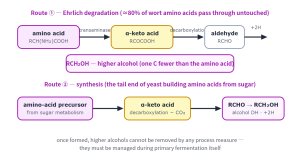
Higher alcohols — fusels. Above 120 mg/L total, with isoamyl alcohol above 50 mg/L and isobutanol above 10 mg/L, their slow human metabolism and longer stimulation produce the “morning-after” effect.
6. Which yeast makes fewer higher alcohols?
Flocculent strains (22–49 mg/L) versus powder-type strains (69–90 mg/L). Combine with pitching (1.5–1.8)×10⁷ cells/mL, multiplication within 4×, and low-temperature primary fermentation.
7. Why do wheat beers taste so ester-rich?
Top-fermenting yeast esterifies far more than bottom-fermenting yeast — wheat-beer yeasts are selected specifically for their ethyl acetate, isoamyl acetate and 4-vinylguaiacol signature.
8. How do I cut DMS in the finished beer?
Attack it along the whole chain: low-protein barley and low-temperature kilning (less DMS-P), strong boil evaporation, mashing pH 5.2–5.5, sulphide-hungry yeast strains, controlled aeration and pitching, and CO₂ washing — which alone cuts DMS about 50%.
Want fermentation equipment that keeps by-products exactly where you set them?
Diacetyl schedules, fusel control and ester balance are decided by temperature precision, pressure control and yeast management — all equipment questions. ZR Brewing builds conical fermenters and complete fermentation systems engineered for repeatable flavour profiles.
Questions about fermentation control or brewhouse design? Contact us at [email protected] or visit www.zrbrewing.com.


 Published