A commercial kombucha line is not one tank. It is a brewing vessel, a fermentation section sized for a 10-14 day hold, cooling, CIP, and a control panel tying them together — and a system built for 2,500L batches behaves differently than a scaled-up homebrew setup.
Why “Buy a Bigger Fermenter” Is the Wrong Starting Question
Most kombucha buyers researching commercial equipment start by sizing a fermentation vessel and treat everything else as an accessory. That ordering causes problems later: cooling capacity gets bolted on after the tank is already ordered, CIP connections get retrofitted, and the control panel ends up managing three separate subsystems that were never designed to talk to each other.
Current supplier pages in this category tend to describe kombucha equipment the same way — a prose list of “fermenters, brite tanks, and CIP systems” without a named commercial configuration attached to a stated batch volume, heating method, and control level. Several of them also mix home-scale kits into the same catalog as commercial gear, which makes it harder for a buyer to tell what’s actually sized for daily production versus a hobby upgrade.
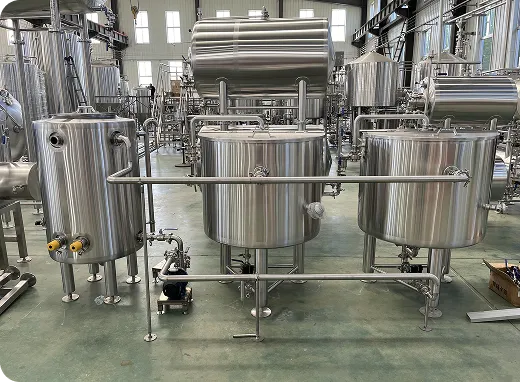
A published system removes that ambiguity. The ZR-KBC-2500L Kombucha Brewing System is documented with a stated batch size, heating method, and control type, and it is built around four linked sections rather than a single vessel:
- Brewhouse — where sweet tea is prepared before culturing
- Fermentation section — where the tea is inoculated and held through primary (and often secondary) fermentation
- Cooling system — temperature control through fermentation and prior to packaging
- CIP support and control system — cleaning circuits and the PLC panel that runs the process
Inside the ZR-KBC-2500L: What’s Actually Published
The specification below reflects only what ZR Brew has published for this model. Anything not listed here — cooling jacket surface area, exact fermenter dimensions, ports and manway configuration — has not been publicly disclosed and would need to be confirmed on a project drawing.
| Parameter |
ZR-KBC-2500L |
| Batch capacity |
2,500L per batch |
| Published production capability |
Up to 8 batches per day (stated configuration) |
| Material |
SUS304 stainless steel |
| Heating method |
Steam heating |
| Control type |
PLC, semi-automatic |
| System scope |
Brewhouse, fermentation section, cooling system, CIP support, control system |
| Certification |
CE and ISO 9001 claimed at company level |
Two things in that table matter more than they look. First, the “up to 8 batches per day” figure is a published capability, not a guarantee — actual daily output depends on brew time, fermentation time, cleaning cycles between batches, operator scheduling, and how many fermentation tanks are running in parallel. Second, the control level is semi-automatic PLC, not full automation. That distinction affects staffing more than most buyers expect: a semi-automatic panel still needs an operator present for transfers and CIP sequencing, even though temperature and process steps are computer-controlled.
Sizing Batches to Your Actual Production Target
Skip the vessel-size-first approach and work backward from a monthly volume target instead.
- Set the monthly output target. Convert your sales or contract volume into liters per month.
- Divide by the batch size. A 2,500L batch size gives you the number of brews required per month at 100% utilization.
- Apply the fermentation hold time. Kombucha typically needs roughly 10-14 days from inoculation to a finished product, depending on target acidity and flavor profile — that hold time, not brewhouse throughput, is usually the actual bottleneck.
- Check tank count against hold time. If you need six batches in the pipeline at once because each batch sits for 12 days, you need enough fermentation vessels to hold six batches simultaneously, even if the brewhouse itself could technically turn around a new batch daily.
- Subtract cleaning downtime. CIP cycles between batches reduce the realistic number of batches per day below the published maximum, particularly during weeks with tighter turnaround.
This is where a single-vessel system reaches its limit. The brewhouse can prepare a new batch faster than the fermentation section can release capacity, so throughput planning has to start with tank count and hold time, not with how many batches the brewhouse alone could theoretically run.
Heating and Control: Steam and Semi-Automatic PLC, in Practice
The ZR-KBC-2500L uses steam heating rather than direct electric elements. For a 2,500L batch, steam brings sweet-tea preparation to temperature more evenly across the full volume than localized electric heating elements typically manage at that scale, and it avoids the risk of scorching sugars against a hot element surface — a real problem in sugar-heavy tea bases.
PLC semi-automatic control means the panel manages temperature setpoints and can sequence defined steps, but an operator still initiates transfers, confirms CIP stages, and handles manual valve work where the process calls for it. That’s a different operating model from a fully manual steam kettle, where every step is hand-timed, and it’s also different from a fully automated line, where the panel runs transfers without operator confirmation. Buyers moving from a manual setup usually notice the difference in labor first: semi-automatic control reduces the number of people watching a single batch, but it doesn’t eliminate the need for someone on the floor during production.
CIP and the Acidity Problem Most Buyers Overlook
Kombucha’s low pH — generally in the 2.5-3.5 range once fermentation is underway — is a common oversight in equipment planning. Buyers often size CIP around beer-brewing assumptions, where the wort and finished beer sit closer to neutral pH for most of the cycle. Kombucha’s acidity is present through the entire fermentation and holding period, not just briefly during conditioning.
Standard SUS304 construction, as used in the ZR-KBC-2500L, is the material baseline across ZR Brew’s stainless product lines, including fermentation vessels. For projects with unusually aggressive process conditions or extended acid contact, SUS316 is available as a project-specific option on ZR Brew’s custom vessel and fermentation-tank lines — that upgrade path exists, but it is a configuration decision made per project rather than a standard feature of the published 2,500L system.
CIP support is listed as part of the ZR-KBC-2500L’s system scope, but circuit design, spray-ball placement, and detergent compatibility for acidic residue are not part of the published specification and should be confirmed on the project drawing before ordering.
Comparing an Integrated System to a Component-by-Component Build
Buyers assembling a kombucha line piece by piece — a fermenter from one supplier, a heating vessel from another, CIP added later — run into a coordination problem an integrated system avoids by design.
| Attribute |
Component-by-component build |
Integrated system (ZR-KBC-2500L) |
| Batch volume |
Set by whichever vessel is purchased first |
Fixed at 2,500L across brewhouse and fermentation |
| Heating |
Selected independently, may not match vessel capacity |
Steam heating sized to the stated batch volume |
| Control |
Separate panels per subsystem, often unsynced |
Single PLC panel across brewhouse, fermentation, and CIP |
| CIP |
Frequently retrofitted after vessel purchase |
Included in system scope from the outset |
| Certification |
Depends on each individual supplier |
CE and ISO 9001 claimed at the company level |
The trade-off runs the other way too. A component build allows a buyer to phase spending across several purchase cycles and swap individual pieces later without replacing the whole system, while an integrated system locks batch volume, heating, and control together as one configuration from day one.
Certification: What “CE and ISO 9001” Actually Covers Here
ZR Brew states CE and ISO 9001 compliance at the company level, following the general framework set by the International Organization for Standardization for ISO 9001 quality management systems. Model-specific certificate numbers, the issuing or notified body, and the certificate’s scope and validity period for the ZR-KBC-2500L are not publicly disclosed and should be requested directly and confirmed against the applicable destination-market requirements before ordering — CE and ISO 9001 claims at the company level are not the same as a per-machine certificate covering a specific piece of equipment.
Pricing
ZR Brew equipment is configured and quoted according to production capacity, process requirements, vessel quantity, heating method, automation level, material grade, component selection, destination-country utilities, shipping conditions, installation requirements, and applicable certification needs. Contact the ZR Brew project team for an itemized quotation specific to a kombucha production target.
FAQ
Q: What batch size does a commercial kombucha operation actually need to start with?
A: It depends more on fermentation hold time than on brewhouse capacity. A 2,500L batch system with enough parallel fermentation tanks to cover a 10-14 day hold will usually outproduce a larger single vessel with too few tanks to keep batches moving.
Q: Is PLC semi-automatic control enough for a small commercial team?
A: It reduces the manual timing and monitoring load compared to a fully manual steam kettle, but an operator still needs to be present for transfers and CIP confirmation — it is not unattended operation.
Q: Does kombucha equipment need different materials than beer brewing equipment?
A: The published ZR-KBC-2500L uses the same SUS304 baseline as ZR Brew’s other stainless lines. Kombucha’s sustained low pH is a reason some buyers request SUS316 as a project-specific upgrade, not a reason the standard material changes by default.
Q: Can the same fermentation tanks used for beer be used for kombucha?
A: Fermentation vessels share core construction principles across beverage types, but CIP circuit design and gasket or seal material compatibility with sustained acidic contact should be confirmed for the specific process rather than assumed from a beer-focused spec sheet.
Q: Where can I get exact pricing for a 2,500L kombucha system?
A: Pricing depends on capacity, heating method, automation level, material grade, and destination-market requirements, so it is quoted per project rather than published as a fixed number.


 Pubblicato