Cleaning brewery equipment is a controlled production process, not a final rinse at the end of a shift. A repeatable program identifies the soil, selects compatible chemistry, controls concentration, temperature, contact time and flow, verifies removal, and records the result before the next batch begins.
This guide explains how to build a practical clean-in-place program for brewhouse vessels, transfer lines, heat exchangers, fermentation tanks and bright beer tanks. Exact chemical concentrations and temperatures must come from the chemical supplier, equipment manufacturer and brewery safety program because materials, seals, soils and local requirements differ.
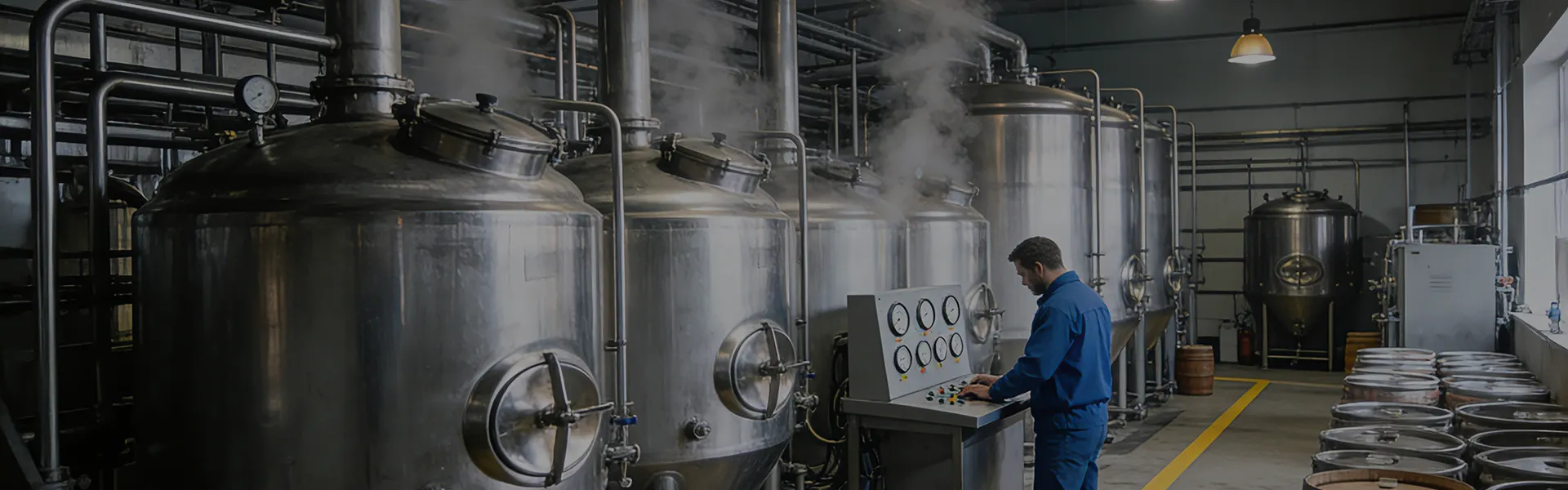
A complete cleaning plan covers vessels, transfer lines, pumps, valves, heat exchangers and drains.
Why Cleaning Brewery Equipment Needs a Defined Cycle
Brewing leaves several types of soil. Grain and protein residues collect in mash and lauter equipment. Hop material and heat-baked deposits can remain in the kettle and whirlpool. Sugars and beer stone can build up in pipes and tanks. Yeast and product residues remain in fermenters, valves, sample points and transfer hoses.
No single step removes every soil safely. Mechanical action, chemistry, temperature and time work together. Increasing one factor cannot automatically compensate for poor flow, an inaccessible valve or the wrong chemical. The program should therefore define the cycle for each equipment group rather than applying one generic recipe to the entire brewery.
Step 1: Map the Cleaning Circuit
Start with the same process map used in the brewery equipment diagram guide. Mark the CIP supply, return, pumps, spray devices, vessel outlets, high points, low points, dead legs, sample valves, heat exchangers and drains. Confirm that the return path is continuous and that every product-contact surface is reached.
Separate circuits when one pump cannot deliver the required flow to all users. A brewhouse loop, cellar loop and packaging loop may need different connections and verification points. Document hose positions and valve states so operators do not rely on memory.
Step 2: Remove Gross Soil Before CIP
Empty vessels and lines completely. Remove spent grain, hops, yeast and other solids through their intended outlets. Pre-rinse with water at a temperature compatible with the soil and equipment. The goal is to remove loose material before chemical circulation, not to bake proteins onto hot surfaces or send large solids into the return pump.
Check strainers, spray devices and return screens. A blocked spray ball or clogged return can make the instrument panel look normal while the tank wall remains unclean.
Operators should verify the CIP route, valve positions and return path before chemical circulation begins.
Step 3: Select Chemistry for the Soil and Material
Use the chemical supplier’s written procedure and safety data sheet. Alkaline cleaners are commonly used for organic soils such as proteins, fats and carbohydrates. Acid cleaning may be used at a separate stage for mineral deposits and beer stone where compatible. Sanitizers serve a different purpose and should not be treated as a substitute for cleaning.
Confirm compatibility with stainless steel, elastomers, pump seals, sight glasses, instruments and any soft metals in the circuit. Never mix incompatible chemicals. Label storage and transfer equipment, provide secondary containment, and control access according to the brewery’s safety program.
Step 4: Control Concentration, Temperature and Time
Measure chemical concentration using the method specified by the supplier rather than estimating from tank volume or foam. Confirm solution temperature at the equipment, not only at the CIP tank, because long pipe runs and cold vessels change the actual condition. Start the contact-time clock only after the circuit reaches the required operating condition.
Record the target and actual values. If a cycle falls outside the approved range, investigate the cause before releasing the equipment. Adding extra time without checking concentration, temperature and flow can hide a failing pump, heater or dosing system.
Step 5: Verify Flow and Mechanical Action
Tank spray devices need enough flow and pressure to wet the intended surface. Pipes and heat exchangers need sufficient velocity to create cleaning action without exceeding equipment limits. Confirm pump performance against the longest or most restrictive circuit and inspect return flow for air entrainment or restriction.
Clean valves, sample ports, level instruments and removable fittings according to their design. Any area outside the automatic circuit requires a documented manual-cleaning step. Dead legs and closed branches should be eliminated where practical or included in the validated flow path.
Step 6: Rinse and Check the Endpoint
Rinse until the approved endpoint is reached. Depending on the procedure, verification may include conductivity, pH, visual clarity, absence of foam or another validated measurement. Do not judge completion only by elapsed time.
Drain the system completely and inspect accessible surfaces under adequate light. Check manways, shadow areas, spray devices, gaskets, valve seats and heat-exchanger connections. If residue is found, investigate the failed condition and repeat the appropriate step rather than simply signing the record.
Visual inspection should cover accessible surfaces, fittings, valves, spray devices and drain points after the cycle.
Step 7: Sanitize at the Correct Time
Sanitizing follows successful cleaning. Select a product and contact condition approved for the brewery’s process and materials. Some equipment is sanitized immediately after cleaning; other equipment is sanitized shortly before use. Define the holding time and protection method so a clean system is not recontaminated through an open vent, hose or fitting.
Product-contact equipment should remain closed and identified after release. Any maintenance work or unplanned opening should trigger a defined re-cleaning or re-sanitizing decision.
CIP Safety Controls
Review the current safety data sheet and chemical supplier instructions.
Use required personal protective equipment and controlled chemical-transfer methods.
Verify that tanks are vented and never create an unsafe vacuum or pressure condition.
Lock out equipment before entering or manually working inside vessels.
Keep incompatible chemicals physically separated and clearly labeled.
Provide eyewash, emergency response procedures and trained supervision.
Prevent hot solution and chemical discharge from reaching people or incompatible drains.
The Brewers Association provides additional industry safety resources. Apply the chemical supplier’s instructions and all applicable local occupational, environmental and food-safety requirements.
How to Verify the Cleaning Program
A release checklist should identify the equipment, previous product, cycle type, operator, start and finish time, chemical, measured concentration, temperature range, contact time, return condition, rinse endpoint, inspection result and corrective action. Trend repeated failures by circuit and component.
Visual inspection is useful but may not be the only verification required. A brewery may add ATP testing, microbiological sampling or other validated checks based on its hazard analysis and product risk. Establish acceptance limits with qualified food-safety and laboratory support.
Applying the Program to 10HL and 20HL Systems
ZR Brew’s verified European project list includes 10HL and 20HL breweries with fermentation tanks, glycol cooling and CIP support, including a 20HL Danibier configuration in Switzerland. The public source does not disclose chemical consumption, cycle time or microbiological results, so those values should not be inferred.
For a new system, the cleaning design should be reviewed together with vessel count, pipe length, pump duty, utility capacity, drainage and operating schedule. The دليل تخطيط تصميم مصانع الجعة explains how these physical interfaces affect the building plan, while the glycol chiller sizing guide covers a separate utility calculation.
الأسئلة الشائعة
Is sanitizing enough without cleaning?
No. Soil can shield microorganisms and interfere with sanitizer performance. Clean first, verify the result, and then sanitize under the approved conditions.
Can every brewery vessel use the same CIP recipe?
Not automatically. Soil, material, seal compatibility, spray device, circuit length and equipment limits differ. Validate the cycle for each equipment group.
Why does return flow matter?
Return flow shows whether the circuit is circulating continuously. A restricted return can reduce mechanical action, flood a vessel or prevent the solution from reaching all surfaces.
How often should an acid cycle be used?
The frequency should follow deposit monitoring, water chemistry, production conditions and the approved chemical program. Do not set a universal schedule without site evidence.
What information should be sent to an equipment supplier?
Provide the vessel list, process soils, pipe routes, cleaning circuits, available utilities, chemical program, drain limitations, automation needs and verification method. Use the ZR Brew contact page to request a project-specific equipment and CIP review.
A reliable CIP program is measurable, repeatable and documented. It protects product quality only when the equipment, chemistry, flow and operator procedure work as one system.


 نُشر
نُشر


