Filling format changes two numbers that determine beer quality and cost: oxygen pickup during fill and beer lost per unit filled. Keg lines with counter-pressure filling and flow-meter control publish these figures more consistently than bottle or can lines do.
Why Filling Format Changes Your Oxygen and Loss Numbers
Every filling method pushes beer through the same basic sequence — purge, fill, and seal — but the equipment controls oxygen exposure and product loss differently depending on container geometry. A keg’s sealed valve and counter-pressure fill path limit air contact more predictably than an open bottle neck moving down a conveyor at speed. This is why counter-pressure keg fillers with flow-meter dosing are the configuration most manufacturers, including several competitors, choose to publish concrete throughput and loss data for — while bottle and can lines are more often sold as generic “filling solutions” without matching numbers.
That difference matters when you’re comparing quotes. A brewery evaluating three filling formats side by side needs to know which numbers on a spec sheet are measured and which are marketing language.
Bottle vs Can vs Keg: Comparison at a Glance
| Dimension |
Bottle Filling |
Can Filling |
Keg Filling |
| Typical Oxygen Pickup Risk |
Higher — open neck exposed during filling and capping |
Moderate — narrower opening and rapid seaming |
Lower — sealed valve and counter-pressure path |
| Container Reuse |
Single-use; glass is recycled rather than brewery-refilled |
Single-use |
Reusable; the same keg returns for multiple fills |
| Published ZR Brew Throughput |
Not published — request a drawing |
Not published — request a drawing |
Approximately 60–80 kegs/hour on one fixed-table configuration |
| Published ZR Brew Beer-Loss Figure |
Not published — request a drawing |
Not published — request a drawing |
Less than 1% on a specified automatic line |
| Available Automation Levels |
Not published for ZR Brew’s line |
Not published for ZR Brew’s line |
Manual, semi-automatic and fully automatic |
| Control Options |
Not published for ZR Brew’s line |
Not published for ZR Brew’s line |
PLC-controlled configurations; Siemens controls or German flow meters on selected models |
Kegs are the one format where the resource library gives you a real number to hold a supplier to. Bottle and can filling belong to the broader packaging scope but don’t currently have a published model list or throughput table on the public side — that gap is the main reason this article leans toward keg data, and it’s flagged again below rather than filled with an estimate.
Keg Filling Lines: What ZR Brew Publishes
Two-Station and Double-Station Configurations
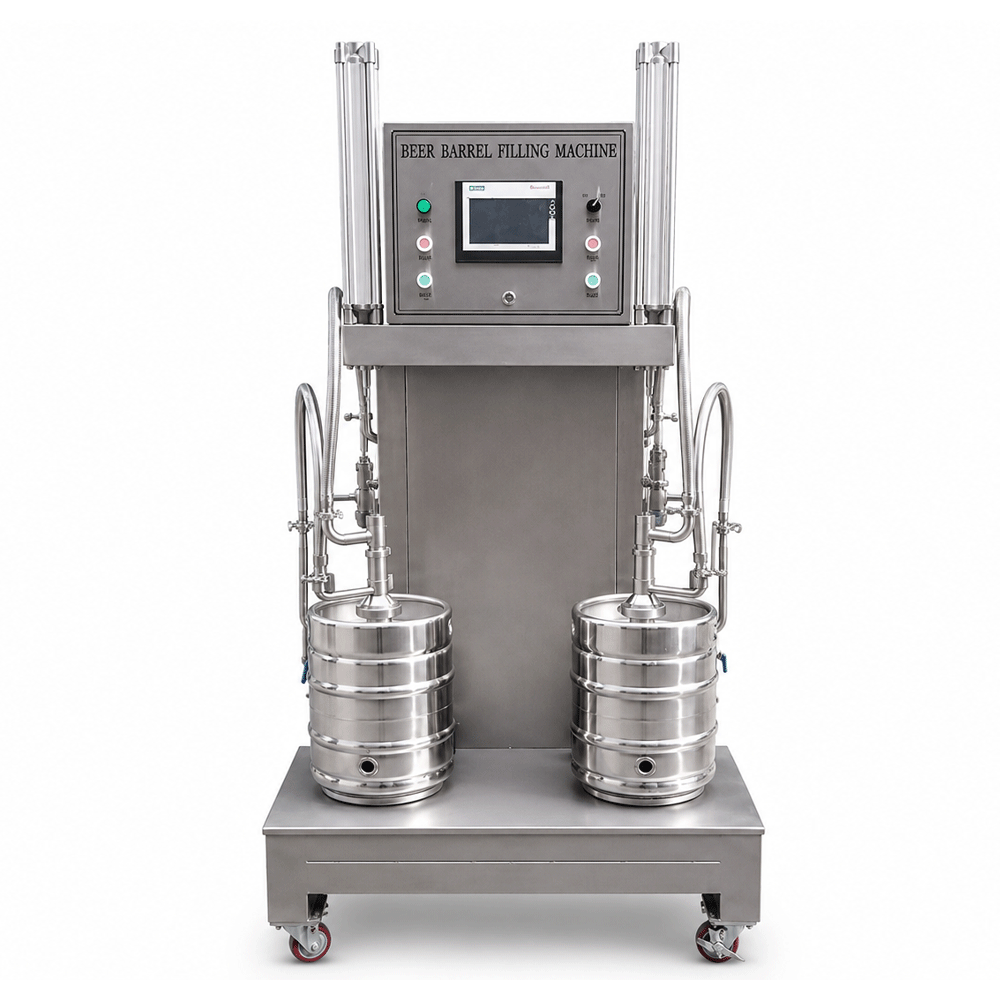
The Two-Station Keg Filling Machine with Flow Meter and the Double-Station Keg Filling Machine both use flow-meter dosing rather than timed or pressure-only fills, which is the detail that lets a brewery hold a fill-volume tolerance across a shift instead of just at startup. Station count is a direct throughput lever: doubling stations doesn’t double output one-for-one because loading and purge cycles still run per station, but it does reduce the queue time between kegs on a busy packaging day.
All-in-One Washer-Filler Units
The All-in-One Keg Washer and Filler is available in a fixed-table and a lifting-table version, and both combine washing, sanitizing, purging, and filling into a single cycle rather than requiring separate machines. One published fixed-table configuration runs at roughly 60–80 kegs per hour with beer loss under 1%. That figure is specific to that configuration — it shouldn’t be quoted for the lifting-table version or for a different station count without confirming it against the actual machine drawing, since loss rates move with fill speed, valve type, and CIP settings.
The Bottle and Can Data Gap
Here’s the edge case that catches breweries switching from keg-only to mixed-package production: they assume the same beer-loss and oxygen numbers that apply to a keg line will carry over to whatever bottle or can filler the same supplier quotes. They don’t automatically transfer, and in ZR Brew’s case, the public packaging pages don’t currently list bottle- or can-specific throughput or loss figures at all. Before ordering, this needs to go on the RFQ as an explicit question, not an assumption:
- Request the exact fill-head count and rated speed for the specific bottle or can size, not a general “up to X per hour” range.
- Ask for the measured oxygen pickup at fill, in ppm, tested on the actual bottle or can format planned for production — not a figure carried over from a keg-line spec sheet.
- Confirm whether beer-loss figures quoted are measured on that machine or estimated from a comparable model.
- Get the CIP and sanitization cycle time in writing, since it affects daily uptime as much as fill speed does.
- Ask whether the automation level (manual, semi-automatic, or PLC-controlled) matches what’s published for the keg line, since bottle and can automation options aren’t currently listed publicly.
Five Steps to Evaluate a Filling Machine Quote
- Match the format to current production, not future plans. A keg-only taproom doesn’t need a bottling line sized for distribution volume it hasn’t reached yet.
- Separate measured specs from marketing language. If a number isn’t attached to a specific model and test condition, treat it as directional, not contractual.
- Check control components against your maintenance capability. PLC-controlled lines with Siemens or comparable brands need an operator who can read fault codes, not just run the start button.
- Ask what “automatic” actually automates. Purge and fill cycles are commonly automated; loading and unloading kegs, bottles, or cans onto the line is not always included at the same automation tier.
- Request the itemized quotation before comparing price. ZR Brew, like most manufacturers in this space, prices equipment according to capacity, automation level, component brand, and destination-country utilities rather than publishing a flat price list — so two “keg filler” quotes aren’t comparable until you can see what’s actually itemized inside each one.
What This Costs
ZR Brew Pricing depends on station count, automation level, flow-meter or control-component brand, destination-country utility requirements, and shipping and installation terms. Contact the ZR Brew project team for an itemized quotation rather than relying on a single published number, since the same “two-station” description can price very differently depending on whether it’s manual or PLC-controlled.
The trade-off on the keg side specifically: fully automatic lines with flow-meter dosing cost more upfront than manual or semi-automatic units, but the published sub-1% beer-loss figure on the automatic configuration is the kind of number that offsets equipment cost over enough production volume — it just isn’t guaranteed on every automation tier.
FAQ
Does a higher station count always mean higher throughput?
Not proportionally. More stations reduce queue time between kegs, but loading, purge, and CIP cycles still run per station, so throughput gains taper as station count rises.
Is the sub-1% beer-loss figure the same across all ZR Brew keg lines?
No — it’s published for one specified automatic fixed-table configuration. Manual and semi-automatic configurations, and the lifting-table version, aren’t confirmed against that same figure and should be verified per machine.
Can ZR Brew supply bottle and can filling lines?
Bottle- and can-packaging equipment falls within ZR Brew’s broader packaging scope, but a public model list and throughput specifications for that side aren’t currently available — request a drawing and itemized spec sheet directly.
What certification applies to ZR Brew filling equipment?
CE and ISO 9001 are claimed at the company level. Machine-specific certificate numbers and issuing bodies for filling equipment aren’t publicly disclosed and should be confirmed per order.
How do I compare a flow-meter-dosed line against a timed-fill line?
Ask both suppliers for the tolerance range on fill volume across a full shift, not just at startup — flow-meter dosing is built to hold that tolerance as line speed and pressure fluctuate, which is the main reason it costs more than timed fill.


 نُشر
نُشر