Beer fermentation tanks are temperature-controlled stainless steel vessels, usually cylindroconical, where yeast turns wort into beer. For an expanding brewery, the decisions that matter are tank type, nominal versus total volume, cone angle, working pressure, glycol jacket zoning, and how many tanks your brew schedule actually needs.
This guide is written for breweries that already sell beer and are adding cellar capacity. Most fermenter guides stop at a type table. The section on tank count below gives you a calculation you can run against your own brew log before you request a single quote.
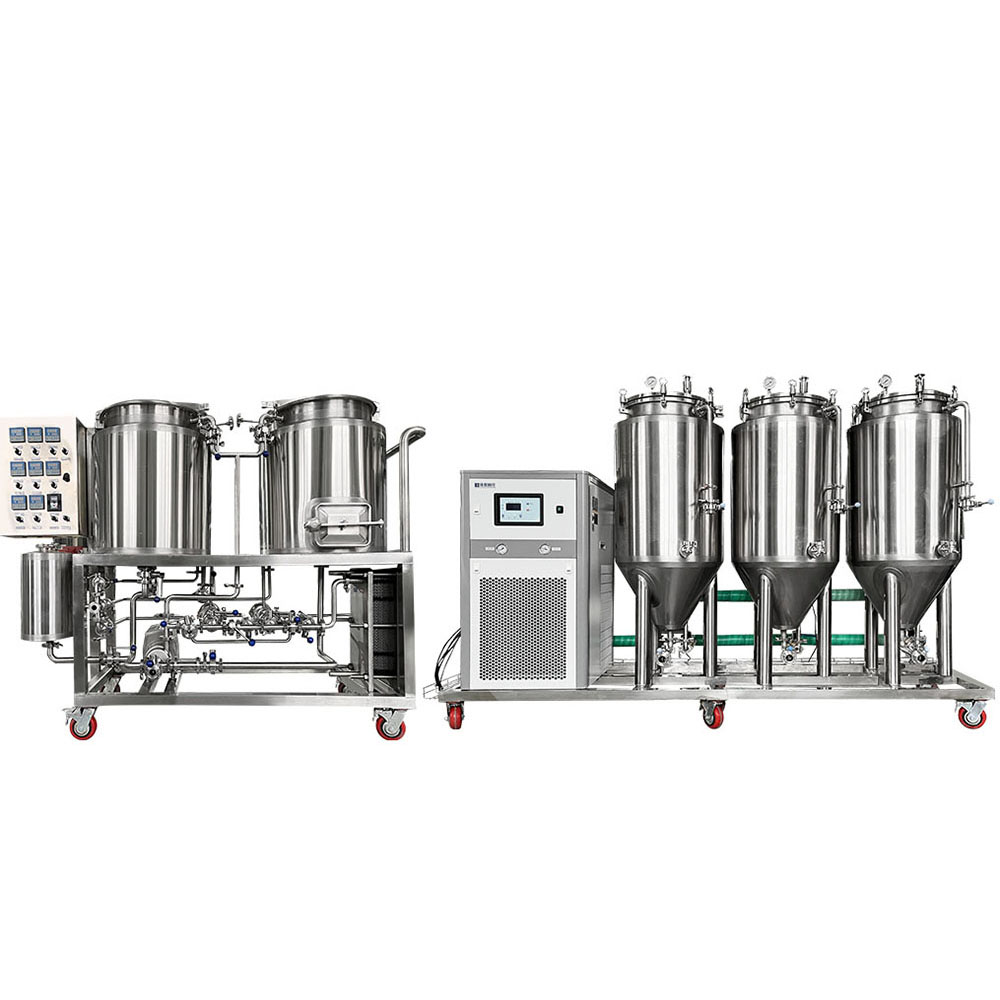
What a Cylindroconical Fermenter Does
A cylindroconical fermenter has four working parts. The cylinder holds the fermenting beer. The cone at the bottom collects yeast and trub so they can be dumped or harvested without moving the beer. A glycol jacket on the outer shell pulls out the heat that fermentation generates. And the vessel’s pressure rating decides whether you can hold CO₂ in the tank or must vent it.
Everything else on the tank (manway, racking arm, sample valve, spray ball, thermowell) supports those four functions.
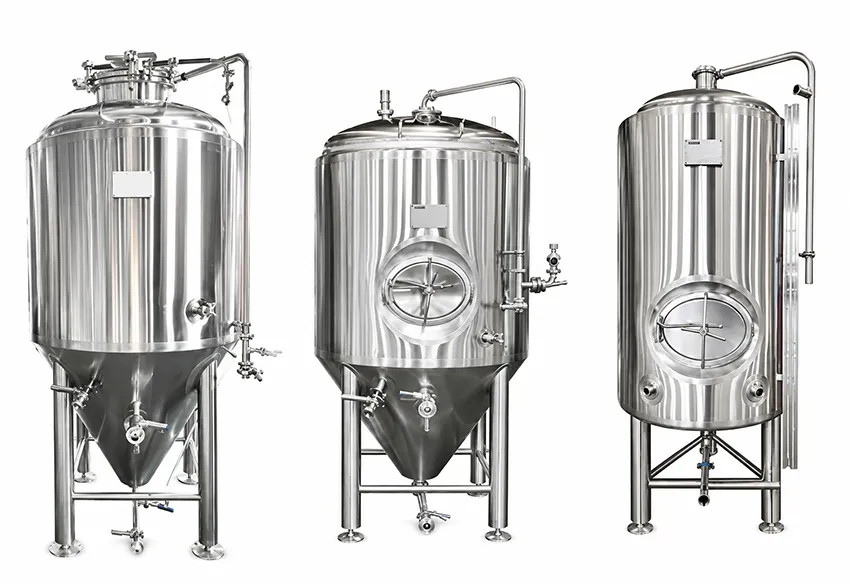
Fermenter, Unitank, or Bright Tank?
Brewers often use these names loosely. The difference shows up in cellar planning, because each type occupies a tank for a different share of the production cycle.
| Tank type |
Bottom shape |
Main job |
Pressure use |
The limitation that matters |
| Fermenter (FV) |
Conical |
Primary fermentation, yeast removal |
Low-pressure operation is common |
Beer must move to another vessel for carbonation unless the tank is rated for it |
| Unitank |
Conical |
Fermentation, conditioning and carbonation in one vessel |
Pressure-rated by design |
Each batch stays in the tank longer, so you need more tanks for the same output |
| Bright beer tank (BBT) |
Dished or flat |
Holding finished, carbonated beer for packaging |
Pressure-rated |
No cone for yeast, so it cannot replace a fermenter |
Open fermenters and horizontal lagering tanks still exist, but they are niche choices for specific styles rather than the default for a production cellar.
The unitank trade-off is worth stating plainly: it removes a transfer and its oxygen pickup risk, but it can double the number of days a batch occupies the vessel. If floor space is your constraint, that matters more than the saved transfer.
5 Specs That Decide Whether a Tank Fits Your Process
Nominal volume vs. total volume
Nominal volume is the beer you plan to put in. Total volume is the full internal space, including the headspace that holds the krausen during active fermentation.
ZR Brew’s published 3000L configuration shows the gap clearly: a nominal 3000L working volume with roughly 3750L total. That leaves about 750L of headspace, or 25% above the nominal figure.
Cone angle
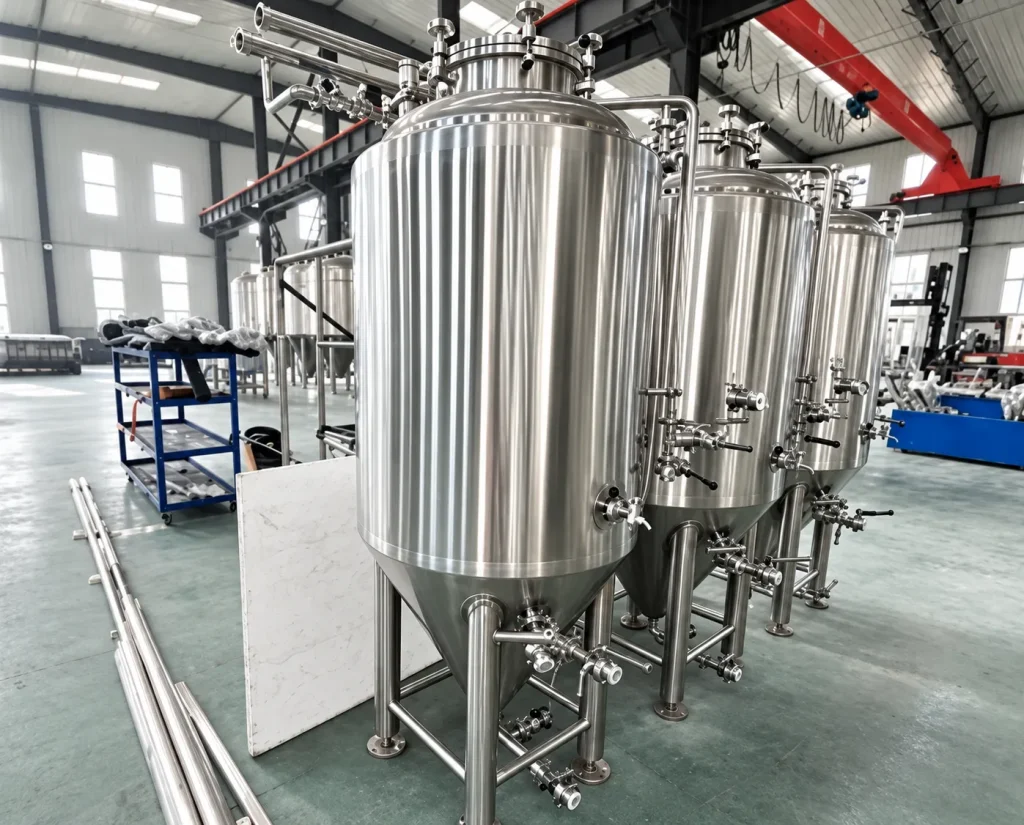
A 60-degree cone is the common choice for ZR-FV fermentation tanks. A steep cone lets yeast slide down and compact into a tight pellet, which makes dumping and harvesting cleaner.
The cost is height. A steeper cone adds vertical length for the same volume, and that collides with low ceilings. If your building forces a shorter, wider tank, the cooling geometry changes too, so raise the ceiling height early in the quotation process rather than after the drawing is approved.
Working pressure
ZR-FV tanks are typically specified at about 0.2 MPa working pressure (roughly 2 bar or 30 psi), depending on the model. That rating is what allows spunding, natural carbonation in the tank, and CO₂ top pressure during transfers.
Working pressure is not the same as test pressure. The hydraulic pressure test is performed above working pressure to verify the vessel, and the record of that test should be part of your order documents. Never run a tank above its stated working pressure, and confirm the relief valve setting matches it.
Glycol jacket zoning
Most production fermenters use separate jacket zones, typically one on the cone and one or more on the cylinder, each controlled by its own valve. Zoning lets you control fermentation temperature gently and then crash-cool hard at the end.
Edge case worth planning for: partial fills. If you sometimes fill a 40HL tank with a single 20HL batch, the upper cylinder zone may sit entirely above the liquid line. That zone then chills empty headspace and does nothing for the beer. If half-fills are part of your schedule, ask for the lower zone to cover the single-batch fill level.
Jacket area also has to match your glycol chiller. Adding tanks without checking chiller capacity is a frequent reason expansions underperform in summer.
Material and insulation
SUS304 stainless steel is the standard material for ZR-FV tanks, with SUS316 available when project conditions call for it. 316 contains molybdenum and resists chloride attack better, which is worth considering for high-chloride water or aggressive cleaning regimes. For most beer cellars, 304 is the practical choice.
The published 3000L configuration uses a 100 mm insulation layer. Manways can be top- or side-mounted; a side manway gives floor-level access for inspection on larger tanks.
ZR-FV Series Specifications
The ZR-FV series covers fermenters from pilot scale to production cellar sizes.
Published models
| Size bracket |
Models |
Typical use |
| Pilot / test |
ZR-FV-100L, 200L, 300L, 500L |
Recipe trials, small-batch specialty beer |
| Small production |
ZR-FV-1000L, 1500L, 2000L |
Brewpubs, taprooms, nano and small microbreweries |
| Production cellar |
ZR-FV-2500L, 3000L, 5000L |
Microbreweries and capacity expansion |
| BBL-based |
ZR-FV-10BBL and other BBL sizes |
Breweries planning in US barrels (1 US bbl ≈ 117.3 L) |
Series parameters
| Parameter |
Published value |
| Nominal capacity |
About 100L to 5000L, plus BBL-based sizes |
| Material |
SUS304; SUS316 per project requirements |
| Cooling |
Glycol cooling jackets, configurable zones |
| Structure |
Vertical, insulated, top or side manway |
| Cone |
Commonly 60° for fermentation tanks |
| Working pressure |
About 0.2 MPa (30 psi), depending on model |
| Applications |
Fermentation, maturation, conditioning, carbonation, bright beer storage |
| Configurable items |
Ports, valves, cooling zones, pressure settings, surface treatment, dimensions, accessories |
3000L reference configuration
| Parameter |
Value |
| Nominal capacity |
3000L |
| Total volume |
About 3750L |
| Insulation |
100 mm |
| Working pressure |
0.2 MPa |
| Material |
SUS304 |
These figures apply to that published 3000L configuration only. Shell thickness, overall height, diameter and jacket area are drawn per project and are not published as standard values for the series.
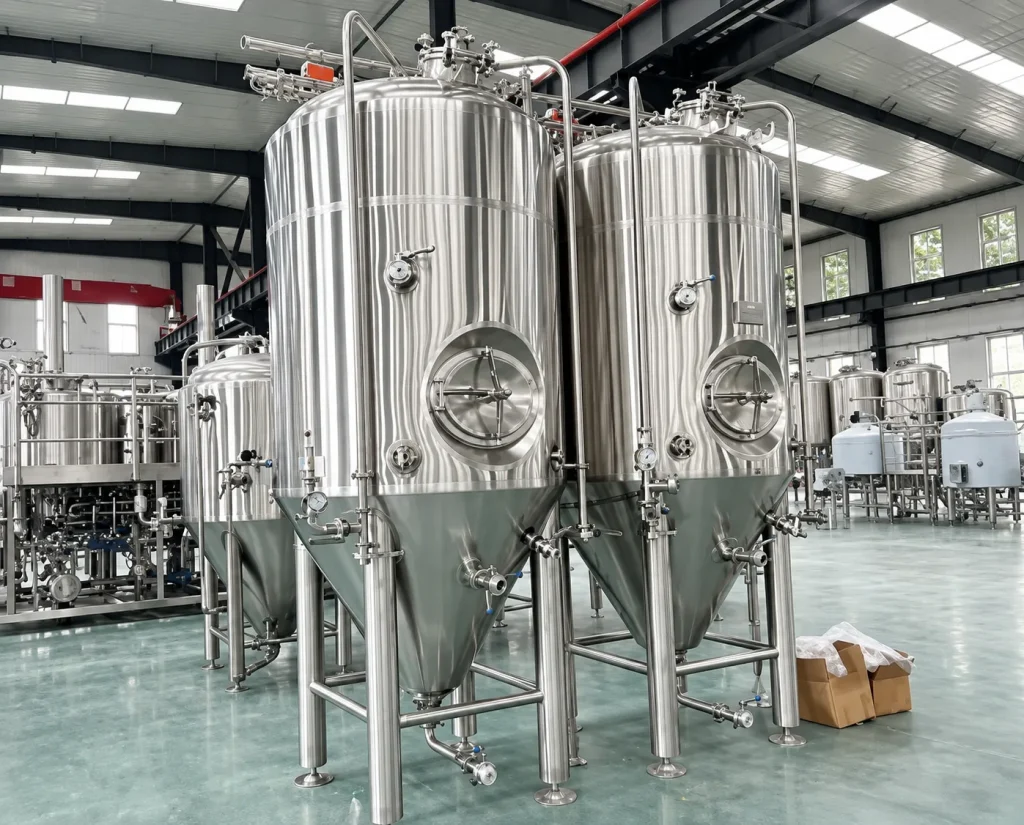
How Many Fermentation Tanks Do You Need?
Brewhouse size gets most of the attention during an expansion, yet the cellar usually sets the real output ceiling. The method below converts your brew schedule into a tank count.
- Fix your brew length and weekly batches. Count batches per brew day and brew days per week. Call the weekly total B.
- Choose fills per tank (k). A tank equal to brew length is a single fill (k = 1). A tank at twice brew length takes two batches (k = 2). Plan double fills so the second batch follows the first on the same brew day.
- Measure tank occupancy (D) in days. Use your own brew log, not a textbook figure: count from first fill through fermentation, crash, any conditioning done in the same vessel, transfer and CIP, until the tank is ready to fill again.
- Calculate tank fills per week. F = B ÷ k.
- Calculate tanks. Tanks = F × D ÷ 7, rounded up.
- Weight by style mix and add a buffer. Run step 5 separately for each occupancy group, add the results, then add one or two tanks for schedule slips.
Worked example. A 20HL brewhouse runs 2 batches a day, 5 days a week, so B = 10. With 40HL fermenters, k = 2 and F = 5 fills per week. The occupancy values below are assumptions for illustration only; replace them with your own records.
| Occupancy assumption (D) |
Tanks required (before buffer) |
| 14 days |
10 |
| 21 days |
15 |
| 28 days |
20 |
| Mix: 70% of fills at 14 days, 30% at 28 days |
13 (7 + 6) |
Now look at the brewhouse ceiling. ZR Brew publishes 20HL to 50HL four-vessel brewhouse configurations designed for up to approximately six batches per day, depending on process and schedule. At six 20HL batches a day, five days a week, B = 30 and F = 15. With a 14-day occupancy, that schedule needs 30 fermenters. A brewery running 10 tanks is using about a third of what that brewhouse can produce.
That is why tank count, not brewhouse size, is usually the first lever in an expansion. Two things can still cap you before the brewhouse does: glycol chiller capacity and CIP turnaround time. Check both whenever you add tanks.
Choosing tank size within the plan. Larger tanks (k = 2 or 4) mean fewer valves, fewer CIP cycles and less floor space per hectolitre. Smaller tanks give more freedom to run many styles and low-volume seasonals. Many expanding breweries combine the two: production-size tanks for core beers and a few single-fill tanks for everything else.
Checks Before You Order
Both nominal and total volume are stated on the drawing.
- Working pressure, relief valve setting and the hydraulic pressure-test record are part of the order documents.
- A material certificate confirms the steel grade (304 or 316).
- Jacket zones line up with your planned fill levels, including partial fills.
- Overall height, including legs and manway clearance, fits your ceiling, and the tank can pass through your delivery route.
- Destination-market compliance is confirmed for the specific tank. Under the European Union’s CE marking framework, the applicable legislation must be determined for each machine and destination market; a supplier’s general statement does not replace this check.
- The port list matches your process: sample valve, CIP spray ball, thermowell, racking arm, and a carbonation port if the tank will work as a unitank.
What to Send Before Requesting a Quote
A tank quote is only as accurate as the input behind it. Before contacting any supplier, prepare:
- brew length and batches per brew day
- brew days per week, now and after expansion
- your style mix with measured tank occupancy for each group
- whether tanks will run as fermenters only or as unitanks
- ceiling height, floor plan and delivery route dimensions
- glycol chiller capacity and available utilities
- destination country for compliance checks
FAQ
What size fermentation tank do I need for a 20HL brewhouse?
Most breweries choose either 20HL tanks (one batch per tank) or 40HL tanks (two batches per tank). 40HL tanks reduce the number of vessels and CIP cycles; 20HL tanks give more flexibility for small-volume beers. Base the decision on your style mix and the tank-count calculation above.
What working pressure should a beer fermenter have?
ZR-FV tanks are typically rated at about 0.2 MPa (around 30 psi), depending on the model. That supports spunding and in-tank carbonation. Confirm the rating for your specific tank on its drawing and pressure-test record.
Why do fermenters use a 60-degree cone?
A steep cone lets yeast and trub settle into a compact layer at the bottom, so they can be removed or harvested without disturbing the beer above. The trade-off is added tank height.
Can a fermentation tank also be used as a bright tank?
A pressure-rated tank with a carbonation port can ferment, condition and carbonate beer as a unitank. The ZR-FV series lists carbonation and bright beer storage among its applications. The trade-off is longer tank occupancy per batch, which raises the number of tanks you need.
Should I choose SUS304 or SUS316 stainless steel?
SUS304 is the standard choice for beer fermentation. SUS316 is available when conditions such as high-chloride water or aggressive cleaning chemicals justify the added material cost.
How much does a beer fermentation tank cost?
ZR Brew quotes each project individually based on capacity, pressure rating, material, cooling configuration, fittings, shipping and certification requirements. No standard price list is published; contact the project team for an itemized quotation.


 Published