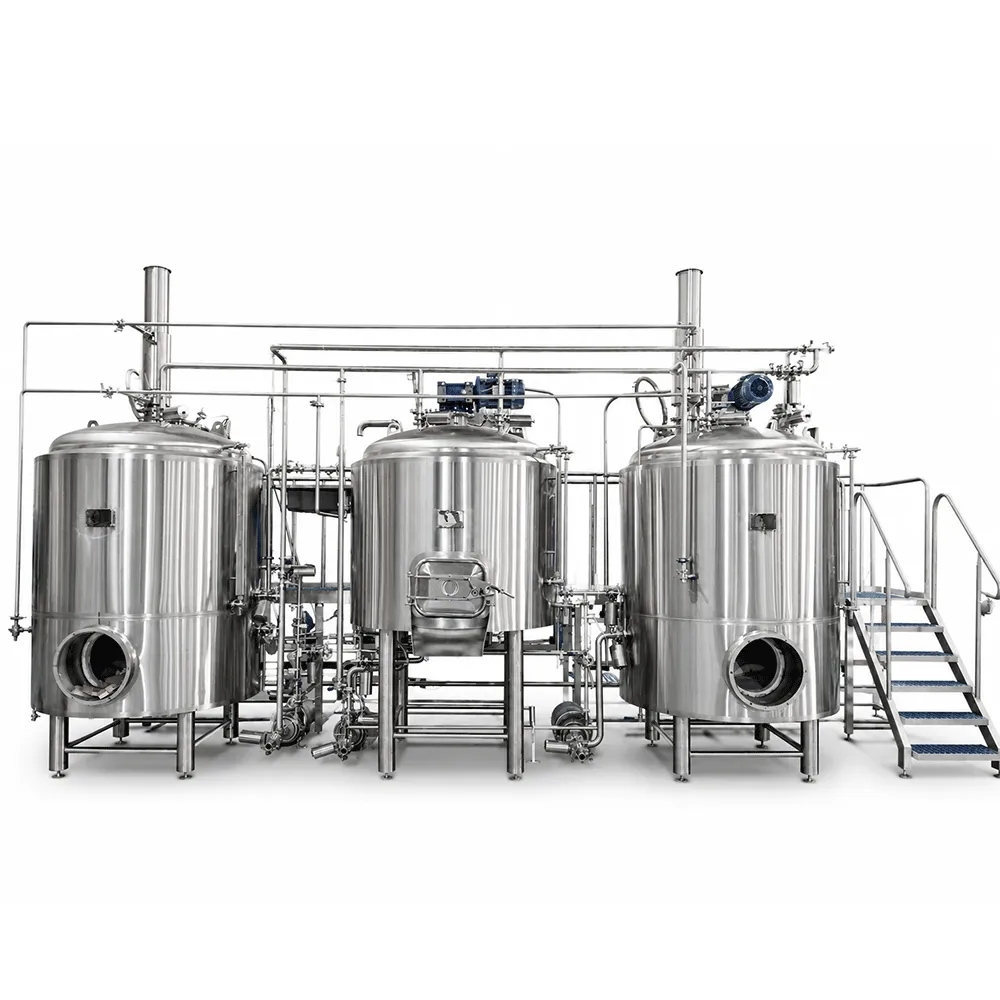
A 12HL–40HL microbrewery needs nine equipment groups: grain handling, a two- to five-vessel brewhouse, hot and cold liquor tanks, fermenters, bright tanks, glycol cooling, a heat source with water treatment, CIP, and packaging. The difficult part is sizing them against each other.
Start With Three Numbers, Not a Shopping List
Every piece of equipment in a microbrewery is sized from three inputs. Write them down before you request any quotation:
- Brew length. The volume of cast-out wort per brew, for example 20HL. This sets the brewhouse.
- Brews per week. Include whether you plan to double-brew, meaning two brews into one larger fermenter on the same day.
- Tank residence time. The number of days a batch occupies a fermenter, from fill to transfer. Lagers and ales differ, so use your own recipe plan.
Fermenters needed = fermenter fills per week × residence time in weeks
Here is a worked example. The 21-day residence time is an assumption for illustration, not a ZR Brew figure. A 20HL brewhouse that double-brews twice a week fills two 40HL fermenters weekly. At 21 days in tank, that works out to 2 × 3 = six 40HL fermenters. One of ZR Brew’s published 20HL configurations uses that same count, alongside two 40HL pressure tanks.
Add one more tank if you want room for a slow fermentation or a seasonal recipe that runs long.
The 9 Equipment Groups, in Process Order
1. Grain handling: mill and conveyor
A malt mill cracks the grain to the crush your lauter tun is designed for. At 12HL–40HL, carrying sacks up to a grist case wears out staff quickly. Most layouts therefore add a conveyor between the mill and the brewhouse.
ZR Brew supplies malt mills, standard and 90-degree screw conveyors, and tube-chain conveyors. Which conveyor fits depends on the distance and height difference between the mill room and the mash tun.
2. The brewhouse (2 to 5 vessels)
Vessel count matters more than volume here. Extra vessels let mashing, lautering, boiling and whirlpooling overlap, so the same brew length produces more brews per day.
| Brewhouse |
Vessel roles |
Published daily output |
Best fit |
| 2-vessel |
Combined mash/lauter tun + combined kettle/whirlpool |
Set per project |
One brew per day, limited floor space |
| 3-vessel |
One combined step moved into its own vessel (agreed per project) |
Set per project |
Occasional double-brew days |
| 4-vessel |
Mash tun, lauter tun, kettle, whirlpool |
Up to ~4 batches/day at 10HL; up to ~6 batches/day at 20HL–50HL |
Regular double- or triple-brewing |
| 5-vessel |
Four-vessel layout plus one additional vessel defined per project |
Set per project |
Maximum overlap, complex mash programs |
The batches-per-day figures depend on the selected process, the operating schedule and the system configuration.
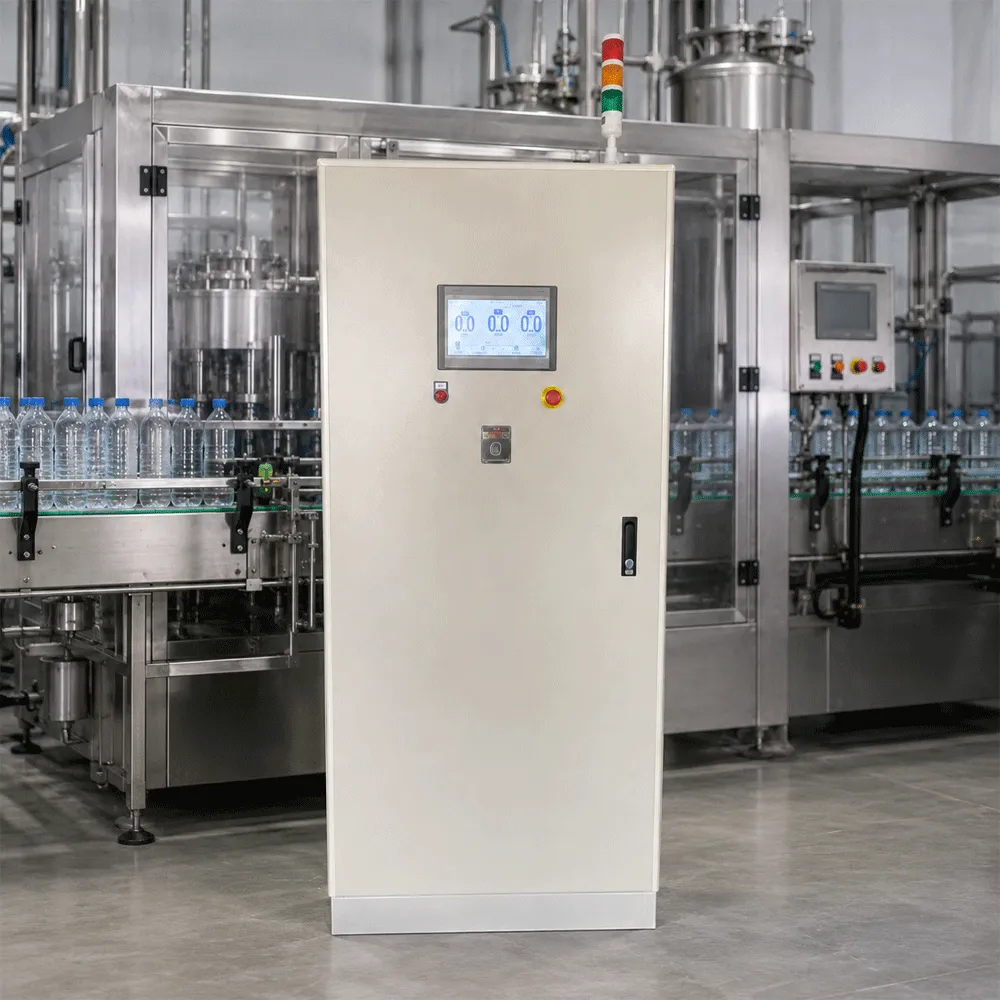
Controls are chosen at the same time. PID control covers single-brew operation. PLC control becomes worth the cost once several vessels run in parallel, because one operator then has to track overlapping steps. ZR Brew builds automation around Siemens, Schneider, Allen-Bradley or other brands agreed per project.
3. Hot and cold liquor tanks
The hot liquor tank (HLT) stores heated water for mashing in and sparging. Double-brewing roughly doubles that demand within one shift. This is why ZR Brew’s published 20HL configurations specify a 40HL HLT, twice the brew length.
A cold liquor tank holds pre-chilled water for the wort heat exchanger. It spreads the cooling demand across the day instead of hitting the glycol system with a peak during knockout.
4. Fermenters and unitanks
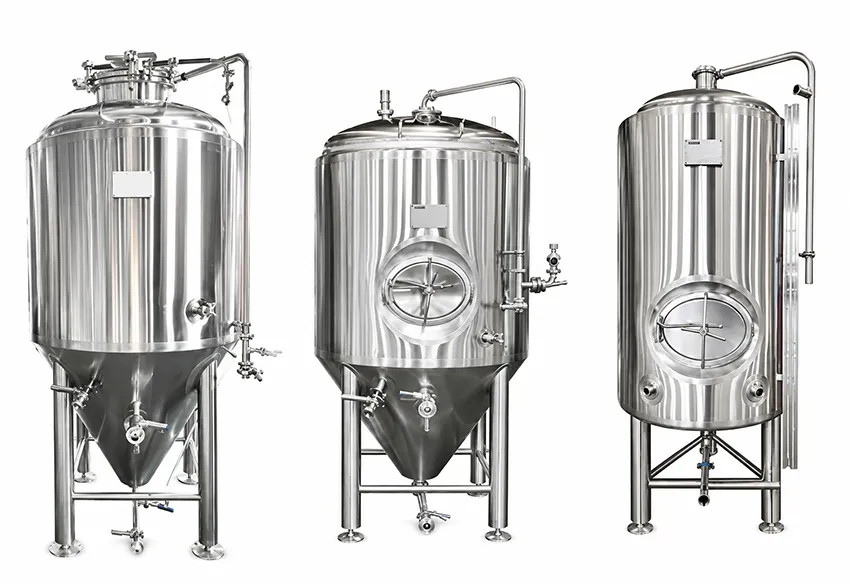
For most microbreweries, fermenters account for the largest number of vessels on the floor. The standard ZR Brew build:
- SUS304 stainless steel, with SUS316 available when the project requires it
- Glycol cooling jackets, with configurable cooling zones
- A 60-degree conical bottom, the common fermenter cone design
- Typical working pressure around 0.2 MPa (30 psi), depending on the model
- Top or side manway, with ports, valves and accessories configured per order
Size fermenters as a multiple of brew length: 20HL or 40HL tanks for a 20HL brewhouse. A unitank lets you ferment, condition and carbonate in one vessel. This reduces transfers but ties up the tank for longer, which feeds straight back into the formula above.
5. Bright beer tanks
Bright tanks hold finished beer for conditioning, carbonation and packaging. Match their volume to your fermenters so one fermenter empties into one bright tank. The number of bright tanks depends on your packaging days, not your brew days. A taproom serving directly from tanks needs extra serving capacity on top of this.
6. Glycol cooling
A glycol chiller feeds every fermenter jacket, the bright tanks and, in many layouts, the cold liquor tank. The load grows with each tank you add. It peaks when several tanks crash-cool at once. Size the chiller for the tank count in your expansion plan, or leave space and pipework for a second unit.
7. Heat source and water treatment
Your heating method decides a good share of the building work. ZR Brew offers all three options, depending on system size and site conditions:
|
Electric |
Steam |
Direct fire |
| What the site must provide |
Sufficient incoming electrical capacity |
Space for a steam generator, plus condensate return piping |
Gas supply, flue and ventilation |
| How heat reaches the wort |
Heating elements |
Steam jackets on the vessel |
Burner under the kettle base |
| Main operating watch-point |
Electrical load during the boil |
Steam-equipment rules under local regulations |
Scorching risk with high-gravity worts |
| ZR Brew supply |
Electric heating systems |
Steam heating, including steam generators |
Direct-fire configurations |
Water treatment is the item most often left until last. Brewing water and steam-generator feed water both depend on your local supply. Get a water analysis first, then specify the treatment system from it.
8. CIP (cleaning in place)
A CIP system circulates cleaning and sanitizing solutions through tanks and pipework using a pump and spray devices. Without it, cleaning a 40HL fermenter means ladders and manual scrubbing, which is slow and a safety risk. ZR Brew supplies CIP systems and configures fermenter ports to match them.
9. Packaging
Most microbreweries start with kegs and add bottles or cans when their distribution plan calls for them. ZR Brew’s published keg equipment covers:
- Single- or double-station machines, manual, semi-automatic or fully automatic
- PLC control on selected configurations
- A fixed-table keg washer and filler rated at roughly 60–80 kegs per hour in one published configuration
- An automatic keg washing and filling line published with beer loss under 1%
- Siemens controls or German flow-meter options on selected models
Bottling and canning equipment is also available. Throughput for those lines is set per project.
Optional, depending on recipes: plate-and-frame filters, centrifuges, hop guns, yeast-propagation equipment and CO₂ recovery. A brewery with a narrow range of unfiltered ales may skip most of these at launch.
ZR Brew Microbrewery System Specifications
| Parameter |
Published value |
| Microbrewery capacity category |
12HL–40HL (full brewery line: 50L–150HL) |
| Representative brewery models |
ZR-1000, ZR-1500, ZR-2000, ZR-2500, ZR-5000 (model and capacity confirmed in the quotation) |
| Brewhouse structure |
2-, 3-, 4- or 5-vessel |
| Daily brew capability (4-vessel) |
Up to ~4 batches at 10HL; up to ~6 batches at 20HL–50HL |
| Vessel material |
Food-grade stainless steel, normally SUS304; other grades subject to confirmation |
| Heating |
Electric, steam or direct fire |
| Control |
PID or PLC |
| Automation components |
Siemens, Schneider, Allen-Bradley or other agreed brands |
| Fermenter cooling |
Glycol jackets, configurable cooling zones |
| Fermenter cone |
Commonly 60° |
| Fermenter working pressure |
Approx. 0.2 MPa / 30 psi, model-dependent |
| Fermenter material |
SUS304; SUS316 on request |
| Pre-production documents |
2D and 3D layouts, process-flow design, itemized quotation, material and component confirmation |
| During production |
Factory video inspections, weekly production photos and videos, hydraulic pressure testing |
| After delivery |
Operating manuals in English, French or Spanish; remote installation guidance; on-site installation and commissioning where agreed; spare-parts support |
Send These Six Items With Your Quote Request
A quotation is only as accurate as the brief behind it. Send:
- Brew length and target brews per week, including any double-brew plans
- Beer styles and expected tank residence times
- A floor plan with ceiling height and drain locations
- Available utilities: electrical capacity, gas, and whether a steam generator is permitted
- A local water analysis
- Destination country and your expansion target for years two to five.
With this brief, the first quotation round becomes a sizing discussion rather than a price list.
FAQ
How many fermenters does a 20HL brewhouse need?
Multiply fermenter fills per week by residence time in weeks. Two double-brew days per week into 40HL tanks, with a 21-day residence time, gives six 40HL fermenters. Your own recipes and schedule will change that number.
Is a two-vessel brewhouse enough for a microbrewery?
It is enough for one brew per day. If your plan relies on double- or triple-brewing, a four-vessel brewhouse is the configuration ZR Brew publishes for up to about six batches per day at 20HL–50HL.
Steam, electric or direct fire for a 30HL system?
It depends on your site more than on the brewhouse. Check incoming electrical capacity, gas availability, and whether local regulations allow a steam generator, then choose.
Which stainless steel grade is used for fermenters?
SUS304 is standard. SUS316 is available when the project requires it.
Can I start with fewer fermenters and add more later?
Yes, if you plan for it now. Leave floor space, glycol header capacity and chiller headroom for the extra tanks, and keep new tanks at the same multiple of brew length.
How much does a 12HL–40HL microbrewery cost?
ZR Brew quotes each project individually, because price depends on vessel count, heating, automation, materials, shipping and installation scope. Request an itemized quotation.


 Published