“Brewing vessel” gets used for at least five different pieces of equipment, and the spec that matters changes with each one. A mash tun needs insulation and a false bottom; a fermenter needs a cone and a pressure rating. Confusing the two leads to the wrong equipment order.
What Happens Before the Wort Ever Reaches a Tank
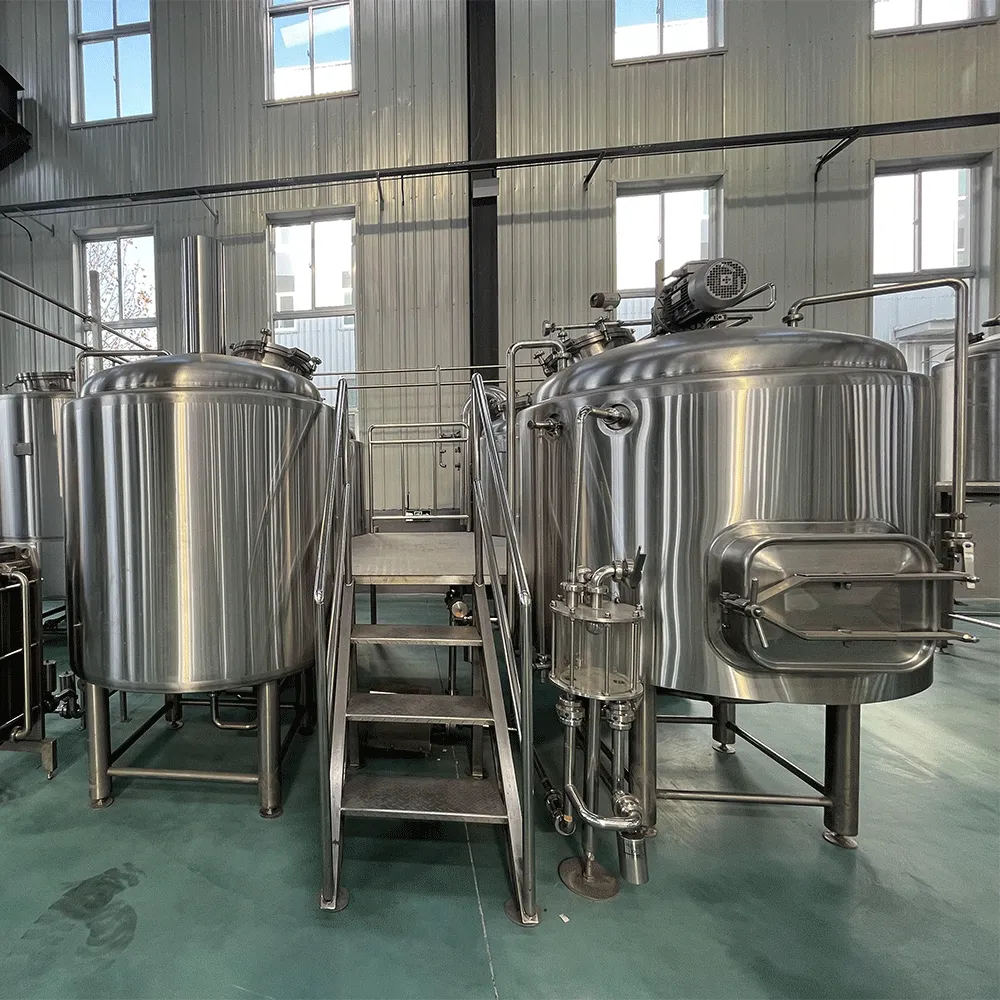
Before liquid touches a fermenter, it passes through the brewhouse — the set of vessels responsible for converting malt and water into fermentable wort. Three functions happen here, in order:
- Mashing — crushed grain is mixed with hot water to convert starches into fermentable sugars. This happens in the mash tun (or mash/lauter tun, which also separates spent grain from the liquid wort).
- Boiling — the extracted wort is boiled with hops, typically for 60–90 minutes depending on the recipe, to sterilize the liquid, isomerize hop acids, and drive off unwanted volatile compounds. This happens in the kettle.
- Clarifying — after boiling, the wort is spun to separate trub (hop and protein solids) from the clear liquid before it’s pumped to fermentation. This happens in the whirlpool.
Whether these three functions live in one vessel, two vessels, three vessels, or more is a configuration decision, not a fixed rule — and it’s the first thing that determines what a “brewing vessel” quote actually includes.
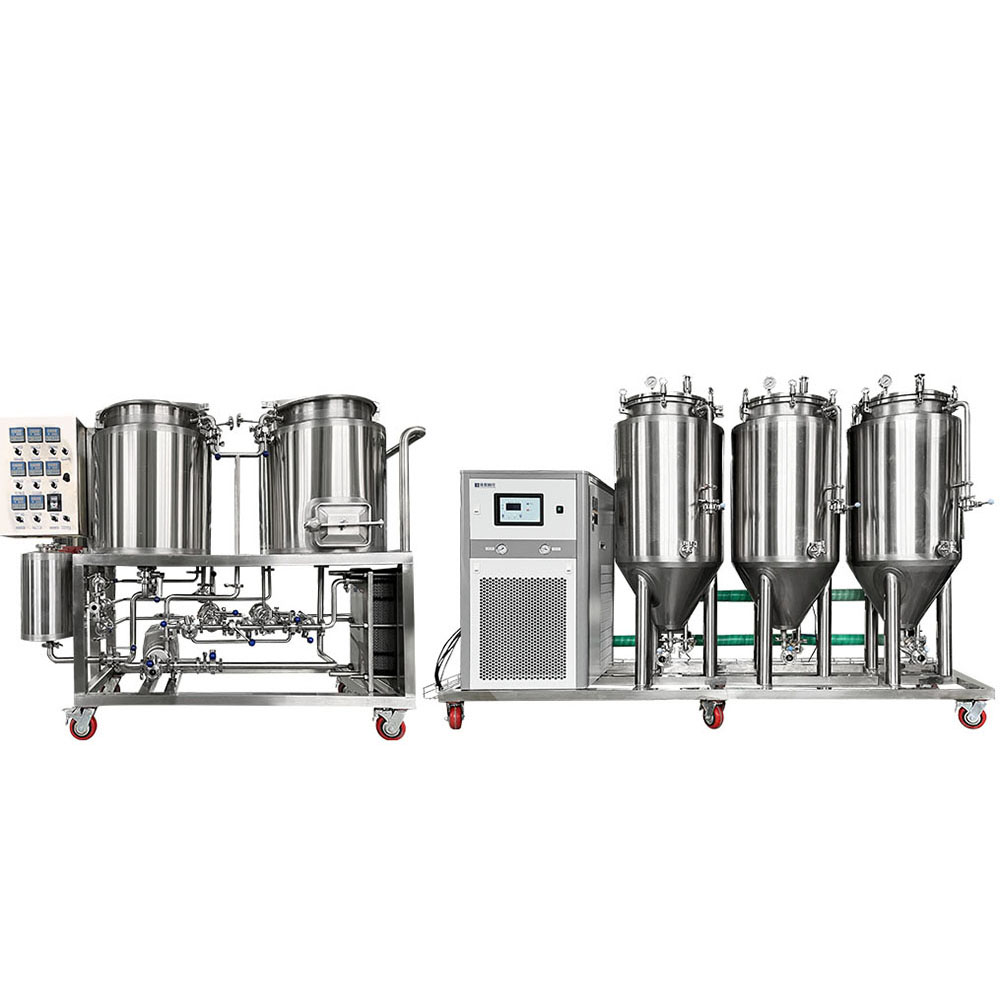
Two-Vessel, Three-Vessel, Four-Vessel: What the Number Actually Changes
ZR Brew’s published brewhouse line covers two-vessel, three-vessel, four-vessel, and five-vessel configurations, built in food-grade stainless steel (normally SUS304) with electric, steam, or direct-fire heating depending on system size and site conditions, and PID or PLC control with Siemens, Schneider, or Allen-Bradley automation components depending on the project.
| Configuration |
Typical Vessel Roles |
What’s Combined |
Where It Fits |
| Two-vessel |
Mash/lauter tun + kettle/whirlpool |
Mashing and lautering share one vessel; boiling and whirlpooling share another |
Smallest footprint, longest cycle time per batch |
| Three-vessel |
Mash tun, kettle, whirlpool (or lauter tun) |
One function per vessel, minus one shared step |
Common mid-size configuration |
| Four-vessel |
Mash tun, lauter tun, kettle, whirlpool |
Fully separated functions |
Higher batch throughput, larger footprint |
| Five-vessel |
Four-vessel setup plus an additional process or hot-liquor vessel |
Fully separated, with added buffer capacity |
Larger commercial operations |
The trade-off runs in one direction: fewer vessels means less floor space and lower equipment count, but each shared vessel has to be cleaned and repurposed between steps, which stretches the total time per batch. More vessels shorten that cycle but need more plant space and more piping and control points to commission.
ZR Brew’s published examples put this in concrete terms — a 10HL four-vessel system is configured to support up to approximately four batches per day, while a 20HL–50HL four-vessel system is designed for up to approximately six batches per day, subject to the process, schedule, and configuration selected. Those figures apply to the specific published configurations they come from and shouldn’t be assumed for a different capacity or vessel count without confirming the layout.
Representative brewhouse models in this range include the ZR-1000, ZR-1500, ZR-2000, ZR-2500, and ZR-5000, spanning home and pilot systems (50L–200L), nano breweries (2HL–10HL), microbreweries (12HL–40HL), and commercial systems (45HL–150HL). CE and ISO 9001 claims apply at the company level rather than to individual model certificates — a certificate number specific to one machine should be requested and verified for the order, not assumed from the general company claim.
From the Brewhouse to the Cellar: Fermenter and Bright Tank
Once wort leaves the whirlpool, it’s cooled and pumped into a fermentation vessel — a different category entirely from anything upstream, built around a different problem: holding a biological process at controlled temperature and pressure for days or weeks, not hours.
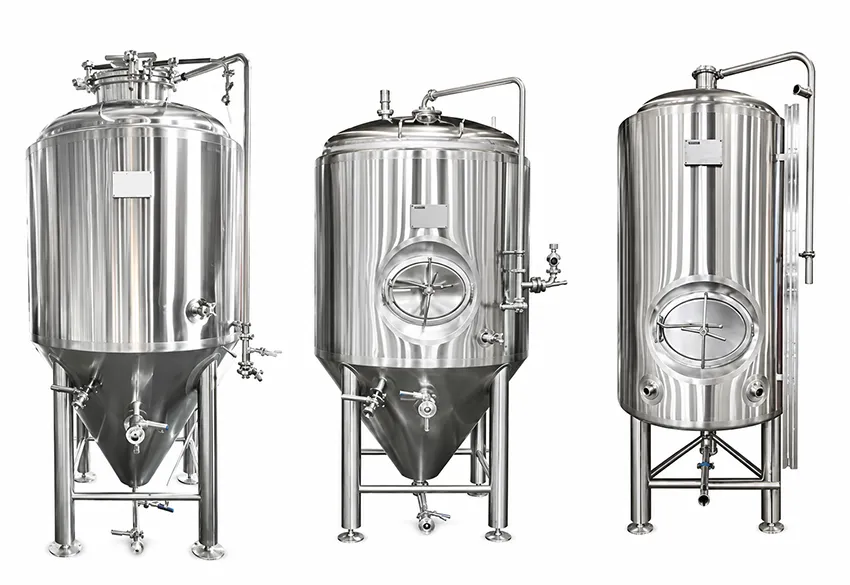
ZR Brew’s fermentation tank line (ZR-FV Series) covers nominal capacities of roughly 100L to 5,000L, with additional BBL-based sizes, built in SUS304 as standard with SUS316 available on request. The common design elements are:
- Glycol cooling jackets to hold fermentation temperature through an active, heat-generating process
- A 60-degree conical bottom, standard on fermentation tanks, which lets flocculated yeast settle and be harvested from the cone without opening the vessel
- A typical working pressure of approximately 0.2 MPa (30 psi), which supports natural carbonation under pressure during the later stage of fermentation
- A vertical, insulated shell with a configurable top or side manway
One published 3,000L configuration lists a total volume of approximately 3,750L (accounting for headspace), a 100mm insulation layer, 0.2 MPa working pressure, and SUS304 construction — figures specific to that model, not a default for every fermenter in the range.
Bright beer tanks and unitanks share this same base construction — vertical, glycol-jacketed, pressure-rated stainless steel — but the role shifts once fermentation is complete: holding finished, clarified beer for conditioning and carbonation ahead of packaging, rather than actively managing yeast activity. Ports, valves, cooling zones, and cone configuration are project-specific choices at this stage; a fixed spec sheet for “the bright tank” the way there is for a specific fermenter model isn’t published and should be requested per project.
A Common Mix-up: Treating Every Cylindroconical Tank as a Fermenter
The most frequent spec error at the buying stage isn’t confusing a mash tun with a kettle — those are visibly different in a brewhouse layout. It’s assuming that any cylindroconical, glycol-jacketed tank in a quote is doing fermentation work. A unitank can run fermentation and conditioning in the same vessel; a dedicated bright tank downstream of it may need a different cone angle, a different pressure rating, or no cone at all if it’s built purely for storage. Two tanks that look nearly identical in a floor plan can carry different working pressures and different CIP requirements depending on which stage they’re assigned to — and pulling the wrong one into a quote changes both the cost and the plumbing.
Compared to single-vessel all-in-one brewing systems sometimes sold for home-scale or nano operations — where mashing, boiling, and whirlpooling happen in one tank — a multi-vessel brewhouse trades a larger footprint for shorter per-batch cycle time, and it separates the brewhouse question entirely from the fermenter and bright tank question downstream.
Matching Vessel to Stage: Quick Reference
| Vessel |
Process Stage |
Key Spec That Matters |
ZR Brew Capacity Reference |
| Mash tun |
Converting starch to sugar |
Insulation, false bottom, agitation |
Sized to brewhouse configuration |
| Kettle |
Boiling and hop isomerization |
Heating method (electric/steam/direct-fire), boil-off rate |
Sized to brewhouse configuration |
| Whirlpool |
Trub separation |
Tangential inlet geometry, rest time |
Often combined with kettle in 2-vessel systems |
| Fermenter |
Primary fermentation, yeast management |
Cone angle, cooling jacket, pressure rating |
ZR-FV Series, ~100L–5,000L + BBL sizes |
| Bright tank |
Conditioning, carbonation, storage |
Pressure rating, cone (project-dependent) |
Shares ZR-FV base construction |
Vessel count and capacity are project-level decisions — driven by target batch size, brewing schedule, and site layout — and ZR Brew‘s project team configures and quotes brewhouse and fermentation packages against those inputs rather than against a fixed price list.
FAQ
Can a two-vessel brewhouse produce the same beer quality as a four-vessel system?
Yes — vessel count changes cycle time and floor space, not the chemistry of mashing, boiling, or whirlpooling. A two-vessel system just performs some of those steps sequentially in the same tank rather than in parallel across separate ones.
Does every fermenter need a 60-degree cone?
It’s the standard design on ZR Brew’s published fermentation tank line because it supports yeast harvesting from the cone, but cone angle, along with ports and cooling zone layout, is configurable per project.
What’s the practical difference between a unitank and a bright beer tank?
A unitank is built to handle fermentation and conditioning in the same vessel; a dedicated bright tank downstream is typically used only for holding finished beer before packaging. Both share the same base stainless steel, glycol-jacketed construction.
Is CE certification on the brewhouse the same as CE certification on the fermenter?
No — CE and ISO 9001 claims apply at the company level. A certificate covering a specific machine should be requested and verified separately for each vessel in an order.


 Published