

お見積りをご依頼ください
24時間以内にご返信いたします。お急ぎの場合は、WhatsAppまたはWeChat(+8613188932181)までご連絡ください。.
*当社はお客様のプライバシーを尊重し、すべての情報を保護いたします。.
お客様の情報は、お問い合わせへの回答にのみ使用し、未承諾のメールや宣伝メッセージを送信することは一切ありません。.
 公開日
公開日
Infusion mashing, decoction mashing, double mash processes, and special mashing techniques — 13 process diagrams and 3 comparison tables in one guide.
Have you ever wondered why British ales taste so different from Czech lagers, even when the recipes look almost identical? The answer often hides in the mash tun. Mashing methods are generally divided into two families — infusion mashing and decoction mashing. Which one fits your malt, your adjuncts, and your brewhouse? Let’s walk through every process, step by step, with the temperature charts you can actually use.
What makes infusion mashing so simple? The mash is never boiled from mash-in to mash-out. Soluble substances are extracted purely by enzyme action, and the wort still retains a certain enzyme activity before the kettle boil. Depending on whether adjuncts are added, infusion mashing splits into single-mash infusion and double-mash infusion — and the single-mash version comes in two flavors: constant-temperature and rising-temperature.
Could you really mash at a single temperature and still filter normally? Yes — if your malt is well-modified. Mashing-in at about 65 °C (the saccharification temperature itself), holding for 1–2 hours, then raising to the filtration temperature of 78 °C. Notice what’s missing: there is no protein rest at all. That’s why this method is only suitable for malts whose protein degradation is already complete. If your malt is under-modified, would this shortcut hurt foam and head retention? It certainly can.
How do you build a full enzyme schedule without a second vessel? Start by mashing in at 35–37 °C to soak the grist, then heat directly to 50 °C for the protein rest, slowly on to 65 °C and 72 °C for staged saccharification, and finally up to 78 °C for filtration. Infusion mashing demands well-modified malt, which is exactly why it is especially suited to all-malt beers and top-fermented beers. Did you know that around 70% of British beers are top-fermented — and virtually all of them use infusion mashing?
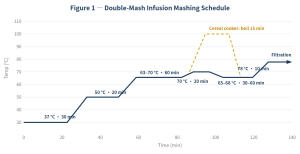
When adjuncts enter the recipe, how do you gelatinize rice while protecting delicate malt enzymes? In the double-mash (two-vessel) infusion method, the mash and the cereal mash are combined — and after combining, neither mash is boiled. Instead, the combined mash is heated directly in the mash tun to each saccharification stage. Because only the cereal mash was actually boiled (in the cereal cooker), fewer high-molecular gums from endosperm cell walls and other impurities are extracted. The result? A wort that is pale in color, low in viscosity, soft on the palate, and highly fermentable — isn’t that exactly what light, crisp lager beers demand?
How does the full double-mash infusion schedule look on a temperature chart?
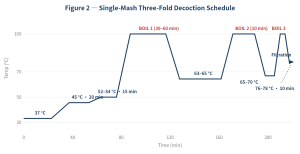
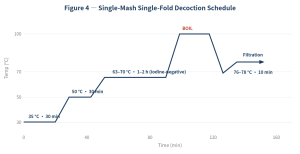
Why would anyone deliberately boil a third of the mash? In decoction mashing, a portion of the mash is drawn off and heated in stages to boiling, then pumped back into the unboiled mash, raising the whole mash step by step to the temperature each enzyme group requires — until the final saccharification temperature is reached. Depending on whether adjuncts are used, decoction divides into single-mash decoction (no adjuncts, mash only) and double-mash decoction; and by the number of mash pulls, each family splits into three-fold, two-fold, and single-fold decoction.
Which decoction method stands at the head of the family tree? The three-fold single-mash decoction — nearly every other decoction process evolved from it. Because part of the mash passes through three boils, the temperature rises gently, which favors enzyme action and the dissolution of substances. But what’s the price? More boils mean longer working hours, higher heat and power consumption, higher production costs, and lower equipment utilization. Would you trade time and energy for maximal malt expression?
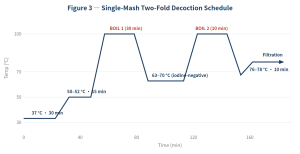
Which beer made two-fold decoction famous? The legendary Pilsner. Widely applied to malts of the most varied qualities and to the most varied beer types, the two-fold method keeps much of the three-fold’s character while trimming one boil. Flexibility is its real strength — could this be the sweet spot for a classic lager program?
Can you keep most of the decoction benefit with just one pull? The single-fold version draws the mash only once, keeping the schedule leaner while preserving the decoction flavor signature. It remains a workhorse for breweries that want depth of malt without a 6-hour brewhouse day.
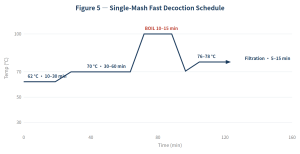
What if your malt is excellent and your schedule is tight? The fast single-mash decoction skips the protein rest entirely and keeps the boil very short — designed for malts with good protein modification and high diastatic power. Mashing-in at 62 °C, holding 10–30 minutes, then 30–60 minutes at 70 °C, a brief 10–15 minute boil of the pull, and straight to 76–78 °C for filtration. The entire mash can finish within 2 hours. The trade-off? Beers tend to be lighter-bodied with slightly lower extract yield. Is speed worth a point of body — or would you rather have both?
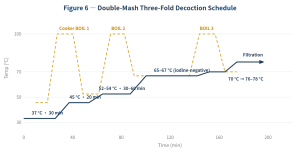
Where did double-mash decoction come from? It appeared because of adjuncts — rice, corn, unmalted grains that must be gelatinized in a separate cereal cooker. Both vessels are mashed in at the same time, and by the number of boils of the cereal mash we speak of three-fold, two-fold, or single-fold double-mash decoction. In the three-fold version, part of the mash is boiled three times and the schedule stretches to 4–6 hours — excellent for poorly modified malt, but is your energy budget ready for that?
And if three boils is too many, what does the single-fold double-mash version look like?
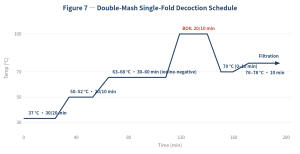
Concrete practice varies a lot — so what really distinguishes one double-mash single-fold recipe from another? The final mash and filtration temperatures are nearly always around 78 °C. The differences lie in whether the malt mash passes through a 35–37 °C steeping stage, the level and length of the protein rest (45–52 °C), and the level and length of saccharification (63–72 °C). A typical workflow:
What should you watch out for with decoction mashing?
So which method wins on equipment, labor, malt requirements, and beer character? The table below puts the two families side by side. Notice how every advantage on one side has a matching cost on the other — can you now see which column your next beer belongs in?
| Item | Decoction Mashing | Infusion Mashing |
|---|---|---|
| 設備 | More complex; at least two mashing vessels required | Simple; one mash/lauter vessel is enough |
| Operation | Complex operation, long working time, higher production cost | Simple operation, short working time, lower production cost |
| Time | Long (up to 4–6 h with three boils) | Short (as little as 2–3 h) |
| Malt requirement | Tolerates lower-quality / under-modified malt; adjuncts possible | Needs well-modified malt; adjuncts possible in double-mash form |
| Wort character | Better protein control; fewer high-molecular gums; bright, low-viscosity wort | More medium-molecular nitrogen compounds retained |
| Beer character | Full-bodied, soft, well-rounded malt character | Crisp, clean, better foam color and freshness |
Source: Table 3-22 of the original text; wording condensed. Energy consumption of decoction is about 20% higher than infusion.
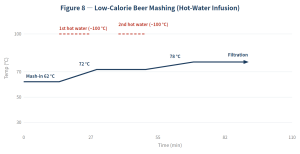
What if you want faster saccharification without extra vessels? Mashing-in at about 35 °C and then adding 100 °C hot water pushes the mash straight to 72 °C — the optimum temperature of α-amylase. Even though α-amylase acts quickly at this temperature, the dextrins it produces still need the coordinated work of β-amylase, so the final fermentability depends on how the rest of the schedule is arranged. Clever trick or risky shortcut?
Aiming for 90% apparent attenuation and excellent foam stability? Low-calorie beer mashing uses two contrasting mash-in strategies — low-temperature mash-in and high-temperature mash-in. In both, the key is to rapidly suppress endopeptidase activity so the wort keeps the right nitrogen balance while limit dextrinase survives to strip those unfermentable dextrins. Compare the two schedules below: in which one does the peptidase survive longer?
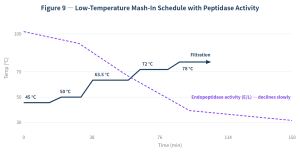
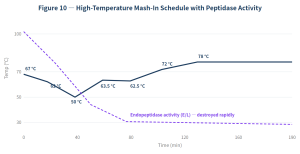
And how do the two strategies compare in the glass? The nitrogen figures tell the story:
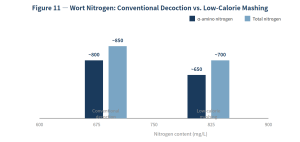
Which mash-in wins on fermentability? The original data compares three schedules:
| Parameter | Variation 1 | Variation 2 | Variation 3 |
|---|---|---|---|
| Mash-in temperature (°C) | 62 | 62 | 52 |
| 45–50 °C rest time (min) | 20 | 30 | 30 |
| 62–63 °C rest time (min) | 60 | 60 | 30 |
| 71–72 °C rest time (min) | 20 | 20 | 20 |
| Saccharification endpoint (min) | 75 | 145 | 205 |
| Total mashing time (min) | 185 | 205 | 145 |
| Apparent attenuation (%) | 89.2 | 89.8–93.4 | 90–91.7 |
Source: Table 3-23 of the original text. Some cells in the source scan were partially legible; values are restored as faithfully as possible. Adjusting mash-in temperature and rest times raises attenuation — high mash-in temperature with a short, cool protein rest performs best.
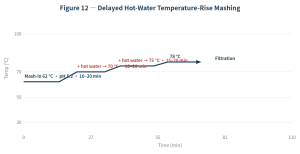
Why would a brewer deliberately mash in low and add hot water in stages? The delayed temperature-rise method mashes in at 62 °C, pH adjusted to 5.2–5.4 and grist:water ≈ 1:2.5, rests 10–20 minutes, then raises stepwise with hot water — first to 70 °C (enzyme endpoint check, 10–20 min), then to 75 °C (15–20 min, said to favor foam and flavor), and finally to 78 °C. Filtering with a thinner mash (1:4–1:5 sparge). Could gentle, staged heating be the cheapest foam improver you already own?
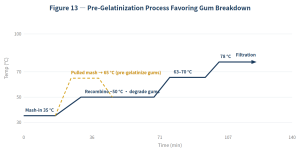
Struggling with slow runoff from high-β-glucan malts or adjuncts? In the pre-gelatinization process, mash in at 35 °C, pull a partial mash and heat it to 65 °C so the gummy β-glucan materials swell out, while the rest of the mash stays cooler to protect β-glucanase activity. After recombination at about 50 °C, the surviving enzymes then degrade those high-molecular gums. Isn’t that an elegant way to have cooking and conservation at the same time?
What if the mash tun could handle almost any raw material? Using exogenous enzyme preparations — α-amylase, proteinase, and pullulanase (sometimes partly saccharifying enzyme) — you can directly saccharify barley, rice, corn, and other adjuncts, with adjunct levels reaching 70% or more. Barley and malt are homologous materials, which is why barley is the first-choice representative adjunct, subject to local resource availability. Typical dosages: α-amylase 5–6 u/g barley, proteinase 60–80 u/g, pullulanase 50 u/g — adjusted to raw material quality and process conditions. How does milling method affect the outcome?
| Item | Control (Malt) | Enzyme Mashing · Dry-Milled Barley | Enzyme Mashing · Wet-Milled Barley |
|---|---|---|---|
| Raw material ratio (%) | Malt 70 / Rice 30 | Barley 70 / Rice 30 | Barley 70 / Rice 30 |
| Filtration time (min) | 45 | 64 | 56 |
| Total filtration time (min) | 107 | 108 | 106 |
| Raw material utilization (%) | 95.98 | 97.73 | 98.09 |
Source: Table 3-24 of the original text. With 12 °P wort, the mash-tun liquor ratio is about 1:3.5 and the cereal-cook ratio 1:(4–5); a second wort of 15–16 °P is recommended.
Beyond enzyme mashing, pressure mashing and pressure boiling exist but are rarely adopted. With so many options — which one should your brewery actually run? The honest answer: test on a small scale first, check your malt quality, and match the method to your own equipment, energy costs, and beer style targets.
Yes — but expect a different beer. Decoction builds malt depth through boiling; an infusion version of the same grist will taste cleaner and lighter but less rounded. If you convert, consider a longer 65 °C rest and a small hot-water temperature boost to recover some body.
Low-calorie mashing schedules (Table 2) reach 89–93% apparent attenuation by suppressing endopeptidase early and preserving limit dextrinase. Double-mash infusion worts are also highly fermentable thanks to low viscosity and fewer high-molecular gums.
Around 20% more than infusion. You can trim this by limiting boils to 1–2 pulls and keeping each boil to 10–15 minutes for pale beers (20–30 minutes for dark beers).
For double-mash infusion and double-mash decoction, yes — a cereal cooker is required to gelatinize rice or corn before mash combination. Single-mash infusion, by definition, runs in a single vessel.
The unboiled mash carries the enzyme load that will digest the starch from the boiled pull. Pouring unboiled mash into boiling-hot mash would shock and denature the enzymes — wasting the entire point of decoction.
Is there one “best” mashing method? No — there is only the best method for your malt, your adjuncts, and your brewhouse. Well-modified malt and all-malt styles point to infusion; under-modified malt and full-flavored lagers reward decoction; high-adjunct recipes demand a cereal cooker; and low-calorie or high-adjunct enzyme mashes open the door to 70%+ unmalted grist. The charts and tables above give you every temperature, every rest, and every trade-off — the rest is your brewing decision.
24時間以内にご返信いたします。お急ぎの場合は、WhatsAppまたはWeChat(+8613188932181)までご連絡ください。.
*当社はお客様のプライバシーを尊重し、すべての情報を保護いたします。.
お客様の情報は、お問い合わせへの回答にのみ使用し、未承諾のメールや宣伝メッセージを送信することは一切ありません。.