

お見積りをご依頼ください
24時間以内にご返信いたします。お急ぎの場合は、WhatsAppまたはWeChat(+8613188932181)までご連絡ください。.
*当社はお客様のプライバシーを尊重し、すべての情報を保護いたします。.
お客様の情報は、お問い合わせへの回答にのみ使用し、未承諾のメールや宣伝メッセージを送信することは一切ありません。.
 公開日
公開日
Ever wondered why mash temperature matters so much? Here is how temperature, pH, time, and enzymes turn malt into fermentable wort.
Have you ever watched a mash sit at 65 °C and wondered what the grain is really doing? Mashing is a controlled biochemical reaction—while you see temperature ramps and rest timers, inside the tun enzymes are launching a coordinated attack on starch, proteins, beta-glucans, phosphates, lipids, and minerals. So why should you care? Because understanding these mashing biochemical changes lets you predict extract yield, fermentability, foam stability, and beer flavor long before the wort ever reaches the kettle.
So how does insoluble starch become the sugar that yeast can ferment? Starch breakdown is the single most important enzymatic reaction in the mash. Given the right temperature, pH, time, and calcium concentration, malt amylases convert insoluble starch granules into fermentable sugars and dextrins. It happens in three overlapping stages—but do you know which one is limiting your brew? Gelatinization, liquefaction, and saccharification.
Why can’t amylases attack raw starch directly? Because raw starch granules are sealed inside cell walls and are simply not accessible to enzymes. When heated in water, the granules absorb water, swell, and burst—a process called gelatinization. And here is the catch: different grains gelatinize at different temperatures:
So what happens if you miss the gelatinization window? The starch molecules never become soluble, never meet the enzymes, and stay locked inside the grain—which is exactly why poor gelatinization quietly drains your extract yield.
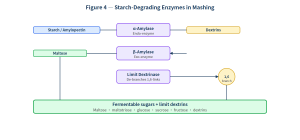
Have you ever stirred a mash that felt like glue? That is precisely what liquefaction is fighting against. Liquefaction is the rapid reduction of mash viscosity: α-amylase attacks starch chains at random internal points, splitting long molecules into shorter dextrins. Why does it matter so much? Because without liquefaction the mash becomes too thick to pump or stir—and the starch never gets properly prepared for the next stage.
β-amylase clips maltose units from the non-reducing ends of starch chains and dextrins, while Limit dextrinase cleaves the 1,6-branch points that α- and β-amylase cannot access. Together these enzymes produce the fermentable sugars—maltose, maltotriose, glucose, sucrose, and fructose—that yeast will consume during fermentation. Where does the sugar that yeast actually ferments come from?
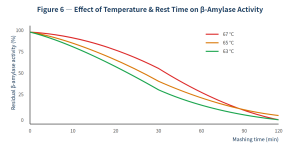
But here is the key question: is your mash actually giving these enzymes the conditions they need? The next three figures show how temperature, time, and pH each shape enzyme activity—and where many brewhouses go wrong.
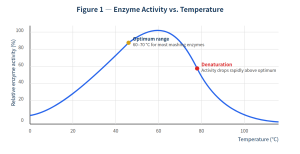
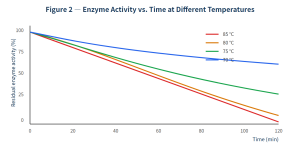
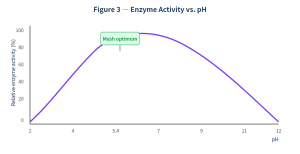
Practical target: For most mash enzymes, aim for 62–70 °C (144–158 °F) and pH 5.2–5.6. α-amylase tolerates higher temperatures (72–75 °C optimum), while β-amylase is more heat-labile and prefers 60–65 °C.
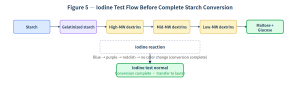
And how do you know when conversion is actually done? The iodine test is the brewer’s classic answer—here is the full color progression from raw starch to fermentable sugar.
Want to know why one beer finishes crisp and dry while another feels full and sweet? The ratio of fermentable sugars to total extract decides exactly that. So what does the distribution actually look like? The table below shows the typical profile of a 12 °P wort.
| Fermentable sugar | % of total extract | g/100 mL in 12 °P wort | % of fermentable extract |
|---|---|---|---|
| Hexose (glucose + fructose) | 7–9 | 0.9–1.2 | 11.9 |
| Sucrose | 3–4 | 0.4–0.5 | 5.1 |
| Maltose | 43–45 | 5.6–5.9 | 65.4 |
| Maltotriose | 11–13 | 1.4–1.7 | 17.6 |
| Total | 62–68 | 100.0 |
Source: Table 3-18. Maltose is the dominant fermentable sugar in wort, followed by maltotriose and hexoses.
Did you know the same protein family can both build your foam and ruin your clarity? Proteolytic enzymes break malt proteins down into high-molecular-weight nitrogen, medium-molecular-weight nitrogen, low-molecular-weight nitrogen, and free amino acids. Each fraction plays a very different role in the finished beer—so how do you keep the balance right?
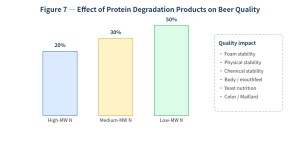
So which protein fraction does what—and which one should you actually worry about? The table below breaks down each fraction and the exact job it does in your beer.
| 製品 | Role in beer |
|---|---|
| High-MW nitrogen | Forms foam, contributes physical and chemical stability, adds body and mouthfeel |
| Medium-MW nitrogen | Acts as a CO₂ carrier, influences palate fullness and bitterness perception |
| Low-MW nitrogen / amino acids | Provides yeast nutrition; participates in Maillard reactions and color development |
Source: Table 3-19. Balanced protein breakdown is essential for both foam quality and fermentation performance.
But which enzymes are really doing the work, and under what conditions do they thrive? Table 3 lists the four main proteolytic enzymes, their optima, and their products.
| Enzyme | Type | Optimum conditions | Action | 製品 |
|---|---|---|---|---|
| Endopeptidase | Endo-enzyme | pH 5.0–5.2, 50–60 °C | Cleaves peptide bonds inside protein chains | Peptones, peptides |
| Carboxypeptidase | Exo-enzyme | pH 5.0–5.2, 50–60 °C | Removes amino acids from carboxyl end | Amino acids |
| Aminopeptidase | Exo-enzyme | pH 7.2, 40–45 °C | Removes amino acids from amino end | Amino acids |
| Dipeptidase | Endo-enzyme | pH 7.8–8.2, 40–50 °C | Splits dipeptides into free amino acids | Amino acids |
Source: Table 3-20. Endopeptidases and carboxypeptidases are most active under normal mash conditions; aminopeptidases and dipeptidases require higher pH or lower temperatures.
Ever had a lauter tun that simply refused to run? β-glucans are often the hidden culprit. These cell-wall polysaccharides raise viscosity and can cause lautering and filtration problems if they are not degraded. Here is the twist: a moderate level of β-glucan is desirable for foam and mouthfeel, but too much leads to stuck runoffs and hazy beer. So where does the tipping point sit?
So when should you actually schedule a β-glucan rest? A 45–50 °C rest is especially useful for under-modified malt or high-β-glucan adjuncts such as oats and barley. With well-modified malt, though, you can usually skip it—so how do you know which situation you are in?
Why does mash pH drift on its own? Phytases and phosphatases release phosphate from organic phosphate compounds in malt—and that same reaction releases hydrogen ions, lowering mash pH and boosting enzyme activity. Phosphate hydrolysis is fastest at pH 5.0 and 50–53 °C, but it is strongly inhibited above 65 °C.
As phosphate dissolves, mash pH can drop from about 5.85 to 5.40. So what does that natural acidification actually buy you? It helps β-amylase and limit dextrinase, improves protein precipitation, and reduces polyphenol extraction.
Could that harsh, astringent aftertaste be starting in your mash? Quite possibly. Polyphenols (tannins) are released from husk and aleurone tissue as mashing temperature and time increase. Too much extraction creates harsh bitterness and astringency—yet controlled polyphenol levels are useful, because they bind with proteins and improve non-biological stability.
And what about lipids? Lipids are partly degraded during malting, and further changes happen during mashing. Lipase activity peaks in two temperature windows: 30–35 °C and 65–70 °C. After about 30 minutes at 65 °C, lipase is largely inactivated. Free fatty acids and lipid oxidation products can affect foam stability and flavor, so excessive lipid release is generally undesirable.
Would you ever guess that a trace metal could stall your fermentation? Zinc is an essential micronutrient for yeast—it activates several yeast enzymes and supports healthy fermentation. During mashing, roughly 20% of the malt zinc dissolves into the wort. But how much do you actually recover? It depends strongly on mash temperature, pH, and grist-to-water ratio.
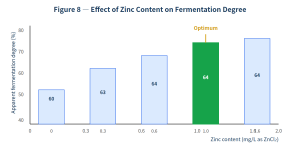
So how do you maximize zinc without overcomplicating your mash? The table below shows how mash-in temperature, rest time, pH, and grist-to-water ratio shift the zinc available to your yeast.
| Mash-in temperature (°C) | Rest time (min) | pH | Grist-to-water ratio | Zinc in wort (mg/L) |
|---|---|---|---|---|
| 45–50 | 30–60 | 5.45 | 1 : 2.5 | 0.20–0.22 |
| 50 | 30 | 5.45 | 1 : 2.5 | 0.18 |
| 60 | 30 | 5.45 | 1 : 2.5 | 0.16 |
| 45–50 | 30–60 | 5.45 | 1 : 4.5 | 0.18 |
Source: Table 3-21. Lower mash-in temperatures and thicker mashes favor zinc extraction. A separate zinc rest at 45 °C is common when malt zinc is low.
With so many enzymes competing for the same temperature window, is a perfect mash program even possible? Not a universal one—but a well-designed mash balances the competing needs of several enzyme systems. The following principles apply to most breweries:
There is no single most important enzyme, but α-amylase and β-amylase together determine starch conversion and fermentability. Without them, there would be no fermentable sugars for yeast.
Higher mash temperatures favor α-amylase, which produces more non-fermentable dextrins. These dextrins remain in the finished beer and create a fuller mouthfeel. Lower temperatures favor β-amylase and produce more maltose, leading to a drier beer.
Take a small sample of wort, cool it to room temperature, and add iodine. A blue or purple color indicates residual starch; a colorless or light yellow reaction means conversion is complete.
Over-proteolysis reduces foam-positive proteins and can make the beer thin and unstable. It may also increase free amino nitrogen to levels that promote unwanted yeast by-products.
If you use well-modified base malt, a separate β-glucan rest is usually unnecessary. For under-modified malt, high-β-glucan barley, or large amounts of oats, a 45–50 °C rest can prevent stuck runoffs and haze.
So what is mashing, really? It is the biochemical engine of the brewery. Every rest temperature, pH adjustment, and minute of contact time influences the final ratio of sugars to dextrins, the nitrogen profile, the viscosity, and the micronutrient content of the wort. Once you understand starch, protein, beta-glucan, phosphate, polyphenol, lipid, and zinc transformations, you can design mash programs that deliver consistent, high-quality beer.
Still struggling with a slow lauter, low attenuation, or weak foam? The answer usually starts in the mash tun. Use the diagrams and data in this guide to diagnose your process and make informed changes.
24時間以内にご返信いたします。お急ぎの場合は、WhatsAppまたはWeChat(+8613188932181)までご連絡ください。.
*当社はお客様のプライバシーを尊重し、すべての情報を保護いたします。.
お客様の情報は、お問い合わせへの回答にのみ使用し、未承諾のメールや宣伝メッセージを送信することは一切ありません。.