

お見積りをご依頼ください
24時間以内にご返信いたします。お急ぎの場合は、WhatsAppまたはWeChat(+8613188932181)までご連絡ください。.
*当社はお客様のプライバシーを尊重し、すべての情報を保護いたします。.
お客様の情報は、お問い合わせへの回答にのみ使用し、未承諾のメールや宣伝メッセージを送信することは一切ありません。.
 公開日
Two brews, same recipe, same equipment — yet one batch pours brilliant and the next throws haze, throws off flavours, or drags your yield down. Where did it go wrong? The uncomfortable truth: quality is not tested at the end of the brewhouse, it is controlled from the very first grain. So what does a modern mashing cellar actually have to get right — and which trouble spots quietly sabotage uniformity? Let’s walk through the quality goals, the classic weak points, and the control philosophy that separates world-class brewhouses from average ones.
The correct target sounds modest: beer quality that at least meets the national standard — reliably, every single brew. Chasing an ever-higher quality level sounds admirable, but it drives costs up disproportionately. A modern brewhouse therefore balances fourteen requirements at once:
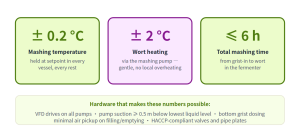
Quality control starts with hardware. A textbook-compliant mashing cellar is designed, built and commissioned against these rules:
Uniformity is not an accident. The textbook’s schematic is brutally simple: inputs (necessarily intermittent) → production control → uniformity and quality. In practice that means two pillars stand side by side, and only their combination produces the third box — constant quality.
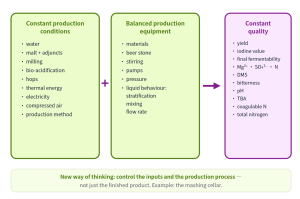
Look at what sits in the middle column: beer stone and liquid behaviour — stratification, mixing, flow rate — are equipment properties, not recipe choices. A brewhouse that layers, channels or scours unevenly will drift batch to batch no matter how disciplined the recipe is. That is exactly why vessel geometry, agitator design and pump selection belong in any serious quality conversation.
Before you can control quality, you need to know where it leaks. The textbook maps eleven physical and chemical danger zones in the mashing cellar — from by-product handling to the evaporation surface. How many of these does your brewhouse actively manage?
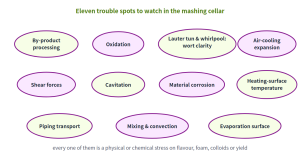
The textbook lists 16 weaknesses of the traditional mashing cellar. Read them as a checklist and you will notice they cluster into four families — milling & oxygen, mechanical stress, thermal load, and process-control gaps:
| Family | Weaknesses | Typical consequence |
|---|---|---|
| Milling & oxygen | Dry milling with poor classification · wet-milling transfer systems · milling that oxidises · oxidation of mash and wort · oxygen pickup during operation | Loss of reducing power, duller flavour, darker colour, fewer foam-positive proteins |
| Mechanical & hydraulic | Pump cavitation · uneven mixing · microbial contamination from dead zones in pipework | Shear damage, inconsistent conversion, wort acidification and butyric acid formation |
| Thermal load | Excessive heat load · heating surface too large · evaporation surface too large · reflux of kettle condensate · high thermal load in the whirlpool | Rising TBA (thiobarbituric-acid value), harsher bitterness, accelerated flavour ageing |
| Process control | Turbidity and particles during lautering · optimal saccharification never reached · by-product effects · secondary effects of steam condensate | Inconsistent attenuation, hazy beer, hidden extract losses |
Here is the leverage point: more than 40% of beer quality is determined by malt quality alone. Good malt shortens the process, saves energy and lifts almost every finished-beer parameter at once — see how tightly the operation column and the beer column of Table 2 mirror each other.
| Operation | Finished beer |
|---|---|
| Shorter mashing process | Lighter colour |
| Lower energy consumption | Good foam |
| Shorter filtration time | Fewer fermentation by-products |
| Higher brewhouse yield | Good aroma |
| Promotes fermentation | Pure, full-bodied entry |
| Good filtration performance | Moderate bitterness |
| Better stability | Longer shelf life · better flavour stability |
The buying lesson: every dollar saved on marginal malt is repaid with interest in longer boiling, more filtration downtime, hazier beer and shorter shelf life. Quality control in the brewhouse begins at the malt silo door.
Strip the theory down and nine technical issues decide whether the mashing process protects or destroys quality. The recurring villains? Oxygen, mechanical action and heat — and the places they combine:
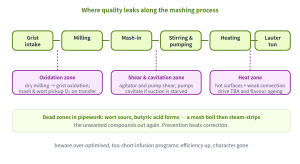
Even well-equipped brewhouses struggle with human and process realities. The textbook names eight — do any of them sound familiar?
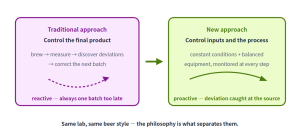
Beer quality that at least meets the national standard — consistently. Aiming far beyond that level raises costs disproportionately; uniformity and reliability create more value than occasional brilliance.
Enzyme systems respond steeply to temperature. A 1 °C drift shifts the beta/glucanase-to-amylase balance measurably, changing fermentability, FAN and filtration behaviour batch to batch.
Beyond roughly six hours from grist-in to wort in fermenter, microbial risk, oxidation load and dimethyl-sulfide precursor formation all climb, while foam-positive proteins degrade. Long brewhouse dwell time is a quality tax.
Strong convection and mixing keep beer stone (calcium oxalate scale) particles suspended and scrubbing against wort; the textbook explicitly lists beer stone among equipment factors that create beer off-flavours. Clean vessels and gentle flow keep it bonded to the wall, not in your beer.
The thiobarbituric-acid value indicates lipid oxidation load. High thermal load, oversized heating surfaces and large evaporation surfaces all push TBA up — and high TBA correlates with faster flavour ageing in the packaged beer.
Malt supplies the extract, the enzyme potential, the nitrogen spectrum and most foam- and flavour-active precursors. Good malt simultaneously shortens mashing, cuts energy use, speeds filtration and lifts colour, foam, aroma and shelf life.
Check mashing-in temperature and grist dissolution first: both strongly influence FAN release, and casting temperature in particular is flagged as critical for foam and α-amino nitrogen. Then review whether trub separation is stripping too much zinc.
No. Over-optimised, too-short infusion programs may raise capacity but flatten beer character — the textbook warns they lead to bland beer that loses its typicity. Optimise towards a target flavour profile, not just towards minutes saved.
ZR Brewing engineers mashing systems around exactly these control principles: ±0.2 °C temperature control, VFD pump packages, bottom grist dosing, gentle pipework geometry and HACCP-compliant valves — so uniform quality is designed in, not hoped for.
Contact us at [email protected] or visit www.zrbrewing.com to spec your next brewhouse.
24時間以内にご返信いたします。お急ぎの場合は、WhatsAppまたはWeChat(+8613188932181)までご連絡ください。.
*当社はお客様のプライバシーを尊重し、すべての情報を保護いたします。.
お客様の情報は、お問い合わせへの回答にのみ使用し、未承諾のメールや宣伝メッセージを送信することは一切ありません。.