Stainless steel fermentation tanks for beer run roughly from 100L to 5000L in nominal capacity, with BBL-based sizes alongside them. The figures that decide whether a tank fits are total volume, cone angle, working pressure, insulation thickness and steel grade, not the headline litre number on its own.
All specifications below reflect what ZR Brew publishes as of August 2026. Anything not published is marked as such rather than estimated, because a fermenter is a pressure-bearing vessel and a guessed number becomes an expensive problem at the installation stage.
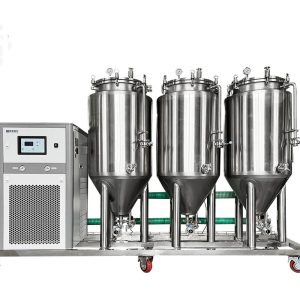
Nominal volume is not the volume ferment
Two numbers describe every fermentation tank, and suppliers usually quote only one of them.
Nominal (working) capacity is the wort volume the vessel is sold to hold. Total volume is the physical internal volume, including the headspace that krausen needs.
ZR Brew‘s published 3000L model lists a total volume of approximately 3750L. That is 750L of headspace on a 3000L working volume, or 25% of the working capacity. Treat that as one documented configuration rather than a rule for the whole range: headspace allowance shifts with cone geometry, tank height and the yeast behaviour a brewery plans for. A hop-forward beer pitched warm will use headspace differently than a lager fermented cold.
The practical consequence is that a “3000L fermenter” occupies floor and ceiling space appropriate to a 3750L vessel. Breweries that size a cellar off nominal figures alone tend to discover the gap when the tank is already on a truck.
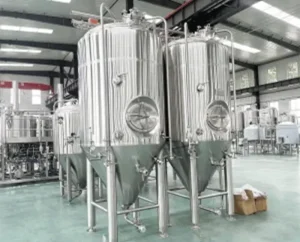
Cone angle, pressure rating and insulation: reading the numbers that matter
60-degree cone. The angle governs how yeast consolidates and how cleanly it drops out of the racking path. Shallower cones (some vessels use 45 degrees, and some brite tanks are dished rather than conical) reduce overall tank height in a low-ceilinged cellar, at the cost of slower and less complete yeast collection. If you harvest and repitch, the cone angle is a process decision, not a styling one.
0.2 MPa / 30 psi working pressure. This figure sets the ceiling for spunding, natural carbonation and transfer pressure. It is a working rating, not a test rating: the hydraulic test pressure is higher and appears on the test report, not the datasheet. Two things follow. First, a brewery planning pressure fermentation should state the target pressure before the vessel is drawn, because raising the rating changes shell thickness and jacket design. Second, the PRV setting must sit under the working rating, and it needs to be verified on delivery rather than assumed.
100 mm insulation. Polyurethane thickness determines how much of your glycol duty is spent fighting the room instead of pulling heat out of the beer. In a warm ambient cellar, thinner insulation shows up as a chiller that runs continuously during crash cooling. It also affects the tank’s outside diameter, which is the dimension that decides whether the vessel clears your doorway.
Steel grade. SUS304 is the default across the range. SUS316 is available where the project calls for it.
| Decision Driver |
Points to SUS304 |
Points to SUS316 |
| Water Chemistry |
Low-chloride municipal supply |
High-chloride supply, coastal groundwater, or brines used near the vessel |
| Cleaning Regime |
Standard caustic and acid CIP at controlled contact times |
Chlorinated sanitisers in routine use or long soak cycles |
| Prodotto |
Beer and standard wort |
Fruit-acid, high-salinity, or aggressive beverage projects |
| Budget Position |
Cost-sensitive expansion where SUS304 meets the duty |
Long-life vessel where material cost is a small share of the project |
Most beer fermentation projects specify SUS304. The grade question becomes worth arguing about when chloride exposure is chronic rather than occasional. Ask for the material certificate either way, since the grade on the quotation and the grade on the mill certificate are two different claims until you have seen the second one.
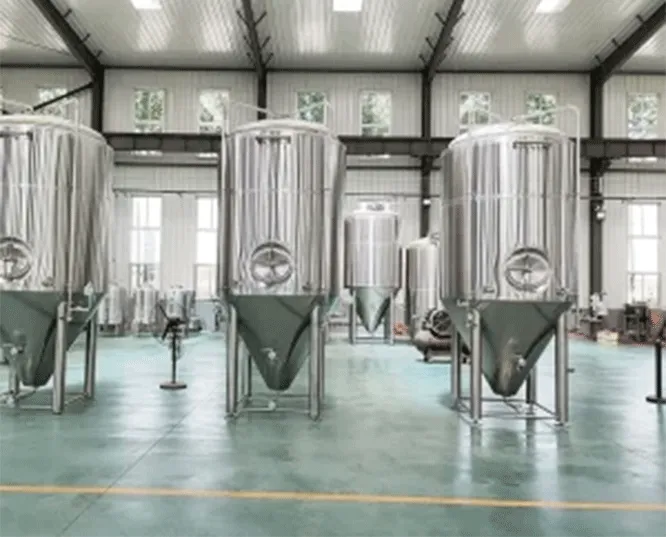
How to size a fermenter set for an expansion (6 steps)
This sequence is for a brewery that already knows its sales volume and is adding capacity to an existing cellar.
- Fix the annual volume you are building for. Use the twelve-month figure you expect two years out, not last year’s. Write it down in hectolitres.
- Divide by brewhouse batch size to get batches per year, then per week. A 20HL brewhouse producing 4000HL per year needs 200 batches, roughly four per week.
- Set your cellar turn time per beer style. Count from knockout to tank empty, including crash, dry hop and CIP. A 14-day turn at four batches per week means eight tanks of one batch each, or fewer tanks if you double-batch.
- Choose tank size against batch size, not against annual volume. Single-batch tanks give scheduling flexibility; double-batch tanks cut vessel count and floor area but lock two brews to one beer. Most expansions land on a mix.
Documents to request before you pay a deposit
For each vessel, ask for these in writing:
- General arrangement drawing with overall height including legs, outside diameter over insulation, manway position, and port schedule
- Nominal and total volume, stated separately
- Working pressure and the corresponding hydraulic test pressure, with the test report to follow after fabrication
- Material certificate for the shell and cone
- Cooling jacket layout, showing zone count and coverage area
- Surface finish specification for product-contact surfaces
- The applicable CE documentation for your destination market, and the ISO 9001 certificate covering the manufacturing scope
On the last item: ISO 9001 is the quality management systems standard maintained by the International Organization for Standardization, and it certifies a management system rather than any individual vessel. A valid ISO 9001 certificate tells you how the factory documents and controls its processes. It does not, by itself, tell you that a specific tank meets a pressure directive in your market. Those are separate pieces of paper and both are worth having.
ZR Brew supplies drawings, factory video inspections, weekly production photographs, hydraulic pressure testing and itemised project documentation as part of the standard project process, which makes these requests routine rather than exceptional.
FAQ
Q: What is the difference between nominal and total volume on a fermentation tank?
A: Nominal volume is the wort the tank is sold to hold. Total volume is the internal volume including headspace. ZR Brew’s published 3000L model lists approximately 3750L total, a 25% allowance for that specific configuration. Ask for both figures on every quotation.
Q: Why are fermenter cones usually 60 degrees?
A: A steeper cone consolidates yeast into a smaller, denser plug and keeps it clear of the racking arm, which supports harvesting and repitching. The trade-off is tank height. Shallower cones save vertical space and give up some yeast recovery.
Q: Can a fermentation tank be used as a bright beer tank?
A: Sometimes, but the two duties differ in bottom geometry, carbonation fittings and often pressure specification. Specify the duty per vessel at the design stage rather than assuming one tank covers both.
Q: What working pressure do stainless steel fermentation tanks hold?
A: ZR-FV vessels are typically in the region of 0.2 MPa (30 psi), varying by model. Confirm the rating for your specific model, and confirm the hydraulic test pressure separately, since the two are different numbers.
Q: Is SUS304 sufficient for beer fermentation?
A: For most beer projects, yes. SUS316 is worth specifying where chloride exposure is chronic, such as coastal water supplies or routine chlorinated sanitiser use. Request the mill certificate whichever grade you order.
Q: How many fermentation tanks does an expansion need?
A: Batches per week multiplied by cellar turn time in weeks, adjusted for style mix and any double-batching. Size the tanks against brewhouse batch size, then check ceiling height, door width and glycol duty before ordering.
Q: What sizes are available?
A: Published ZR-FV models run from 100L to 5000L, with BBL-based configurations alongside them. Vessel ports, valves, cooling zones, pressure settings, surface treatment and dimensions are configured per project.
If your expansion is still at the layout stage, the next thing to settle is the glycol load across the whole cellar rather than the tank list, because chiller capacity is the constraint that most often forces a tank plan to be redrawn.


 Pubblicato