

お見積りをご依頼ください
24時間以内にご返信いたします。お急ぎの場合は、WhatsAppまたはWeChat(+8613188932181)までご連絡ください。.
*当社はお客様のプライバシーを尊重し、すべての情報を保護いたします。.
お客様の情報は、お問い合わせへの回答にのみ使用し、未承諾のメールや宣伝メッセージを送信することは一切ありません。.
 公開日
Your kettle is filled, the heater is covered — but what happens next decides whether your beer tastes clean or drags a DMS shadow into the glass. How long should the boil run? How violent is too violent? And why does the same hop bill deliver 20 EBC in one brewhouse and only 14 in another? Let’s walk through the complete operating technology of wort boiling, step by step.
Once the wort enters the boil kettle and reaches 100 °C, the clock starts: that is when boiling time is counted. Everything that follows — evaporation, protein coagulation, isomerisation of α-acid, stripping of unwanted volatiles — is governed by three operating levers: boiling time, boiling intensity and hop addition, supported by additives, gravity checks and a clean transfer to the whirlpool. Get these right, and the rest of the brew day falls into place.
There is no single magic number, but there is a proven band: most breweries boil for 70–90 minutes. The right value depends on beer style, process and quality targets — so what does each end of the band buy you?
Boiling is not one steady state — it is three distinct operating phases, each with its own steam demand and its own job. Do you know which phase your kettle is actually in?
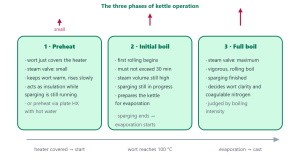
As soon as the wort covers the heater surface, preheating starts — with the steam valve only cracked open. Why so gently? Because during sparging, the wort would simply cool down again while it sits. Preheating therefore acts as insulation and slow warm-up, protecting the heat you have already invested. Alternatively, some brewhouses preheat the wort with hot water through a plate heat exchanger.
The initial boil follows, and here is the discipline point: the initial boil phase must not exceed 30 minutes. Sparging is still running and steam volume is still high — this phase is purely preparation, so that evaporation can begin the moment sparging finishes. Only then does the third phase begin: the steam valve goes to maximum and the wort is held in a vigorous, rolling boil.
Boiling intensity is the percentage of the mixed wort volume that evaporates per hour:
The practical target is 8–12% per hour. And there is a handy field shortcut: for every 1000 L of wort, evaporation of 1.1–1.4 L per minute is the rule of thumb. But why does this number matter so much?
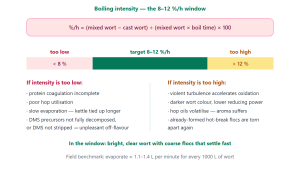
Too low, and the kettle underperforms everywhere: proteins do not flocculate completely, hop utilisation stays poor, evaporation drags on and occupies the kettle longer — and critically, DMS precursors are not fully decomposed, or the DMS itself is never stripped from the wort. That is how cooked-corn off-flavours survive into the finished beer.
Too high, and you pay a different bill: violent turbulence accelerates oxidation, darkens the wort and lowers its reducing power. Hop oils volatilise faster — so aroma takes the hit — and the coarse hot-break flocs you worked to build are torn apart again.
Hops added to boiling wort do two jobs: the isomerisation of α-acid to iso-α-acid gives beer its clean, refreshing bitterness, while hop oils contribute the pleasant aroma. But how many grams per hectolitre does your beer actually need? Start with the bitter units:
Three factors sit between the hop bag and the glass:
Suppose a conical fermenter process achieves 25% utilisation, the target beer bitterness is 20 EBC, and hops are added in two charges: first, a bitter hop with 15% α-acid carrying 70% of the bitter load; then an aroma hop with 6% α-acid carrying 30%. Since 1 EBC = 1 mg/L of iso-α-acid:
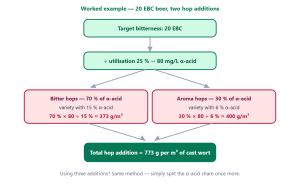
So the numbers run: required α-acid = 20 mg/L iso-α-acid × 100 ÷ 25 = 80 mg/L. First addition: 70% × 80 ÷ 15% ≈ 373 g/m³. Second addition: 30% × 80 ÷ 6% ≈ 400 g/m³. Total hop addition ≈ 773 g per m³ of cast wort. A three-addition regime follows exactly the same arithmetic — you simply divide the α-acid share once more.
Most breweries add hops three times. The rhythm is simple, and each charge has a distinct job:
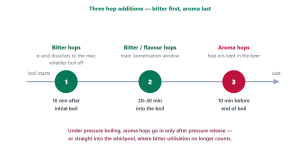
Add the calculated amounts, at the calculated times — and always check hop quality before charging, because no calculation rescues a bad batch of hops. Bitter hops go in first so that α-acid dissolves to the maximum and unwanted volatile compounds boil off before they can reach the glass. Aroma hops go in last: in pressure-boiling plants they are added only after pressure release, and some breweries dose them directly into the whirlpool — where, to be fair, bitter-substance utilisation is no longer a consideration.
Whole leaf, pellets or extract — each format has its own handling logic. Which one fits your brewhouse?
| Hop product | How it is added | Points to watch |
|---|---|---|
| Whole leaf hops | Charged directly into the kettle; usage is declining but still widespread worldwide | A hop separator is mandatory after the kettle to remove spent hops — at the cost of notable wort losses. Some breweries mill leaf hops first, so trub separates well in the whirlpool. |
| Pellet hops (type 90, 75 or 45) | Open the foil pouch by hand and charge the pellets straight into the boiling kettle | Simplest handling and minimal storage space — the default for most modern breweries. |
| Hop extract | Viscous concentrate in metal containers; warmed to 45–50 °C it liquefies, then is dosed at the scheduled time. Small breweries drill the tin and add it cold, or boil the tin in a mesh basket with the wort | Very compact and stable; dosing accuracy depends on complete liquefaction. |
| Automatic hop dosing system | Daily hop demand — pellets, extract and other products — is weighed into metering vessels and added automatically | Standard for large, highly automated breweries where manual dosing can no longer meet production and quality-management demands. |
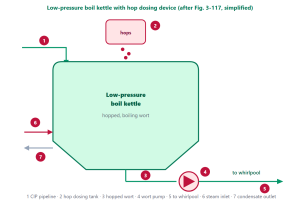
Besides hops, most breweries add processing aids to the kettle according to process and quality requirements. Each one has a specific job — do you know what yours is doing?
| Additive | Purpose in the kettle |
|---|---|
| Lactic acid | Lowers wort pH — which promotes protein flocculation and reduces beer colour. |
| Kieselguhr, silica gel and bentonite | Enlarge the contact area between wort and hop bitter substances, promoting nitrogen coagulation and α-acid isomerisation; they also contribute an adsorption effect. |
| Zinc salts (Zn²⁺) | Yeast needs zinc from the wort. Normal-gravity wort usually supplies enough, but with poor malt quality or high-gravity brewing followed by dilution, Zn²⁺ may fall short — supplemental zinc salts then secure yeast propagation and fermentation. |
Concentration control is a measurement discipline: wort quantity and concentration must be measured before the boil, during the boil, 10 minutes before the end, and after the boil. Why so many checkpoints? Because the relationship between wort volume and wort concentration is what finally defines your cast wort — and once it is set, there is no correcting it downstream.
pH is the second silent lever. It is closely tied to protein coagulation, wort colour and flavour stability:
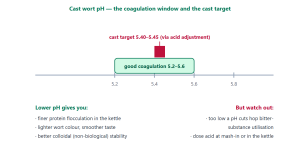
After hop addition and boiling, cast wort is water, malt degradation products and dissolved hop solids. Its pH sits at 5.0–5.7, viscosity (at 12 °P) at 1.70–2.00 mPa·s, and surface tension around 40–50 × 10⁻³ N/cm. But what does the full composition look like, component by component?
| Group | コンポーネント | Range |
|---|---|---|
| Carbohydrates | Hexoses | 7–9 % |
| Sucrose | 2–3 % | |
| Maltose | 42–47 % | |
| Maltotriose | 11–13 % | |
| Low-molecular dextrins | 6–12 % | |
| High-molecular dextrins | 19–24 % | |
| β-glucan | 0.22–0.4 % | |
| Pentosans | 3–4 % | |
| Nitrogen compounds | Total nitrogen | 950–1150 mg/L |
| High-molecular N | 18 % (coagulable N 2 %) | |
| Medium-molecular N | 22 % | |
| Low-molecular N | 60 % (formol N 34 %, FAN 22 %) | |
| Polyphenols | Total polyphenols | 180–300 mg/L |
| Anthocyanogens | 70–140 mg/L | |
| Tannins | 60–100 mg/L | |
| Bitter substances | Bitter value (EBC) | 35–55 mg/L |
| α-acid | 3–20 mg/L | |
| Iso-α-acid | 25–55 mg/L | |
| Humulinic acid | 3–5 mg/L | |
| Minerals (1.5–2 %) | Phosphate (as P₂O₅) | 600–850 mg/L |
| Silicate (as SiO₂) | 30–40 mg/L | |
| Chloride (Cl⁻) | 100–200 mg/L | |
| Sulfate (SO₄²⁻) | 40–200 mg/L | |
| Nitrate (NO₃⁻) | 10–80 mg/L | |
| Calcium | 23–60 mg/L | |
| Magnesium | 80–100 mg/L | |
| Potassium | 500–550 mg/L | |
| Sodium | 10–13 mg/L | |
| Zinc | 0.10–0.25 mg/L | |
| Vitamins | Thiamine (B₁), riboflavin (B₂), pyridoxine (B₆), niacin, pantothenic acid, biotin | |
The table is the snapshot — these are the levers behind it. Where does your wort stand on each?
When the boil ends, the wort is pumped straight to the whirlpool — and speed matters, because the next batch is waiting for the kettle. But fast does not mean rough: the transfer must avoid cavitation and mechanical shear, both of which damage the wort quality you just spent 90 minutes building. A well-sized wort pump and a clean, short pipe run are the quiet heroes of every brew day.
Yes. Boiling time is counted from the moment the wort reaches boiling temperature — not from filling the kettle. That is why preheating and a maximum 30-minute initial boil matter: they position the wort to start evaporating the instant sparging ends.
No. Beyond the 70–90 minute window, extended boiling consumes large amounts of energy while cast wort quality declines — darker colour, lower reducing power and loss of desirable volatile characters. Coagulation and isomerisation saturate; the damage keeps growing.
Use the volume method: measure mixed wort and cast wort, insert both into the intensity formula. In daily operation, the field benchmark works too — about 1.1–1.4 L of evaporation per minute for every 1000 L of wort corresponds to the 8–12%/h window.
Early addition gives α-acid maximum time to dissolve and isomerise, and lets harsh volatile compounds boil off. Aroma hops added late — or after pressure release, or into the whirlpool — keep their delicate hop oils, which would otherwise be stripped within minutes of a rolling boil.
Yes — the α-acid arithmetic is identical. What changes is the product’s α-acid content: pellet types 90, 75 and 45 carry different concentrations, and extracts state theirs on the certificate. Always calculate from the actual α-acid value of the product you are charging.
Yeast draws its zinc from the wort. Dilution of high-gravity wort, or poor malt quality, can leave Zn²⁺ below what yeast metabolism requires — leading to sluggish fermentation. Zinc salts restore the physiological supply for propagation and fermentation.
Yeast needs amino nitrogen to build proteins. When FAN is too low, fermentation generates more acetoin precursors and higher alcohols — maturation takes longer and the flavour profile drifts. Keep FAN above 180 mg/L whenever adjuncts dilute the malt’s nitrogen contribution.
Cavitation bubbles collapse against the wort with intense local energy, and mechanical shear tears apart the coarse hot-break flocs you formed in the boil. Both damage the protein structure that later drives fast settling and bright beer — so the transfer should be fast, but hydraulically smooth.
Successful wort boiling comes down to respecting four numbers and one order of operations: 70–90 minutes of boiling time, 8–12%/h boiling intensity, pH steered to 5.40–5.45, and hops dosed by calculated α-acid — bitter first, aroma last. Add the right kettle additives, track gravity and pH at all four checkpoints, and transfer to the whirlpool fast but gently. Do you know all five numbers for your own brewhouse? If not, the next brew is the perfect time to measure them — your beer’s clarity, flavour stability and bitterness precision all start here.
ZR BREW manufactures complete brewhouse systems — internally and externally heated wort kettles, whirlpools, automatic hop dosing and full process control — engineered for stable 8–12%/h boils and repeatable cast wort quality, from 100 L pilot systems to industrial scales.
Talk to our engineers about your kettle configuration → [email protected] · www.zrbrewing.com
24時間以内にご返信いたします。お急ぎの場合は、WhatsAppまたはWeChat(+8613188932181)までご連絡ください。.
*当社はお客様のプライバシーを尊重し、すべての情報を保護いたします。.
お客様の情報は、お問い合わせへの回答にのみ使用し、未承諾のメールや宣伝メッセージを送信することは一切ありません。.