

お見積りをご依頼ください
24時間以内にご返信いたします。お急ぎの場合は、WhatsAppまたはWeChat(+8613188932181)までご連絡ください。.
*当社はお客様のプライバシーを尊重し、すべての情報を保護いたします。.
お客様の情報は、お問い合わせへの回答にのみ使用し、未承諾のメールや宣伝メッセージを送信することは一切ありません。.
 公開日
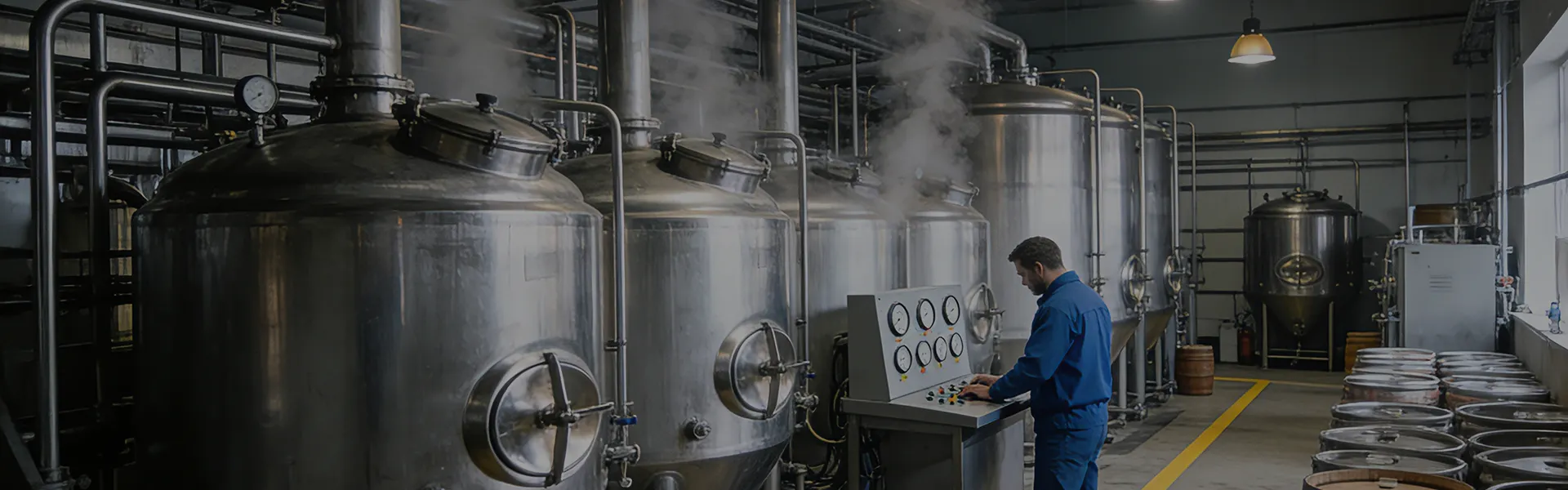
During a 90-minute boil, a typical brewhouse evaporates 8–12% of the wort volume. All of that evaporated water leaves the kettle as saturated vapor at about 100 °C, and every kilogram of it carries roughly 2,260 kJ of latent heat. Vent it straight up the stack and two problems hit you at once:
How can this heat be captured instead? The brewing industry relies on three battle-tested approaches: the vapor condenser, vapor compression, and low-pressure boiling with thermal energy storage. Let’s walk through each one.
The vapor condenser is the simplest and most widely used heat-recovery technology in the industry: modest investment, easy retrofit, fast payback. It is installed at the vapor stack outlet of the boil kettle, where rising vapor flows through a shell-and-tube heat exchanger and transfers its heat to water.
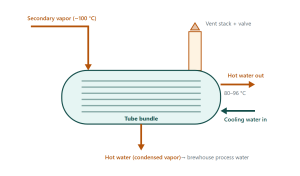
The numbers speak for themselves. For every 100 L of wort boiled, the condenser typically delivers around 80 L of 80 °C hot water. The outlet temperature depends on how you boil:
Where does all this hot water go? Straight back into the process. It serves as mashing-in water or sparging water in the lauter tun, displacing large amounts of primary steam that would otherwise be burned to heat cold brewing liquor. And because the vapor itself condenses into hot water, nothing is left to waste.
Depending on the intended use, vapor condensation can run as a one-stage or two-stage system. Two-stage design heats water to a high temperature in the first stage, then uses the leftover low-grade heat in the second stage to warm cold water — extracting the maximum possible heat from every cubic meter of vapor.
In practice, though, a brewery running several batches per day produces more hot water than the brewhouse can absorb. Hot water only equals saved energy if someone actually uses it. That is why most breweries deliberately pick the simpler one-stage condenser — matching recovery to their real hot-water balance rather than chasing theoretical maximum efficiency.
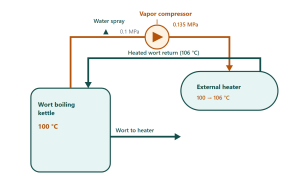
Condensing vapor into hot water recovers heat — but what if you could reuse the vapor as heating steam directly? That is exactly what a vapor compression system does. A compressor takes the kettle’s own vapor (about 0.1 MPa) and squeezes it to 0.135 MPa of superheated steam. Compression raises the steam temperature above 100 °C, so it can condense against boiling wort and hand its latent heat back to the very same kettle — a beautifully closed loop.
Most vapor compression installations use an external wort heater, because the heat-transfer surface must be very large to condense the compressed steam efficiently. Wort circulates rapidly between the kettle and the external heater, where the compressed vapor delivers its energy.
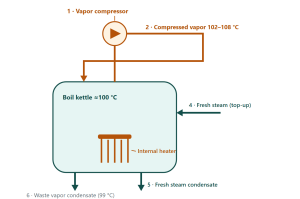
An internal-boiling kettle can carry a vapor compressor too. Here, the compressed vapor (102–108 °C) is fed directly into the kettle’s internal heater, where it condenses and drives the wort fountain.
The benefits are compelling:
But be honest about the challenges too:
Here is a paradox every brewer recognizes: the brewhouse produces enormous quantities of low-grade hot water — far more than it needs — while simultaneously burning primary steam to make the high-grade hot water that mashing and boiling actually demand. Low-grade heat cannot meet process temperatures, so it is dumped, and energy is wasted twice.
The low-pressure boiling system with energy storage resolves this elegantly. Its heart is a tall, stratified energy storage tank — typically 10–20 m high — in which 98 °C high-grade water floats on top of 78 °C low-grade water, separated by an adjustable mixed zone. The interface height can be tuned to the day’s production plan, and the thermal battery keeps surplus heat stored for long periods, ready for reuse at any time.
Follow the heat, step by step:
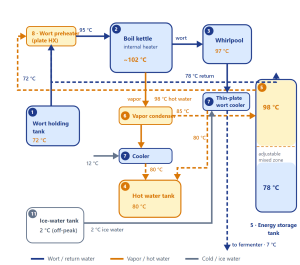
Stratification is physics doing free work: hot water is less dense and floats, cold water sinks, and the boundary between them — the mixed zone — is the system’s “state of charge”. The taller the tank, the more precisely the 98 °C/78 °C interface can be positioned to match production. That is why these storage tanks are built 10 to 20 m tall, and why the mixed-zone height is treated as an adjustable operating parameter rather than a fixed property.
In wort production, the boil kettle is the single largest steam consumer — so any serious energy-saving program starts there. Consumption is expressed in kW·h or kJ (1 kW·h = 3,600 kJ). Comparing common fuels makes the stakes concrete:
| Fuel | Calorific value |
|---|---|
| Natural gas | 11.2 kW·h/m³ |
| Fuel oil | 10.14 kW·h/L |
| Heavy oil | 11.16 kW·h/kg |
| Coal | 8.95 kW·h/kg |
Now compare the boiling systems themselves. A traditional boil at 100 °C for 90 minutes with 12% total evaporation needs about 14 kW·h (50,400 kJ) per 100 L of cast wort. Low-pressure boiling shortens the boil to 60–70 minutes and trims evaporation from 12% (10–15%) to 5–7%, cutting consumption to roughly 9 kW·h per 100 L. And a brewhouse with an energy storage system gets down to approximately 5 kW·h (18,000 kJ) per 100 L — a 64% saving against the traditional benchmark:
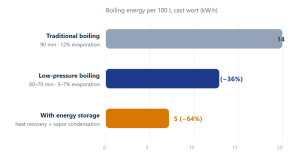
The energy-storage route deserves a closer look. In this configuration, the 78 °C water from the lower half of the storage tank is heated to 96 °C by kettle vapor in the condenser, then parked in the tank’s upper half. The vapor’s heat is thus stored as high-grade hot water and used as the mashing-in water for the next batch — cutting the brewhouse’s hot-water demand at the source. Measured against conventional boiling without recovery (at 5% evaporation), the energy-storage system saves about 9 kW·h per hectoliter of cast wort, leaving a net heat consumption of only about 5 kW·h per 100 L.
Translate the engineering into money. At roughly 9 kW·h saved per hectoliter, annual heat recovery scales directly with production volume — and the numbers get serious fast:
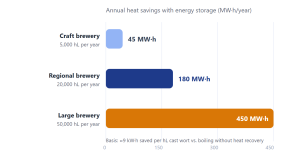
And that is only the fuel side. Add the hot water the system delivers (which displaces heated brewing liquor), the avoided odor-abatement equipment, and the carbon footprint reduction that more and more markets now price in — and the payback conversation changes completely. For a mid-size regional brewery, the question is rarely whether the system pays for itself; it is how many years you want to keep paying the alternative.
Each of the three technologies answers a different question — so the right choice depends on your priorities, existing equipment and utility prices:
| System | Investment & complexity | Main benefit | Watch out for | Best suited for |
|---|---|---|---|---|
| Vapor condenser | Low investment, simple technology | ~80 L of 80–96 °C hot water per 100 L wort boiled; fast payback | Hot-water surplus if brewhouse demand is small | Most breweries; the default first step |
| Vapor compression | Medium–high; compressor + tight air-sealing, extra maintenance | Reuses vapor as heating steam directly; no surplus hot water; no odor emissions | Electricity consumption; strict vacuum (0.003 MPa) and sealing; jet-pump startup steam | Breweries retrofitting existing kettles that don’t want low-pressure boiling |
| Low-pressure boiling + energy storage | Highest; tall stratified tank (10–20 m) plus condenser and exchangers | Up to 9 kW·h saved per hL; heat stored for reuse anytime; shorter boil (60–70 min) | Space for the tall tank; more sophisticated controls | New brewhouses and multi-brew days with large hot-water swings |
Learn from the projects that disappointed:
As a rule of thumb, every 100 L of wort boiled yields about 80 L of 80 °C hot water. With atmospheric boiling the outlet can reach 96 °C, and with low-pressure boiling up to 102 °C — hot enough for mashing-in and sparging without further heating.
Because multi-brew days generate more hot water than the brewhouse can use. Two-stage extraction maximizes heat recovery, but unrecovered hot water is wasted value. One-stage systems match production reality and cost less — so they dominate in practice.
Yes. Vapor compression systems can be installed on existing wort boiling equipment, which is precisely why they appeal to breweries that don’t want to switch to low-pressure boiling. The main requirements are a large heat-transfer surface (usually an external heater) and an absolutely airtight vapor circuit.
Air is incondensable. It accumulates on the condensing surface and acts as an insulation layer, sharply reducing heat transfer and system performance. That is why the kettle operates at a slight vacuum (~0.003 MPa) and why sealing quality is a top maintenance priority.
It depends on your fuel price and hot-water demand, but because the condenser is the cheapest of the three systems and works on every single brew, payback is typically measured in months to a couple of years for breweries with a solid hot-water balance.
Typically 10–20 m. Height creates stable thermal stratification: 98 °C water floats above 78 °C water with a thin, adjustable mixed zone. The interface height acts as the “state of charge” and can be tuned to the brewery’s production schedule.
The boil kettle. Traditional 90-minute boiling with 12% evaporation needs about 14 kW·h per 100 L of cast wort — which is exactly why every serious energy-saving program starts with the boiling system.
Every kilogram of vapor carries about 2,260 kJ of heat, and a traditional boil releases hundreds of kilograms of it per batch. Whether you start with a simple vapor condenser, retrofit a vapor compressor, or design a low-pressure boiling system with thermal energy storage from day one, the physics works in your favor: the same heat that boils your wort can mash your next batch, sparge your lauter tun, and warm your brewing liquor — almost for free. Cut boiling energy by up to 64%, shrink your carbon footprint, silence the odor complaints, and let thermal stratification work the night shift at off-peak tariffs. In modern brewing, the question is no longer whether to recover boiling heat — but how quickly you can start.
24時間以内にご返信いたします。お急ぎの場合は、WhatsAppまたはWeChat(+8613188932181)までご連絡ください。.
*当社はお客様のプライバシーを尊重し、すべての情報を保護いたします。.
お客様の情報は、お問い合わせへの回答にのみ使用し、未承諾のメールや宣伝メッセージを送信することは一切ありません。.