

お見積りをご依頼ください
24時間以内にご返信いたします。お急ぎの場合は、WhatsAppまたはWeChat(+8613188932181)までご連絡ください。.
*当社はお客様のプライバシーを尊重し、すべての情報を保護いたします。.
お客様の情報は、お問い合わせへの回答にのみ使用し、未承諾のメールや宣伝メッセージを送信することは一切ありません。.
 公開日
公開日
What is a bright beer tank? It is a pressure-rated brewery vessel used after fermentation to clarify, carbonate, hold, and prepare beer for packaging or direct service. Moving finished beer into this dedicated tank frees the fermenter for the next batch and gives operators a controlled buffer before filling kegs, cans, or bottles.
Published by the ZR Brew Technical Team | Updated August 15, 2026
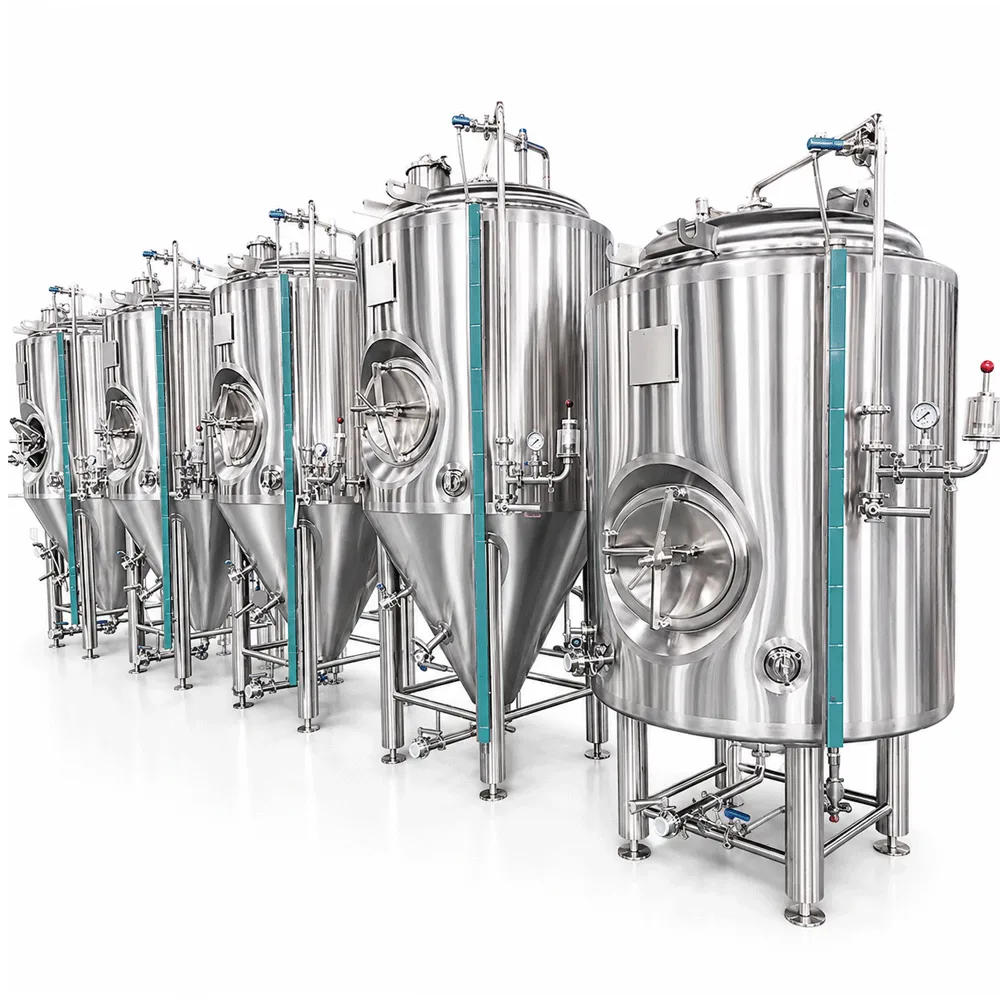
A bright beer tank, also called a brite tank, is normally the final process vessel between fermentation and packaging or serving. Beer enters after primary fermentation and most yeast or solids have been removed. Inside the vessel, the brewery can hold the beer cold, complete carbonation, allow remaining particles to settle, verify quality, and feed packaging equipment at a stable pressure.
The word bright refers to beer that has reached the required clarity for the product, not to the appearance of the stainless steel. Some beer styles remain intentionally hazy. In those cases, the vessel still provides carbonation, cold storage, blending, packaging supply, and scheduling functions without changing the intended visual character.
Separating conditioning from primary fermentation lets the brewer move beer out of a cylindroconical fermenter once the fermentation and initial maturation plan is complete. The fermenter can then be cleaned and returned to production instead of remaining occupied until packaging day.
A pressure-rated bright tank can receive carbon dioxide through a carbonation stone or another approved carbonation arrangement. Operators control beer temperature, head pressure, gas flow, and contact time to reach the product specification. The required procedure depends on the beer, equipment, and brewery quality plan.
Cold holding gives remaining particles time to settle. A brewery may also transfer beer into the tank after filtration or centrifugation. The tank does not replace every clarification method; it provides a controlled receiving and holding stage for the chosen process.
Packaging lines work best with a steady supply. The bright tank separates cellar timing from the filling schedule, so a fermenter transfer does not need to occur at the same moment cans, bottles, or kegs are filled. This buffer becomes more valuable as packaging speed and production frequency increase.
Brewpubs may serve directly from a bright tank when the design, local requirements, temperature control, cleaning plan, and dispense arrangement support it. Direct service can reduce keg handling, but it ties serving availability to the tank and cellar layout.
A dedicated vessel gives the brewery a defined point for approved blending, carbonation confirmation, sensory checks, dissolved-oxygen control, and release testing before packaging. The exact tests should be documented in the brewery quality program.
The most important benefit may be operational rather than mechanical. A bright tank creates time between cellar completion and packaging. That time helps absorb minor schedule changes without keeping fermentation capacity unavailable.
Low-oxygen handling matters during these downstream steps because fermentation is no longer consuming oxygen at the same rate. Connections, purge procedures, pressure balance, and operator technique should therefore be part of the equipment and process review.
A unitank is a cylindroconical vessel designed to perform fermentation and selected conditioning duties in the same tank. A bright beer tank is a separate downstream vessel. Neither arrangement is automatically better; the correct choice depends on tank count, batch frequency, beer mix, packaging schedule, cellar space, labor, and cleaning capacity.
| Decision factor | Separate bright tank | Unitank-only approach |
|---|---|---|
| Fermenter availability | Can release a fermenter before packaging | Fermenter remains occupied through final holding |
| Transfers | Requires one additional controlled transfer | Avoids that transfer |
| Packaging buffer | Dedicated buffer can serve the filler | Packaging draws from the production vessel |
| Tank utilization | Specialized vessels support different duties | Flexible vessel performs multiple duties |
| Floor space and piping | Needs another vessel, services, and transfer path | May reduce vessel count and piping |
| Product changeover | Can stage one beer while another fermenter turns | Scheduling depends more heavily on each unitank |
| Process risk | Transfer must control oxygen and contamination | Longer occupancy can constrain capacity |
For a small brewery with irregular packaging, a unitank-only plan may be practical. For a brewery trying to turn fermenters faster or feed packaging on a predictable schedule, one or more bright tanks can remove a real bottleneck.
Start with finished batch volume, not nominal brewhouse size alone. The tank must accept the expected transferable beer volume while maintaining the required headspace, working pressure, and operating procedure. Ask the tank supplier to distinguish total volume from working volume on the approved drawing.
Then model the schedule. Record how often a batch finishes, how long conditioning takes, when packaging runs, packaging speed, cleaning time, and whether the tank also supplies draft service. A tank that matches one batch may still be inadequate if packaging is delayed while the next batch becomes ready.
For every planned batch, place four events on a calendar: transfer in, conditioning complete, packaging start, and cleaning complete. If the next transfer arrives before cleaning ends, the cellar needs another bright tank, a larger batch strategy, or a changed production schedule. This method answers what is a bright beer tank worth operationally: it shows whether the vessel actually releases fermenter capacity.
For broader utility planning, review the brewery glycol chiller sizing guide. More tanks also affect cooling load, glycol flow, cleaning demand, carbon dioxide supply, floor drainage, and cellar access.
Bright tanks commonly use a vertical cylindrical body with a dished or shallow bottom suited to storage, carbonation, and product withdrawal. Horizontal tanks and stacked arrangements can serve space-constrained cellars or direct-draw applications. The selected geometry changes access, support structure, cleaning coverage, usable volume, and floor loading.
ZR Brew’s public product range includes bright beer tanks and custom beverage-storage vessels. Published project configurations include SUS304 construction with SUS316 options subject to project requirements, glycol cooling jackets, insulation, configurable manways, ports, valves, pressure settings, surface treatment, dimensions, and accessories. Final materials and ratings must be confirmed for the individual quotation and approved drawing.
The ステンレス製発酵タンクガイド provides related vessel-selection context, while the brewery layout guide covers spacing, utilities, drainage, and expansion. For cellar and packaging planning, the Brewers Association Draught Beer Quality Manual is a useful external reference for beer handling and dispense-system practices.
ZR Brew’s documented 20HL microbrewery project in Sweden includes a steam-heated three-vessel brewhouse, a 40HL hot-liquor tank, six 40HL cylindroconical fermentation tanks, two 40HL pressure tanks, grain-handling equipment, and supporting systems. The configuration illustrates a production principle: downstream pressure-tank capacity must be considered alongside the larger fermentation inventory.
The public project record confirms the supplied configuration but does not disclose production increases, utilization, packaging speed, or return on investment. Those results should not be inferred. A new project should be sized from its own batch calendar and packaging plan.
You are likely to benefit from a separate bright tank when packaging waits for fermenter availability, fermenters remain occupied by finished beer, multiple fermenters must feed one packaging line, direct service is planned, or the brewery needs a defined final quality-release stage. The case becomes stronger when tank-turn time limits sales or when packaging staff need a stable daily schedule.
You may postpone the purchase when production is infrequent, unitanks have adequate spare time, packaging is small and flexible, space is extremely limited, or another process constraint is more urgent. In that case, leave utilities and floor space available for later expansion.
To review a project, send ZR Brew the brewhouse volume, fermenter list, beer calendar, conditioning time, packaging format and speed, available footprint, utility conditions, and local code requirements. Request a project-specific tank and cellar review.
It is used to hold beer after fermentation for final clarification, carbonation, cold storage, quality release, packaging supply, or direct service where the design permits.
No. A fermenter is designed around fermentation and yeast handling. A bright tank is normally a downstream conditioning and holding vessel, although individual equipment designs and brewery processes vary.
Yes, in a properly designed brewpub or taproom system. The tank, cooling, pressure control, cleaning, dispense lines, operating procedure, and local requirements must all support direct service.
No. Some breweries package from unitanks. The need depends on production frequency, fermenter utilization, transfer controls, packaging schedule, space, and labor.
Build a batch and packaging calendar. Count the overlapping conditioning, packaging, direct-service, and cleaning periods. The required number follows from that schedule rather than a universal ratio.
Brite tank is a common industry spelling for the same vessel. Equipment documents should use one term consistently to avoid confusion in drawings, controls, and operating procedures.
24時間以内にご返信いたします。お急ぎの場合は、WhatsAppまたはWeChat(+8613188932181)までご連絡ください。.
*当社はお客様のプライバシーを尊重し、すべての情報を保護いたします。.
お客様の情報は、お問い合わせへの回答にのみ使用し、未承諾のメールや宣伝メッセージを送信することは一切ありません。.