

お見積りをご依頼ください
24時間以内にご返信いたします。お急ぎの場合は、WhatsAppまたはWeChat(+8613188932181)までご連絡ください。.
*当社はお客様のプライバシーを尊重し、すべての情報を保護いたします。.
お客様の情報は、お問い合わせへの回答にのみ使用し、未承諾のメールや宣伝メッセージを送信することは一切ありません。.
 公開日
公開日
Every brewery starts with water, but not every water source is ready to brew. Minerals, carbonates, chlorine, iron and organic contaminants can ruin flavor, stall fermentation and damage expensive equipment. That is why a well-designed brewery water treatment system is one of the most important investments a commercial brewery can make.
In this guide, we explain how to treat brewing water using proven methods and brewery water treatment equipment including acid dosing, gypsum additions, boiling, lime softening, ion exchange, reverse osmosis and electrodialysis. Whether you operate a nano brewery or a full-scale production plant, the right water treatment for craft breweries improves consistency, extends equipment life and protects your brand.
Untreated source water can contain excessive calcium, magnesium, carbonate, bicarbonate, chlorine, iron, manganese, nitrate and organic matter. These impurities create problems across the brewing process:
A commercial brewery water treatment setup solves these issues at the source, giving brewers full control over their most-used ingredient.
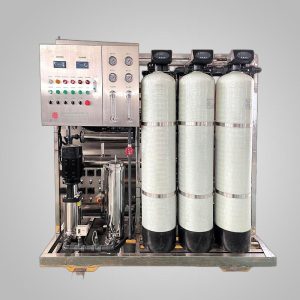
Acidification is one of the simplest and most cost-effective ways to lower residual alkalinity and mash pH. Food-grade acids react with bicarbonate to form carbon dioxide and water, reducing the water’s ability to resist acidification.
The general reaction for calcium bicarbonate with acid is:
Ca(HCO₃)₂ + 2H⁺ → Ca²⁺ + 2H₂O + 2CO₂↑
| Acid | Typical Concentration | Dose per 100 kg Malt (Mash) | Dose per 100 kg Malt (Boil) | Considerations |
|---|---|---|---|---|
| Lactic acid | 100% | 58 g | 29 g | Food-grade; adds lactate ions at high doses. |
| Lactic acid | 80% | 72 g | 36 g | Diluted form; easier to handle and dose. |
| Hydrochloric acid | 37% | 63 g | 32 g | Increases chloride; monitor flavor and corrosion. |
| Sulfuric acid | 98% | 32 g | 16 g | Increases sulfate; useful for hop-forward beers. |
Important: acidification lowers pH and residual alkalinity, but it does not remove hardness ions. For breweries with very hard water, acid dosing should be combined with a brewing water filter or softening step.
Adding gypsum (calcium sulfate, CaSO₄) or calcium chloride (CaCl₂) is a common way to adjust brewing water chemistry. These salts increase calcium hardness, which helps lower residual alkalinity through the Kolbach effect, while also building specific flavor profiles.
The acidifying reaction of gypsum with malt phosphate compounds is:
3Ca²⁺ + 2HPO₄²⁻ → Ca₃(PO₄)₂↓ + 2H⁺
| 製品 | Adds | Flavor Effect | Best Used For |
|---|---|---|---|
| Gypsum (CaSO₄) | Calcium + sulfate | Enhances hop bitterness and dryness | IPAs, pale ales, hop-forward lagers |
| Calcium chloride (CaCl₂) | Calcium + chloride | Improves roundness, sweetness and mouthfeel | Stouts, porters, malt-forward styles |
These additions are often the first step in a brewery water treatment system because they are inexpensive and easy to control. However, they cannot fully correct very high carbonate hardness or contaminated source water.
Boiling is the traditional method for removing carbonate hardness. When water is heated, soluble calcium and magnesium bicarbonates decompose into insoluble carbonates, which precipitate out of solution.
The reactions are:
Ca(HCO₃)₂ → CaCO₃↓ + CO₂↑ + H₂O
Mg(HCO₃)₂ → MgCO₃↓ + CO₂↑ + H₂O
However, magnesium carbonate is more soluble than calcium carbonate, especially in cold water, so boiling is more effective at removing calcium-based carbonate hardness. In modern breweries, boiling large volumes of source water is rarely economical. Instead, it is usually replaced by a brewery water softener, lime softening or ion exchange system.
Lime softening adds calcium hydroxide (Ca(OH)₂) or quicklime to water, raising pH and converting soluble bicarbonates into insoluble calcium carbonate. This method is widely used in breweries with moderate-to-high carbonate hardness.
The main reactions include:
CO₂ + Ca(OH)₂ → CaCO₃↓ + H₂O
Ca(HCO₃)₂ + Ca(OH)₂ → 2CaCO₃↓ + 2H₂O
Mg(HCO₃)₂ + Ca(OH)₂ → CaCO₃↓ + MgCO₃↓ + 2H₂O
4Fe(HCO₃)₂ + 8Ca(OH)₂ + O₂ → 4Fe(OH)₃↓ + 8CaCO₃↓ + 6H₂O
Lime softening is usually a two-step process. The first step removes carbonate hardness up to a certain limit; the second step removes additional magnesium hardness and iron. For source water with very high hardness, lime softening can be combined with ion exchange or reverse osmosis as part of a complete commercial brewery water treatment train.
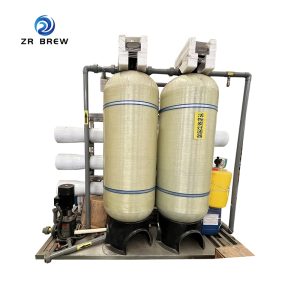
Brewery ion exchange systems use synthetic resin beads to swap unwanted ions in the water for more desirable ones. They are one of the most flexible brewery water treatment equipment options and are commonly used for softening, dealkalization, deionization and nitrate removal.
| Resin Type | Removes | Replaces With | Common Application |
|---|---|---|---|
| Weak acid cation (WAC) | Carbonate hardness, alkalinity | H⁺ | Reducing RA and bicarbonate |
| Strong acid cation (SAC) | Calcium, magnesium, other cations | Na⁺ or H⁺ | Water softening, full demineralization |
| Weak base anion (WBA) | Strong acid anions (Cl⁻, SO₄²⁻, NO₃⁻) | OH⁻ | Partial deionization |
| Strong base anion (SBA) | All anions including silica, CO₂ | OH⁻ | Complete deionization |
In a standard brewery water softener, strong acid cation resin exchanges calcium and magnesium for sodium. The reaction is:
2R-Na + Ca²⁺ → R₂-Ca + 2Na⁺
The resin is regenerated with brine (NaCl):
R₂-Ca + 2NaCl → 2R-Na + CaCl₂
Softening is effective for reducing scale-forming hardness, but it increases sodium content. For breweries that need to remove sodium or control sulfate and chloride, a two-bed or mixed-bed deionization system is better.
A brewery RO system uses semi-permeable membranes to remove up to 90–99% of dissolved solids, ions, organic compounds, bacteria and viruses. It is the most reliable way to create a blank slate for brewing water profile design.
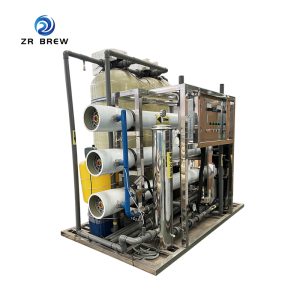
RO forces water through a membrane that blocks dissolved salts and contaminants while allowing pure water to pass. The process requires pressure greater than the natural osmotic pressure of the feed water. Modern brewery RO membranes are typically made of polyamide or cellulose acetate and operate at pressures around 2.8 MPa.
| Parameter | Raw Water | Permeate | Reject / Concentrate |
|---|---|---|---|
| Total hardness (mmol/L) | 4.64 | 0.13 | 12.7 |
| Carbonate hardness (mmol/L) | 3.00 | 0.25 | 5.01 |
| Non-carbonate hardness (mmol/L) | 1.64 | -0.13 | 5.94 |
| Calcium hardness (mmol/L) | 3.44 | 0.99 | 8.81 |
| Magnesium hardness (mmol/L) | 1.20 | 0.04 | 3.92 |
| Alkalinity (mmol/L) | 1.84 | 0.21 | 3.92 |
| Chloride (mg/L) | 15 | 12 | 38 |
| Sulfate (mg/L) | 90 | 1.6 | 420 |
| Silica (mg/L) | 49 | 6.0 | 141 |
RO is ideal for breweries that need to replicate soft water profiles like Pilsen or produce consistent water despite seasonal source changes. The main trade-off is water recovery: only 75–90% of feed water becomes permeate, so breweries must plan for concentrate disposal.
Electrodialysis (ED) is an advanced membrane process that uses an electric field to drive ions through selective ion-exchange membranes. It is particularly effective for removing salts and reducing hardness in brewery feed water.
In an electrodialysis stack, alternating cation- and anion-selective membranes are placed between electrodes. When an electric current is applied, cations move toward the cathode through cation membranes, while anions move toward the anode through anion membranes. This creates alternating dilute (product) and concentrate (waste) channels.
Key advantages of electrodialysis for water treatment for craft breweries include:
However, electrodialysis equipment has higher capital costs and requires skilled maintenance. It is most commonly used by mid-size to large breweries with stable production volumes and challenging source water.
Selecting the right brewery water treatment equipment depends on your source water quality, beer styles, production scale and budget. Here is a practical decision framework:
| Water Problem | Recommended Treatment | Equipment Type |
|---|---|---|
| High residual alkalinity / high pH | Acid dosing + gypsum/calcium chloride | Dosing pumps, mixing tanks |
| High carbonate hardness | Boiling, lime softening or WAC ion exchange | Hot-water tank, lime reactor or ion exchange column |
| High calcium / magnesium scale | Water softener or reverse osmosis | Softener resin bed or RO skid |
| High chloride, sulfate or nitrate | Reverse osmosis or selective ion exchange | RO membrane system or anion exchange unit |
| Chlorine / chloramine | Activated carbon filtration | Carbon filter housing |
| Variable municipal supply | Reverse osmosis + remineralization | RO system with salt dosing loop |
For most commercial breweries, a multi-stage brewery water treatment system delivers the best results. A common configuration is: activated carbon filter → water softener → reverse osmosis → remineralization skid. This protects equipment, removes contaminants and gives brewers precise control over final water chemistry.
The best brewery water treatment system depends on your source water. For most craft breweries, a combination of carbon filtration, water softening and reverse osmosis gives the greatest flexibility. Breweries with high carbonate hardness may also need lime softening or acid dosing.
Not all craft breweries need RO, but it is highly recommended when source water is hard, variable or unsuitable for the target beer styles. A brewery RO system lets brewers build any water profile from a consistent baseline.
Costs vary widely. Basic carbon filters and dosing systems may cost a few thousand dollars, while full commercial brewery water treatment trains with RO, softening and storage can range from tens of thousands to over a hundred thousand dollars depending on capacity and automation.
A standard brewery water softener removes calcium and magnesium, but it adds sodium. For most beer styles, sodium levels should be kept low. Breweries often use softening only as a pre-treatment step before RO or blending.
Send a sample to a certified water laboratory for a full brewing water analysis. Test at least twice per year, or quarterly if your source is a well or surface water. Key parameters include calcium, magnesium, sodium, sulfate, chloride, bicarbonate, carbonate, iron, manganese and nitrate.
Ion exchange swaps specific ions using resin, while reverse osmosis removes most dissolved solids through a membrane. Ion exchange is often cheaper for targeted problems like hardness; RO is more thorough and produces a blank water profile.
Treating brewing water is not optional for commercial breweries that want consistency, quality and equipment longevity. From simple acid and gypsum additions to advanced brewery water treatment equipment like reverse osmosis, ion exchange and electrodialysis, the right approach depends on your source water and production goals.
ZR Brew designs and supplies complete brewery water treatment systems including carbon filtration, softening, RO skids, ion exchange columns and custom utility integration. If you are planning a new brewery or upgrading your existing water loop, contact our team for a water analysis and system recommendation.
24時間以内にご返信いたします。お急ぎの場合は、WhatsAppまたはWeChat(+8613188932181)までご連絡ください。.
*当社はお客様のプライバシーを尊重し、すべての情報を保護いたします。.
お客様の情報は、お問い合わせへの回答にのみ使用し、未承諾のメールや宣伝メッセージを送信することは一切ありません。.