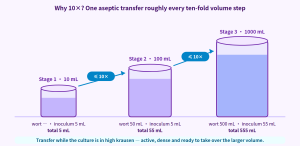
How fast can you multiply yeast without weakening it? Laboratory propagation typically starts with a test tube holding 5 mL of wort, into which the stock culture is inoculated. The culture is then transferred several times: at the high-krausen (active fermentation) stage, the whole culture is poured into a vessel roughly ten times larger.
3. How Do You Run Each Laboratory Stage Step by Step?
Which vessel does what, and which numbers must you hold? Here is the laboratory sequence in operating order.
Step 1 — Where does the original slant come from?
The slant tube is generally the brewery’s own preserved pure stock strain, or a culture supplied by a research institute or a culture collection centre. It is the genetic starting point — treat it as a master, not as a working culture.
Step 2 — What happens in the Freudenreich flask?
A Freudenreich flask is filled with 10 mL of wort and sterilised before use. The stock yeast is transferred with a platinum needle or a Pasteur pipette, then incubated at 25–27 °C for 2–3 days. Why shake it daily? A timed swirl each day re-suspends the sedimented yeast back into the medium, keeping the whole culture fed. Cultivate 2–4 flasks of the same strain each time and select the best at transfer — the first example of parallel culture.
Step 3 — How is a Pasteur flask prepared and inoculated?
Take a 500–1000 mL Pasteur flask, add 250–500 mL of wort, and boil it so steam vents from the side arm. After 30 minutes, draw off the condensate in the bent tube, plug with cotton, and cool. In the sterile room, inoculate the yeast from the tube through the side arm, then incubate at 25 °C for 2 days, checking daily.
Want the yeast to adapt gradually to cooler fermentation conditions? Drop the incubation temperature to around 20 °C — but allow a somewhat longer culture time. A large Erlenmeyer flask or a flat-bottom flask can substitute for a Pasteur flask.
Step 4 — Why is the Carlsberg vessel the last laboratory step?
Laboratory yeast propagation normally stops at the stainless-steel Carlsberg vessel, which is precisely the link to production-site propagation. Its capacity ranges from 10 L to 25 L. Table 2 gathers all four stages into one operating sheet.
| Stage |
Vessel & wort volume |
Temperature |
Time |
Key action |
| 1 · Slant tube |
Agar slant / 5 mL wort tube |
Stock storage |
— |
Preserve pure strain; revive before use |
| 2 · Freudenreich flask |
10 mL wort, sterilised |
25–27 °C |
2–3 days |
Inoculate with platinum needle; shake daily; run 2–4 flasks |
| 3 · Pasteur flask |
500–1000 mL flask, 250–500 mL wort |
25 °C (or ~20 °C) |
2 days |
Boil 30 min with side-arm steam vent; cotton plug; check daily |
| 4 · Carlsberg vessel |
10–25 L, filled to 50–80 % |
15–20 °C |
3–5 days |
Boil-sterilise in situ; inject 100–200 mL; aerate with sterile air |
Table 2 Operating parameters for the four laboratory propagation stages.
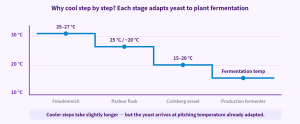
Notice the temperature trend? Each step is cooler than the last. Figure 3 shows why: progressively lowering the culture temperature adapts the yeast to real fermentation conditions in the plant, instead of shocking a 27 °C culture straight into a cold cellar.
4. What Does a Carlsberg Vessel Look Like — and What Do Its Five Fittings Do?
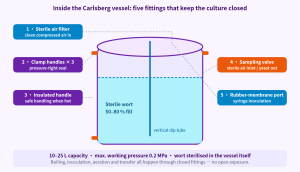
How can one closed can boil wort, accept an inoculation, breathe sterile air and discharge yeast without ever opening to the room? The answer is in its fittings. Figure 4 redraws the classic vessel: three clamps seal the lid, and it carries an insulated handle, a sterile-air filter and a sampling valve.
5. How Does the Carlsberg Vessel Culture Cycle Actually Work?
Can you really sterilise, inoculate, aerate and discharge from one sealed can? Figure 5 follows the four-step cycle. First, fill the vessel with wort to about 50–80 % of total capacity and boil the vessel and wort together. During heating, remove the cotton plug from the side arm so steam escapes from both the side arm and the bent tube for 30 minutes; then stop heating, re-plug, and draw off the condensate. Add 1 L of sterile water to replace evaporative loss, and cool the vessel in a refrigerator or cold room to inoculation temperature.
How is the yeast introduced without opening the lid? Most Carlsberg vessels have a rubber-membrane inoculation port: under aseptic conditions a syringe injects 100–200 mL of yeast through the connector. Sterile air then enters through the sterile-air connector on the sampling valve and travels down the vertical dip tube, bubbling from the bottom of the wort to promote yeast growth. Once the target cell count is reached, compressed air through the filter pushes the yeast suspension out through the dip tube and sampling valve on its way to the Hansen tank.
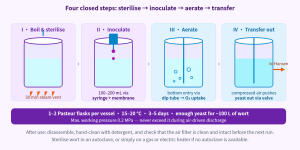
What does one finished vessel actually deliver? A Carlsberg vessel is normally inoculated with the yeast from 1–2 Pasteur flasks, mixed by swirling, and held at 15–20 °C for 3–5 days. It is then ready for the next propagation stage — or it can supply enough yeast to ferment roughly 100 L of wort. Table 3 collects the numbers worth pinning to the lab wall.
| Parametro |
Value |
Why it matters |
| Vessel capacity |
10–25 L |
Last laboratory size before plant-scale equipment |
| Wort fill |
50–80 % of total volume |
Leaves headspace for boiling, foam and sterile air |
| Steam venting |
30 min, side arm + bent tube |
Drives out air and sterilises the vent path |
| Evaporation make-up |
1 L sterile water |
Restores wort volume and gravity after boiling |
| Inoculum |
100–200 mL (1–2 Pasteur flasks) |
Keeps the step within the ~10× rule |
| Incubation |
15–20 °C for 3–5 days |
Progressively adapts yeast to plant fermentation |
| Max. working pressure |
0.2 MPa |
Safe limit for air-driven transfer; protects seals |
| Output |
Yeast for ~100 L of wort |
Defines the hand-over batch size to the brewhouse |
Table 3 Key Carlsberg vessel operating parameters and their purpose.
6. Why Do Breweries Still Use Carlsberg Vessels — and Where Do They Stop?
Isn’t a sealed stainless can more trouble than a modern propagator? In the laboratory it still wins on five points: wort can be sterilised in an autoclave or on a gas or electric heater; the design suits wort oxygenation; it gives yeast transfer a safe, closed route; it is easy to clean; and it is portable.
So why not keep scaling up in the lab? When the wort volume becomes large, laboratory propagation stops being practical — transporting that much liquid is simply too difficult. That is the moment to continue the expansion in the brewhouse yeast propagation equipment. In other words, the Carlsberg vessel is not the end of propagation; it is the end of glassware-scale propagation.
Where should a growing brewery invest? If your pitch volumes already exceed what a 25 L Carlsberg vessel can seed, the bottleneck is no longer technique — it is the plant-side propagation train: a Hansen tank or hygienic propagation vessel with sterile-air supply, jacket temperature control and CIP cleaning. That is exactly the hardware a brewing equipment supplier can size to your batch volume.
7. What Are the Six Golden Rules of Aseptic Laboratory Propagation?
Why do some labs lose a strain after three transfers while others run for years without a contamination? The difference is rarely a single dramatic mistake — it is the quiet discipline of six routine rules. Figure 6 summarises them; the paragraphs that follow explain the reasoning.
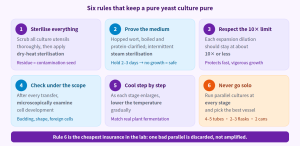
How many parallel cultures are enough? Run them at every expansion stage and then choose the best performer for the next step. Table 4 gives the classic counts.
| Stage |
Parallel units per stage |
What to check before choosing |
| Test tubes |
4–5 tubes |
Vigorous growth, uniform turbidity, no film or off-colour |
| Pasteur flasks |
2–3 flasks |
High-krausen timing, clean smell, microscope check |
| Carlsberg vessels |
2 vessels |
Cell count, budding ratio, absence of foreign cells |
Table 4Parallel culture counts and selection criteria at each laboratory stage.
8. What Goes Wrong in Laboratory Yeast Propagation — and How Do You Fix It?
Even with the six rules in place, what should you do when a culture looks wrong? Most failures trace back to four variables: asepsis, oxygen, temperature and dilution ratio. Table 5 is a practical troubleshooting sheet drawn from brewery lab practice.
| Symptom |
Most likely cause |
Corrective action |
| Slow start after transfer |
Dilution step far above 10×, or inoculum taken past high krausen |
Reduce the step size; transfer active culture; re-check cell density |
| Film, haze or off-odour |
Utensils not dry-heat sterilised; wort not proven by 2–3 day hold |
Discard the whole parallel, re-clean, re-sterilise and re-run from the previous clean stage |
| Low viable cell count |
Insufficient sterile aeration or clogged air filter |
Verify filter integrity; increase sterile-air flow through the dip tube; harvest earlier |
| Yeast shocked at pitching |
Temperature held at 25–27 °C right up to the plant |
Step the temperature down stage by stage to 15–20 °C before hand-over |
| Foaming over / gravity drift |
Overfilled vessel or evaporation not replaced |
Keep 50–80 % fill; add ~1 L sterile water after boiling |
| Difficult discharge |
Pressure above 0.2 MPa or blocked sampling valve |
Stay within the pressure limit; strip, hand-clean and inspect the valve and filter |
Table 5 Troubleshooting laboratory yeast propagation: symptom, root cause and fix.
Want one habit that prevents most of these? Record every transfer — time, temperature, vessel, inoculum volume, microscope result and which parallel was selected. A propagation log turns a mysterious off-flavour three weeks later into a traceable event.
9. How Do You Hand Over from the Lab to the Brewhouse?
When does a culture stop being a lab sample and become a production input? At the moment the Carlsberg vessel is pressure-transferred into the Hansen tank under sterile air. From there the same logic continues at larger scale: keep oxygen available, hold temperature on a downward curve, stay within a sane step ratio, and expose the culture to the open atmosphere as little as possible.
What equipment makes that hand-over safe? A hygienic yeast propagation tank with a sterile-air inlet and filter, jacket cooling, a sampling valve, and CIP-capable surfaces — plus a conical fermenter sized to the batch. If you are planning that step, size the propagation train from your pitching volume backwards, not from an equipment catalogue forwards.
Frequently Asked Questions About Laboratory Yeast Propagation
1. What is laboratory yeast propagation and where does it end?
It is the controlled multiplication of a stored pure yeast strain through slant tubes, Freudenreich flasks, Pasteur flasks and Carlsberg vessels. It ends at the stainless-steel Carlsberg vessel; from the Hansen tank onward, propagation continues in the production plant’s yeast propagation equipment.
2. Why is the scale-up ratio limited to about 10× per step?
Because yeast at high krausen is transferred into roughly ten times its volume of wort. A larger jump leaves too few active cells per mL, lengthens the lag phase and lets contaminants compete. The classic sequence is 5 mL → 55 mL → 555 mL of culture.
3. What is a Freudenreich flask used for, and how is it incubated?
It holds 10 mL of sterilised wort for the first expansion from the stock slant. Inoculate with a platinum needle or Pasteur pipette, incubate at 25–27 °C for 2–3 days, and shake daily to re-suspend sedimented yeast. Cultivate 2–4 flasks per strain and select the best.
4. How does a Pasteur flask differ from a Carlsberg vessel?
A Pasteur flask is a 500–1000 mL glass flask holding 250–500 mL of wort, boiled for 30 minutes with steam venting through the side arm and incubated at 25 °C for 2 days. A Carlsberg vessel is a 10–25 L stainless-steel pressure vessel that also handles sterile aeration and closed yeast transfer, held at 15–20 °C for 3–5 days.
5. Why is sterile air introduced from the bottom of the Carlsberg vessel?
Sterile air enters through the connector on the sampling valve and travels down the vertical dip tube, bubbling up through the wort. Bottom entry maximises oxygen transfer for cell growth; compressed air through the same filter later pushes the finished yeast suspension out to the Hansen tank.
6. What temperature and duration should a Carlsberg vessel use?
Inoculate with 100–200 mL of yeast (from 1–2 Pasteur flasks), mix by swirling, and hold at 15–20 °C for 3–5 days. The lower temperature is deliberate: each expansion stage should be cooler than the last so the yeast adapts to plant fermentation conditions.
7. How many parallel cultures should each propagation stage have?
Run parallel cultures at every stage and choose the best for the next transfer: 4–5 test tubes, 2–3 Pasteur flasks, and 2 Carlsberg vessels. Always examine yeast cell development under the microscope after each inoculation.
8. What is the maximum working pressure of a Carlsberg vessel?
About 0.2 MPa under normal operation. Keep air-driven discharge within that limit, and after use disassemble the vessel, hand-clean it with detergent and verify that the sterile-air filter is clean and intact before the next run.
So, Is Your Propagation Chain Protecting Your Strain?
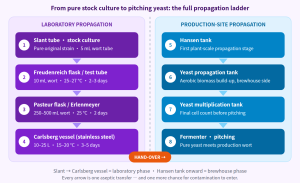
Every arrow in Figure 1 is an aseptic transfer — and every transfer is a chance to lose the purity you worked for. Get the 10× rule, the temperature curve, sterile aeration, parallel cultures and microscope checks right, and laboratory yeast propagation becomes a repeatable routine rather than a gamble. Get the hardware right at the hand-over, and that pure strain can keep defining your beer for years.
Ready to Scale Up Beyond the Laboratory?
When your Carlsberg vessel can no longer seed the batch, the next step is a hygienic propagation train: stainless-steel yeast propagation tanks with sterile-air filtration, jacket temperature control, sampling valves and CIP cleaning, paired with conical fermenters sized to your production volume. ZR Brewing designs and manufactures yeast propagation tanks, fermentation systems and complete brewhouse equipment for breweries that take strain purity seriously.


 Pubblicato