The boil is over — but is your wort actually clean? Hot break and cold break together carry away protein–polyphenol complexes, hop resins and off-flavour precursors. Separate them well, and your beer gains colour stability, foam quality and fermentability. Do it badly, and yeast pays the price. So how does a spinning tank of hot wort separate particles too small to see — and how much trub should you actually keep?
What exactly is hot break — and why does it appear the moment wort boils?
Hot trub is the insoluble floc formed during wort boiling by the coagulation of high-molecular nitrogen compounds. Its particles measure roughly 30–80 µm and consist mainly of protein–polyphenol complexes. As proteins denature and polyphenols keep combining during the boil, the floc keeps precipitating — and along the way it adsorbs part of the hop resins and other organics. A typical wort carries 200–400 g of hot trub per hL.
Here is the key trade-off: the more bound complexes precipitate with the trub during boiling, the more stable the wort — and the beer — become.
Which factors decide how much hot break forms?
- Nitrogen content and malt modification — the more nitrogen in the wort and the better modified the malt, the more trub precipitates; highly kilned dark malts form comparatively little.
- Mashing method — a low mash-in temperature and a large boiled fraction (decoction mashing) reduce trub formation; decoction worts clearly form less hot trub than infusion worts.
- Wort turbidity, hopping, pH and polyphenols — all shift the precipitated amount to some degree.
- Gravity — high-gravity worts throw out more trub than low-gravity worts.
Why must hot break leave the wort before fermentation?
Because suspended hot trub attaches to yeast cells as soon as fermentation starts. It disturbs normal yeast metabolism, fermentation and sedimentation. Left in the wort, hot trub also increases beer colour, makes the taste rough and lingering-harsh, and worsens both foam and flavour stability. That is why modern breweries rarely bother with open coolers and sedimentation tanks — they go straight to the whirlpool.
How does a whirlpool separate trub from wort using nothing but rotation?
A whirlpool tank is a vertical, closed, flat-bottomed cylindrical vessel with a 2% slope at the wort outlet. Hot wort enters tangentially, spins, and — as rotation slows naturally — generates a whirlpool effect. How does physics do the rest? Centrifugal force pushes heavier particles outward and downward; the walls and bottom slow the liquid locally; and a low-pressure core forms in the centre. In that quiet centre, particles keep gathering, spiralling down with the rotation, and finally settle as a compact trub cone in the middle of the tank bottom. Rotation is the one process the whirlpool simply cannot do without.
What does a modern whirlpool look like inside?
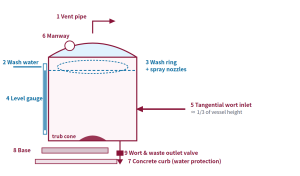
Beyond the numbered parts, three structural requirements decide whether the whirlpool works. First, two wort inlets: one near the tank bottom to avoid oxygen pick-up, and one at about one-third of the vessel height. Second, smooth, clean inner walls — the upper wall carries a wash-spray ring, and the tank must contain no protruding objects such as cooling coils, ladders or inward-opening man doors, because anything that sticks out causes local turbulence or eddies that wreck the separation. Third, a flat, sealed bottom with a 2% slope at the outlet and a conical trub-collecting cup at the centre, all wrapped in insulation so the hot wort cannot cool down.
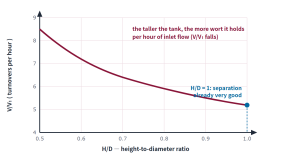
Which dimensions matter most — the height-to-diameter ratio?
Look at the curve again: if the wort inlet flow is fixed, a larger H/D simply means more wort held per hour of flow. At H/D = 1 separation is already very good — yet modern whirlpools still choose H/D between 1:2 and 1:3. Why trade efficiency away? Because the tank needs enough area to accept the hot trub, so real brewhouses run H/D ≈ 0.3–0.5.
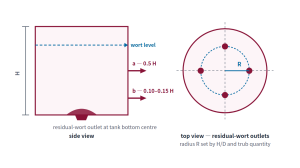
Where should the wort outlets be placed?
The wort is always drawn off from the side of the whirlpool, through two outlets — one at half the wort height and one near the bottom. Valves open top-down, and flow must be watched closely: drawn off too fast, the current hits the trub cone and the wort turns cloudy. After the main run, the residual wort leaves through openings at the very bottom centre, on a radius R determined by the H/D ratio and the trub load — and confirmed in practice, vessel by vessel.
Which bottom shape fits your brewhouse?
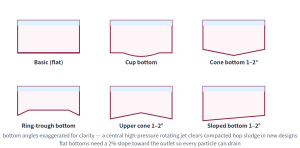
Once the wort has been drawn off, the tank is rinsed with water to flush out the sediment. If the bottom centre carries a small cone, it stores the entire deposit for easy draining; if the bottom is flat, it needs that 2% slope. And what about the trub itself? The hop sludge in the whirlpool can be recovered with a press or centrifuge — but that is tedious. A simpler route exists: knock the sludge into the lauter tun with the last sparge. Careful though — dosed too early, fine particles in the deposit clog the filter Pro-interstices and the lautering stalls.
Clockwise or counterclockwise — does rotation direction really matter?
Try this experiment at home: drip water into a calm basin, then open the bottom drain. As the water sinks, a vortex forms over the drain — and it always spins counterclockwise. Why? Because of the “Coriolis” inertial force produced by the Earth’s west-to-east rotation. Once formed, the vortex is sustained by the water-flow pressure pointing at the low-pressure centre.
The same physics applies to your whirlpool. Rotation direction genuinely affects both separation quality and energy savings: in the Northern Hemisphere the wort should spin counterclockwise, borrowing the Coriolis force — otherwise the tank works against the planet, like rowing upstream, and wastes energy. In the Southern Hemisphere, spin it clockwise.
Practical takeaway: when commissioning a new whirlpool, check the inlet orientation against your hemisphere before the first brew — it costs nothing and follows the brew for its whole life.
Which technical points make or break hot-trub separation?
The targets are unambiguous: wort turbidity below 10 EBC and wort solids below 25 mg/L, with a trub cone that is firm and well shaped. Reaching them comes down to four disciplines:
Table 1 — Whirlpool operating targets and rules of thumb
| Parametro |
Target / rule of thumb |
Why it matters |
| Hot trub load |
200–400 g/hL wort; particles 30–80 µm |
Sets the cone volume and the tank footprint needed |
| Total hot-stand time |
< 60 min from boil-out to rest finished |
Shorter hot time protects colour and flavour stability |
| Pump delivery speed |
≤ 5 m/s, gentle and steady, no cavitation |
Cavitation creates shear that smashes the floc; lower speed still spins the wort |
| Rest after spinning |
20–40 min, never below 20 min |
Gives the cone time to compact |
| Tangential inlet velocity |
3.5–5.0 m/s |
The best weapon against secondary flow (see below) |
| Result targets |
Turbidity < 10 EBC, solids < 25 mg/L |
Bright wort into the plate heat exchanger |
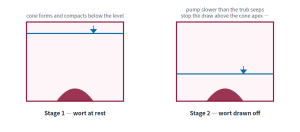
Watch the pump-out phase. After the rest, open the highest outlet first and work downward. When the level nears the apex of the trub cone, the pump must be precisely throttled: it must lift wort more slowly than the trub seeps out of the compressing cone. Push harder, and the cone breaks apart (Figure 5), the floc rides into the plate heat exchanger, blocks it — and can even disturb normal fermentation. A bonus: pellet hops help build a firm cone while lowering trub losses.
Then there is secondary flow. As rotation weakens, a secondary current — driven by the settling force difference of the hot trub — rolls already-settled trub back up. The thrust and shear between the currents smash the floc, undermine the whirlpool effect, and block separation. The worst offender is the ring-shaped eddy near the tank bottom, which drags occasional other vortices along and keeps the sediment suspended. Countermeasures? Control the wort inlet velocity to 3.5–5.0 m/s — and if the trub floc is on the large side, extend the rest so the re-rolled particles settle again.
Cold break — what is it, and when does it form?
Cold trub is the cloudy precipitate formed while the wort cools — again a complex dominated by protein–polyphenol substances. Precipitation actually starts between 25 and 55 °C, but the bulk appears as the wort cools further. Under the microscope the particles are tiny — only 0.5–1.0 µm — which makes them far harder to settle than hot trub. What else is in there? Hop resins, and a share of the wort’s β-glucan.
Why do these invisible particles cause so much trouble?
Their particles are small but highly charged, so they adsorb wort components. Carried into the fermenter, cold trub harms fermentation and beer quality: worts rich in cold trub ferment more slowly, and the trub’s own gas-forming tendency produces floating yeast rafts. Most damaging of all, cold trub adsorbs onto yeast cells, impairing their ability to multiply — so the more of it you leave in, the more yeast you must pitch and the slower the fermentation runs.
Which cold-break removal methods actually work?
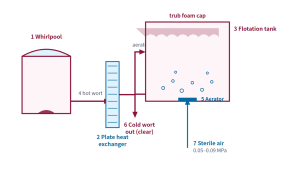
Table 2 — Cold-break removal methods compared
| Metodo |
How it works |
Typical result |
| Natural settling |
Rest the cooled wort 6–16 h in a clarifying vessel; about 60% of the trub sinks, buoyant floc rises with CO₂ bubbles (0.05–0.09 MPa dosing) |
Simple but slow; long wort holding, infection risk |
| Flotation |
After the plate heat exchanger, sterile air (0.05–0.09 MPa) is dispersed through an aerator; bubbles bind the charged trub particles and float them as a foam cap; the tank keeps 30–50% headspace; the cap is skimmed, bright wort drawn from below |
Foam cap within ≈30 min; removes roughly 50–70% of cold trub; can be combined with yeast pitching |
| Centrifuge / separator |
Continuous mechanical clarification of the cold wort |
Highest solids removal, higher investment and oxygen-pick-up control needed |
Why does flotation work so elegantly? The air bubbles adhere to the small, highly charged trub particles — the same particles that would otherwise adsorb onto yeast — and lift them away within minutes instead of the 6–16 hours natural settling demands. The tank simply needs enough headspace for the foam, and the aerator must shear the sterile air into a fine, dense dispersion.
How much cold break should stay in the wort — is zero really the goal?
Surprisingly, no. Brewers generally agree that cold trub lends beer a fuller, more rounded palate. Strip it out too thoroughly and the beer turns thin and bland. The optimum residual is 40–60 mg of cold trub per litre of wort. And with well-modified malt — where the wort’s inherent cold-trub load is already low — plus downstream non-biological stabilization (silica gel, bentonite, and the like), there is no need to remove every trace during cooling anyway.
Table 3 — What flotation changes in the wort (quality balance)
| Effect |
Figure |
Reading |
| Coagulable nitrogen removed by flotation |
≈ 2 mg/100 mL |
A 1.5–2.0 h boil removes only 4–6 mg/100 mL — flotation is genuinely efficient |
| β-glucan removed with the trub |
≈ 20% |
Especially favourable for the subsequent beer filtration |
| Optimum residual cold trub |
40–60 mg/L |
Fuller palate; too little → thin beer |
| Yeast pitching during flotation |
Yeast Ø 6–8 µm |
Yeast cells are too big to ride the bubbles into the cap — no yeast loss, and aeration boosts yeast vitality and metabolism |
And yeast? Flotation can even run with yeast pitched slowly into the pipe downstream of the aeration mixer. Because yeast cells measure 6–8 µm, the micro air bubbles do not carry them into the trub cap — so nothing is lost, while the aeration step gives the yeast full contact with oxygen, raising vitality and metabolic speed. Roughly 20% of the β-glucan leaves with the trub, which is precisely what later makes the beer easier to filter.
Frequently asked questions about hot and cold break separation
1. How long may hot wort wait in the whirlpool?
Keep the entire hot phase — from boil-out through transfer to the end of the rest — under 60 minutes. Longer holding deepens colour and drives flavour-damaging reactions.
2. Why is my trub cone loose instead of firm?
Check inlet velocity first (aim 3.5–5.0 m/s), then secondary flow at the tank bottom, then pump speed during draw-off. Pellet hopping also firms the cone while cutting trub losses.
3. Does whirlpool rotation direction really matter?
Yes. The Coriolis force means Northern Hemisphere worts should spin counterclockwise, Southern Hemisphere clockwise — otherwise the tank works against the natural vortex direction and wastes energy.
4. Should I remove all of the cold break?
No. The optimum residual is 40–60 mg/L; cold trub contributes palate fullness. Removing it completely risks a thin-tasting beer — and with quality malt plus silica gel or bentonite downstream, total removal is unnecessary.
5. Is flotation worth it for a smaller craft brewery?
It needs only an aerator, sterile air at 0.05–0.09 MPa and tank headspace — no centrifuge investment. It removes 50–70% of cold trub in about 30 minutes and can double as an oxygenation step for the yeast.
6. Whirlpool or centrifuge — which should I buy?
A whirlpool is the standard, low-maintenance choice and doubles as a hot-stand vessel; a centrifuge removes more solids continuously but costs more and needs careful oxygen control. Many mid-size brewhouses run both.
7. What happens if I pump the wort out too fast at the end?
The trub cone breaks apart, floc enters the plate heat exchanger and blocks it, and suspended trub can disturb fermentation. Throttle the pump below the rate at which trub seeps from the compressing cone.
8. Which numbers define “bright wort” after the whirlpool?
Turbidity below 10 EBC and suspended solids below 25 mg/L, achieved with a total hot stand under 60 minutes and a rest of 20–40 minutes.
Want a brewhouse whose whirlpool delivers bright wort every single brew?
ZR Brewing engineers whirlpool tanks with correctly sized H/D ratios, tangential inlets and trub cones that compact on cue — plus plate heat exchangers and flotation-ready cold-block layouts for complete hot and cold break control.
Contact us: [email protected] · www.zrbrewing.com


 Pubblicato