


견적 받기
24시간 이내에 답변해 드리겠습니다. 긴급한 사안이신 경우, WhatsApp/WeChat(+8613188932181)으로 연락해 주시기 바랍니다.
*당사는 귀하의 개인정보를 존중하며, 모든 정보는 안전하게 보호됩니다.
당사는 귀하의 정보를 오직 문의에 답변하는 용도로만 사용하며, 원치 않는 이메일이나 홍보 메시지를 절대 보내지 않습니다.
 게시됨
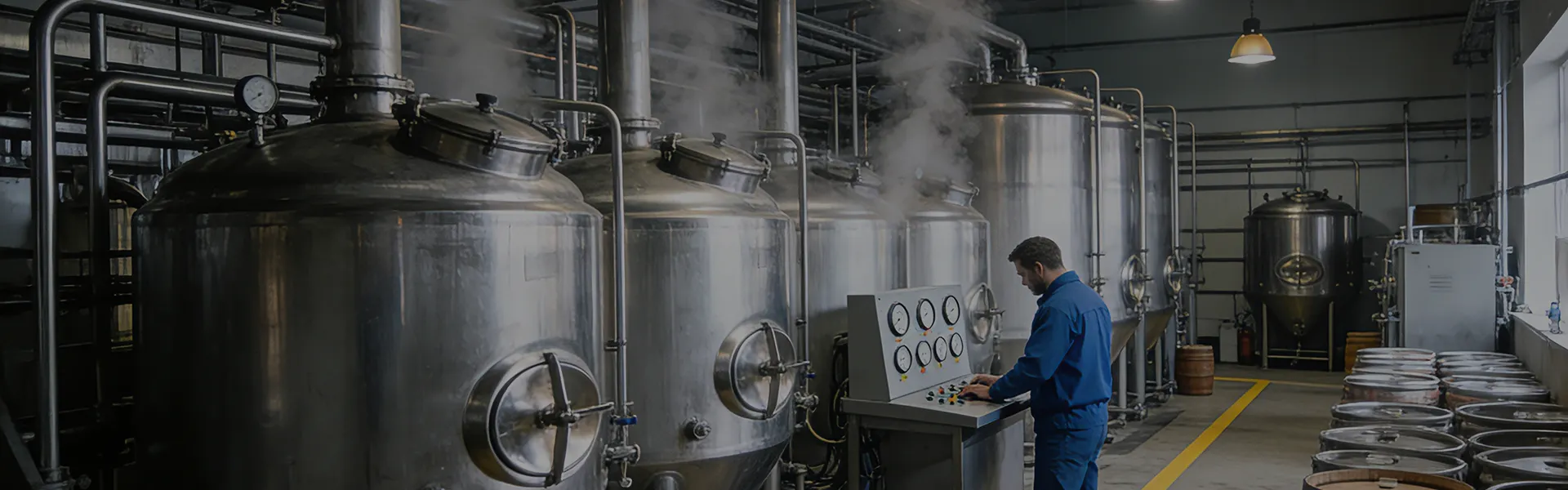
A brewery uses up to seven types of brewing tanks in sequence: hot liquor tank, cold liquor tank, mash and lauter vessels, kettle, whirlpool, fermenter and bright tank. Brewhouse vessels set batch size, fermenters hold one or more batches, and the bright tank holds finished beer for carbonation and storage.
Compared with category pages that name each vessel and stop there, this guide follows the order of a brew day and says, for every tank, what fills it and what decides its size. It is written for nano and microbrewery operators. ZR Brew’s own capacity categories put nano systems at 2HL–10HL and microbreweries at 12HL–40HL.
1. Hot liquor tank (HLT): the water supply
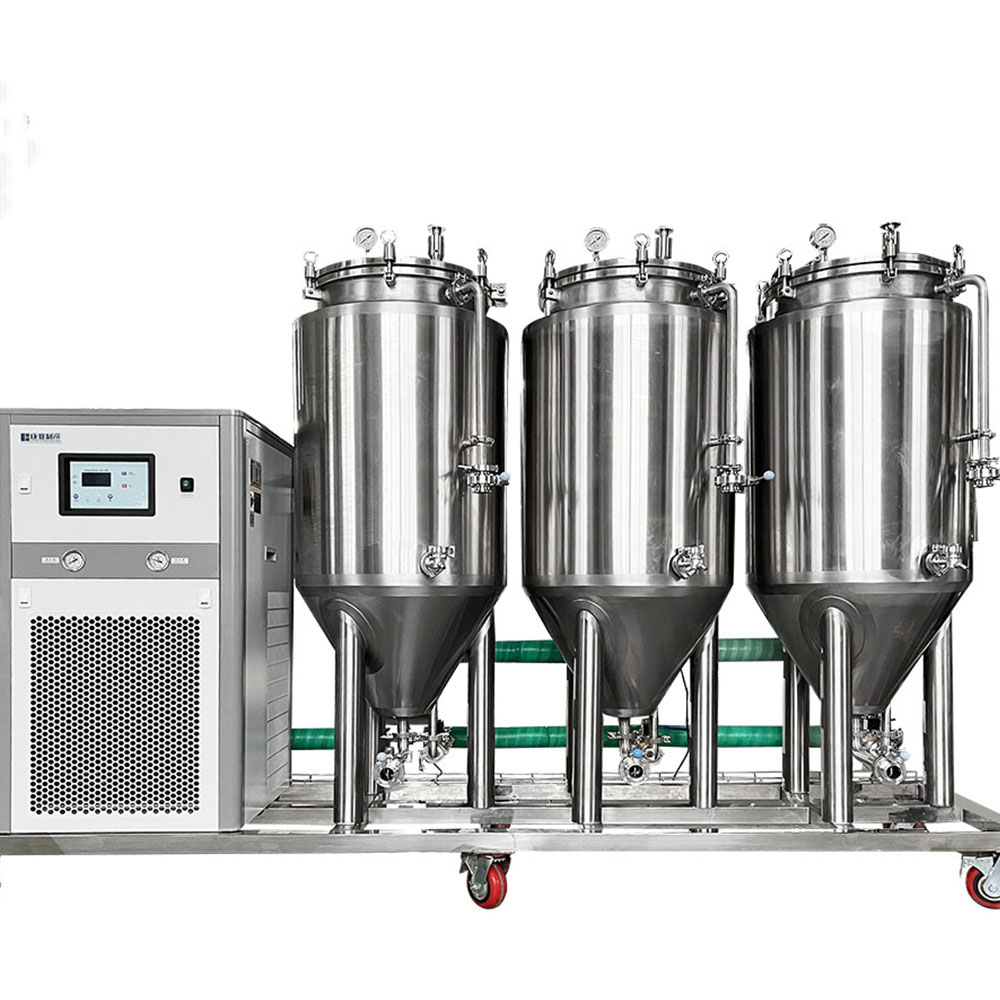
The HLT stores heated brewing water so mashing and sparging never wait on the heating system. Its volume is not the batch volume. It covers mash water and sparge water, plus cleaning water if you draw that from the same tank, and a brew day with several brews drains it more than once. Heating method follows the brewhouse project (see the specification table below).
2. Cold liquor tank (CLT): chilled water for wort cooling
A CLT typically holds water chilled by a glycol chiller, which the heat exchanger uses to bring boiled wort down to pitching temperature. Warmer incoming water and larger batches both raise the cooling load, so the tank and the chiller are sized as a pair.
3. Mash tun and lauter tun: where grain becomes wort
The mash tun mixes crushed malt with hot water so enzymes convert starch into fermentable sugar. The lauter tun then separates sweet wort from spent grain. On smaller systems one vessel often does both jobs. ZR Brew lists brewhouses in two-, three-, four- and five-vessel layouts, and the vessel count tells you which functions are split. Because these vessels hold grain plus water, they need more working volume than the wort they deliver, so confirm whether a “10HL brewhouse” describes batch output or vessel capacity.
4. Brew kettle: the boil
Wort boils here and hops go in. Some volume boils off, so the kettle is charged with more than the batch you send onward. Ask the supplier for the pre-boil volume the kettle is built for, not only the finished-batch figure.
5. Whirlpool: clearing the hot wort
Circulating hot wort in the whirlpool collects hop debris and protein solids in a cone at the center, which leaves cleaner wort for the heat exchanger. On compact brewhouses this step may be built into the kettle, so read the vessel list instead of assuming a separate tank.
6. Fermenter: where the yeast works
The ZR-FV line is a vertical insulated vessel with a glycol cooling jacket and, commonly, a 60-degree conical bottom. A fermenter can take one brew or several. If a 5HL brewhouse feeds a 10HL fermenter, two brews fill it, which commits that tank to a two-brew-day schedule. Stated capacity is also not always working volume: one published ZR Brew 3000L model lists a total volume of approximately 3750L, a figure that applies to that configuration only. Ask which number a quotation uses.
7. Bright tank: holding finished beer
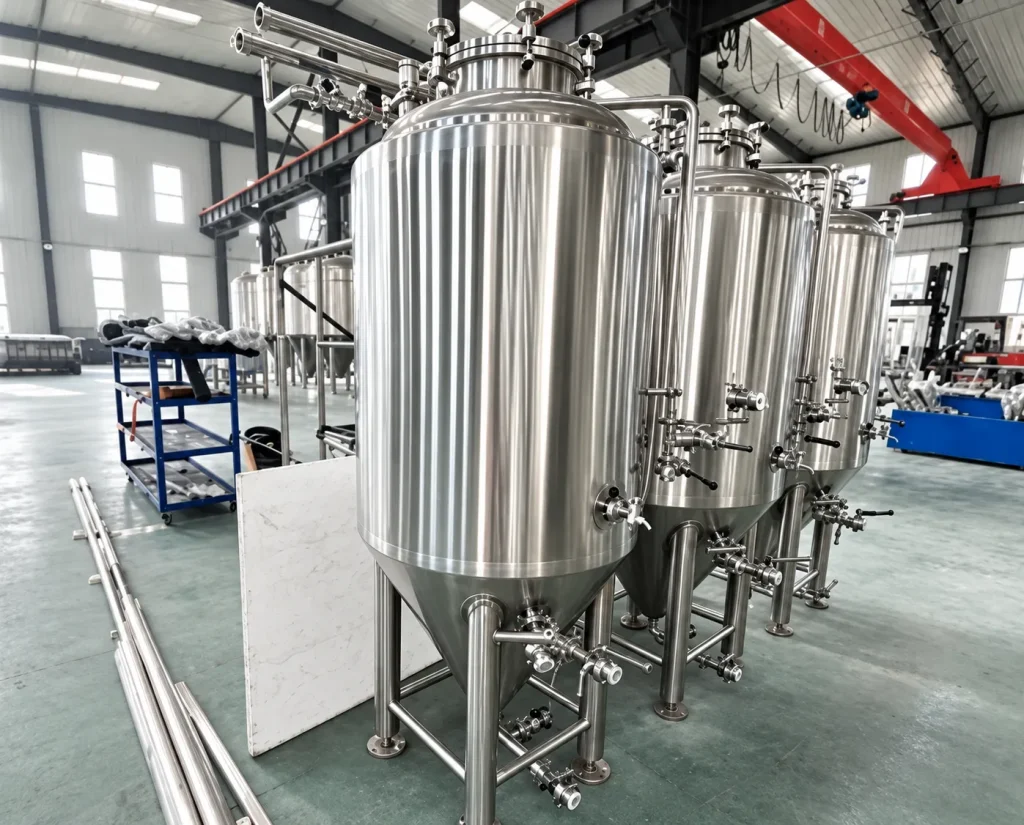
After fermentation, beer moves to a bright tank for carbonation and storage before kegging or packaging. To receive a full fermenter in one transfer, the bright tank needs at least that fermenter’s volume; a smaller one means split transfers. Pressure rating matters here because carbonation happens under pressure. ZR Brew’s tank line lists a typical working pressure of about 0.2 MPa (30 psi), depending on model.
| Tank | What fills it | What drives its size | Ask the supplier |
| HLT | Heated water | Water used per brew, brews per day, refill time | Refill time between brews |
| CLT | Chilled water | Cooling water per brew, incoming water temperature | Chiller capacity matched to the tank |
| Mash/lauter vessel | Malt and hot water | Grain bill and water-to-grain ratio | What the “HL” figure measures |
| Kettle | Wort from lauter | Pre-boil volume, above finished batch | Designed pre-boil volume |
| Whirlpool | Hot boiled wort | Kettle outflow | Separate vessel or shared with kettle |
| Fermenter | Cooled wort, one or more brews | Batch volume × brews per fill, plus headspace | Nominal or total volume |
| Bright tank | Beer from one or more fermenters | The transfer you plan | Working pressure, cooling |
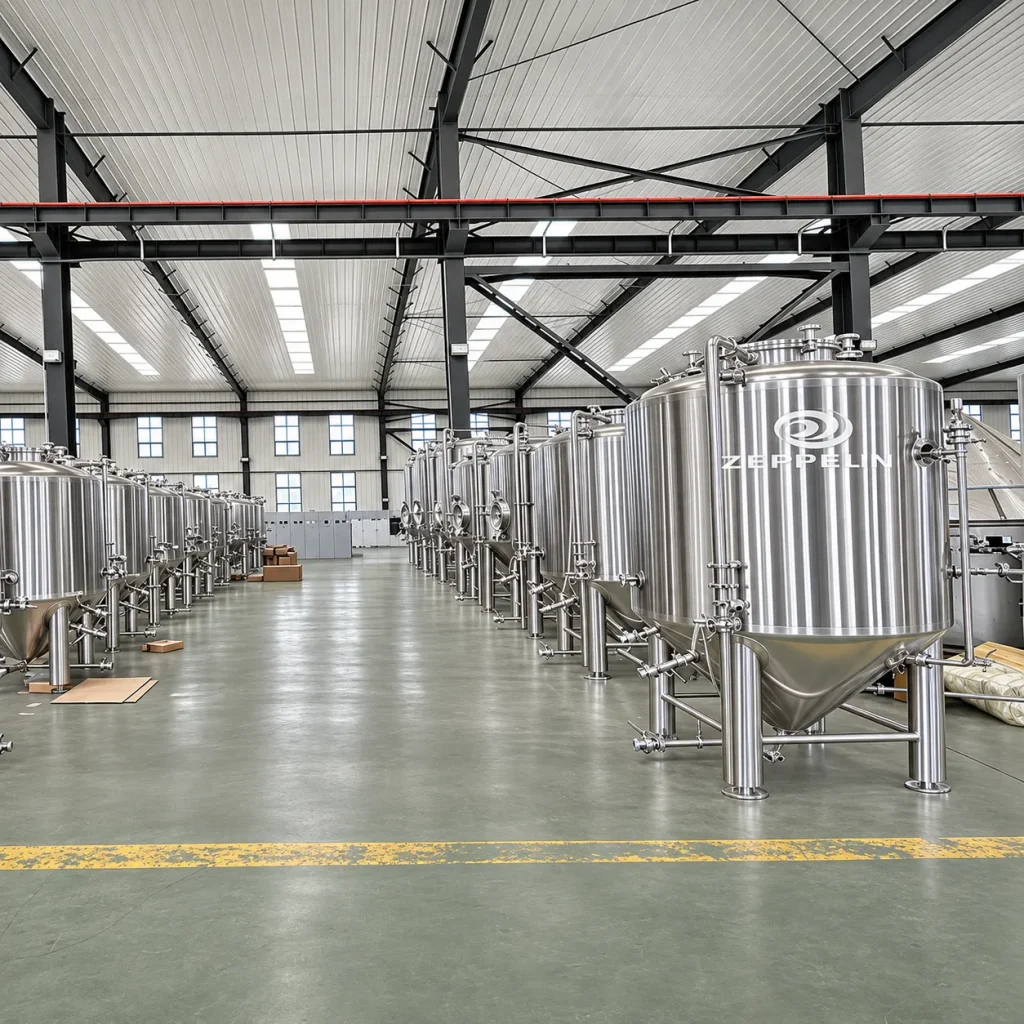
Because the ZR-FV line is published for fermentation, maturation, conditioning and carbonation, one vessel can carry beer from yeast pitch to serving. That saves floor space and removes a transfer step. The cost is that the tank stays occupied through conditioning, so a brewery that brews weekly may need extra fermenters to keep the brewhouse busy.
A separate bright tank frees the fermenter for the next brew and gives you a place to hold beer until kegging. It adds a vessel, a transfer and more floor area. A brewery with limited space and a modest brew schedule has a reason to skip it; one planning to raise brew frequency has a stronger case for adding it.
ZR Brew tank specifications
ZR Brew builds stainless steel brewing tanks and brewhouse vessels, and states that most major vessels are manufactured in-house.
Brewhouse (ZR Brew brewery equipment)
| 매개변수 | Published information |
| Capacity categories | Home and pilot 50L–200L; nano 2HL–10HL; microbrewery 12HL–40HL; commercial 45HL–150HL |
| Representative models | ZR-1000, ZR-1500, ZR-2000, ZR-2500, ZR-5000 |
| Layout | Two-, three-, four- or five-vessel |
| 재료 | Food-grade stainless steel, normally SUS304; other materials subject to project confirmation |
| 난방 | Electric, steam or direct fire, depending on system size and site |
| 제어 | PID or PLC |
| Published throughput | 10HL four-vessel: up to about 4 batches/day; 20HL–50HL four-vessel: up to about 6 batches/day |
Fermentation and bright beer tanks (ZR-FV line)
| 매개변수 | Published information |
| Models | ZR-FV-100L, 200L, 300L, 500L, 1000L, 1500L, 2000L, 2500L, 3000L, 5000L; ZR-FV-10BBL and other BBL-based sizes |
| Nominal capacity | Approximately 100L–5000L, plus BBL sizes |
| 재료 | SUS304; SUS316 options subject to project requirements |
| 냉각 | Glycol cooling jackets |
| Structure | Vertical insulated vessel, top or side manway |
| Cone | Commonly 60 degrees on fermentation tanks |
| Working pressure | Approximately 0.2 MPa (30 psi), depending on model |
| Customization | Ports, valves, cooling zones, pressure settings, surface treatment, dimensions, accessories |
Collect these for the ZR Brew project team: target batch volume and beer styles, brews per week, available electric, steam or gas supply, water supply, room dimensions, destination country, and whether you want a unitank or separate bright tank. The team provides capacity consultation, site and utility evaluation, layouts and an itemized quotation.
What is the difference between a hot liquor tank and a cold liquor tank?
The HLT stores heated water for mashing and sparging. The CLT stores chilled water, typically used to cool wort after the boil.
Do I need a separate bright tank?
Not always. A fermenter can condition and carbonate beer, but it stays occupied while it does. A separate bright tank frees it for the next brew at the cost of an extra vessel and transfer.
Is a fermenter’s stated capacity the amount of beer it holds?
Not necessarily. One published ZR Brew 3000L model lists a total volume of approximately 3750L. Confirm whether a quotation states nominal or total volume.
What material are ZR Brew fermentation and bright beer tanks made from?
SUS304 stainless steel, with SUS316 options subject to project requirements.
How much do brewing tanks cost?
Cost depends on capacity, vessel quantity, heating method, automation level, material grade, destination utilities and shipping, so request an itemized quotation.
24시간 이내에 답변해 드리겠습니다. 긴급한 사안이신 경우, WhatsApp/WeChat(+8613188932181)으로 연락해 주시기 바랍니다.
*당사는 귀하의 개인정보를 존중하며, 모든 정보는 안전하게 보호됩니다.
당사는 귀하의 정보를 오직 문의에 답변하는 용도로만 사용하며, 원치 않는 이메일이나 홍보 메시지를 절대 보내지 않습니다.