

견적 받기
24시간 이내에 답변해 드리겠습니다. 긴급한 사안이신 경우, WhatsApp/WeChat(+8613188932181)으로 연락해 주시기 바랍니다.
*당사는 귀하의 개인정보를 존중하며, 모든 정보는 안전하게 보호됩니다.
당사는 귀하의 정보를 오직 문의에 답변하는 용도로만 사용하며, 원치 않는 이메일이나 홍보 메시지를 절대 보내지 않습니다.
 게시됨
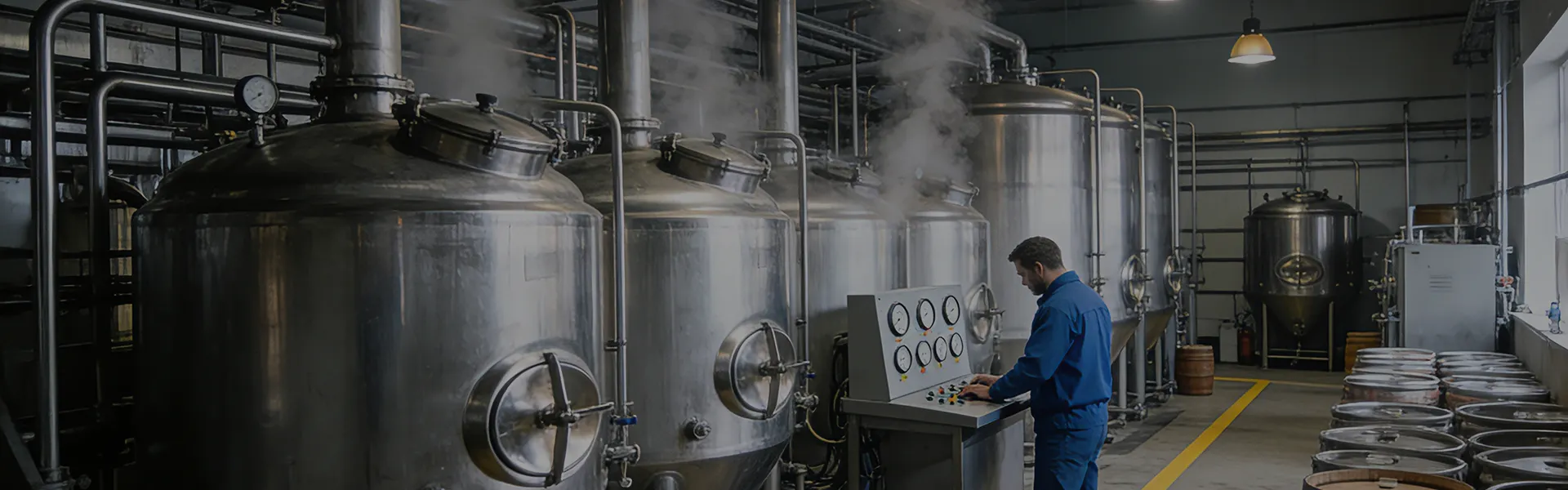
For decades, the answer to every wort problem was “boil it harder”. Then research delivered an uncomfortable truth: evaporation rate barely controls DMS at all — temperature and pH do. So if a gentler boil strips DMS just as well, why are you still evaporating 8% of your wort? Let’s walk through the novel wort boiling technologies that cut thermal load, remove DMS deliberately and return the heat to your brewhouse.
DMS (dimethyl sulfide) is the benchmark volatile of wort boiling: how your kettle handles DMS-P (its precursor) is a good proxy for how it handles every other unwanted volatile. Classical kettles burn enormous energy to evaporate water — only to discover that DMS-P decomposition follows temperature and pH, not the evaporation meter. That single insight unlocks an entire generation of low-evaporation, energy-recovering boiling systems.
In the traditional wort boil, the water evaporation rate runs almost parallel to the DMS-P decomposition rate — which means boiling intensity and evaporation volume have hardly any influence on how much DMS-P actually decomposes. Research shows the factors that really drive DMS release are temperature and pH. What does the free-DMS curve actually look through a conventional boil?
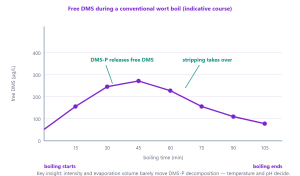
That is exactly why the novel technologies exist: once you accept that a gentler boil can still strip DMS, you gain a powerful lever to cut boiling intensity and evaporation volume — and save enormous amounts of energy without sacrificing the DMS target.
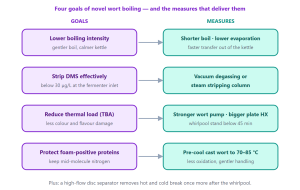
Every novel boiling system — vacuum degassing, steam stripping, Merlin, low-pressure evaporation — is built around the same four targets:
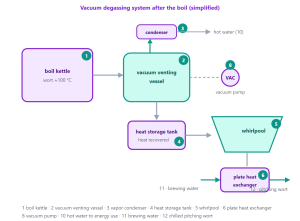
The vacuum degassing system treats the wort the moment boiling ends. The hot wort first enters a negative-pressure venting vessel topped by a condenser: flash evaporation under vacuum strips volatile substances — DMS among them — while the vapor is condensed and its heat fully recovered. The degassed wort then passes through a heat storage tank into the whirlpool, and from there everything proceeds traditionally. The effect: lower boiling intensity, less evaporation, major energy savings and lower production cost.
Steam stripping (desorption) tackles volatiles after the boil. The wort first runs through a clarifier and a pre-run tank, then is pumped to the top of a stripping column and sprayed evenly over the packing. Why packing? Because contact area is everything: depending on the packing type, one cubic metre of packing offers 50–500 m² of surface. Low-pressure steam is injected at the column bottom and rises against the falling wort film, evaporating the undesirable volatiles out of the wort. The stripped vapor is condensed — and the condensate leaves as 85 °C hot water stored in a buffer tank for process use. Nothing is wasted.
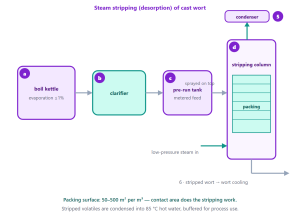
The stripping workflow treats boiling as three disciplined phases instead of one long rolling boil:
Only then comes clarification, stripping, and wort cooling — where the stripped wort reaches the fermenter with DMS below 30 µg/L. And because the evaporation load is so low, the heat recovered from the condenser side can cut the process energy demand dramatically — savings of up to 92% are reported for the concept.
Put side by side, the operating figures tell the story clearly:
| 매개변수 | Traditional boiling | Modern boiling |
|---|---|---|
| Minimum boiling time | 60 min | 50–60 min |
| Total evaporation | 6–7 % | variable — much lower with stripping |
| Iso-α-acid (isomerisation) rate | 50–60 % | 60–65 % |
| Hot wort pump-out from kettle | 15 min | < 10 min |
| Coagulable nitrogen (12 °P) | 15–20 mg/L | 20–28 mg/L |
| Colour increase | < 1 EBC | < 1 EBC |
| Thermal load (TBA value) | < 35 | < 35 |
| DMS at the fermenter inlet | higher, evaporation-dependent | < 30 µg/L by design |
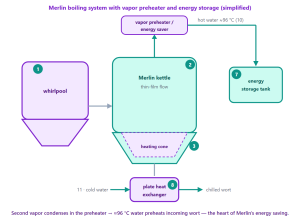
The Merlin system replaces part of the flat heater area with a conical heating surface — typically divided into a one-third and a two-thirds zone. Wort flows as a film over the cone, gaining excellent heat transfer with a small heating area, and the vapor generated is put to work: it is led into a vapor preheater and energy saver, where it condenses and heats process water to about 96 °C — water that then preheats incoming wort. The result is a boil that is shorter, cooler on the wort, and dramatically cheaper.
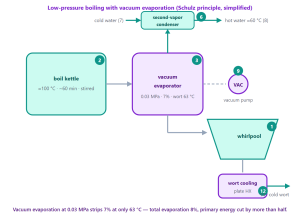
The Kasper Schulz principle combines gentle low-pressure boiling with a vacuum evaporator, so the total evaporation stays at a full 8% — without the usual energy bill:
Energy balances from a working brewhouse (per 225 hL of cast wort) put total brewhouse heat demand at roughly 3,249 kWh — split into about 46% for evaporation and 54% for wort heating, plus around 10% losses. In other words: even a perfect burner cannot escape the fact that more than half the heat goes into simply warming wort and vessels. That is why heat recovery matters more than burner size:
Temperature and pH. DMS-P decomposes as a function of thermal history, and free DMS is stripped by contact between wort and vapor phase — both of which vacuum degassing and steam stripping deliver deliberately, without evaporating litres of wort for show.
Vacuum degassing flashes the hot wort into a negative-pressure vessel immediately after the boil — fast, gentle, and integrated into the transfer path. Steam stripping runs the clarified wort through a packed column against low-pressure steam — more thorough contact, and it produces 85 °C hot water as a by-product.
No — it helps. Thermal load, tracked as the TBA value, falls because the wort spends less time at high temperature. Lower thermal load means less oxidation, lighter colour and better flavour stability; modern systems hold TBA below the same limits as traditional boils.
Vacuum degassing concepts report savings up to 92% on process energy via condensate heat recovery; the Schulz low-pressure plus vacuum evaporation route cuts primary energy by more than half at a full 8% total evaporation; Merlin cuts total evaporation to 4.1–4.5% and recycles its vapor into ≈96 °C preheat water.
Yes. A Merlin kettle combined with a degassing unit can operate as an external boiling device as well — shortening total boil time while keeping its heat-recovery behaviour intact. Dual-use equipment is one of the quiet economics of novel boiling.
Every minute of standing adds thermal load without doing useful work. With a stronger wort pump and a larger plate heat exchanger, the transfer and stand sequence completes in under 45 minutes — protecting both the TBA value and the next brew’s schedule.
Comparative trials say no: beer analyses from the Schulz low-pressure/vacuum route match conventional brewing, and taste panels plus forced-aging tests showed no differences — while foam, palate and hop aroma actually improved with Merlin-type operation.
Above roughly 5.5% evaporation, the recoverable second-vapor heat becomes large enough for compression-based heat recovery to be worthwhile. Below that, simple condenser heat recovery into process water usually delivers the better return.
The lesson of novel wort boiling is simple and uncomfortable: brute-force evaporation was never the point. DMS obeys temperature and pH; thermal load obeys time; and your energy bill obeys every litre you boil away for no reason. Vacuum degassing, steam stripping, the Merlin conical kettle and low-pressure vacuum evaporation each attack a different part of that waste — and all of them hand the recovered heat back to the brewhouse. Which of the four goals — lower intensity, stripped DMS, reduced TBA, protected foam proteins — is your current kettle failing first? That answer tells you exactly which system to look at.
24시간 이내에 답변해 드리겠습니다. 긴급한 사안이신 경우, WhatsApp/WeChat(+8613188932181)으로 연락해 주시기 바랍니다.
*당사는 귀하의 개인정보를 존중하며, 모든 정보는 안전하게 보호됩니다.
당사는 귀하의 정보를 오직 문의에 답변하는 용도로만 사용하며, 원치 않는 이메일이나 홍보 메시지를 절대 보내지 않습니다.