

お見積りをご依頼ください
24時間以内にご返信いたします。お急ぎの場合は、WhatsAppまたはWeChat(+8613188932181)までご連絡ください。.
*当社はお客様のプライバシーを尊重し、すべての情報を保護いたします。.
お客様の情報は、お問い合わせへの回答にのみ使用し、未承諾のメールや宣伝メッセージを送信することは一切ありません。.
 公開日
公開日
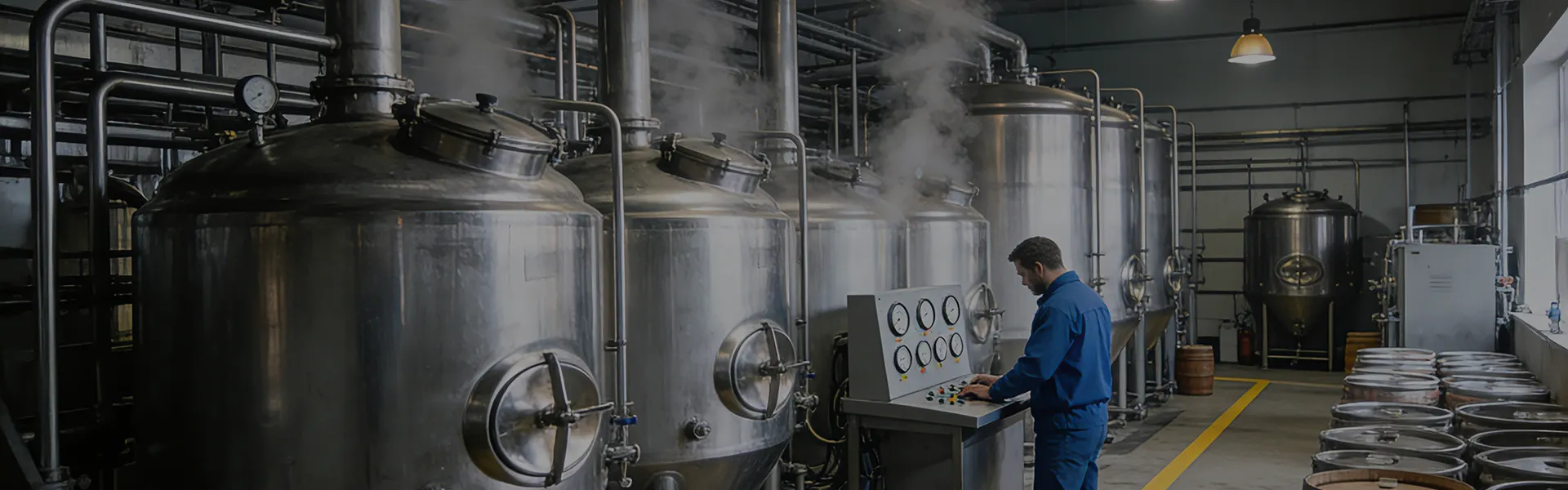
A practical comparison of four malt crushing technologies for modern brewhouses.
Choosing the right malt crushing method is one of the most important decisions a brewer makes. It affects extract yield, lautering speed, wort color, flavor stability, dust control, and even plant safety. This guide breaks down the four main approaches used in breweries today—dry milling, wet milling, conditioning (moisture restoration) milling, and direct immersion conditioning milling—using real process data and performance comparisons.
Malt crushing is not just about particle size. The method you choose determines how much of the husk survives intact, how much moisture enters the grain before fracture, how much dust is generated, and how the grist behaves in the mash tun or lauter tun. Each method represents a different balance between capital cost, operating complexity, safety, and beer quality.
Dry milling is the most widely used method in small and medium-sized breweries because the equipment is simple, easy to operate, and relatively inexpensive. Clean malt is conveyed to a destoner, weighed, and then crushed in a roller mill. The ground grist is stored temporarily and then fed into the mash tun.
Safety is the biggest concern with dry milling. When malt is crushed dry, fine dust is released. Every 100 kg of malt can generate 0.4–1.4 kg of dust, and at the right concentration this dust can explode if ignited by a spark. Therefore, dry mills must include:
Accurate weighing is critical for calculating brewhouse yield and malt usage per 1,000 litres of beer. Two common systems are used:
A grist case or intermediate hopper is normally installed between the mill and the mash tun. Without it, mashing-in time is forced to match milling time. A typical buffer volume is about 300 L per 100 kg of raw material.
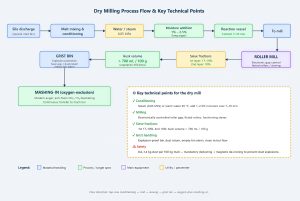
In wet milling, malt is steeped in hot water at about 50 °C for 15–20 minutes until its moisture content reaches roughly 30%. The conditioned malt then passes through a two-roll mill with a gap of 0.35–0.45 mm. Mashing water is added inside the mill at a grist-to-water ratio of at least 1:3, creating a slurry that is pumped directly into the mash tun.
Conditioning milling—often used with four-roll, five-roll, or six-roll mills—adds a small amount of moisture to the husk just before crushing. Cold water, hot water, or low-pressure steam (0.05–0.1 MPa) is sprayed onto the malt in an auger or conditioning vessel. Steam conditioning lasts 30–40 seconds and raises husk moisture by about 0.7–1.0%; water spraying takes 90–120 seconds and raises moisture by 1.5–2.0%.
During conditioning, malt temperature must stay below 30 °C to protect enzymes. The water is not evenly distributed: while total grain moisture may rise only 0.7%, husk moisture can increase 1.5–1.7%, and endosperm moisture only 0.3–0.5%. This targeted hydration makes the husk flexible while leaving the endosperm relatively dry and brittle.
Direct immersion conditioning milling takes conditioning one step further. A complete mash charge of dry malt is held in a conditioning vessel and sprayed with warm water for about 60 seconds until the husk absorbs roughly 20% moisture. The malt is then milled in a two-roll mill and slurried with additional warm water to the target mash thickness before being pumped into the mash tun. Adjuncts are milled dry separately and then slurried to the required consistency for the cereal cooker.
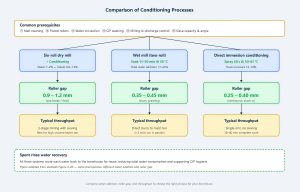
The image above summarizes how the three main conditioning/moisturizing approaches differ in water addition and prerequisites. Water addition levels are typically:
Common prerequisites for all three systems include malt cleaning, fluted rollers, proper water circulation, CIP washing, controlled feed/discharge, adequate sieve capacity and angle, and roller gaps in the range of 0.25–0.40 mm for final crushing. Spent rinse water is recovered and reused.
| Parameter | Dry Milling | Wet Milling | Conditioning Milling | Direct Immersion Conditioning |
|---|---|---|---|---|
| Grist bulk volume (m³/t) | 2.6 | — | 3.2 | — |
| Lauter loading rate (kg/m²) | 160–190 | 280–330 | 190–220 | 280–330 |
| Max spent-grain bed thickness (m) | 0.32 | 0.45–0.55 | 0.36 | 0.45–0.55 |
| Laboratory extract yield (%) | 76.6 | 76.6 | 76.6 | 76.6 |
| Brewhouse extract yield (%) | 75.0 | 76.1 | 76.6 | 76.6 |
| Wort color (EBC) | 11.5 | 10.2 | 10.4 | 9.5 |
Data source: brewing process textbook comparison table. Brewhouse extract is the practical figure that matters for yield and cost.
| Method | Advantages | Disadvantages |
|---|---|---|
| Dry milling |
|
|
| Conditioning milling |
|
|
| Wet milling |
|
|
| Direct immersion conditioning |
|
|
The best method depends on your scale, beer styles, budget, and layout:
Install dust collection (bag filters or silos), magnetic separators before the mill, and explosion vents or suppression on the mill and grist case. Keep dust concentrations below explosive limits and eliminate ignition sources such as metal sparks.
Pre-soaking keeps the husk elastic and largely intact, reducing the extraction of polyphenols and tannins that darken wort and add astringency. Table 3-5 shows wort color dropping from 11.5 EBC with dry milling to 10.2 EBC with wet milling.
Conditioning milling adds only 1–2% moisture to the husk surface before dry roller milling. Wet milling soaks the malt to about 30% moisture and mills it into a slurry. Conditioning is less effective than wet milling but simpler and cheaper.
Yes. Because the entire charge must be milled in 30–40 minutes, the instantaneous power demand is high—often more than double that of dry milling. However, the gains in extract yield, wort quality, and reduced dust handling can offset the higher energy cost.
A common rule of thumb is 300 L of grist-case volume per 100 kg of raw material. This provides enough buffer so that milling and mashing-in can run independently.
There is no single “best” malt crushing method. Dry milling remains the economical choice for many breweries, while wet milling and direct immersion conditioning deliver superior husk protection, extract yield, and wort quality. Conditioning milling sits in the middle, offering a practical upgrade path for breweries that want better results without a full wet-mill investment.
Use the data in Table 3-5 and Table 3-6 to compare real performance metrics, and match the process flow in Figure 3-19 to your own brewhouse layout. The right decision will improve your yield, shorten your brew day, and produce cleaner, more consistent beer.
24時間以内にご返信いたします。お急ぎの場合は、WhatsAppまたはWeChat(+8613188932181)までご連絡ください。.
*当社はお客様のプライバシーを尊重し、すべての情報を保護いたします。.
お客様の情報は、お問い合わせへの回答にのみ使用し、未承諾のメールや宣伝メッセージを送信することは一切ありません。.