Mash mixer, cereal cooker, and agitator design — how vessel configuration and stirring technology decide your wort quality.
Have you ever wondered why two breweries using the same recipe can produce wort that tastes completely different? The answer often hides in the brewhouse itself. Mashing equipment — the vessel configuration, the heating system, and above all the mash agitator design — determines whether your mash is heated evenly or scorched locally, whether enzymes work in a homogeneous environment, and how much shear force your wort is exposed to. In this guide, we break down the vessel sizing rules, the roles of the mash mixer and cereal cooker, and the new-generation agitators from Hupmann and Steinecker — with the data that proves why they matter.
1. How Many Mashing Vessels Does Your Brewery Actually Need?
Is there a universal answer? Not quite — it depends on your production scale. For a microbrewery line, two or three multi-functional mashing vessels are usually enough, because one vessel can combine several functions. Large breweries, however, typically run a classic “three vessels and one tun” configuration: mash mixer, cereal cooker, wort kettle, and lauter tun — a more complete and flexible setup.
Want to increase the number of daily brewing batches? Then the brewhouse is usually extended with a wort holding tank (to buffer first wort while the kettle is still occupied) and a whirlpool. This simple addition can raise daily capacity significantly without buying a whole second brewhouse.
How Should You Size Each Vessel?
Did you know that vessel sizing follows a simple rule of thumb based on grain bill? Per 100 kg of grist, the typical vessel volumes are:
- Mash mixer (mash tun): 6–8 hL
- Wort kettle: 8–9 hL
- Cereal cooker: 4–5 hL
- Lauter tun: 6–8 hL
- Wort holding tank: 3–4 hL
What ultimately decides the size? The volume of wort you need to cast per brew. Size the vessels around your target cast-out volume, and everything else falls into place.
2. Mash Mixer vs. Cereal Cooker: What Does Each Vessel Actually Do?
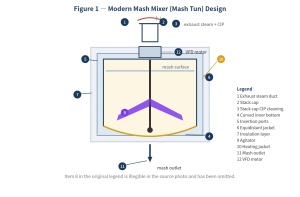
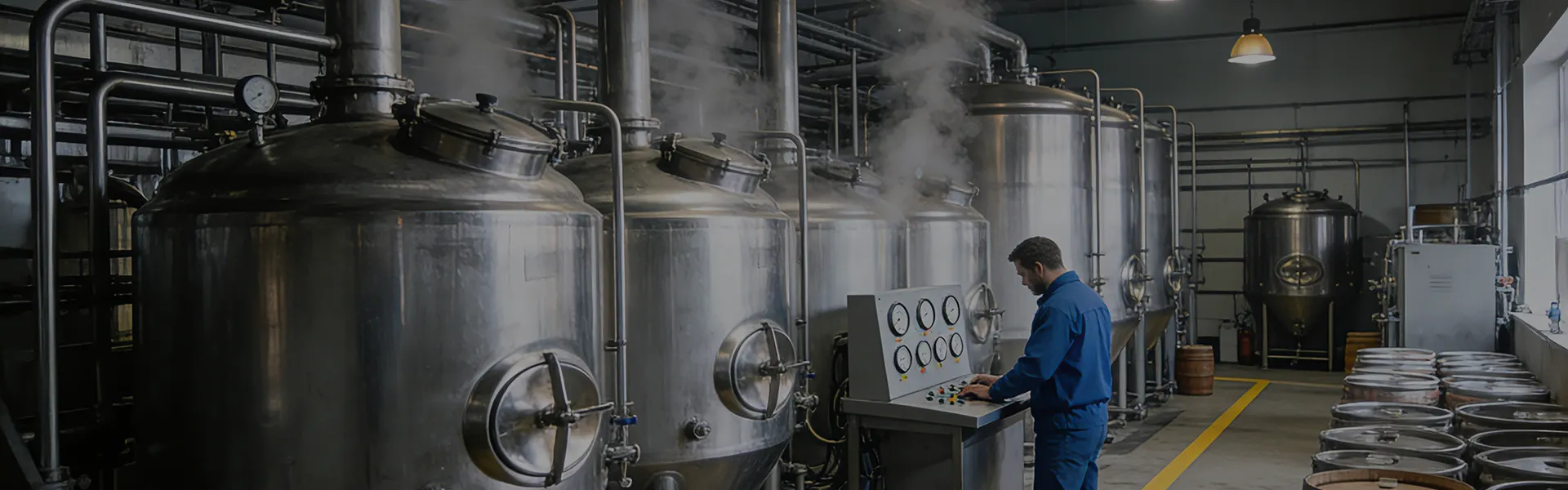
The mashing process usually requires two vessels that look remarkably similar: the mash mixer and the cereal cooker (see Figure 1). So what is the difference? The mash mixer is where malt starch and protein degradation take place — the gelatinized adjunct mash is pumped here, blended with the malt mash, and held at defined temperatures for saccharification. The cereal cooker, by contrast, is where rice or other adjuncts — together with a portion of the malt mash — are heated and boiled to gelatinize and liquefy their starch.
How Has Mash Mixer Heating Evolved?
Why should you care about the heating system? Because it decides whether your mash scorches. Older vessels relied on large-are steam jackets: a big heating surface seemed efficient, but if the steam was not shut off and vented in time after boiling, a vacuum could form and deform the jacket. Modern designs use equidistant half-pipe jackets that stay open to atmosphere, which prevents vacuum collapse and wasted steam. And what about materials? Replacing the bottom carbon-steel plate with stainless steel improves heat transfer efficiency by more than 20% — whila se carbon-steel sections, where cost demands it, are still used for the upper, less critical areas.
3. What Makes a Great Mash Agitator?
What is the basic job of the agitator? To keep every solid particle in suspension and distribute it uniformly in the liquid, so that no zone overheats and no grist scorches on the heating surface — because localized overheating produces Maillard and caramelization products that damage beer quality and flavor.
How fast should it turn? Here is the golden rule: the impeller tip speed must stay below 3 m/s — otherwise the blades generate shear force that changes the mash contents (see the next section for why that matters so much).
4. Why Are the New Hupmann and Steinecker Agitators Better?
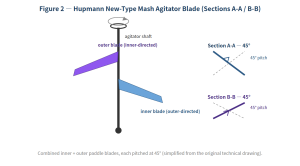
In recent years, German equipment makers Hupmann and Steinecker have introduced new-type agitators that dramatically improve mixing while reducing shear. What makes them different? Let’s look at the designs.
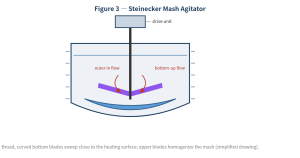
And what does the Steinecker version look like? Its agitator follows the same philosophy — a low-shear, high-efficiency impeller matched to the vessel geometry — but with its own blade geometry and drive arrangement.
What Are the Four Design Features Behind the Improvement?
So what exactly did the German engineers change? Four things stand out:
- Long, wide, symmetric blades. Heat must reach the mash by convection and radiation without creating hot spots near the heating surface. The wide blades cover up to 85–90% of the relevant flow area, establishing a stable convection loop with a short heat-transfer path. As a result, the maximum tip speed can drop below 1 m/s — far below the conventional 3 m/s limit — while the blade width reduces the load per blade and cuts heat conduction losses along the shaft.
- Angled blades generate full rotation. The pitched blades force the mash into a rotating, three-dimensional flow: outer-in and bottom-to-top circulation prevents the heavier particles from settling in a middle zone and keeps the temperature uniform to within ±0.3 °C from top to bottom. Moreover, perforations in the new blades reduce shear force and oxygen pickup — a double win for wort quality.
- Height-adjustable agitator. During heating, the agitator runs low, close to the heating surface, to maximize heat transfer and prevent scorching. During rests, a higher position is better, because the “suction effect” works more effectively than at low positions, where the suction space is restricted. One agitator, two optimal operating points.
- Variable-frequency drive (VFD). Agitator speed can be matched flexibly to each mashing phase, keeping flow velocity — and therefore shear force — under control at every step. This pays off especially in high-gravity mashing, where viscous mashes demand far more from the mixing system.
5. How Does Agitator Speed Affect NHF and Filterability?
Here is a question many brewers never ask: how do we even measure the shear stress a mash suffers? The industry uses the content of non-water-soluble substances (NHF) as the key indicator — the higher the NHF content, the more shear the mash has experienced. In practice, the absolute NHF level depends largely on the structure of the agitator itself.
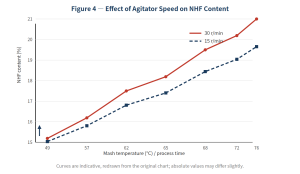
What does the data tell us? Two things:
- A. Faster stirring means more NHF. As agitator speed increases, NHF content rises at every temperature. And why is that a problem? Because an excessively high NHF content impairs wort filtration.
- B. After the 57 °C saccharification phase, the damage becomes permanent. By this point the mash enzymes have been largely inactivated or are working outside their optimal environment, so large and small dextrin molecules can no longer be broken down further. If you keep stirring fast now, the molecules will link through hydrogen bonds into β-glucan gel substances — a well-known cause of stubborn filtration problems. Low-speed stirring is therefore mandatory in this phase.
How Big Is the Difference? New vs. Conventional Agitator, by the Numbers
Does all this engineering actually show up in the data? Yes — and the comparison is striking:
Table 1 — New-Type vs. Conventional Mash Agitator: Key Parameters
| Parameter |
Conventional Agitator |
New-Type Agitator |
| Heating rate (°C/min) |
0.53 |
0.84 (≈60% faster) |
| Top-to-bottom temperature difference (°C) |
0.4–0.7 |
0.1 |
| Agitator diameter / mash vessel diameter |
0.7–0.75 |
0.8 |
Data from the original comparison table (Table 3-30).
Brewing tip: Faster heating AND a more uniform temperature AND less shear — the new-type agitator improves all three at once. If your lauter keeps stalling for no obvious recipe reason, look at your agitator speed in the phases after 57 °C first. It is the cheapest place to look and often the real culprit.
Často kladené otázky
Q1: What is the “three vessels and one tun” configuration?
It is the classic large-brewery brewhouse layout: mash mixer, cereal cooker, wort kettle, and lauter tun. Small breweries combine functions into two or three multi-functional vessels instead; adding a wort holding tank and whirlpool raises the number of daily batches.
Q2: Can one vessel do both mashing and adjunct cooking?
They look similar, but their roles differ. The mash mixer performs starch and protein breakdown and holds the saccharification temperature; the cereal cooker boils rice or other adjuncts with a portion of malt mash to gelatinize and liquefy their starch. Two-vessel brewhouses rely on both working in sequence.
Q3: Why must the agitator tip speed stay below 3 m/s?
Above roughly 3 m/s, the blades generate shear force that changes the mash contents — measurable as rising NHF. New-type agitator designs push the working tip speed below 1 m/s while still mixing the full vessel volume.
Q4: What is NHF and why should brewers track it?
NHF stands for the non-water-soluble substances in the mash. It serves as a practical indicator of shear stress: the higher the NHF content, the more shear the mash has experienced, and the harder wort separation becomes.
Q5: When should the agitator run low, and when high?
Low during heating — close to the heating surface, to boost heat transfer and prevent scorching. High during rests — the suction effect works better there. With a height-adjustable, VFD-controlled agitator you can optimize both positions in the same brew.
Conclusion: So Which Equipment Should You Choose?
Mashing equipment is not just steel around a process — it actively shapes your wort. Size your vessels around cast-out volume, keep heating surfaces modern and vented, and treat the agitator as a precision instrument rather than a simple stirrer: wide symmetric blades, 45° pitch, height adjustment, and VFD control. The numbers speak for themselves — 60% faster heating, tenfold tighter temperature uniformity, and measurably lower shear.
Planning a new brewhouse or upgrading an old one? Start with the agitator. It is the component where a smart design decision pays you back in every single brew — in extract yield, in filtration speed, and in the flavor stability of the finished beer.


 Zveřejněno