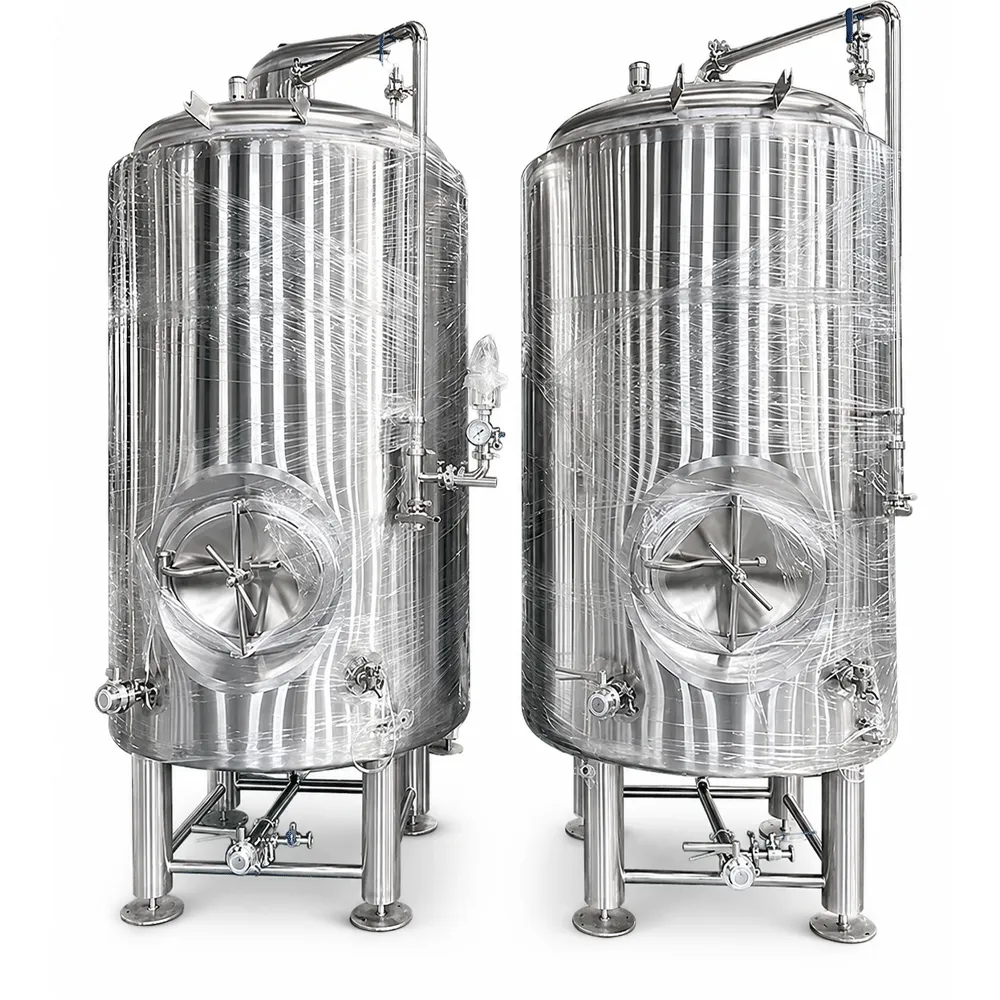
A bright tank is a pressure-rated, glycol-jacketed stainless steel vessel where finished beer is conditioned, carbonated and held cold until packaging, so fermenters can restart sooner. How many you need depends on days of occupancy per batch; unitanks can replace them if you package straight from the fermenter.
What a bright tank does, and where it sits in the line
A bright tank (also spelled brite tank, and sometimes called a serving tank when beer is dispensed straight from it) is the last vessel beer touches before kegs, cans or bottles. Beer arrives from a fermenter once fermentation and any diacetyl rest are finished, or from a filter if you filter. It then does four jobs:
- Conditioning: cold holding gives remaining yeast and haze particles time to drop out.
- Carbonation: CO₂ is brought to the target level under pressure.
- Scheduling buffer: the fermenter returns to the brewhouse queue while packaging waits for its day.
- Quality hold: you sample, check carbonation and clear the beer for release before it is packaged.
Because it holds finished beer rather than active fermentation, a bright tank usually has a dished or shallow-cone bottom, not the steep cone a fermenter uses to collect yeast. Check the bottom geometry in the drawing of any model you buy.
How many bright tanks does a brewery need?
Start from time, not volume. Each batch occupies a bright tank for some number of days, and tank count follows from how often batches arrive:
Bright tanks = (batches per week × days each batch sits in the bright tank) ÷ 7, rounded up
The same formula works for fermenters, using days in the fermenter. It assumes one bright tank takes one full fermenter transfer. If your bright tanks are smaller than your fermenters, count each split transfer as its own batch.
| Scenario (assumed numbers) |
Batches/week |
Days in fermenter |
Days in bright tank |
Fermenters |
Bright tanks |
Ratio |
| A: ale, low volume |
2 |
14 |
3 |
4 |
1 |
4 : 1 |
| B: ale, steady |
4 |
14 |
3 |
8 |
2 |
4 : 1 |
| C: lager |
4 |
28 |
5 |
16 |
3 |
about 5.3 : 1 |
| D: fast ale |
6 |
10 |
2 |
9 |
2 |
4.5 : 1 |
These day counts are placeholders, not industry benchmarks. Replace them with your own recipes’ tank times. The ratio is simply fermenter-days divided by bright-tank-days, which is why the lager line needs the most fermenters per bright tank. If your packaging day is fixed, for example a mobile canner who visits on set dates, consider adding one tank so a finished batch is not forced to wait in a fermenter.
Compared with a fixed rule such as “one bright tank per N fermenters,” the occupancy method adjusts for lagers, fast ales and different packaging schedules.
Volume check. Nominal volume is not the volume of beer a vessel can take, because you need headspace. One published ZR Brew 3000L model lists a total volume of about 3750L, but that gap belongs to that configuration and should not be applied to other models.
Bright tank vs unitank: where each setup fits
A unitank ferments, conditions and can carbonate in one vessel, and its cone lets you dump yeast. The trade-off is that the vessel stays occupied through conditioning and the wait for packaging.
| Factor |
Fermenter + bright tank |
Unitank only |
| Vessels and floor space |
An extra vessel type, glycol zone and piping |
Fewer vessels, one vessel does both jobs |
| Fermenter turnover |
Freed at transfer; next batch can start |
Occupied until the beer is packaged |
| Transfers |
One extra transfer, with oxygen pickup risk if done poorly and extra cleaning |
No transfer between fermentation and packaging |
| Yeast and sediment at packaging |
Beer is moved off the yeast before packaging |
Beer is drawn from above the cone, so dumping and draw-off need care |
| Filtered beer |
Has a natural destination vessel |
Needs somewhere to go after the filter |
| Packaging flexibility |
Packaging date is decoupled from fermenter schedule |
Packaging date is tied to the unitank |
Compared with a unitank-only line, a fermenter-plus-bright-tank line costs more in vessels and floor space but separates fermenter turnover from packaging dates.
A unitank-only setup tends to fit when:
- batches per week are low,
- beer is packaged soon after conditioning,
- a single package path, such as kegs to a taproom, is enough,
- floor space is the tighter constraint.
Adding a bright tank starts to pay off when:
- you filter, and the filtered beer needs a destination,
- a canning or bottling line works to a fixed schedule,
- fermenter turnover is the bottleneck and the formula above shows you short of fermenters,
- you need a precise carbonation level held before release.
A mixed line is also possible: unitanks for fermentation, with one or two bright tanks as the shared packaging buffer.

0.2 MPa explained: pressure rating versus carbonation
The ZR-FV range lists a typical working pressure of about 0.2 MPa (roughly 30 psi), depending on model. That number is the ceiling the vessel is designed to run at, not a carbonation setting. The pressure you actually use depends on target CO₂ volumes and beer temperature. The rated pressure should sit comfortably above that, and the pressure relief valve should open at or below the vessel’s working pressure.
The rating gets tested when beer is transferred too early. If fermentation has not finished, residual yeast keeps producing CO₂ in a closed tank and pressure climbs. Confirm terminal gravity and finish any diacetyl rest in the fermenter before the transfer, and keep the relief valve and a pressure gauge in plain view.
Edge cases that catch first-time buyers
- “Bright” describes the beer, not the tank’s ability to clarify. A bright tank does not filter. Clarity depends on cold holding time and on whatever filtration or fining happens upstream, such as a plate-and-frame filter or centrifuge.
- A bright tank is not extra fermentation space. Some supplier pages describe it that way. It is built to hold finished beer, and the transfer-timing risk above is what happens when it is used as a fermenter.
- Retrofits need planning. A unitank-only brewery that adds bright tanks later needs spare glycol capacity, a transfer route and a CIP path. Ask about chiller headroom at the start.
ZR-FV bright tank specifications
ZR Brew builds bright beer tanks within its ZR-FV range of stainless steel fermentation and bright beer vessels, and states that most major stainless steel vessels are manufactured in-house. Published models run from ZR-FV-100L through ZR-FV-5000L (100L, 200L, 300L, 500L, 1000L, 1500L, 2000L, 2500L, 3000L, 5000L), plus BBL-based sizes such as ZR-FV-10BBL.
| Parameter |
Published value |
| Nominal capacity |
Approx. 100L to 5000L, plus BBL-based sizes |
| Materiál |
SUS304; SUS316 options subject to project requirements |
| Cooling |
Glycol cooling jacket |
| Structure |
Vertical insulated vessel; top or side manway configurable |
| Typical working pressure |
Approx. 0.2 MPa / 30 psi, depending on model |
| Applications |
Fermentation, maturation, conditioning, carbonation, bright beer storage |
| Customization |
Ports, valves, cooling zones, pressure settings, surface treatment, dimensions, accessories |
| Documents |
Pressure-test reports, material certificates and drawings confirmed per order |
| Price |
Quoted per project |
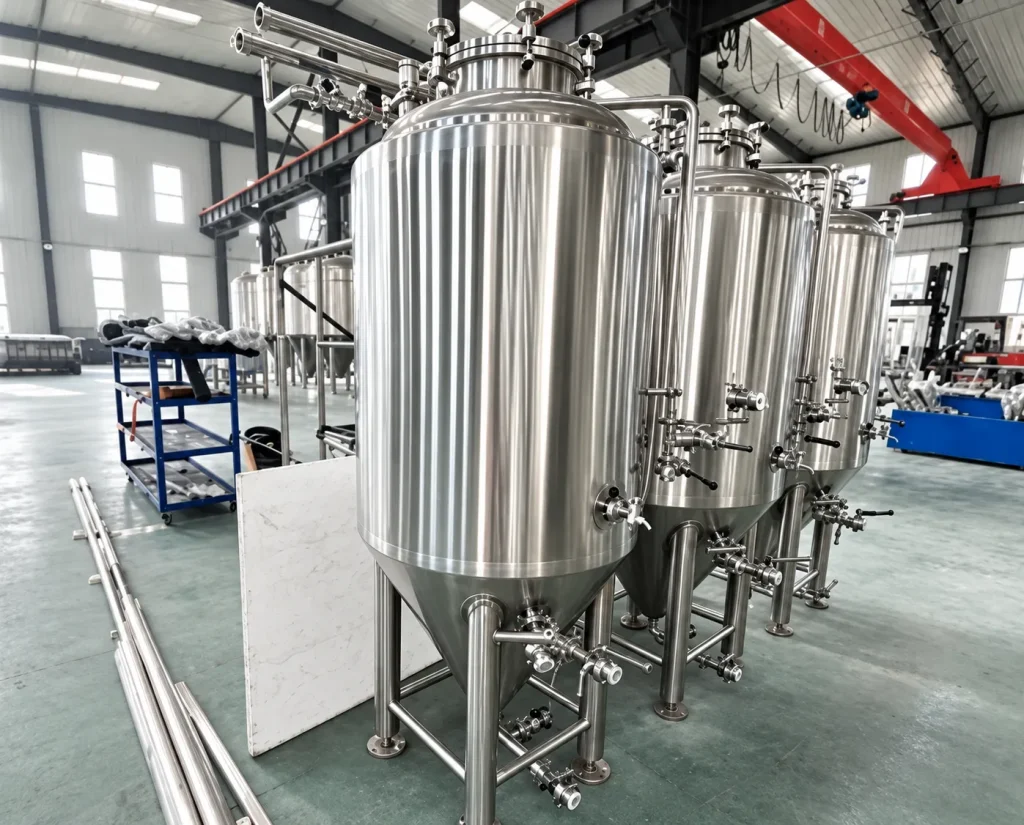
Fermenters in this range commonly use a 60-degree conical bottom. Confirm bottom geometry in the drawing for a bright tank configuration. If you need a size outside the list, ask the project team whether it is available as a custom vessel.
Six steps before you order a bright tank
- Run the sizing formula for both fermenters and bright tanks using your own tank-day numbers. Round up and note where you rounded.
- Decide the packaging path (kegs, cans, bottles, direct draft). It sets the volume per transfer and how strongly a fixed packaging date constrains you.
- Decide whether beer is filtered. If it is, the filter output needs a destination vessel, and that sets the transfer volume.
- State pressure in writing: working pressure for the exact model, relief valve set point and gauge range, checked against your target carbonation.
- Request documents tied to your order: drawing, pressure-test report and material certificate. ISO 9001, published by the International Organization for Standardization, is a quality management standard for how a manufacturer runs its processes; it does not assign a pressure rating to a given tank. ZR Brew states company-level ISO 9001 and CE credentials, and CE applicability must be confirmed for each machine and destination market.
- Check utilities: glycol capacity per jacket zone, ceiling height and floor loading, and manway orientation against your walkway. Then request the itemized quotation.
Často kladené otázky
Is a bright tank the same as a brite tank or a serving tank?
They are the same vessel family. “Brite” is a spelling variant, and “serving tank” usually describes one used to dispense beer directly, for example at a taproom.
Do I need a bright tank if I already have unitanks?
Not necessarily. If you package straight from the unitank and your batch frequency is low, a unitank-only line can work. Add a bright tank when you filter, run a fixed packaging schedule, or need to free fermenters sooner.
How many bright tanks per fermenter?
There is no single ratio. Divide fermenter-days by bright-tank-days using your own recipes. In the assumed scenarios above, the result ranged from 4:1 to about 5.3:1.
Can I ferment beer in a bright tank?
It is not designed for that. It has no yeast-collection cone like a fermenter, and active fermentation in a closed tank raises pressure.
What working pressure do ZR-FV tanks have?
Typically about 0.2 MPa (30 psi), depending on model. Confirm the exact rating and relief valve setting for your model in writing.
What should I send to get a bright tank quote?
Send batch size and batches per week, tank-day estimates from the formula, packaging format, whether beer is filtered, target carbonation level, available voltage, steam and glycol capacity at your site, and the destination country.


 Zveřejněno