Choosing the wrong distillery equipment can limit output, make cleaning harder, and leave little room for future growth. A still that works for gin may not be ideal for vodka or whiskey. The solution is to design the complete distillation system around your spirit, batch size, utilities, automation needs, and production plan.
The right distilling equipment combines a properly sized still, fermentation system, condenser, column or swan neck, controls, storage, and supporting equipment. Pot stills suit flavor-driven spirits such as whiskey and brandy, while column and reflux systems provide greater rectification for vodka and neutral spirits. Material, heating method, capacity, and automation should all match the distillery’s production goals.
Article Outline
- What equipment does a commercial distillery need?
- How does the distillation process work?
- Should you choose a pot still, column still, or reflux still?
- Copper or stainless steel: which material is right?
- How does equipment change for whiskey, gin, vodka, rum, and brandy?
- How should you size distilling equipment?
- What supporting fermentation and storage equipment is required?
- Why consider custom and modular distillery equipment?
- How should you evaluate a distillery equipment manufacturer?
- Frequently asked questions about commercial distilling equipment
What Equipment Does a Commercial Distillery Need?
A commercial distillery requires more than one still. From our experience manufacturing brewery, fermentation, and beverage processing systems, one of the first questions we ask is what enters the plant, what spirit will leave it, and how much product the customer plans to make.
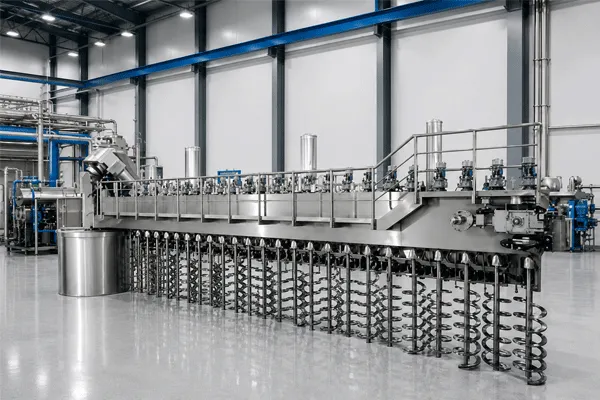
A complete production line may move through mash preparation → fermentation → distillation → condensation → collection → storage or maturation → bottling. ZR Brew’s current commercial distillery range covers systems from 100L to 5000L and includes copper, stainless steel, and hybrid configurations. Its complete system concept can include grain preparation, mash vessels, fermenters, a distiller, column components, condenser, collection tanks, storage tanks, CIP equipment, and process controls.
| Production Stage |
Typical Equipment |
Main Purpose |
| Raw material preparation |
Crusher, auger |
Prepare grain |
| Mashing |
Mash/lauter vessel, cooker |
Convert raw materials into fermentable mash |
| Kvašení |
Fermentor |
Let yeast create alcohol |
| Distillation |
Still, column, dephlegmator |
Separate and concentrate volatile compounds |
| Condensation |
Condenser |
Turn vapor back into liquid |
| Collection |
Collection vessel |
Receive different spirit fractions |
| Storage |
Stainless steel tank or barrel |
Hold, blend, dilute, or mature spirit |
| Cleaning |
CIP system |
Clean process equipment |
| Control |
PID or PLC |
Monitor and manage production |
This system-level approach matters. Buying individual components without considering pipe routing, utilities, floor space, cleaning, and future production can create expensive integration problems later.
How Does Distillation Equipment Work in a Spirit Production Line?
The process begins before the distillation equipment itself. For grain-based spirits, raw material is prepared and mashed. After cooling, yeast is introduced and fermentation produces an alcoholic wash. That wash becomes the feed for the still.
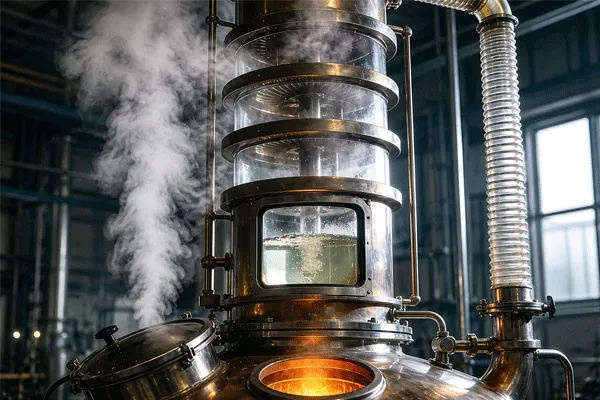
Inside the still, heat causes volatile compounds to enter the vapor phase. Vapor then travels through a swan neck, column, or other rectification section depending on the configuration. The condenser removes heat and turns the selected vapor back into liquid spirit. ZR Brew describes this same production sequence in its turnkey distillery system: mashing and fermentation precede distillation, while collected spirit can later move to dilution, filtration, barrel aging, storage, or bottling.
The key point is simple: the still is part of a process, not an isolated piece of equipment. Tank size, fermentation capacity, heating power, condenser capacity, collection method, and storage should work together. An engineer should therefore start with the desired finished product and work backward through the required configuration.
Should You Choose a Pot Still, Column Still, or Reflux Still?
The right still depends strongly on the spirit you want to make.
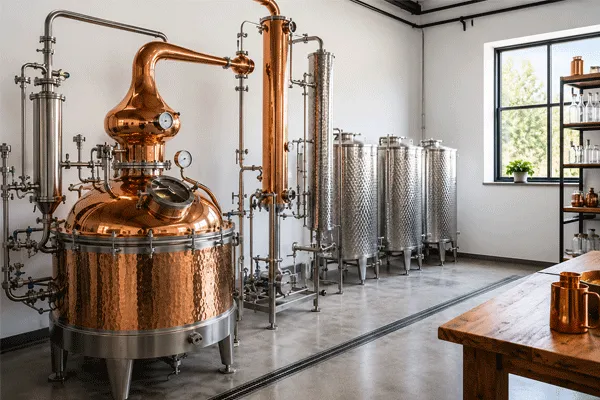
A pot still is a batch system commonly associated with flavor-driven products such as whiskey, brandy, and rum. Its relatively simple vapor path helps producers retain more character from the fermented wash. ZR Brew’s published whisky configuration, for example, combines a still pot, swan neck, condenser, CIP, and pipe system.
A column-based system adds plates or rectification stages. Vapor and liquid interact repeatedly inside the column, allowing the distiller to increase separation. This makes column-based systems particularly useful when producing vodka or higher-purity neutral-style spirit. A reflux still uses controlled condensation to return some heavier vapor to the column for further separation. ZR Brew’s vodka configurations add an onion head, column, dephlegmator, and condenser to the still pot.
A hybrid system sits between these approaches. A producer can combine a pot with a column and interchangeable components. This provides valuable versatility when one distillery wants to produce gin today, rum next month, and another spirit later.

Copper or Stainless Steel: Which Is Better for Distilling Equipment?
There is no universal winner between copper and stainless steel. The right choice depends on spirit type, process design, maintenance expectations, appearance, and budget.
Copper is widely used in traditional spirit production because it can interact with sulfur-containing compounds in the vapor. ZR Brew therefore offers full-copper stills and copper components for flavor-oriented applications. Its current range also includes full stainless steel and hybrid designs.
Stainless steel offers excellent durability and straightforward sanitary maintenance. It is especially useful for tanks, columns, piping, fermenters, and large commercial systems. A hybrid setup can use stainless steel for structural and process advantages while placing copper where meaningful vapor contact is desired.
| Material Configuration |
Common Reason to Choose It |
| Full copper |
Traditional spirit production and strong copper contact |
| Stainless steel |
Durability, sanitation, easier maintenance |
| Copper + stainless steel |
Balance of process performance, maintenance, and cost |
For a B2B project, we recommend selecting material at the component level rather than asking whether the entire system should simply be “copper or stainless.”
How Does Distillery Equipment Change for Whiskey, Gin, Vodka, Rum, and Brandy?
Different spirits place different demands on the same basic distillation system.
For whiskey, a copper pot or hybrid still with a swan neck is a common direction when the producer wants a rich, character-driven spirit. Bourbon and other whiskey styles also require careful planning around mash handling, fermentation capacity, distillation cuts, and eventual barrel maturation.
For gin, the still may include a botanical basket. Vapor can pass through botanicals so the producer can develop the desired aroma profile. ZR Brew offers dedicated gin configurations as well as multifunctional systems with a gin basket.
For vodka, producers generally require greater rectification. A taller column, dephlegmator, and suitable reflux control can help the distiller move toward a cleaner and higher-strength spirit. Rum and brandy can use pot or hybrid approaches depending on the intended flavor profile.
ZR Brew’s 300L multifunctional model illustrates this concept. The ZR-DT-300L can be configured for brandy, rum, gin, and vodka using spirit-specific components such as a column, dephlegmator, gin basket, onion head, or swan neck. The published model offers selectable SUS304, SUS316, or red copper construction and PID or PLC control options.
How Do You Choose the Right Size of Distilling Equipment?
Capacity is one of the most important purchasing decisions. A small kit can be useful for development work, but commercial production requires equipment sized around expected sales, operating days, fermentation cycles, and available labor.
ZR Brew currently positions 100L–300L systems toward craft startups, while its wider range extends to 1000L–5000L commercial systems. Its 300L multifunctional distiller is positioned as a commercial entry point for regular batch production, while larger systems serve established operations with higher production needs.
Before choosing a still, calculate more than nominal volume. Consider:
- Target batch volume and weekly runs
- Wash ABV and desired spirit style
- Fermenter quantity and fermentation time
- Heating source and site utilities
- Column height and building clearance
- Condenser water requirements
- Operator availability
- Collection and stainless steel storage tank capacity
- Future expansion
Buying an oversized still can tie up capital and create inefficient small runs. Buying too small can force excessive batches. The optimal choice is the capacity that fits the complete production schedule.
What Fermentation Tanks, Mixing Vessels, and Storage Tanks Does a Distillery Need?
Good spirits begin before the still. Fermentation quality affects what enters the distillation system, so fermenter sizing should be planned alongside still capacity.
A typical fermenter receives prepared mash or another fermentable liquid and provides the environment for yeast to produce alcohol. Depending on the process, a distillery may also require an agitated vessel, mash cooker, mixing tank, transfer tank, or dedicated storage vessels.
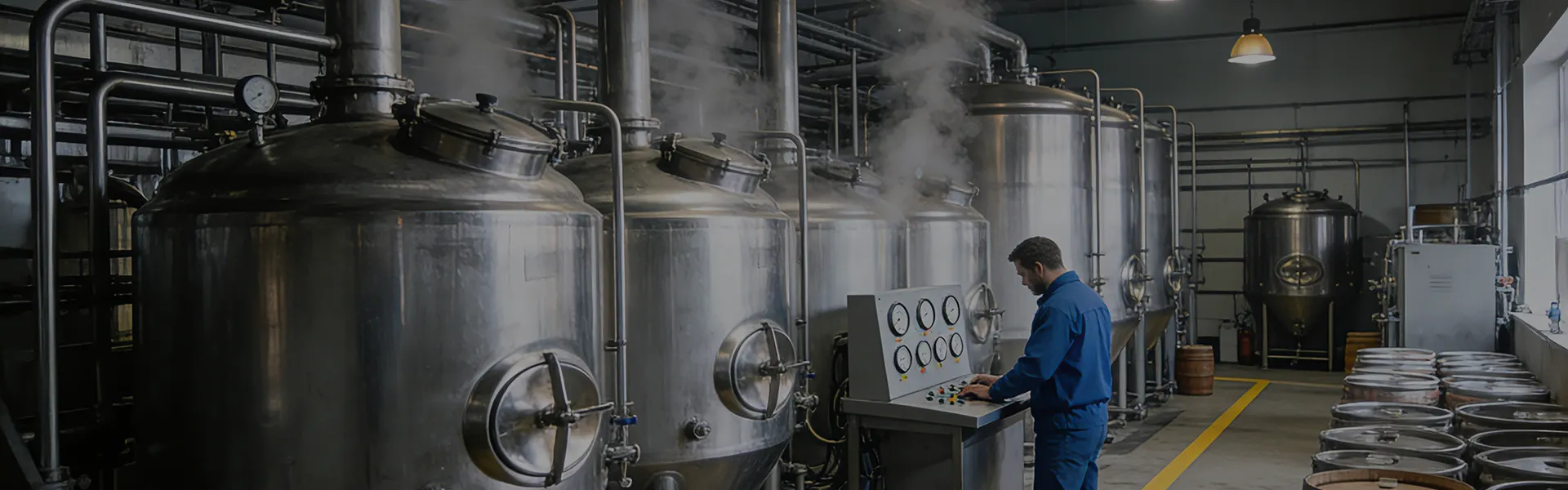
After distillation, stainless steel storage tanks can hold spirit before dilution, filtration, maturation, or bottling. ZR Brew’s commercial distillery page specifically describes distilled spirit moving into stainless steel storage tanks for subsequent processing.
This is where our broader beverage-equipment manufacturing experience becomes useful. The distiller itself may attract attention, but the production line only works well when fermentation tanks, mixers, cooling, pumps, storage, piping, CIP, and the still are engineered as one system.
Why Consider Custom Distilling Equipment and Modular Systems?
Standard equipment works well when your product and building fit the standard design. Many real projects do not.
A custom distilling project may need to accommodate an unusual ceiling height, an existing brewery, a limited utility supply, a specific heating source, or several spirit styles. In those cases, custom distilling equipment can be configured around the plant rather than forcing the plant to fit the machine.
A modular or skid arrangement can also simplify integration. Key components can be assembled into coordinated sections before shipment. For a brewery adding a distillery, shared infrastructure may also be possible. ZR Brew explicitly positions hybrid brewery-distillery projects as a use case for facilities that already have fermentation capacity.
A well-designed custom system may tailor:
- Still capacity and geometry
- Copper pot or stainless construction
- Column and reflux configuration
- Heating method
- Gin basket or dephlegmator
- PID or PLC control system
- Fermentation and storage capacity
- CIP arrangement
- Piping and layout
Customization should always solve a real process problem. More components do not automatically mean exceptional quality or better spirit.
What Should You Look for in a Distillery Equipment Manufacturer?
A high-quality distilling equipment supplier should help you define the complete project rather than simply send a quote for a still.
Ask how the manufacturer handles drawings, material selection, welding, surface finishing, pressure testing, controls, piping integration, installation, and commissioning. Also ask which specifications are standard and which are optional. Clear documentation matters because the still must eventually work inside a real factory with real operators.
ZR Brew manufactures 100L–5000L distillery systems and currently offers full copper, stainless steel, and hybrid configurations. Its published 300L system uses steam heating and offers Schneider PID semi-automatic or Siemens PLC configurations; larger turnkey systems can integrate fermentation, distillation, storage, and control modules.
For international buyers, field service, spare parts, remote support, commissioning, and documentation can be just as important as the fabrication itself. A strong equipment manufacturer should discuss these points before finalizing the order.
Často kladené otázky
What is the difference between a pot still and a column still?
A pot still is generally batch-operated and is widely used for flavor-rich spirits such as whiskey, rum, and brandy. Column stills use several separation stages to achieve greater rectification and are often selected for vodka and neutral-style spirits. Hybrid systems combine elements of both.
Is copper better than stainless steel for a commercial still?
Not always. Copper provides useful vapor contact for many traditional spirits, while stainless steel offers durability and easier maintenance. Many commercial systems therefore use stainless steel and copper together.
Can one distiller produce whiskey, gin, rum, and vodka?
A multifunctional distiller can support several spirit types when it is configured with the required components. For example, ZR Brew’s 300L system can be fitted with a swan neck, column, dephlegmator, onion head, or gin basket depending on the target spirit.
What size still should a new craft distillery buy?
There is no single correct size. Start with your planned sales volume, batch schedule, fermentation capacity, labor, site utilities, and expansion plan. ZR Brew currently offers systems from 100L to 5000L, with smaller 100L–300L configurations positioned toward craft startups.
Do I need fermentation tanks with my distilling equipment?
If you are producing the fermented wash yourself, yes. Your fermentation capacity should match the still schedule so you can keep production moving without long idle periods.
Can a brewery add a distillery to its existing facility?
Potentially. Existing fermentation and utility infrastructure may be reusable depending on the brewery design, local regulations, and target spirits. ZR Brew specifically offers brewery-distillery system planning for this type of project.


 Zveřejněno