How the right brewery grain mill improves extract yield, lautering speed, and beer quality.
Malt milling is the first mechanical step in transforming raw malt into wort. The way malt is crushed directly affects enzyme activity, wort composition, lautering efficiency, and raw material utilization. Whether you run a microbrewery or an industrial-scale brewhouse, choosing the right malt crusher is one of the highest-ROI decisions in your process line.
Why Malt Crushing Quality Matters
Before mashing, malt and cereal adjuncts such as rice, corn, and barley must be milled to expose starches and proteins to water and enzymes. The finer the grind, the faster and more completely these materials dissolve. In theory, a very fine malt flour would maximize extract yield. In practice, however, over-milling creates serious problems.
Malt husk is rich in cellulose, polyphenols, bitter compounds, silicates, and proteins. If husks are shredded during milling, these substances leach into the wort and can darken beer color and create astringent off-flavors. Husk also acts as a natural filter bed during lautering. Intact husks create channels that allow wort to drain efficiently; pulverized husks form a dense paste that blocks runoff and extends lauter time.
The golden rule of malt milling: Crush the endosperm finely enough for complete conversion, but keep the husk as intact as possible for fast, clear lautering.
The endosperm is where the brewing value lives. It contains starch, carbohydrates, and proteins that must be fully gelatinized and converted during mashing. A good milling process fractures the endosperm into grits and flour while leaving the husk largely unbroken. This balance is what separates an efficient brewhouse from one that struggles with slow runoff and low extract.
Types of Malt Crushing Equipment
Modern breweries use several types of milling systems, each optimized for different production scales, malt qualities, and downstream processes. The four main categories are roller mills, wet mills, direct immersion conditioning mills, and conditioning conveyors.
1. Roller Mills: The Industry Standard
Roller mills are the most common brewery grain mills because they offer precise control over particle size and husk integrity. They crush grain between two or more rotating rollers rather than pulverizing it, which preserves the husk structure.
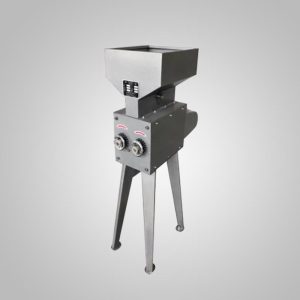
Key Components of a Roller Mill
- Rollers: Usually made of centrifugally cast chilled iron with extremely hard surfaces. A typical roller diameter is around 250 mm; smaller diameters reduce throughput and crushing efficiency.
- Surface finish: Plain rollers are used for some applications, but fluted (“wire-drawn”) rollers are preferred for most brewing because the flutes create a shearing action that opens the endosperm without tearing the husk.
- Roller speed differential: The driven roller rotates faster than the passive roller. A typical ratio for fluted rollers is about 2.5:1, which improves the shearing effect.
- Roller gap: Adjustable from 0 to 2.5 mm. Precise gap control lets brewers tune the crush for different malt qualities.
- Speed: Pre-break rollers typically run at 400–420 rpm, husk rollers at ~400 rpm, and coarse-grit rollers at 380–440 rpm.
| Roller Configuration |
Best For |
Typical Gap / Speed |
Throughput |
| Two-roll mill |
Small breweries, well-modified malt |
160–180 rpm; 5–20 kg/h per cm of roller length |
Low |
| Four-roll mill |
Mid-size breweries needing husk separation |
Pre-break 1.3–1.5 mm; coarse 0.3–0.6 mm |
Moderate |
| Five-roll mill |
High-capacity lines with flexible grist specs |
Shared intermediate rollers |
High |
| Six-roll mill |
Large industrial breweries, high extract + intact husk |
Three-stage crush with integrated sieves |
Very high (up to 4 t/h on 700 mm rolls) |
Two-Roll Malt Crusher
A two-roll malt crusher is the simplest configuration. Two rollers rotate in opposite directions at slightly different speeds and pull the grain through the gap. This design works well when malt is highly modified and dissolves easily, but it gives a relatively coarse grist. For poorly modified malt, a two-roll mill may not deliver the extract yield or lautering speed a brewery needs.
Four-Roll Brewery Grain Mill
A four-roll brewery grain mill adds a second crushing stage. The first pair of rollers acts as pre-breakers, gently cracking the malt kernels without damaging the husks. The second pair finishes the grind on the coarse grits. Many four-roll mills include vibrating sieves that separate husk, coarse grits, and flour between stages, so only the material that needs further crushing reaches the second rollers.
Two sieve layouts are common. In layout A, fine particles pass through the sieve while husks and coarse grits go to the second rollers. In layout B, a double-deck sieve removes both fines and husks, sending only the coarse middle fraction to the final crushing stage. This targeted re-crushing improves energy efficiency and reduces husk damage.
Five-Roll and Six-Roll Malt Mills
Five-roll and six-roll malt mills are designed for high-volume, high-extract operations. A six-roll mill performs three crushing stages. The first two pairs share rollers and open the malt; the third pair receives only the coarse fraction and grinds it intensively. Integrated sieves keep the fractions separate, and the large sieve area—often tilted—ensures even separation.
Modern six-roll designs may use a single large sieve box rather than separate sieve sets. This simplifies maintenance and keeps the machine running stably. A 700 mm roller length six-roll mill can process approximately 4 tonnes per hour, or about 55 kg per hour per centimetre of roller length.
2. Wet Milling: Protecting the Husk with Water
Even with careful roller-gap settings, dry milling damages some husk. Wet milling solves this by soaking malt before crushing. When malt absorbs water, the husk becomes elastic and flexible, while the endosperm becomes easier to fracture. The result is a very fine endosperm grind with husk that remains almost completely intact.
How a Wet Mill Works
- Soaking: Weighed malt is conveyed to a conditioning silo above the mill and soaked in 30–50 °C water for 15–30 minutes. Moisture content rises by about 30%, and grain volume increases by 35–40%. Enzymes begin to activate during this step.
- Mashing-in water: The system switches to mashing water. The water-to-grist ratio is set according to the target mash concentration.
- Milling and pumping: Conditioned malt passes through feed rollers with a very tight gap—often around 0.45 mm. The resulting slurry is collected by an auger and pumped to the mash tun. Spray and wash systems keep the equipment clean.
Wet milling is especially valuable for breweries that want maximum extract and very fast lautering. The trade-offs are higher equipment cost, more complex cleaning, and the need for precise water temperature control.
3. Direct Immersion Conditioning Mills: Speed Meets Efficiency
Direct immersion conditioning mills combine the benefits of wet milling with much shorter conditioning times. Developed in the 1980s and widely adopted by major breweries including Yanjing and Huibo, these systems steep malt for only about 40 seconds before immediate milling.
Process Parameters
- Conditioning time: ~40 seconds
- Water temperature: 50–65 °C
- Moisture addition: ~20%
- Final roller gap: 0.3–0.35 mm
- Typical throughput: 4–20 t/h
Because only the outer husk layer needs to absorb water, the conditioning step can be very brief. The conditioned malt is then milled in a two-roll mill with specially grooved stainless-steel rollers. The gap is adjustable between 0.25 and 0.40 mm, and roller speed is tuned to malt hardness: harder, less modified malt is fed more slowly to allow longer steeping.
To prevent oxidation, the entire grinding chamber can be blanketed with nitrogen or another inert gas. Mashing-in water is injected tangentially through nozzles to mix immediately with the grist, and lactic acid can be dosed automatically via pH sensors to reach the optimal mash pH.
4. Modern Conditioning Conveyors
A common problem during mashing-in is oxygen uptake. Modern conditioning conveyors (also called mash mixers or conditioning augers) reduce this risk by combining grist and mashing water in a sealed, slow-moving auger before the mash tun. The low rotation speed prevents clumping, and water enters tangentially so that every particle is evenly wetted from the start.
Advanced systems also dose carbon dioxide and lactic acid during mixing to lower pH and exclude oxygen. The conveyor is CIP-cleanable, and the wash water can be recovered for the next mash, reducing overall water consumption.
How to Choose the Right Malt Milling System
Selecting a milling system depends on production scale, malt quality, brewhouse layout, and beer style. Here are the key variables to evaluate:
- Malt modification: Well-modified malt can use simpler two-roll or four-roll mills. Under-modified or hard malt benefits from wet milling or conditioning mills.
- Throughput: Match roller length and mill configuration to your batch size and cycle time.
- Lautering method: Lauter tuns need intact husks; mash filters can tolerate finer milling.
- Oxygen sensitivity: For delicate beer styles, consider conditioning conveyors and inert-gas blanketing.
- Cleaning requirements: Wet mills and conditioning mills need CIP systems; dry roller mills are easier to clean but create more dust.
| System |
Husk Integrity |
Extract Yield |
Best Use Case |
| Two-roll dry mill |
Moderate |
Good |
Small breweries, simple recipes |
| Four-roll dry mill |
Good |
Very good |
Mid-size breweries with lauter tuns |
| Six-roll dry mill |
Very good |
Excellent |
Large industrial breweries |
| Wet mill |
Excellent |
Excellent |
High-end lager and Pilsner breweries |
| Direct immersion conditioning mill |
Excellent |
Excellent |
High-throughput plants needing fast cycle times |
Malt Milling FAQ
What is the ideal gap setting for a brewery grain mill?
There is no single ideal gap because it depends on roller diameter, surface finish, malt quality, and lautering equipment. Pre-break rollers are often set to 1.3–1.5 mm, while finishing rollers are set to 0.3–0.6 mm. For wet mills, gaps as tight as 0.45 mm are common.
Can I use a hammer mill instead of a roller mill for brewing?
Hammer mills pulverize grain into flour, which destroys husk structure and creates lautering problems. Roller mills are preferred for traditional lauter-tun brewing because they preserve husks. Hammer mills are only suitable if you use a mash filter that does not rely on a husk bed.
Why does malt need to be conditioned before wet milling?
Conditioning softens the husk and makes it elastic. This allows the rollers to fracture the endosperm cleanly while the husk remains as a protective filter layer. The result is higher extract, faster runoff, and lower risk of astringency.
How do six-roll mills improve efficiency over two-roll mills?
Six-roll mills use three crushing stages and integrated sieving to apply more energy only where it is needed. Coarse fractions are re-crushed while fines and husks are removed early. This staged approach improves extract yield while keeping husk damage to a minimum.
What maintenance does a malt mill require?
Regular maintenance includes checking roller gap, inspecting roller surface wear, lubricating bearings, cleaning sieves, and verifying drive-belt tension. Wet mills and conditioning systems also need CIP validation and spray-nozzle inspection to prevent clogging.
Conclusion
Malt milling is far more than a simple size-reduction step. The right malt milling strategy balances fine endosperm grinding with husk preservation, directly influencing brewhouse efficiency, lautering time, and beer flavor. From compact two-roll crushers to advanced six-roll mills, wet mills, and direct immersion conditioning systems, each technology offers a different trade-off between capital cost, complexity, and performance.
If you are planning a brewery upgrade or new installation, start by auditing your current crush quality, lautering performance, and oxygen exposure. Then choose a milling system that matches your scale and beer portfolio. Investing in the correct brewery grain mill pays back quickly through higher extract yield, shorter brew days, and more consistent wort quality.


 Published